Rear alley gating orders
A council-issued gating order allows residents to install a locked gate across a shared rear alley or ginnel that's become a route for anti-social behaviour, converting what was a public right of way into a controlled access point.
Gates fitted under a gating order usually need to match a specification set by the council, including emergency-service access provision, rather than being chosen freely by residents.
Pale spacing tolerance on a palisade run
Palisade pale gaps are set to a maximum spacing so a foot or hand can't find purchase between adjacent pales, and drift beyond that tolerance over a long run is usually a sign the pales were fixed by eye rather than gauged off a jig.
A gauge batten cut to the exact centre spacing keeps every bay consistent, which matters more on security runs than on a purely decorative fence because a single wider gap becomes the obvious point of attack.
Boundaries against a railway embankment
A boundary running along a railway embankment is very often owned and maintained by the railway infrastructure operator rather than the adjoining householder, and any work close to the operator's land, including digging near its toe or crest, usually needs prior notice or permission.
Embankment ground can also be made up of variable historic fill rather than natural strata, since many were built up from spoil during original construction, which affects both digging and the stability assumptions for post bases near the base of the slope.
Access for materials and machinery along these boundaries is frequently restricted, so confirming land ownership and any operator consent needed is a necessary step before quoting the work.
Combining a windbreak hedge with a lighter fence
Planting a windbreak hedge or shrub line on the exposed side of a fence reduces the wind load the fence structure has to carry directly, since the vegetation absorbs and diffuses much of the force before it reaches the panels.
This takes several years to become effective as the planting matures, so it's usually specified alongside a fence built to cope with full exposure initially, with the expectation that loads reduce over time rather than the reverse.
It's a useful option where a client wants a lighter, less heavily-specified fence than pure exposure would otherwise demand, provided they accept the interim years before the hedge does its share of the work.
Brace direction on a braced timber gate
A diagonal brace on a ledged-and-braced gate has to run from the bottom hinge corner up to the top latch corner to work in compression rather than tension, and a brace fitted the wrong way round does almost nothing to stop the frame dropping.
This is a common fault on older self-built gates, and correcting brace direction is sometimes enough to fix a sagging gate without replacing any timber.
High water table and post-base concrete
On a plot where the water table sits close to the surface, a post hole can start filling with groundwater before the post is even positioned, which stops a wet concrete mix from curing properly around the base.
The usual fix is a free-draining pea shingle or hardcore base rather than solid concrete, letting water pass the post instead of holding it in permanent damp.
Pumping a hole dry immediately before setting the post is only a short-term measure if the water simply returns within minutes, and that's usually the signal to change the base specification rather than repeat the attempt.
Sherardised nails and fixings
Sherardising coats small steel fixings in zinc through a low-temperature diffusion process using zinc dust rather than a molten bath, giving a matt grey, evenly distributed coating well suited to fasteners with fine threads.
Because the process doesn't build up excess zinc at edges and threads the way hot-dip galvanising can, sherardised nails and screws keep a cleaner, more precise fit than galvanised equivalents of the same size.
The coating is thinner than typical hot-dip galvanising, so sherardised fixings are generally specified for above-ground, moderate-exposure use rather than permanent ground contact.
Planning material handling for single-access rear gardens
A rear garden with no side access at all means every post, panel and bag of aggregate has to go through the house, so protecting flooring and doorways along that route is as much a part of the job planning as the fencing itself.
Breaking deliveries into smaller loads that fit through internal doorways and turns avoids the alternative of discovering a full-length panel won't clear a hallway corner on the day.
Where the volume of material makes carrying through the house impractical, a temporary lift or chute over a side wall, arranged and agreed with the client in advance, is sometimes the more efficient option despite the extra setup time.
Drop bolts and ground sockets
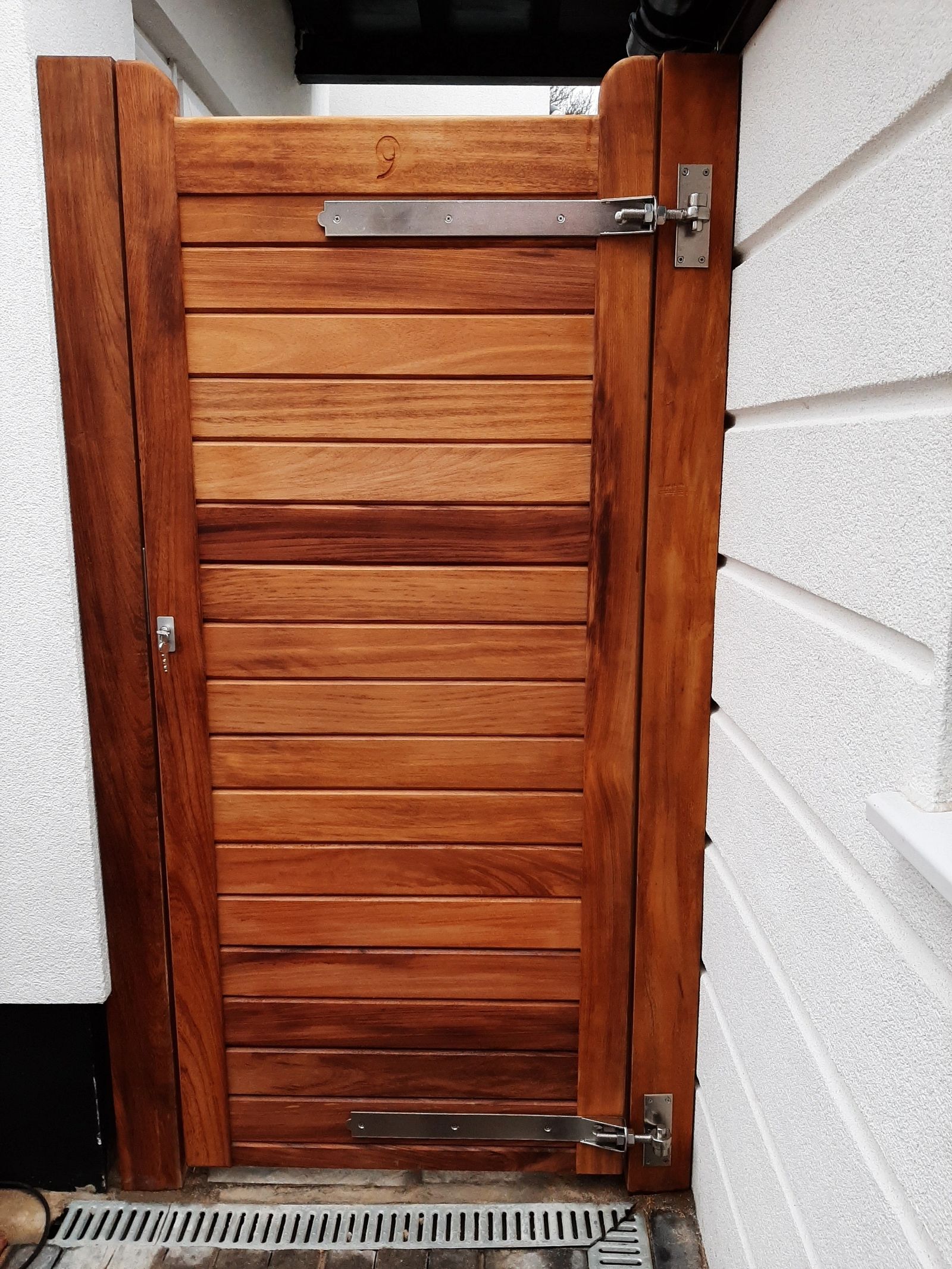
A drop bolt fixed to the bottom rail of a leaf drops into a ground socket to hold that leaf still while the other leaf is used for daily access, and a socket that's silted up or out of alignment is a common reason a drop bolt stops locating properly.
We check the socket depth and drainage as well as the bolt itself, since a blocked socket is often mistaken for a bent or worn bolt.
Deciding between stepping and raking a panel run
Stepped panels stay level themselves and drop in increments post to post, leaving a small triangular gap under each panel that grows towards the low end of a run; raked panels are cut at an angle so the top edge follows the slope continuously with no gap.
Stock panels can be stepped without alteration, but raking almost always means cutting a panel's top rail and infill to an angle on site, which only works with materials that can be cut and re-fixed cleanly, such as featheredge or slatted boards.
A steep, uneven slope generally favours stepping for speed and future repairability; a long, gentle and even gradient often looks better raked, since the steps would otherwise be very shallow and visually fussy.
Replacing a post without dismantling the whole run
A single post can often be replaced by supporting the panels either side on temporary props, cutting the old post out at ground level, and fitting the new post into a fresh footing without lifting the neighbouring panels out.
This depends on the panel fixing type — nailed panels are harder to free without damage than panels held with clips or brackets, which come apart more cleanly.
Hedge disputes and the high hedge complaint route
A hedge over 2m tall made up mainly of evergreen or semi-evergreen species can be the subject of a formal 'high hedge' complaint to the local council under the Anti-social Behaviour Act 2003, but only after direct attempts to resolve it with the neighbour have failed and a fee is paid.
The council can then issue a remedial notice requiring the hedge to be reduced to a specified height, enforceable in the same way as a planning enforcement notice, though it typically won't require complete removal.
This process is separate from ordinary fence or boundary work and doesn't apply to deciduous hedges or single ornamental trees, which fall under general nuisance and tree law instead.
Post caps and end-grain protection
A timber post's end grain sits at the top, cut across the fibres, and that exposed grain draws in water far faster than the treated face of the post, which is why an unprotected post top is often the first place rot takes hold.
A weathered or pyramid-cut post cap sheds water off the end grain instead of letting it pool, and a cap that oversails the post slightly also keeps water from tracking down the sides at the joint.
It's a small, low-cost detail that's frequently skipped on budget jobs, and its absence is a reliable way to predict which posts in an older fence will need replacing first.
Timber moisture content testing
A pin-type moisture meter measures electrical resistance between two probes pushed into the timber's surface, giving a reasonably reliable reading of moisture content near the surface but not necessarily reflecting the core of a thick section.
Fencing timber delivered at above roughly 20% moisture content is more prone to significant post-installation shrinkage and movement than timber closer to its long-term equilibrium moisture content for outdoor use.
Because timber left stacked outdoors and uncovered reabsorbs moisture from rain and humidity, a moisture reading taken on delivery can differ significantly from the same stack a fortnight later if it hasn't been kept covered.
HMO licensing and boundary obligations
A licensed House in Multiple Occupation can carry specific conditions relating to the external areas of the property, including secure and well-maintained boundary fencing, safe means of escape through a rear garden, and bin storage screened from the street.
Licensing officers inspecting the property will check the condition of boundary structures as part of the wider fire safety and amenity standards, and a broken or unsafe fence can be flagged as a licence condition breach requiring remedy within a set period.
Landlords of licensed HMOs should treat boundary repair requests from the council's licensing team as time-limited compliance matters rather than routine maintenance to schedule at leisure.
Washing off mould before treatment
Black mould spotting, distinct from green algae, tends to appear on shaded timber with poor airflow behind it, such as a fence panel sitting close against dense shrub planting on one side.
A proprietary fungicidal wash left to dwell before rinsing removes far more of the surface growth than a plain water wash, which can spread spores across the surface rather than lifting them off.
Cutting back planting to restore airflow behind the affected section addresses the underlying cause; treating the timber alone without improving ventilation usually sees the mould return within a year.
Continuous strip footing compared with individual post holes
A continuous concrete strip footing running the full length of a fence line gives even support and a clean base for a plinth wall or kickboard, and is generally chosen where the boundary also needs a level base to close gaps under the fence.
Individual post holes are quicker and cheaper on a long straight run over consistent ground, but they leave open ground between posts that needs a separate gravel board or infill strip if a continuous barrier at ground level is also required.
Western red cedar characteristics
Western red cedar contains natural oils and extractives that give it decay and insect resistance without chemical treatment, which is why it's often left untreated and allowed to silver naturally over time rather than stained.
It's considerably lighter and softer than most fencing softwoods, which makes it easier to work but also more prone to surface denting and scuffing during handling and fitting.
Because it's naturally durable rather than pressure-treated, cedar doesn't carry the green or brown tint of treated softwood, and any colour change over its life comes from UV exposure rather than a fading dye.
Schedules of condition before nearby works
A schedule of condition is a dated record, often with photographs, of a boundary structure's state before nearby building work begins, used to settle any later dispute about damage caused during that work.
Where a neighbour is undertaking significant building work close to a shared boundary, requesting this kind of record beforehand is reasonable and protects both parties.
This is distinct from a full party wall agreement but is often produced as part of the wider party wall process where one applies.
Checking screw and bolt length matches the timber section
A fixing that's too short doesn't engage enough timber to hold under load, while one that's too long can punch through the far face of a rail or post, both of which are easy mistakes when reaching for whatever's in the tool bag rather than checking the actual section thickness first.
As a rough guide, a screw fixing generally wants to penetrate the receiving timber to a meaningful multiple of its own diameter to hold securely, which is worth checking against the actual post or rail dimensions being used on a given job rather than assumed from habit.
Where a through-bolt is used instead of a screw, matching the bolt length to the combined thickness of both pieces plus washer and nut avoids either an unsightly protruding stub or a bolt that can't be tightened properly.
Post cap material and function
A post cap's primary function is shedding rainwater away from the post's end grain, which is the most absorbent and vulnerable part of a timber post, rather than being purely decorative.
A pyramid or bevelled profile sheds water faster than a flat cap, reducing the time water sits pooled on the timber surface after rain, which matters more on a flat-topped post than people often assume.
Metal, plastic and timber caps all achieve the same water-shedding function to varying degrees, but a cracked or ill-fitting cap that lets water track down between the cap and the post can trap moisture worse than no cap at all.
Concrete post lifetime versus timber in like-for-like exposure
A reinforced concrete post doesn't rot and isn't vulnerable to the ground-level moisture that ends most timber posts' service life, which is why concrete posts with timber panel infill are a common way to combine a long-lived structural frame with a more traditional timber appearance.
Concrete posts are heavier and less forgiving to adjust once set, and a cracked or spalled concrete post — usually from a hard frost hitting a hairline crack, or from an impact — can't be patched as simply as replacing a length of timber.
For a boundary where the main failure history has been posts rather than panels, moving to concrete posts while keeping timber panels is often a more effective lifetime upgrade than simply replacing like-for-like.