London & Hertfordshire Free Site Visit
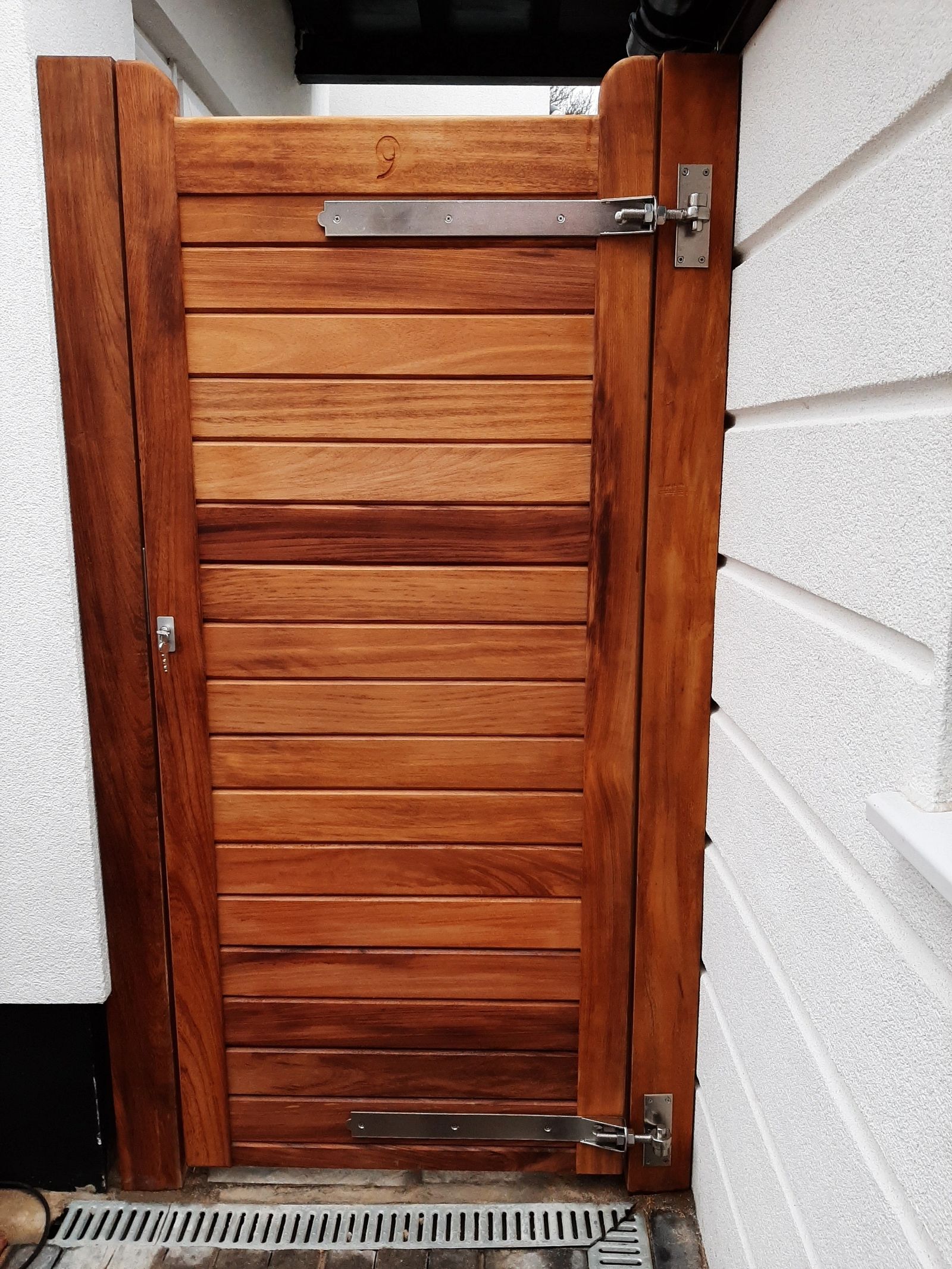
bespoke wooden gate installed by Capital Fencing in Mill Hill (NW7)
Mill Hill · NW7

Side Return Gates in Mill Hill (NW7)

Side-return gates in Mill Hill is one of our regular briefs — London terraces and semis with a narrow alley between the house and the neighbouring wall. On large detached homes on the ridgeway with spacious plots — many of the Ridgeway properties have gardens deep enough for full landscaping schemes, the failure mode we see most often is the one we design out first. Roads such as Devonshire Road and The Ridgeway are typical of the local layout. Mill Hill East station is a useful local reference point. The former Mill Hill Barracks site off Milespit Hill was redeveloped for housing, and the area's military history is well documented.

Side-return gates in Mill Hill is one of our regular briefs — London terraces and semis with a narrow alley between the house and the neighbouring wall. On large detached homes on the ridgeway with spacious plots — many of the Ridgeway properties have gardens deep enough for full landscaping schemes, the failure mode we see most often is the one we design out first. Roads such as Devonshire Road and The Ridgeway are typical of the local layout. Mill Hill East station is a useful local reference point. The former Mill Hill Barracks site off Milespit Hill was redeveloped for housing, and the area's military history is well documented.

What goes wrong

Common failure modes on side-return gates

  • fitting a full-weight hardwood gate on domestic pin hinges — drops within six months
  • not shooting a drop-bolt into a concrete socket — kicked or pried open too easily
Default spec

How we build side-return gates in Mill Hill

44mm framed hardwood or planed softwood, tongue-and-groove infill, adjustable ball-race hinges, closing stop and drop-bolt. On Mill Hill jobs we adjust for the mill hill conservation area on the ridgeway has strict rules on materials and finishes.

Property mix locally: large detached homes on the Ridgeway, 1930s semis around the Broadway, and modern infill near Mill Hill East. Typical gardens: spacious plots — many of the Ridgeway properties have gardens deep enough for full landscaping schemes. Postcodes we regularly service: NW7.

Why this spec, for London terraces and semis with a narrow alley between the house and the neighbouring wall

  • framed builds don't drop the way board-and-batten side gates do in year two
  • adjustable hinges handle the seasonal timber movement every London side gate experiences
  • made to the exact opening — no packing pieces, no gaps for burglars or foxes

Typical side-return gates briefs in Mill Hill

  • hardwood side gate between a rendered wall and a brick pier, 780mm opening, drop-bolt into a concrete slab socket
  • matched pedestrian and bin-store gate serving a shared side alley between two flats

Side Return Gates FAQs — Mill Hill

Is a drop-bolt necessary as well as a lock?

On side-return gates jobs in Mill Hill (NW7), our default answer is: 44mm framed hardwood or planed softwood, tongue-and-groove infill, adjustable ball-race hinges, closing stop and drop-bolt. We'll walk you through framed builds don't drop the way board-and-batten side gates do in year two on the site visit before you commit.

How wide can a single side gate span before it needs a wheel?

Across Mill Hill we spec around the mill hill conservation area on the ridgeway has strict rules on materials and finishes, so on side-return gates that usually means iroko hardwood on galvanised ironmongery for 15+ year service. For context: adjustable hinges handle the seasonal timber movement every London side gate experiences. Measured, quoted and installed by the same small crew.

Can you match the gate to my existing side-return fencing?

Barnet coverage means we can survey most NW7 addresses inside a week — London terraces and semis with a narrow alley between the house and the neighbouring wall. We'll walk you through framed builds don't drop the way board-and-batten side gates do in year two on the site visit before you commit.

How do you stop a side gate dropping over time?

Practically: hardwood side gate between a rendered wall and a brick pier, 780mm opening, drop-bolt into a concrete slab socket. That's the Mill Hill version of this job, not a generic one. For context: adjustable hinges handle the seasonal timber movement every London side gate experiences. Measured, quoted and installed by the same small crew.

Do you handle the wall fixing on both sides?

On side-return gates jobs in Mill Hill (NW7), our default answer is: 44mm framed hardwood or planed softwood, tongue-and-groove infill, adjustable ball-race hinges, closing stop and drop-bolt. We'll walk you through framed builds don't drop the way board-and-batten side gates do in year two on the site visit before you commit.

Recent side return gates work
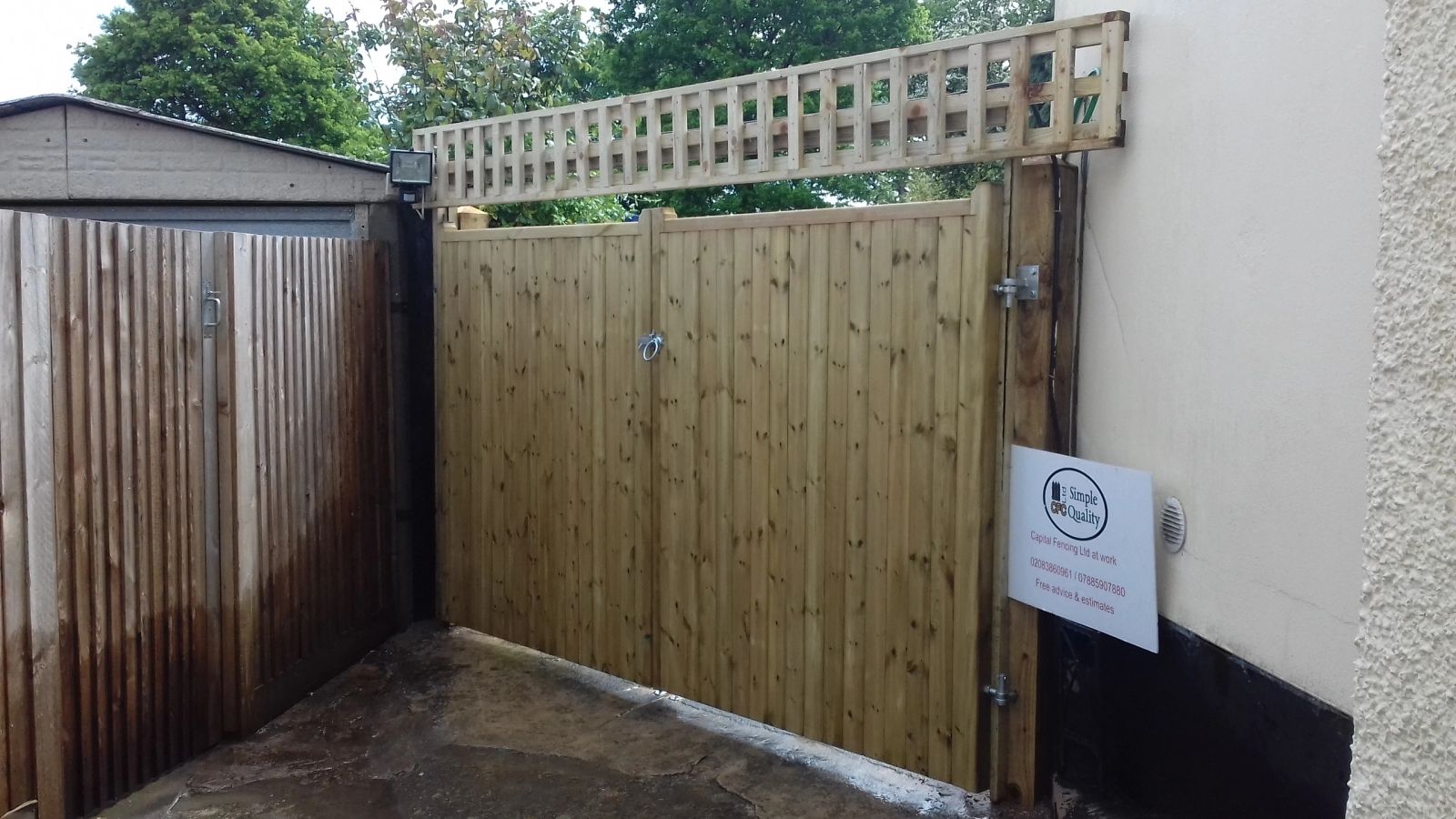
bespoke wooden gate installed by Capital Fencing in Mill Hill (NW7)double driveway gates installed by Capital Fencing in Mill Hill (NW7)hardwood side gate installed by Capital Fencing in Mill Hill (NW7)metal entrance gate installed by Capital Fencing in Mill Hill (NW7)

What actually matters for side return gates around Mill Hill

Mesh aperture and 358 prison mesh

358 mesh — so called for its 3mm wire, 5mm x 76mm aperture — is specified where cutting or climbing resistance matters, because the small aperture won't take a boot toe or bolt-croppers the way a standard weld mesh will.

Standard weld mesh apertures run larger and cheaper for general perimeter use; the tighter 358 pattern is reserved for compounds, substations and sites where the threat model justifies the extra cost per metre.

Rechecking a repaired post after the first full seasonal cycle on clay

Clay ground continues to shrink and swell through its first full dry and wet cycle after a footing has been disturbed, so a post reset in clay is worth a follow-up check after roughly a year rather than assumed permanently settled straight away.

This isn't a sign the repair was done poorly; it reflects how clay behaves around any disturbed footing, and a brief seasonal recheck catches any minor movement before it becomes a repeat failure.

Dog day-care and kennels

Commercial dog day-care and kennel boundaries need to be genuinely dig-proof and jump-proof rather than just visually enclosing, which usually means a below-ground kick board or buried mesh apron along the base as well as adequate fence height.

Licensing under the Animal Welfare (Licensing of Activities Involving Animals) Regulations sets minimum boundary standards for kennels and day-care premises, and an inspector will check fence condition as part of renewal.

Double-gated airlock entries, where an inner and outer gate can't be open at the same time, are a common feature at the perimeter to stop dogs escaping through a single opened gate.

Schools and nurseries

Boundary fencing around a school or nursery has a safeguarding function as well as a security one — height, anti-climb detailing and gate self-closing mechanisms are usually specified to stop children leaving unsupervised as much as to keep intruders out.

Work on an occupied site needs to be sequenced around the school day, with noisy or access-blocking tasks scheduled for after hours, weekends or holiday periods rather than during term-time drop-off and pick-up.

Any gaps at ground level under a boundary fence matter more here than on a typical domestic job, since a small child can get through a gap an adult wouldn't notice.

Patching a section of mesh that has been cut or torn

A cut or torn section of chain-link or welded mesh is normally patched by weaving or wiring in a new panel of matching mesh gauge rather than trying to splice the damaged wires back together.

Matching wire gauge and mesh aperture matters for security fencing, since a patch in a coarser gauge than the surrounding mesh is both visibly obvious and a weaker point than the rest of the run.

Checking a drop bolt for bend before replacement

A drop bolt that no longer locates in its ground socket is often bent slightly from repeated contact rather than broken, and a bent bolt can sometimes be straightened rather than replaced if the bend is caught early.

Leaving a bent bolt in use accelerates wear on the socket edges as it forces its way in at an angle each time, which turns a simple bolt problem into a socket replacement too.

Using a scaffold tower or podium for repairs on a tall or high-level run

A repair above roughly head height, such as capping or bracing on a tall acoustic fence or a boundary on sloping ground, needs a proper working platform rather than a stepladder, both for safety and to allow two hands free for fixing.

On a tall run this can mean the access equipment takes longer to set up and move along the fence than the repair itself, which is worth factoring into how a job like this is planned and priced.

Hinge types found on garden gates

Band-and-gudgeon hinges, tee hinges, plain butt hinges and adjustable bolt-on hinges each suit a different gate weight and post material, and fitting the wrong type for the gate's weight is a common cause of early hinge failure.

A heavy timber gate needs a band-and-gudgeon or heavy-duty tee hinge rather than a light butt hinge sized for an internal door.

Bat and bird nesting season timing

Wild bird nests are protected while in use under the Wildlife and Countryside Act, which in practice means hedge-cutting and dense vegetation clearance along a boundary is generally best avoided during the main nesting season, roughly March to August, unless the hedge has been checked and confirmed clear.

Bats are protected year-round, but works affecting their roosting sites — old sheds, mature trees with cavities, ivy-clad walls — carry particular risk in spring and autumn when bats are moving between summer and winter roosts.

On any boundary job involving significant vegetation or old structure removal, a quick visual check for active nests or signs of bat use before starting is a simple way to avoid inadvertently committing an offence.

Letterplates fitted into gate doors

A letterplate is occasionally fitted into a solid garden or side gate door serving as a secondary entrance, and its position needs to clear internal ledges, braces or a deadlock case before cutting the opening.

Weather sealing around a letterplate in an exterior gate door matters more than on a covered porch door, since the opening faces the weather directly with no canopy above it.

Setting a stepped post line down an embankment

A fence line running down an embankment is usually stepped bay by bay rather than raked to follow the slope continuously, which keeps each panel level and avoids the increasing gap under a raked panel that opens up as the ground falls away more steeply than the panel's rake angle.

Post lengths above ground level vary along a stepped run to keep the top line consistent, so posts are ordered or cut to several different lengths rather than a single stock size for the whole embankment section.

Boundary fence position relative to a neighbour's extension

A recently built extension or conservatory next door can sometimes have its own planning conditions relating to adjacent boundary treatments, particularly around overlooking or privacy screening.

Where this applies, it's the extension's planning history rather than general permitted development rules that governs what's expected at that specific boundary.

Checking a neighbour's relevant planning permission, available on the council's public register, can clarify this before assuming standard rules apply to that stretch of boundary.

Stain, oil and paint finishes compared

A stain sits mostly on the surface with some absorption, giving colour and some UV protection while still letting the timber's grain show through, and it typically needs reapplying every couple of years on an exposed fence.

An oil penetrates further into the timber and feeds it rather than just coating it, which suits open-grained hardwood decking and cladding, but it wears off through foot traffic and weathering faster than a stain on a vertical surface.

Paint gives the most complete colour coverage and hides the timber grain entirely, but it also traps moisture behind an intact film if the substrate isn't fully dry, and a failed paint film is harder to recover from than a faded stain, which just needs cleaning and recoating.

Boundary questions following inheritance or probate

Properties passing through inheritance sometimes bring boundary questions to light for the first time, particularly where an elderly relative had an informal understanding with neighbours that was never documented.

Executors and new owners are generally well advised to check the title plan and deeds carefully during this process rather than simply continuing an inherited informal arrangement without confirming it.

Where a boundary genuinely wasn't clear to the previous owner, this is a reasonable moment to check with the neighbour and consider formalising a written agreement.

Gate detailing on sites prone to flooding

A gate on a boundary that's prone to periodic flooding benefits from open rather than solid infill low down, allowing floodwater to pass through rather than build up against a solid face and load the frame or undermine the posts.

Post fixings on flood-prone ground also need to account for the ground becoming waterlogged and softer than normal during a flood event, not just its condition in dry weather.

Checking wall coping condition before fixing into it

Coping stones or brick-on-edge capping along the top of a garden wall are often loosely bedded rather than solidly fixed, so drilling or clamping a fence post bracket into coping without checking it first can dislodge the coping itself.

A quick check by hand-pressure on each coping unit along the intended fixing line identifies any that are already loose, which is worth doing before committing to that wall as a fixing point at all.

Where coping is sound, spreading the fixing load across a bracket plate rather than a single point fixing reduces the chance of cracking the coping under wind load on the panels above.

Retrospective planning applications for boundary work

Where boundary work turns out to have needed planning permission that wasn't obtained, it's possible to apply retrospectively, though this carries the real risk of the council refusing and requiring the structure to be altered or removed.

A retrospective application doesn't guarantee approval just because the work is already complete, and the council assesses it on the same planning merits as if it hadn't been built yet.

Checking whether permission is needed before work starts is considerably less stressful and less costly than applying retrospectively after the event.

Obstruction offences under the Highways Act

The Highways Act 1980 makes it an offence to obstruct a public highway, including the footway, without lawful authority, which is the underlying reason fencing, skips or materials on a pavement need proper authorisation.

This applies regardless of whether the obstruction is temporary for a delivery or intended as a permanent boundary feature encroaching onto highway land.

Where any part of planned boundary work might extend onto or over a public footway or verge, checking with the highway authority first avoids a straightforward enforcement issue later.

Neighbourhood plan policies on boundary treatments

Some areas have an adopted neighbourhood plan alongside the wider local plan, which can include specific policies on boundary treatments, hedging, or street character that planning officers take into account.

These policies are most relevant when a planning application is genuinely needed, rather than affecting works that fall within standard permitted development rights.

Where a proposed boundary change does need permission, checking whether a neighbourhood plan applies locally can help anticipate what the council is likely to expect.

Choosing rail section size for a security run

Rails on a palisade or railing run are sized in cross-section to the span between posts, not to the pale height alone, because a rail that's too slender for its span will visibly deflect under a leaning or pushing load.

A heavier box-section or channel rail is specified on wider bays or taller runs, and increasing bay width to save on posts only works if the rail section is upsized to match the extra span.

Post cap design and end-grain water shedding

The cut top of a fence post exposes end grain, which absorbs water far faster than the sealed or treated face of the post, making it one of the most vulnerable points on an otherwise sound post if left uncapped.

A pyramid or weathered-top post cap sheds water away from that end grain rather than letting it pool on a flat cut surface, extending the practical life of the post noticeably for a small extra cost.

Where posts are cut to length on site rather than supplied pre-capped, re-treating the freshly cut end before fitting a cap matters just as much as the cap itself, since paint or preservative rarely penetrates deep enough at the mill to protect a subsequent site cut.

Preventing warp in a gate leaf during storage before fitting

A gate leaf left leaning against a wall or stacked flat on damp ground before fitting can pick up an uneven moisture gradient across its faces, encouraging warp before it's even hung.

Storing a gate flat, supported evenly and off the ground, with both faces exposed to similar conditions, reduces the risk of a leaf arriving on site already slightly twisted.

London terraces and semis with a narrow alley between the house and the neighbouring wall — that's who this page is for. In Mill Hill and out to Barnet, we run the side-return gates spec that survives the mill hill conservation area on the ridgeway has strict rules on materials and finishes. Roads such as Hammers Lane and Nan Clark's Lane are typical of the local layout. Mill Hill East station is a useful local reference point. Mill Hill sits on a plateau above the Totteridge Valley, and the higher ground around The Ridgeway is more exposed to wind than the sheltered streets below.

Get In Touch

Get My Free Quote — 24h Response

No callout fee · Free site visit · Friendly local team covering London & Hertfordshire.

Call us
07885907880
or 02036484746
Email
capital_fencing@yahoo.com
WhatsApp
Message us anytime
Area
London & Hertfordshire
Payment
Card payments accepted

Pay by debit or credit card, bank transfer or cash once the work and price are agreed. No deposit taken online.

Request a Free Quote

We'll get back to you within 24 hours.

Free Site Visit No Callout Fee
Call WhatsAppQuote