London & Hertfordshire Free Site Visit
bespoke wooden gate installed by Capital Fencing in Edgware (HA8)
Edgware · HA8

Local side-return gates specialist covering Edgware & mill hill

If you're weighing side-return gates for a property in Edgware, the first thing that matters is how the finish sits next to the neighbour's existing boundary — not the material choice. Once that's settled, iroko hardwood on galvanised ironmongery for 15+ year service is where most of our side-return gates work in HA8 lands, with planed softwood tongue-and-groove for a matched budget option as a considered alternative. Roads such as Hale Lane and Whitchurch Lane are typical of the local layout. Edgware bus station is a useful local reference point. The A5, running through the town, follows the route of the Roman Watling Street.

If you're weighing side-return gates for a property in Edgware, the first thing that matters is how the finish sits next to the neighbour's existing boundary — not the material choice. Once that's settled, iroko hardwood on galvanised ironmongery for 15+ year service is where most of our side-return gates work in HA8 lands, with planed softwood tongue-and-groove for a matched budget option as a considered alternative. Roads such as Hale Lane and Whitchurch Lane are typical of the local layout. Edgware bus station is a useful local reference point. The A5, running through the town, follows the route of the Roman Watling Street.

Why this spec, for London terraces and semis with a narrow alley between the house and the neighbouring wall

  • framed builds don't drop the way board-and-batten side gates do in year two
  • adjustable hinges handle the seasonal timber movement every London side gate experiences
  • made to the exact opening — no packing pieces, no gaps for burglars or foxes

Typical side-return gates briefs in Edgware

  • tongue-and-groove side gate framed on adjustable ball-race hinges to cope with seasonal timber movement
  • hardwood side gate between a rendered wall and a brick pier, 780mm opening, drop-bolt into a concrete slab socket
Default spec

How we build side-return gates in Edgware

44mm framed hardwood or planed softwood, tongue-and-groove infill, adjustable ball-race hinges, closing stop and drop-bolt. On Edgware jobs we adjust for side-return access on edgware semis is genuinely narrow — long panels often have to come up over the garage.

Property mix locally: 1930s semis built around the Tube extension, plus newer flats near the town centre. Typical gardens: rectangular suburban gardens, mostly flat, often with mature fruit trees. Postcodes we regularly service: HA8.

What goes wrong

Common failure modes on side-return gates

  • fitting a full-weight hardwood gate on domestic pin hinges — drops within six months
  • not shooting a drop-bolt into a concrete socket — kicked or pried open too easily

Side Return Gates FAQs — Edgware

How wide can a single side gate span before it needs a wheel?

On side-return gates jobs in Edgware (HA8), our default answer is: 44mm framed hardwood or planed softwood, tongue-and-groove infill, adjustable ball-race hinges, closing stop and drop-bolt. For context: adjustable hinges handle the seasonal timber movement every London side gate experiences. Measured, quoted and installed by the same small crew.

Is a drop-bolt necessary as well as a lock?

Across Edgware we spec around side-return access on edgware semis is genuinely narrow — long panels often have to come up over the garage, so on side-return gates that usually means iroko hardwood on galvanised ironmongery for 15+ year service. The honest trade-off is fitting a full-weight hardwood gate on domestic pin hinges — drops within six months — which is exactly what our default spec designs out.

Can bin-store and pedestrian access share one gate?

Barnet coverage means we can survey most HA8 addresses inside a week — London terraces and semis with a narrow alley between the house and the neighbouring wall. For context: adjustable hinges handle the seasonal timber movement every London side gate experiences. Measured, quoted and installed by the same small crew.

Do you handle the wall fixing on both sides?

Practically: hardwood side gate between a rendered wall and a brick pier, 780mm opening, drop-bolt into a concrete slab socket. That's the Edgware version of this job, not a generic one. For context: adjustable hinges handle the seasonal timber movement every London side gate experiences. Measured, quoted and installed by the same small crew.

How do you stop a side gate dropping over time?

On side-return gates jobs in Edgware (HA8), our default answer is: 44mm framed hardwood or planed softwood, tongue-and-groove infill, adjustable ball-race hinges, closing stop and drop-bolt. The honest trade-off is fitting a full-weight hardwood gate on domestic pin hinges — drops within six months — which is exactly what our default spec designs out.

Recent side return gates work
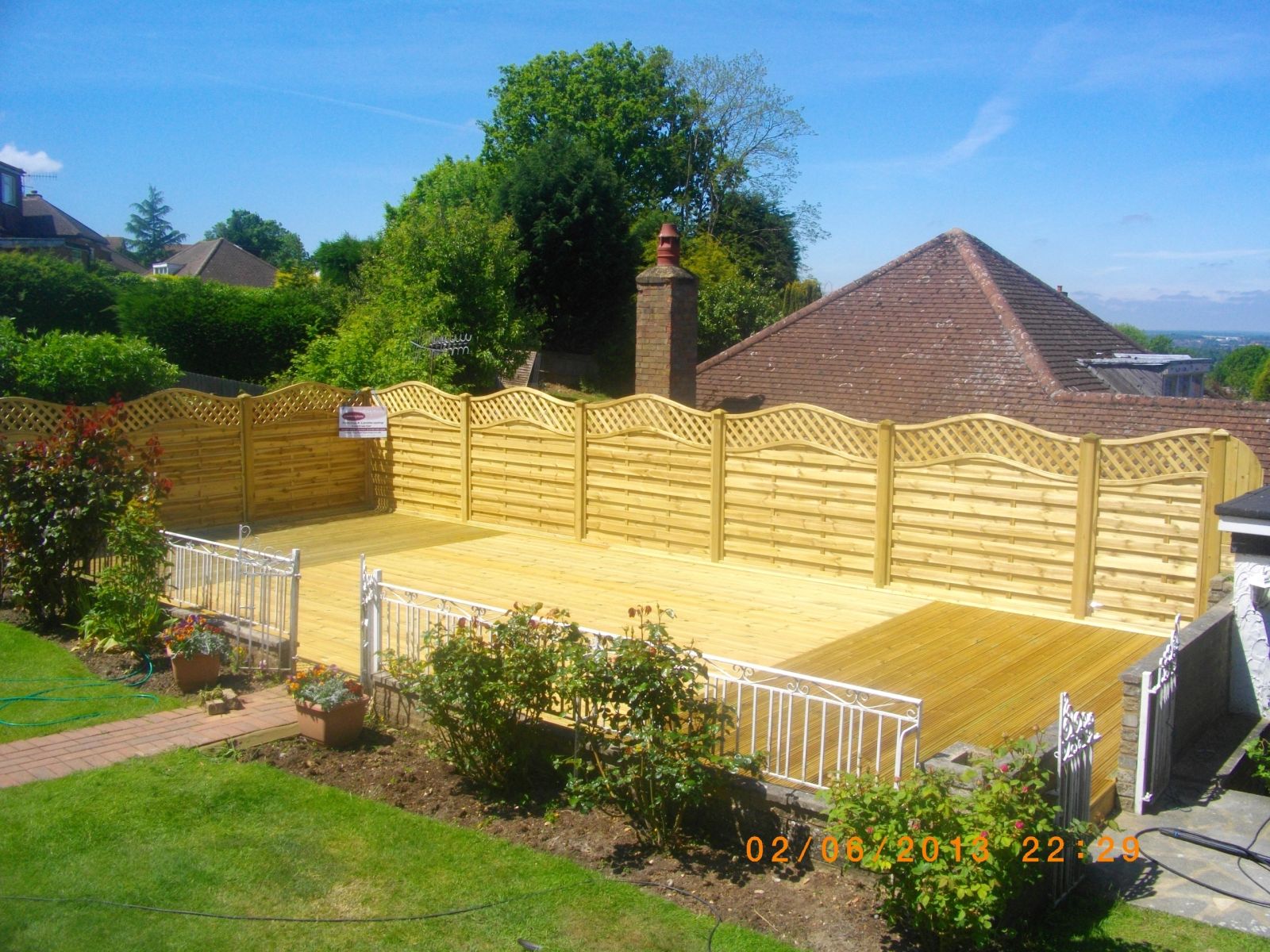
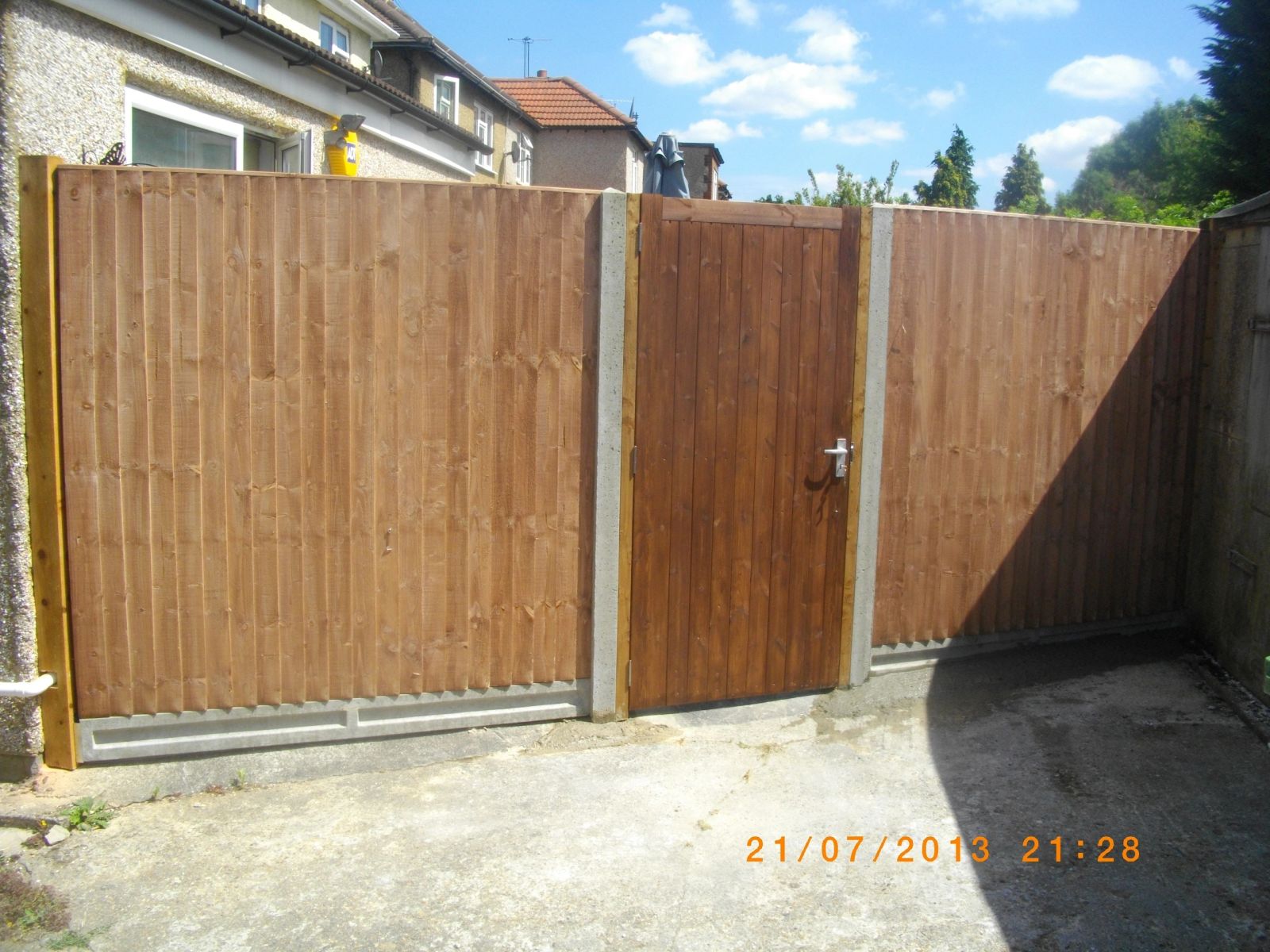
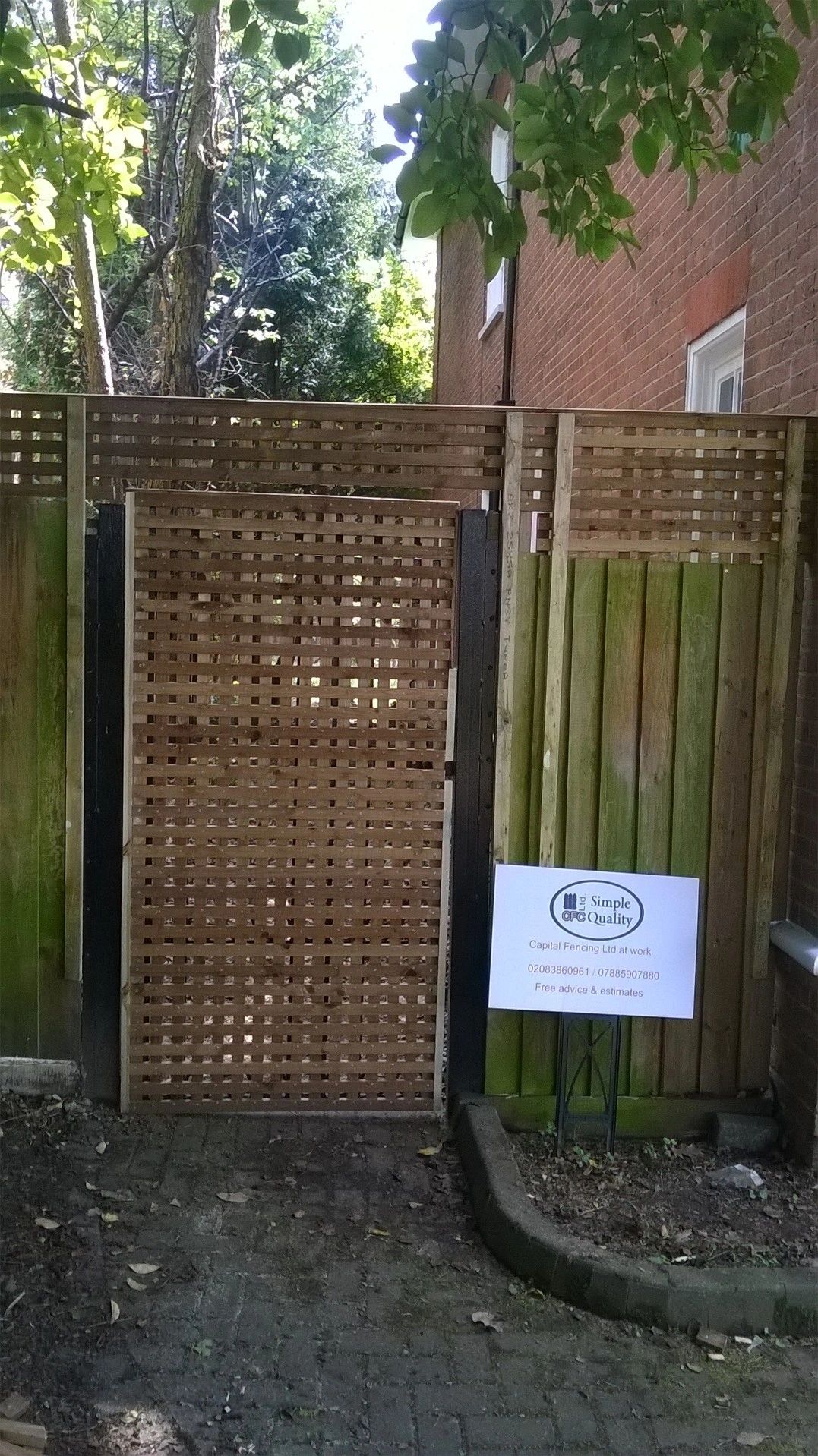
bespoke wooden gate installed by Capital Fencing in Edgware (HA8)double driveway gates installed by Capital Fencing in Edgware (HA8)hardwood side gate installed by Capital Fencing in Edgware (HA8)metal entrance gate installed by Capital Fencing in Edgware (HA8)

Site notes: side return gates in HA8

How a security survey is carried out

A security survey walks the whole perimeter, not just the section that prompted the enquiry — low runs, blind corners and gate junctions elsewhere on the boundary are usually the actual weak point, even when the call came in about one obviously damaged section.

We note sightlines from the street and from within the property, because a fence that blocks a view outward can work against security as easily as a low fence works against it from the other side.

Re-securing wire fencing where staples have popped

Fencing wire under tension gradually works staples out of a timber post as the timber itself shrinks and swells with the seasons, and once enough staples along a run have popped the wire starts to sag between posts.

Repair means re-tensioning the wire with a strainer before re-stapling, since driving new staples into a slack wire only delays the same sagging rather than fixing it.

Access through a house for a rear repair

Where a rear garden has no side access, materials and tools sometimes have to be carried through the house itself, which needs agreeing with the client in advance and protecting flooring and doorways along the route.

This is more common on terraced properties than detached ones, and it's worth factoring into how a repair is scheduled and priced.

Aligning capping rail over a stepped run

Capping rail fitted along the top of a level fence run is a straightforward continuous fix, but on a stepped run each panel sits at its own level, so the capping has to be cut and joined at each step rather than run through in one length.

A clean joint at the step usually means mitring or scarfing the capping ends rather than butting them square, since a square joint leaves an open gap where the two levels meet.

Where the steps are shallow, some fitters run the capping level in short horizontal sections with a visible small drop at each post, which is faster to fit but reads as more obviously stepped than a mitred joint.

Preservative penetration envelope thickness

Pressure treatment doesn't necessarily saturate a timber section all the way through, and the depth of genuine preservative penetration, sometimes called the treatment envelope, can be shallower in dense or resistant species than the treated colour suggests.

Cutting a treated post in half reveals this directly, often showing a pale, untreated core surrounded by a darker treated outer band a few millimetres to a couple of centimetres deep depending on species and process.

This is the practical reason cut ends need separate end-grain treatment, since a fresh cut through the envelope exposes untreated core timber that the original pressure treatment never reached.

Communal gate access arrangements for allotment sites

An allotment site's perimeter fence is usually a lower-cost stock or mesh fence given the modest value at risk, but the communal access gate often gets a disproportionately stronger lock and hinge set, since it's the single point every plot holder and any opportunist intruder both have to pass through.

A keypad or coded padlock at the shared gate avoids the administrative burden of cutting and distributing individual keys to a changing list of plot holders over time.

Self-storage and depot perimeters

Self-storage sites and vehicle depots typically run a continuous high-security perimeter with limited access points, and any repair work has to maintain that perimeter's integrity throughout rather than leaving a gap open overnight.

Because these sites often operate extended or 24-hour access for customers or drivers, fencing work needs scheduling around live access hours, with any section requiring full closure agreed and communicated in advance.

Lighting and CCTV mounted on perimeter fencing at these sites adds a coordination step most domestic jobs don't have — services need identifying and protecting before any post is removed or reset.

Repair-versus-replace decision based on how many posts have failed

Where only one or two posts in a run have failed, individual repair is usually the more sensible option, but once roughly a third or more of the posts along a run show the same rot or movement, a full run replacement often ends up more reliable and no more disruptive.

Counting failed posts as a proportion of the run, rather than judging each one in isolation, gives a clearer basis for that decision than reacting to whichever post has failed most recently.

Checking a panel is square before final fixing

A panel that's racked slightly out of square, even by a small amount, becomes obvious once several are fitted in a row and the tops don't line up evenly.

Measuring both diagonals of the panel frame before fixing, the same check used on gate openings, confirms it's true and worth doing before the first fixing goes in rather than after, when the panel is harder to shift.

A panel forced square against an out-of-true post rather than corrected itself tends to spring back out of shape once the fixings are removed for any future repair, so it's worth addressing the actual cause rather than just clamping it straight.

Matching a railing gate to adjacent railings

A gate set into a run of metal railings needs its bar spacing, finial style and rail heights to match the railings either side, otherwise the opening reads as an obvious later addition rather than part of the original run.

Repro railing gate sections are available in standard spacings, but an older or bespoke railing run sometimes needs a gate made to match rather than bought off the shelf.

Perimeter fencing around a school playing field

A playing field perimeter separate from the main school building boundary is usually lower and more open than the building line itself, since its job is containing pupils during use and deterring casual trespass out of hours rather than resisting a determined intrusion.

Gates onto a playing field are positioned to give staff a clear sightline for supervision, and a field boundary shared with a public path often needs a stock-proof rather than fully solid design to keep sightlines open both ways.

Overhanging branches crossing a boundary line

A property owner generally has the right to cut back branches or roots that cross the boundary from a neighbour's tree, up to the boundary line, though the cut material technically still belongs to the tree's owner and should be offered back.

This self-help right doesn't apply where the tree is protected by a Tree Preservation Order or sits in a conservation area, in which case permission is needed before cutting.

Where a fence line is being planned near an overhanging tree, checking the tree's protected status first avoids inadvertently carrying out unauthorised work.

Tongue-and-groove privacy panels

Tongue-and-groove boards interlock edge to edge with no overlap, giving a genuinely solid, gap-free face that's the most private board profile available in timber fencing.

Because the boards key into each other rather than overlapping, the panel needs to be built with a small allowance for seasonal swelling, or the interlocking edges can bind and cup as the timber moves.

It's a heavier, stiffer panel than lap or slatted profiles, so it's usually paired with more substantial posts, and it's a common choice for pool or hot-tub screening where sightlines matter more than airflow.

Questions to ask any fencing contractor

Worth asking directly: who owns the boundary being worked on, what happens if buried obstructions are found, and whether waste removal and disposal are included in the price rather than charged separately afterwards.

It's also reasonable to ask what post-setting method will be used for the specific ground conditions on site, since a contractor who hasn't looked at soil type before quoting depth and concrete volume is guessing rather than specifying.

Asking how a contractor handles a shared boundary with a neighbour who hasn't been consulted is a good test of whether they've thought through the ownership question at all, rather than just the fence itself.

Painted versus stained finish maintenance

A painted gate hides the timber grain and needs a full film to stay intact, so any crack or chip in that film lets water in behind the coating and can accelerate local rot if left unaddressed.

A stained or oiled finish penetrates the timber rather than sitting as a film, so it wears more evenly and is easier to top up in patches without a full strip-back.

Timber versus metal for a replacement gate

A timber gate is easier to match to an existing fence line and easier to repair in sections, while a metal gate holds its shape better against warping and racking but is harder to alter once fabricated.

We recommend based on what the existing boundary is built from and what the client actually wants to maintain over time, not a single default material.

Dry-mix versus wet-mix concrete for post bases

A dry mix — post-fixing concrete poured dry into the hole around a braced post and left to draw moisture from the surrounding ground — sets over a day or two and suits smaller domestic posts in reasonably moist soil.

A wet mix, gauged and mixed with water before placing, gives more control over strength and is generally preferred for larger posts, gate posts under lateral load, or very dry, free-draining ground where a dry mix may not draw enough moisture to cure properly.

Wet mix also allows proper tamping to remove air pockets around the post, which a dry mix poured in stages can't achieve to the same degree.

Fencing a marina or boatyard compound

A marina or boatyard compound combines standard perimeter security with exposure to salt air and standing water, so galvanising specification and fixing hardware are upgraded from a typical inland commercial job to resist accelerated corrosion.

Gate access often needs to accommodate trailered boats and cradles passing through, which pushes toward a wide sliding gate or a removable section rather than a fixed-width pedestrian-scale opening.

Headroom and finger-trap gaps on gates

A sliding gate leaves a running gap between the gate and its guide posts that can trap fingers if it isn't guarded, and a swing gate's hinge side needs enough clearance to close without shearing anything caught in it.

Guards or brush strips over the trap points are a small addition that matters more on a gate used by children or the public than on a compound gate few people approach closely.

Checking cumulative ground level change along a long boundary

A gentle, barely perceptible slope checked only between adjacent posts can still add up to a substantial total fall over a long boundary, which is easy to miss without measuring from a single fixed datum along the whole run.

Taking level readings from one datum point at both ends and at intervals along the run, rather than only comparing each post to its immediate neighbour, reveals the true overall fall before panel and post heights are finalised.

This matters most for ordering materials in advance, since a run that turns out to need more steps or a longer rake than first estimated can mean extra cut panels or capping that weren't in the original take-off.

Lichen colonising capping and post tops

Lichen tends to establish on horizontal or gently sloped timber surfaces that stay damp longest, which makes flat-topped capping and post caps more susceptible than the vertical panel faces below them.

Unlike algae, lichen grows slowly and bonds tightly to the timber surface, so a stiff brush rather than a pressure washer is usually needed to remove it without damaging the wood fibres underneath.

Once removed, a capping profile with a fall to shed water reduces how quickly lichen re-establishes compared with a flat top that holds a film of moisture after every rain.

Manual override on an automated gate

Most automated gates include a manual release so the gate can be opened by hand during a power cut or motor fault, and checking this release still works is worth doing periodically rather than only discovering it's seized in an emergency.

We check the mechanical gate and release mechanism; motor and control-board diagnosis is referred to a specialist.

Whether the brief is hardwood side gate between a rendered wall and a brick pier, 780mm opening, drop-bolt into a concrete slab socket or tongue-and-groove side gate framed on adjustable ball-race hinges to cope with seasonal timber movement, we quote it from a site visit, not a photo. Edgware is inside our core working patch and most jobs are booked in inside a fortnight. Roads such as Station Road and High Street are typical of the local layout. Stonegrove Park is a useful local reference point. The A5, running through the town, follows the route of the Roman Watling Street.

Get In Touch

Get My Free Quote — 24h Response

No callout fee · Free site visit · Friendly local team covering London & Hertfordshire.

Call us
07885907880
or 02036484746
Email
capital_fencing@yahoo.com
WhatsApp
Message us anytime
Area
London & Hertfordshire
Payment
Card payments accepted

Pay by debit or credit card, bank transfer or cash once the work and price are agreed. No deposit taken online.

Request a Free Quote

We'll get back to you within 24 hours.

Free Site Visit No Callout Fee
Call WhatsAppQuote