Perimeter security at a GP surgery or health centre
A GP surgery boundary balances public accessibility during opening hours against protecting drug storage, equipment and the building itself outside them, so a low decorative frontage often gives way to a more solid, higher fence around plant areas, bin stores and rear access at the same site.
Step-free, wide gate openings are needed anywhere patients using wheelchairs or mobility aids pass through the boundary, which can constrain gate hardware choices compared with a purely commercial yard.
Repairing stock fencing pushed over or leaned on by animals
Fencing bordering land grazed by livestock takes a different kind of load to a garden boundary — sustained leaning and rubbing rather than occasional wind load — and posts along that kind of boundary often fail by gradually leaning outward rather than snapping.
Repair on this type of boundary is worth specifying with a stronger post spacing or additional strainer posts at intervals, since a repair matching a garden-fence specification often fails again quickly under the same ongoing pressure.
Closing dampers to prevent slamming
A hydraulic or pneumatic closing damper fitted alongside a self-closing spring slows the last part of the gate's travel, preventing the slam that a spring alone produces and reducing wear on the frame, latch and keep.
Dampers are a common retrofit on gates that were fitted with a spring only, once the noise or repeated impact damage from slamming becomes a nuisance.
Repair-versus-replace where a run mixes several different panel types
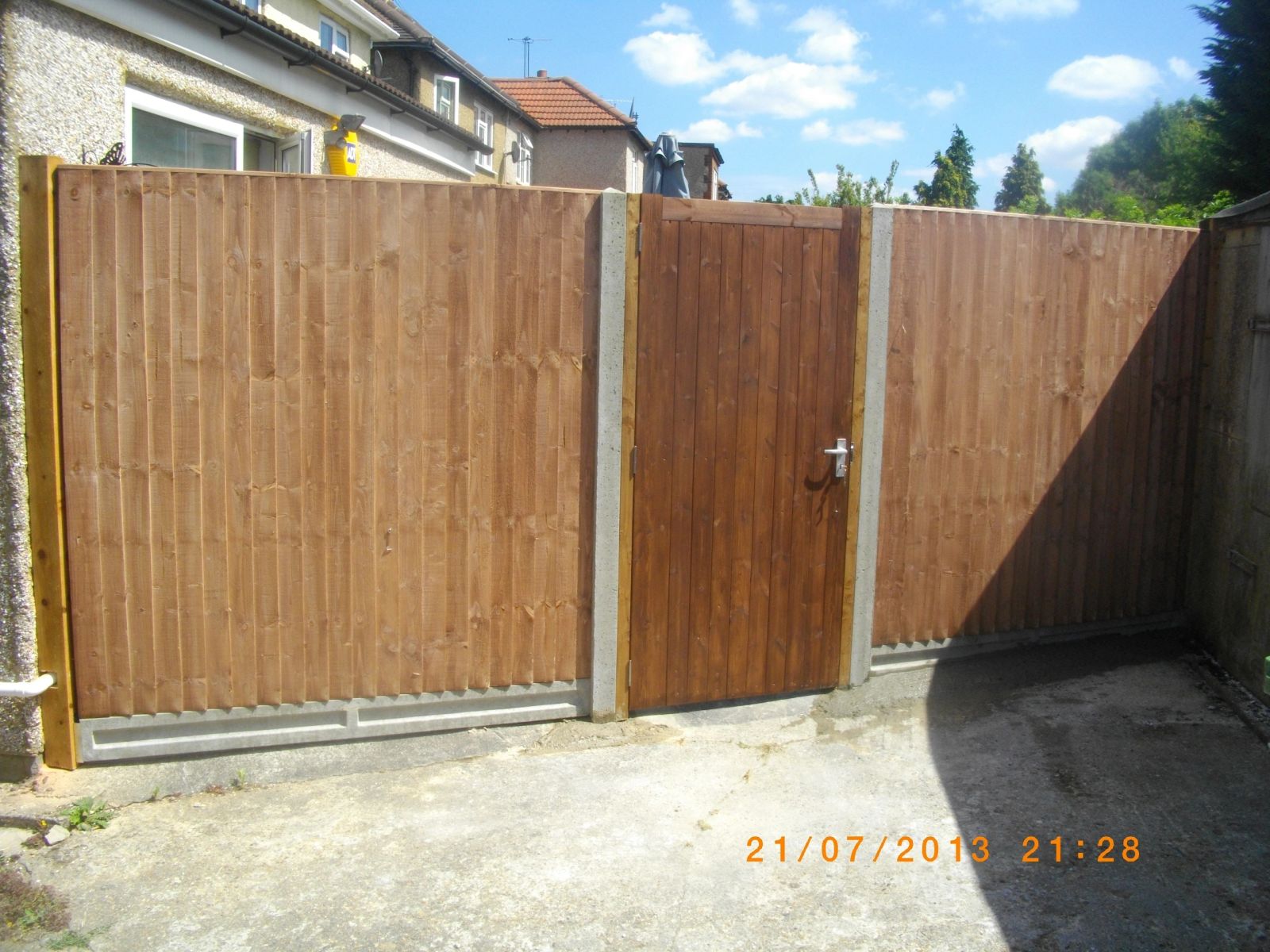
A boundary added to or repaired piecemeal over many years sometimes ends up with two or three different panel styles along its length, which makes a small further repair harder to match convincingly to any one of them.
In that situation it's worth discussing with the client whether continuing to patch in whichever style is easiest to source is acceptable, or whether it's the point to standardise the whole run to a single style during a larger repair.
Handling excavated spoil on a fencing job
Digging even a modest run of post holes generates a surprising volume of spoil, and leaving it in a single heap on a lawn for the duration of a job kills the grass underneath if left more than a few days.
Spreading spoil thinly on a border, bagging it for removal, or arranging same-day disposal all avoid that dead patch, and the right choice depends on whether the client wants the spoil kept for landscaping elsewhere on the plot.
Heavy clay spoil is particularly slow to dry and awkward to barrow once it's rained on, so timing the dig to avoid leaving wet spoil sitting overnight where possible reduces both the mess and the extra effort of moving it later.
Dealing with buried debris uncovered while digging out a repair footing
Old post stubs, broken glass, hardcore or builder's rubble from a previous era of the garden's use sometimes turn up when digging out a footing for repair, particularly on older plots that have been through several changes of use.
Where this happens, it's worth clearing enough of the obstruction to get a clean footing rather than working around it, and flagging anything unexpected — old drainage, buried cabling, unusually large rubble — to the client before continuing.
Mesh tensioning on a chain-link or weld-mesh run
Mesh that's fitted slack sags between posts and can be pulled or climbed more easily, so a straining wire and turnbuckle at each end of a run tension the mesh evenly before it's clipped or tied to the line wires.
Re-tensioning is a routine maintenance task on an older mesh run, since posts settling slightly or ground movement over a season will slacken a mesh that was originally taut.
Council neighbour consultation schemes for permitted development
Certain categories of permitted development, mainly larger extensions rather than fencing itself, fall under a formal neighbour consultation scheme requiring the council to notify adjoining owners even without a full planning application.
Boundary fencing itself is rarely covered by this specific scheme, but it's sometimes confused with the ordinary neighbour notification that happens during a full planning application for other works.
Where in doubt about which process applies to a specific project, the council's planning department can clarify which consultation route, if any, is relevant.
Post depth rules of thumb by height
A common trade rule of thumb is burying roughly a third of the total post length below ground, so a 2.4m fence post typically needs around 600-750mm set depth in reasonable ground.
That ratio needs adjusting upward on wind-exposed sites, in poor bearing ground, or on taller runs above around 1.8m, where the extra leverage on the post multiplies the load on the buried section.
On very firm chalk or dense gravel, slightly shallower depths can be adequate, but as a rule it's easier to justify going deeper than to explain a leaning post two winters later.
Packing as a repair for an uneven panel gap
Packing uses timber shims between a post and a panel to correct a gap that's opened up as ground has settled unevenly beneath one end of a run, restoring a level top line without lifting or resetting every post along the bay.
It's a reasonable short-term fix for minor settlement, but packing over a gap caused by an actively failing post just delays a proper reset and the packing itself will need adjusting again as the post continues to move.
Deciding between stepping and raking a panel run
Stepped panels stay level themselves and drop in increments post to post, leaving a small triangular gap under each panel that grows towards the low end of a run; raked panels are cut at an angle so the top edge follows the slope continuously with no gap.
Stock panels can be stepped without alteration, but raking almost always means cutting a panel's top rail and infill to an angle on site, which only works with materials that can be cut and re-fixed cleanly, such as featheredge or slatted boards.
A steep, uneven slope generally favours stepping for speed and future repairability; a long, gentle and even gradient often looks better raked, since the steps would otherwise be very shallow and visually fussy.
Protecting a patio surface during fencing work
Dragging posts, panels or a wheelbarrow across paving can chip edges or scratch a polished or textured finish, so boards or protective sheeting laid along the route reduce that risk on a patio the client wants kept intact.
Concrete spillage from mixing or haunching is another common cause of permanent staining on natural stone or porous paving, and it sets far harder to remove than it is to prevent with a simple dust sheet under the mixing point.
Where post holes have to be dug close to a patio edge, protecting the adjoining slabs from spoil and tool marks is worth doing before digging starts rather than cleaning up afterwards.
RAL colours and UV fade
RAL is a standardised colour matching system widely used for powder coating and factory paint finishes on metal fencing and gates, allowing a specific shade to be reordered consistently years apart.
Darker RAL shades, particularly reds and some greens, tend to fade faster under UV exposure than blacks and greys, since the pigments used to achieve those colours are often less UV-stable.
South-facing runs in direct sun for most of the day will fade noticeably faster than a shaded run of the same colour and coating, which is worth factoring in in when matching an extension to existing fencing.
Arris rail mortice joint wear
A traditional arris-rail panel fence uses a triangular-section rail slotted into a mortice cut through the post, and repeated wind loading can gradually enlarge that mortice, letting the rail rock and eventually loosen the whole panel.
A mortice cut slightly oversized from the start, or one that's been enlarged by rot before a replacement rail is fitted, is a common weak point that arris-rail brackets were largely developed to bypass.
Galvanised metal arris-rail brackets, fixed to the face of the post rather than through it, avoid weakening the post with a mortice at all and are now the more common detail on new panel fencing.
Fencing over services and cable routes
Before any post hole is dug, service records or a cable-avoidance sweep should confirm what runs under the line — a fence boundary often follows an old cable or drain route because that was the cheapest place to lay it originally.
Where a service can't be avoided, post positions are shifted along the run or a shallower surface-mounted base is used instead of digging through the service.
Narrow access and carrying materials by hand
Where there's no side access wide enough for a barrow, materials have to be hand-carried through the house or over a boundary, which changes both the time a job takes and the choice of components — shorter, lighter sections are far easier to move this way than long concrete gravel boards.
Protecting internal flooring and doorways during a through-house carry is worth agreeing before the first delivery arrives, since a scuffed hallway wall is one of the most common complaints on this kind of access.
On some terraces the only alternative is craning or lifting material over a roof or side wall, which needs its own access and safety plan rather than being treated as a simple manual carry.
Fall direction and drainage across a deck
A deck built dead level holds standing water after rain, which speeds up algae growth and softens the timber surface faster than a deck with a slight fall built in to shed water away from the house.
The fall is normally built into the joist or bearer heights during construction, angled away from any adjoining wall or door threshold, rather than relying on the boards themselves to slope.
Getting the fall direction right at the design stage also avoids water pooling against a house wall, which risks damp ingress at the threshold over time.
Movement joints in timber cladding
Timber cladding boards fixed edge to edge without any allowance for seasonal expansion can buckle or split as the boards swell in wet weather and have nowhere to expand into.
A small gap left between board ends, or a slightly loose fixing pattern that allows a board to expand slightly within its fixing slots, accommodates this movement without transferring stress into the board itself.
The required gap varies by species and board width, since wider boards and more moisture-reactive species move more in absolute terms than narrow boards of a stable species for the same change in humidity.
Terraced housing and rear access
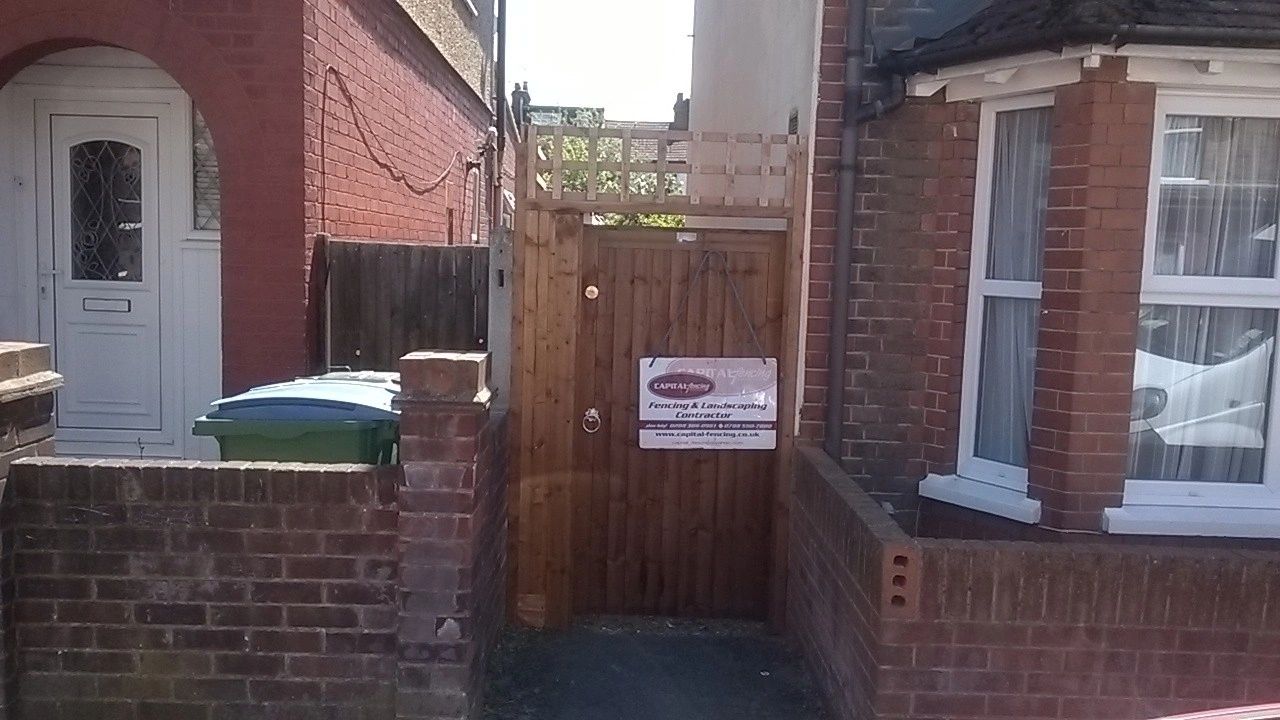
Victorian and Edwardian terraces were rarely built with side access, which means materials for a rear garden fence often have to go through the house, over a shared side return, or down a narrow rear alley shared with several other properties.
That access constraint changes the practical choice of materials — full concrete gravel boards and long panels are harder to move through a narrow hallway than shorter timber sections carried in and built up on site.
It's also why timing matters on these jobs: a delivery that blocks a shared alley for half a day needs agreeing with neighbours in advance, not discovering on the morning of the job.
Screening bin storage without blocking access
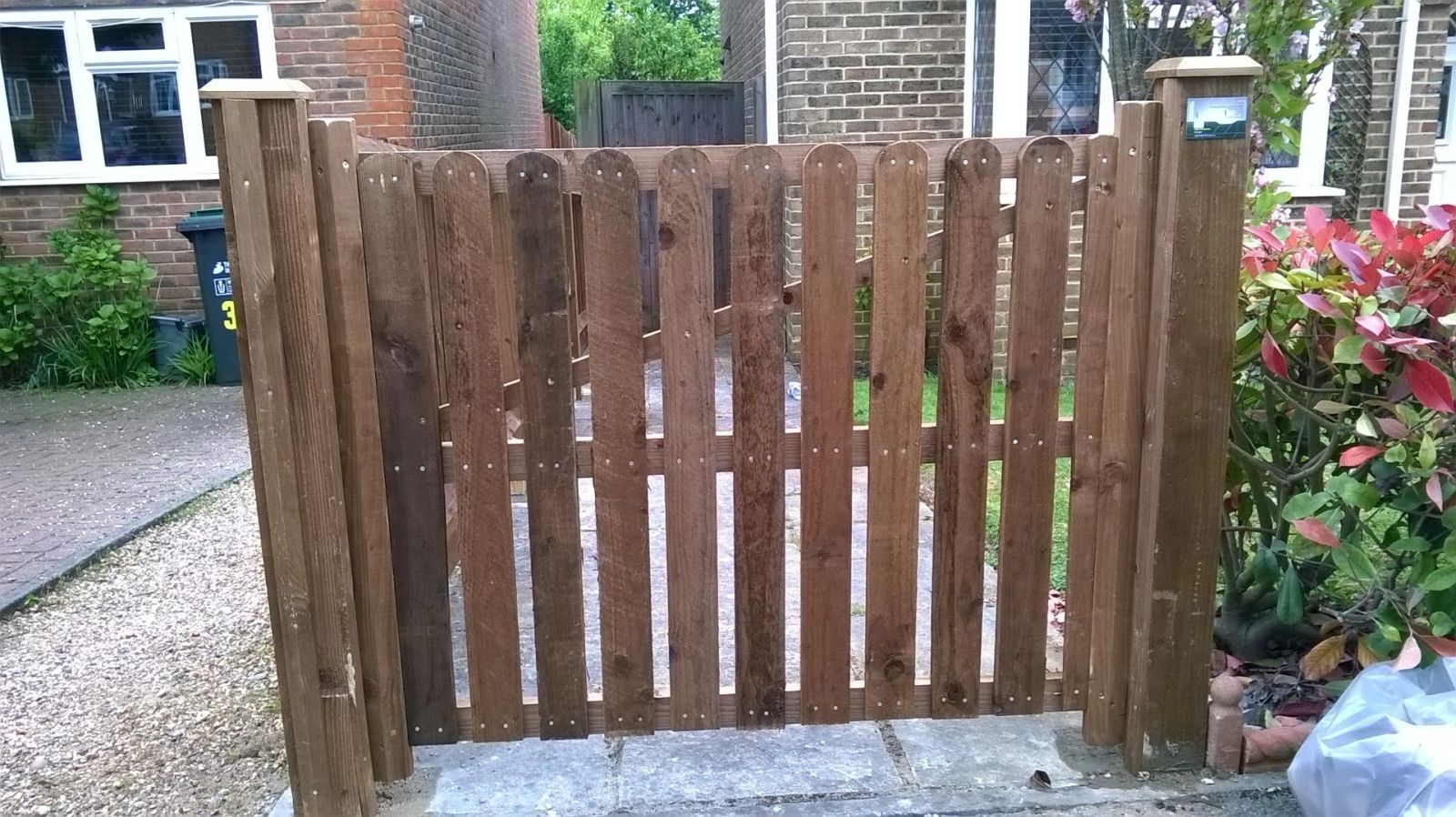
A dedicated bin store or screening fence at the front of a property needs to balance neatness against practical access — bins still need to be wheeled out to the collection point on the correct day without catching on a narrow gate opening.
Local authority bin sizes vary, so it's worth checking actual collection bin dimensions before building a fixed screen enclosure that later turns out too small for a new bin type.
A slatted or louvred screen usually works better than solid panel for bin storage, since it hides the bins from view while still letting air circulate rather than trapping odour against a solid surface.
Checking which face of a panel should face outward
Many panel styles have a clear 'good' face with a neater finish and a reverse face showing the frame, battens or rail ends, and getting this the wrong way round means the less tidy side ends up facing the client's own garden or the neighbour's, depending on convention and agreement.
Where a boundary is shared, it's worth agreeing in advance which side the good face should present, since local convention varies and assuming it defaults toward the neighbour without discussion can cause an avoidable dispute.
Checking panel orientation before fixing, rather than after several panels are already up, saves having to unfix and turn a run of panels that all went in the wrong way round.
Decking board profiles and grooves
Timber decking boards commonly come grooved (ribbed) on the top face for grip, reversible to a smooth face for a more contemporary look, or with a rounded profile that sheds water more readily but offers less traction underfoot.
Grooved boards trap dirt and moisture in the channels more than a smooth or rounded profile, so they need more regular brushing or washing to avoid becoming slippery with algae, particularly in shaded, damp positions.
Composite boards are usually extruded with a fixed groove or embossed texture rather than milled, and the profile is generally part of a wider system with matching edge trims rather than a feature that can be mixed freely between board types.