Constraints on gates near listed buildings or in conservation areas
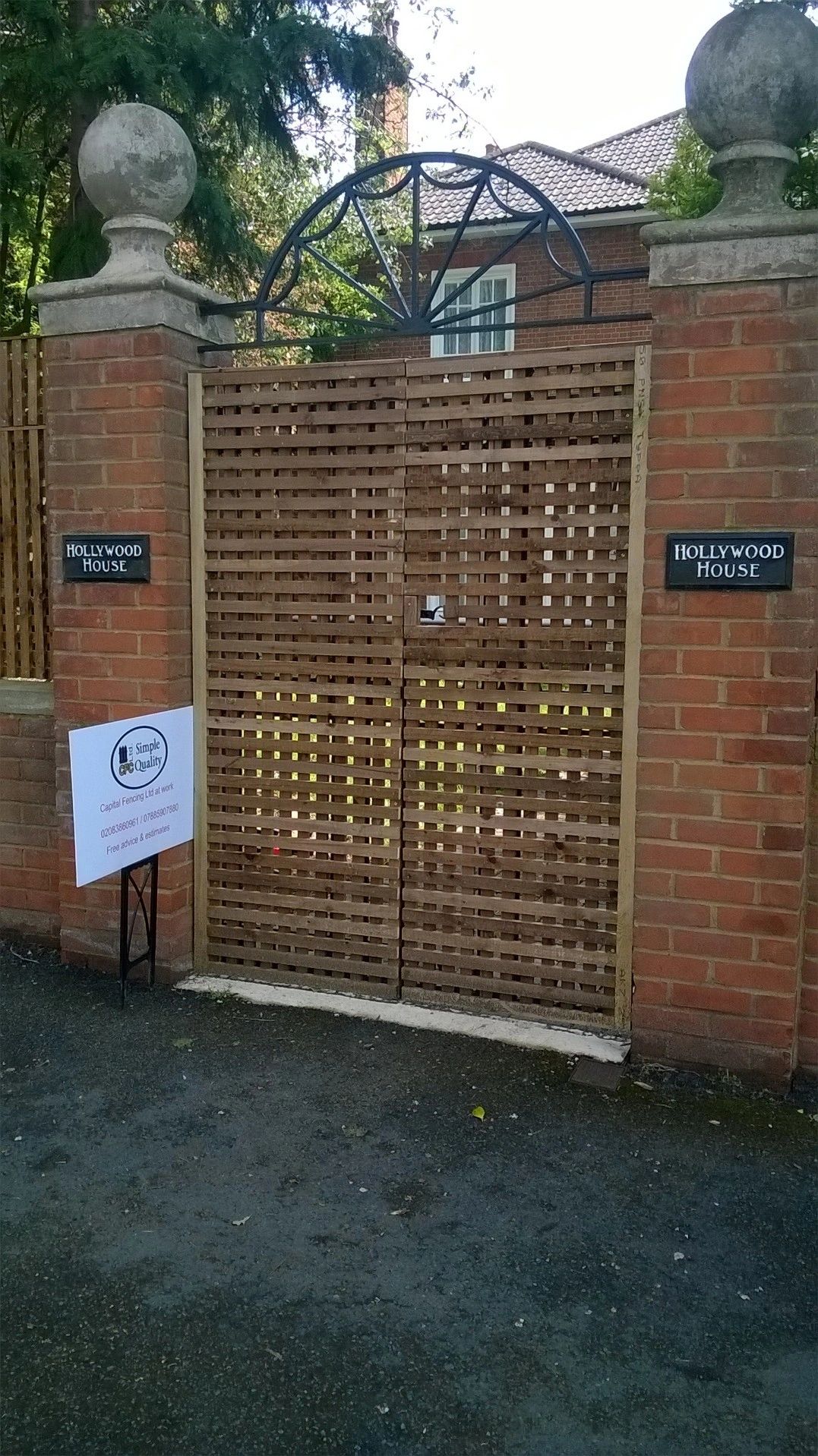
A gate forming part of the boundary treatment of a listed building, or sited within a conservation area, may need consent before being altered or replaced, particularly where the change affects the property's appearance from a public viewpoint.
Checking whether any such designation applies to a site before specifying a replacement gate avoids work that later needs to be reversed or amended.
Fencing a retail service yard
A retail service yard behind a shop or unit typically holds delivery access, waste storage and sometimes gas or refrigeration plant, so its fencing needs to allow regular vehicle and trolley movement while still closing off the yard from the public shopping area.
A sliding gate is often preferred here over a swing gate because it doesn't intrude into a tight yard footprint shared with delivery vehicles manoeuvring at close quarters.
Brush application versus spray for treatment
Brush application works the treatment into the grain and end grain more thoroughly, which matters most at cut ends and joints where untreated timber is exposed and most vulnerable to moisture uptake.
Spray application covers a large run far faster and gives a more even surface finish on smooth-planed boards, but relies on good weather and overspray control, and can leave the coating sitting on the surface rather than penetrating as deeply.
A practical approach on a full boundary is spraying the open panel faces for speed and finish, then finishing post tops, end grain and capping joints by hand with a brush.
Thermal cracking in concrete post caps
Concrete post caps and copings can develop fine cracks from repeated freeze-thaw cycling, where water absorbed into small surface pores expands as it freezes and gradually widens existing microcracks.
A denser, lower-porosity concrete mix, or one finished with a sealant, absorbs less water in the first place and is correspondingly more resistant to this kind of frost damage than a porous, untreated finish.
Once a crack has formed, it tends to widen faster in subsequent winters, since the enlarged crack itself now holds more water than the original surface pores did, which is why early repair matters more than it might first appear.
Working around a soil vent pipe on the boundary
A soil vent pipe running up close to a boundary wall or fence line needs clearance to stay serviceable and to avoid trapping odours or condensation against the timber.
Where a fence panel would otherwise sit directly against the pipe, a narrow gap or a purpose-cut notch in the panel or gravel board keeps the pipe accessible without leaving a large unsightly space either side.
Fixing a post too close to a vent pipe can also make future pipe repairs or clearance rodding awkward, so the post position is usually set slightly back from the pipe run rather than tight against it.
Latch and drop-bolt corrosion over a gate's lifecycle
A gate latch or drop bolt sees repeated mechanical wear on top of weather exposure, and standard zinc-plated steel components typically show surface corrosion and stiffening action within a few years of regular outdoor use.
Stainless steel or marine-grade fittings cost more initially but avoid the seized or snapped bolt that is one of the most common minor gate failures, particularly on a drop bolt that isn't operated daily and can seize unnoticed.
An annual light oiling of moving parts, alongside the general hinge check, keeps a latch mechanism working smoothly well beyond the point a neglected one would start sticking.
Gravel-board clearance over uneven ground
A gravel board sitting flush with the soil on one section of a run can end up buried a couple of inches by the time the ground rises further along an uneven boundary, trapping moisture against timber that was specified to sit clear of the soil.
Stepping the board height slightly at each post, rather than running one continuous level line, keeps a consistent clearance above grade along the whole run.
Concrete gravel boards tolerate this ground contact better than timber ones, which is one reason they're specified as standard on plots with visibly uneven levels.
Seasonal ground heave
Ground heave is the upward or lateral movement of soil as it absorbs water and expands, most pronounced in clay-rich ground after a wet autumn following a dry summer.
A post that was plumb in August can be measurably out of true by the following spring purely from this cycle, without any external damage to the fence.
Where heave is a known issue on a plot, deeper posts and a looser granular surround give the soil room to move without directly loading the post, rather than locking post and ground rigidly together.
Fence height and boundary lighting interaction
A taller solid fence can throw a shadow line that defeats existing security lighting, creating a dark strip right where an intruder would approach the boundary.
Lighting angles are worth reviewing alongside any height change, and a fence contractor should flag an obvious shadow problem even though relocating the light itself is usually a separate trade.
Accessible gate access and reasonable adjustment
A security gate on a route used by the public or by staff and visitors needs to accommodate wheelchair users and people with limited grip strength, which affects latch height, opening force and whether a keypad or fob system is reachable from a seated position.
Retrofitting accessible hardware to an existing gate is usually straightforward, but it's cheaper and simpler to specify it correctly at the point of ordering than to identify the gap only after a complaint or an access audit.
Stainless steel grades near salted roads
Grade 304 stainless steel resists general corrosion well but can develop surface pitting when regularly exposed to chloride from de-icing salt spray thrown up by passing traffic.
Grade 316 stainless includes molybdenum, which significantly improves resistance to chloride pitting, and is the more appropriate specification for fixings and fittings on roadside fencing subject to winter gritting.
The cost difference between the two grades is usually small relative to the fitting itself, so specifying 316 near a heavily gritted road is generally worth it for the extended service life alone.
Tangential shrinkage and cupping
Wood shrinks more in the direction that runs tangentially to the growth rings than along the grain's length, and boards cut close to the outer edge of a log (flat-sawn) show this most, curling into a dish shape known as cupping as they dry.
A board with growth rings running roughly parallel to its face is far more prone to cupping than one cut through the centre of the log, where rings run closer to perpendicular to the face.
Fixing boards with two nails or screws per bearer rather than one resists cupping better, since a single central fixing lets the edges lift and curl relatively freely.
Checking post plumb tolerance after installation
A post that's slightly off plumb when first set can be adjusted while the concrete is still workable, but once cured the only fix is breaking out and resetting it, so plumb is checked with a spirit level in two directions before the pour rather than assumed from a quick visual check.
A run of posts each slightly off plumb in the same direction is usually a sign of a systematic setting-out error rather than individual mistakes, and is worth catching after the first two or three posts rather than the whole run.
Nail versus screw fixing on repairs
Nailed fixings are faster to install and are the standard on new panel builds, but a screwed fixing holds better in timber that's already slightly softened by weathering, which makes screws the more reliable choice on a repair into older stock.
Screws also allow a board or rail to be removed cleanly if it needs replacing again later, whereas a nailed fixing usually damages the surrounding timber on removal.
Acoustic fencing near busy roads or railways
Taller acoustic fencing intended to reduce traffic or railway noise is still subject to the same general permitted development height limits as any other boundary structure, unless it forms part of a formally consented scheme.
Some acoustic fencing along significant infrastructure is installed by the highway or rail authority itself under separate statutory powers, which is different from a homeowner adding their own noise barrier.
A homeowner wanting extra height for noise reasons alone would generally still need to apply for planning permission above the normal limit, the same as for any other reason.
Concrete mix choice by ground type
A standard post-fix or wet-mix concrete works well in firm, free-draining ground, but the same mix in waterlogged clay can trap moisture against the post rather than supporting it, encouraging rot from below rather than preventing it.
In consistently wet ground, a free-draining aggregate base under a shorter concrete collar generally outperforms a full concrete plug for timber post longevity.
In very loose or made ground, a wider hole with more concrete volume compensates for poor natural bearing, essentially building an artificial firm base where the soil itself can't provide one.
Tree proximity and root-safe post positions
Digging a post hole through a tree's root protection area can damage roots enough to destabilise the tree or trigger a preservation order breach, so post positions are offset or moved to hand-dug, narrower holes where a root is found.
A boundary running close to a protected tree is checked against its root spread before any layout is finalised, rather than adjusted only once digging hits a problem.
Part-run replacement and matching heights
Replacing part of a run while leaving the rest standing means matching not just the panel style but the exact height, since even a small step in height between old and new sections is visually obvious along a straight boundary.
Where the original height isn't available in current stock, adjusting the post height or capping detail can sometimes close the gap without replacing the whole run.
Repairing a section of a fence built to a non-standard height
Some existing fences were built to a height that doesn't match a standard panel or board size, often because of a specific planning condition or a personal preference at the time of original construction, and matching that height on a repair takes more care than fitting an off-the-shelf panel.
Site-cutting boards or panels to the existing height, and checking whether that height has any planning significance before changing it, keeps a repair consistent with the rest of the run.
Testing timber moisture content before deciding on a repair
A moisture meter reading on a post or board gives a more reliable picture of remaining life than appearance alone, since timber can look weathered but still be structurally sound, or look reasonably clean-faced while being saturated and soft just beneath the surface.
This is particularly useful where a client is unsure whether a section needs full replacement or can be left, since a moisture reading gives a specific figure to base that decision on rather than a subjective visual judgement.
Fall direction and drainage across a deck
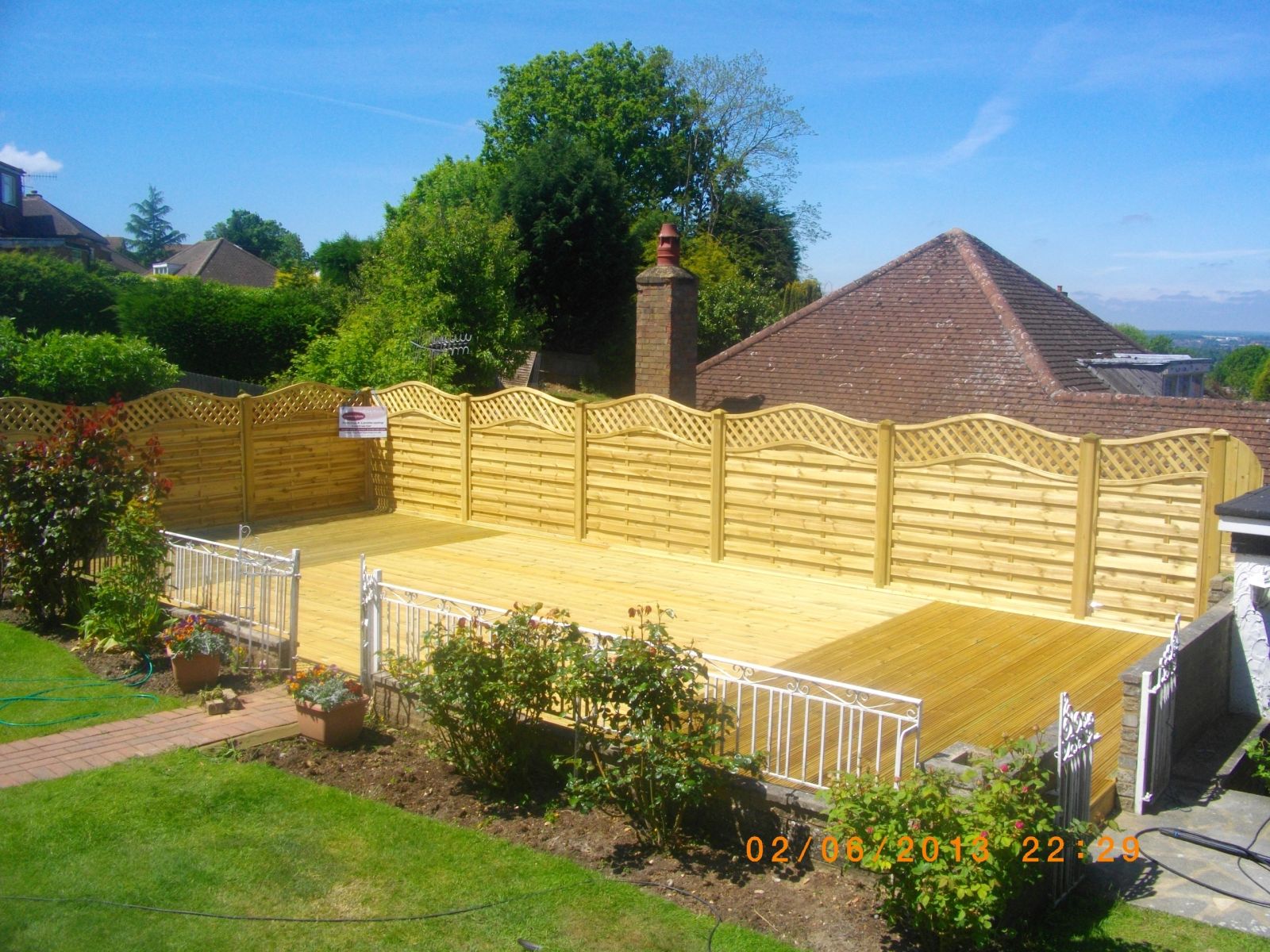
A deck built dead level holds standing water after rain, which speeds up algae growth and softens the timber surface faster than a deck with a slight fall built in to shed water away from the house.
The fall is normally built into the joist or bearer heights during construction, angled away from any adjoining wall or door threshold, rather than relying on the boards themselves to slope.
Getting the fall direction right at the design stage also avoids water pooling against a house wall, which risks damp ingress at the threshold over time.
Aluminium and steel railings
Aluminium railings are lighter, don't rust, and hold a powder-coated finish well without the ongoing maintenance steel needs, which makes them common for low-boundary and pool-safety railings where upkeep is meant to be minimal.
Steel railings are heavier and stiffer for the same section size, which suits taller or higher-security applications, but the finish has to be maintained — a scratch through galvanising or powder coating exposes bare steel to rust from that point.
Both are usually supplied as welded panels between posts rather than built up rail-by-rail on site, so panel width and post spacing need to be agreed before ordering rather than adjusted afterward.