Bat and bird nesting season timing
Wild bird nests are protected while in use under the Wildlife and Countryside Act, which in practice means hedge-cutting and dense vegetation clearance along a boundary is generally best avoided during the main nesting season, roughly March to August, unless the hedge has been checked and confirmed clear.
Bats are protected year-round, but works affecting their roosting sites — old sheds, mature trees with cavities, ivy-clad walls — carry particular risk in spring and autumn when bats are moving between summer and winter roosts.
On any boundary job involving significant vegetation or old structure removal, a quick visual check for active nests or signs of bat use before starting is a simple way to avoid inadvertently committing an offence.
Rights of access to maintain a boundary
Some older deeds include an explicit right for a neighbour to enter adjoining land to maintain their side of a boundary structure, but this isn't automatic everywhere and shouldn't be assumed.
Where no such right exists in the paperwork, entering a neighbour's garden to repair or replace a fence normally needs their permission, arranged directly rather than taken for granted.
The Access to Neighbouring Land Act 1992 provides a separate, more formal route for essential works where agreement can't be reached, though it's aimed at more serious situations than routine fence replacement.
Realistic maintenance intervals
Pressure-treated softwood fencing generally wants a re-application of preservative or stain every two to three years to keep the surface protected, more often on a south-facing run that gets constant UV exposure.
Gate hinges and latches are worth checking annually for movement or corrosion, since a small adjustment caught early avoids the gate racking out of square and needing a rebuild.
Decking boards benefit from a yearly clean to clear leaf litter and algae from the gaps, which is what actually causes most of the slipperiness people blame on the timber itself.
Bearer support on adjustable pedestals
Adjustable plastic pedestals supporting deck bearers let each support point be levelled individually, which is useful over an uneven concrete base, a sloped patio, or ground that isn't practical to excavate level.
Pedestal spacing still needs to follow the same span logic as timber joists, since an adjustable base doesn't change how far the bearer above it can safely span before it needs another support point.
Pedestals also raise the whole deck slightly, which is worth checking against a threshold or step height at the house before committing to the system.
A spec checklist for comparing quotes
Two quotes at very different prices for what looks like the same fence often differ in the parts that aren't obvious from a headline description — post type and spacing, gravel board material, rail count, use class of treatment, and whether waste removal is included.
Worth confirming explicitly: post material and size, number of arris rails for the height quoted, gravel board type, treatment use class of ground-contact timber, fixing corrosion class, and whether post caps and capping rail are included as standard.
A written spec covering those points, rather than just a total price and a photo of a similar job, is the practical way to compare quotes on equal terms rather than discovering the difference once the fence is already up.
Defensive planting alongside a security fence
Dense, thorny planting such as hawthorn or berberis along the inside or outside of a lower fence adds a deterrent layer without extra height, and is sometimes used where planning limits the fence itself.
Planting needs a maintained gap from the fence line so roots don't undermine posts and growth doesn't hide someone approaching the boundary — the deterrent only works if it's kept low enough to see over and dense enough not to push through.
Aligning a drop bolt on double gates
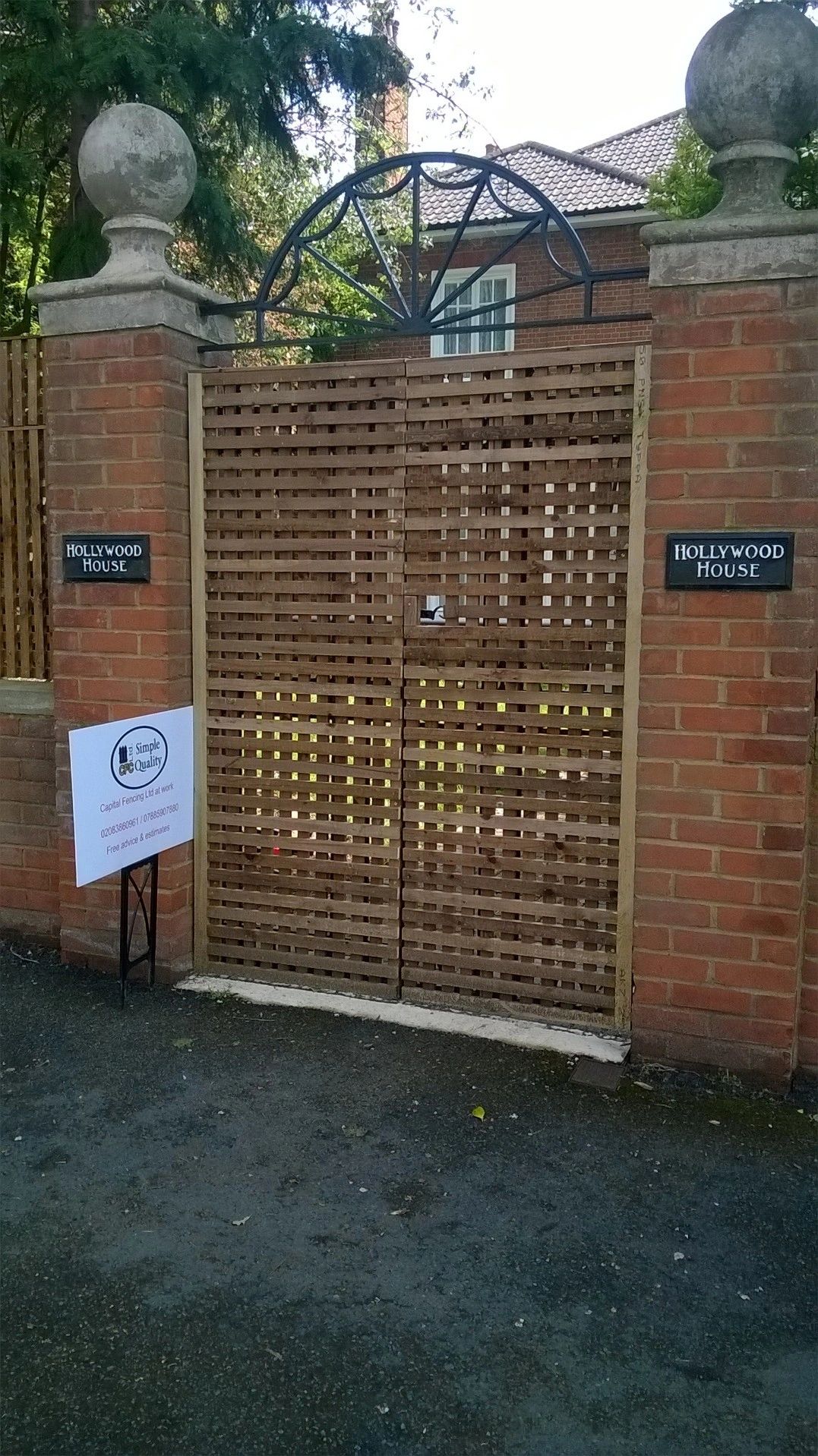
A drop bolt on the leading edge of one leaf of a double gate needs a matching socket set into the ground or a fixed plate below it, and that socket has to be positioned after the gates are hung and checked closed, not marked out in advance from a plan.
Ground movement or a slight settling of the gate posts over the following months can throw the bolt out of alignment with its socket, which is why some installers set the socket in a slightly oversized recess rather than a tight-fitting hole.
Where the ground under the gate is loose gravel or soft earth, a concrete socket set flush with the surface holds alignment far better over time than a bolt simply pushed into bare ground.
Re-securing capping that has lifted along a run
Capping lifts where its own fixings have corroded or worked loose faster than the panel beneath, since it's the most exposed timber on the whole fence and takes the brunt of driving rain and direct sun.
A short lifted section can sometimes be re-screwed if the timber underneath is still sound, but capping that's cupped or split along its length as well as lifting is better replaced in full lengths rather than patched piece by piece.
Planning material handling for single-access rear gardens
A rear garden with no side access at all means every post, panel and bag of aggregate has to go through the house, so protecting flooring and doorways along that route is as much a part of the job planning as the fencing itself.
Breaking deliveries into smaller loads that fit through internal doorways and turns avoids the alternative of discovering a full-length panel won't clear a hallway corner on the day.
Where the volume of material makes carrying through the house impractical, a temporary lift or chute over a side wall, arranged and agreed with the client in advance, is sometimes the more efficient option despite the extra setup time.
Segregating timber and concrete waste
Treated timber, plain untreated offcuts and broken concrete are usually classed and processed differently at a waste facility, so keeping them in separate piles or skip compartments on site can reduce disposal cost and avoid a mixed load being rejected.
Old concrete post bases and gravel boards are inert waste and can sometimes be crushed and reused as hardcore rather than sent to landfill, which is worth checking with the waste carrier before assuming it all goes in one load.
Metal fittings — old hinges, bolts, wire ties — pulled out during a strip-down are usually worth separating too, since scrap metal is handled through a different route to general construction waste.
Metal estate railings and their upkeep
Traditional estate or hoop-top railings suit period properties and low-maintenance open boundaries, but steel needs a rust-inhibiting primer and topcoat maintained over time, unlike galvanised or powder-coated modern equivalents.
Where an old cast or wrought iron railing run is being repaired rather than replaced, matching profiles can mean sourcing reclaimed sections or having new sections cast to match, since standard modern stock rarely matches historic patterns exactly.
Concrete plinth walls under railings are a common point of failure — cracked or spalling concrete at the base undermines the railing fixings even when the metalwork itself is sound.
Snow load and drifting against capping
Snow rarely loads a vertical fence face directly, but it drifts and settles along the top of a run, especially against capping or trellis toppers that catch and hold it rather than shedding it.
A sustained thaw-freeze cycle on wet capping timber is a common cause of splitting, since water trapped in the grain expands as it freezes and opens up hairline cracks that widen each winter.
A capping profile with a slight fall to shed water, rather than a flat top, reduces how much moisture sits there in the first place.
New-build plots and developer specification
New-build plots are frequently handed over with a minimal timber boundary treatment specified by the developer, sometimes with a defects-period clause that ties any alteration to the developer's own maintenance obligations for the first two years.
Ground on a recently-built plot is also often disturbed or re-graded rather than settled, so posts set too soon after landscaping can move as the ground consolidates over the following winter.
Estate-wide design codes on new developments frequently specify a single approved fence style and colour for the first several years of occupation, which is worth checking against the site's planning conditions before replacing anything.
Protecting a driveway surface during on-site concrete mixing
Mixing concrete directly on a resin-bound, block-paved or stamped concrete driveway risks permanent staining if spilt mix isn't cleared immediately, since cement staining bonds into a porous surface far more readily than it wipes off.
A mixing board or tray, and a bucket of clean water kept nearby to rinse tools and any spillage straight away, are simple precautions that cost little time compared with the alternative of professionally cleaning a stained driveway afterwards.
Where a mixer is used rather than hand-mixing, positioning it so any spill or overflow lands on a protected area rather than the finished surface is worth doing before the first batch rather than after the first mess.
Tamper-evident caps over external fixing bolts
A plastic or metal tamper-evident cap fitted over an external bolt head shows visible signs of damage if someone has attempted to remove it, giving a maintenance team an early visual signal that a section of fence has been interfered with even where nothing has actually come loose.
This is a low-cost addition on a run where fixings are otherwise exposed, and it's most useful on a boundary that isn't checked in person every day, where interference could otherwise go unnoticed for some time.
Quiet hours and noise considerations for works
Most local authorities publish informal guidance or byelaws on acceptable working hours for noisy construction activity, often something like weekday daytime hours with reduced or no work on Sundays.
While a single day of fence post digging rarely needs a formal noise permit of the kind larger construction sites require, persistent early or late working can still attract a noise complaint under general nuisance law.
Checking the council's standard hours guidance, and simply letting immediate neighbours know when noisier work like post drilling will happen, tends to avoid most complaints before they start.
Diagnosing an uneven gap between gate and post
A gap that's wider at the top than the bottom, or vice versa, between a gate and its latch post usually indicates the gate has racked out of square rather than simply dropped evenly, which is a frame issue rather than a hinge-height issue.
Measuring the gap at both top and bottom before starting a repair helps distinguish a racking fault from a straightforward drop, since the two need different corrections.
Upgrading security at a farm gateway
A farm gateway is a common target for rural theft of machinery, fuel and livestock, and a five-bar field gate on its own offers little more than a visual boundary marker, so a security upgrade typically adds a padlockable hasp, a stronger hinge set and sometimes a second inner gate as a layered deterrent.
Positioning a gate slightly back from the road with a locked field gate behind an open highway gate can slow a vehicle-based theft attempt without obstructing the farmer's own daily access.
Wind loading and bay spans on taller runs
Taller, solid-faced security screens catch more wind than an open panel fence, so bay spans are shortened and post sections are upsized on exposed boundaries rather than kept at a garden-fence default.
On an open plateau or a boundary that runs the full length of a plot with nothing breaking the wind, that adjustment is the difference between a run that stands for years and one that racks at the first proper storm.
Tenancy and landlord repair responsibilities
Responsibility for a garden boundary at a rented property depends on the tenancy agreement, but where it's silent, the general position is that a landlord is responsible for structural boundary features while day-to-day garden maintenance often falls to the tenant.
A tenant generally can't authorise permanent alterations like a new fence line or wall without the landlord's consent, even where they're happy to pay for it, since it affects the property the landlord owns.
Storm or accidental damage to a boundary fence at a let property is usually the landlord's repair obligation, arranged directly or through a managing agent, rather than something the tenant is expected to fund unless they caused the damage.
Signage and lawful notices on a security boundary
Signage warning of CCTV, guard dogs or electric fencing has to be truthful and visible from the approach it's warning about — a sign for a feature that doesn't exist, or one hidden from view, offers no legal protection and can mislead.
Where a boundary carries a genuine hazard such as an electrified topping, specific warning signage at defined intervals is generally a legal requirement, not an optional extra.
Choosing hand tools over power tools on sensitive sites
A petrol auger or breaker finishes a dig far faster than hand tools but brings noise, vibration and exhaust that matter more on a site with close neighbours, a nervous pet next door, or restricted working hours.
Hand tools also give more control in tight spots — close to a wall, a root, or a service — where a powered tool's speed becomes a liability rather than an advantage.
The practical approach on most jobs is powered tools for the bulk of straightforward digging and hand tools kept ready for the awkward sections, rather than committing to one method for an entire run.