Choosing a self-closing mechanism for pool or drive gates
A spring-loaded hinge, hydraulic closer, or gravity-hinge design (where the hinge itself is angled so the gate swings closed under its own weight) each achieve self-closing in a different way, with different maintenance needs and different feel in use.
Gravity hinges are mechanically simple and low-maintenance but rely on the gate post and hinge post staying accurately set, since any settling changes the closing behaviour.
Hydraulic or spring closers give a more consistent, adjustable close but are an additional mechanical component that itself needs occasional servicing or replacement over the gate's life.
Pool and hot tub enclosure fencing logic
While UK regulations don't mandate pool fencing the way some other countries do, insurers and safety guidance still recommend a self-closing, self-latching gate and a barrier without easy footholds around any domestic pool or hot tub, particularly where young children have access to the garden.
The latch or lock should sit high enough that a small child can't reach it even standing at the gate, and the gate should swing away from the pool area rather than toward it so it can't be propped open accidentally.
A solid or closely-spaced barrier at least 1.2m high with no horizontal rails low enough to climb is the general standard worth applying even without a specific legal requirement to do so.
Earthing and bonding requirements for a substation compound fence
A metal fence around an electrical substation compound needs to be correctly bonded to the site's earthing system, since an ungrounded metal fence near live electrical equipment can become dangerously energised under fault conditions.
Bonding work at a substation compound is carried out to the network operator's own specification rather than a general fencing standard, and a fencing contractor working on this type of site coordinates closely with the operator's engineers on sequencing and isolation.
Feather-edge board overlap
Feather-edge boards are sawn to a tapered profile, thick along one edge and thin along the other, and are hung vertically with each board overlapping the thin edge of its neighbour by a consistent margin, typically 15-20mm.
Getting that overlap consistent matters more than it looks, since too little overlap opens sightlines and lets wind-driven rain through as the boards shrink, while too much wastes timber and adds unnecessary weight to the rails.
Because the boards taper, the overlap measurement is usually taken at the board's face rather than assumed from its nominal width, and a badly calibrated first board throws off the spacing for the rest of the run.
Treatment standards and use classes for timber
British and European standards define timber 'use classes' according to exposure — Use Class 4 covers timber in ground contact, such as fence posts, and requires a deeper level of preservative treatment than Use Class 3 cladding or rails that are exposed to weather but not buried.
Specifying Use Class 3 timber for a post that goes into the ground is one of the most common causes of early rot failure, since the treatment simply isn't rated for sustained soil contact and moisture.
A reputable timber merchant should be able to confirm the use class and treatment certificate for structural components, and it's worth asking for it explicitly rather than assuming 'tanalised' automatically means suitable for ground contact.
Mortice-and-tenon versus halving joints
A mortice-and-tenon frame joint has more glued and pegged surface area than a halving joint, which is simply two timbers notched and lapped over each other, so it resists racking better but is harder to repair once it's failed.
We identify which joint type a frame uses before quoting a repair, since a halving joint can often be re-fixed with new screws and adhesive where a failed mortice needs the whole corner remade.
Aluminium extrusion profiles
Aluminium fencing and gate components are typically formed by extrusion, forcing heated aluminium billet through a shaped die to produce a continuous profile with a consistent cross-section, which allows complex hollow or ribbed shapes not practical in sawn timber or rolled steel.
Extruded profiles are usually finished with an anodised or powder-coated surface, since bare aluminium forms a natural oxide layer that resists corrosion well but can look dull and inconsistent if left unfinished.
Aluminium's lower strength relative to steel for a given section size means extruded profiles are often designed with internal ribbing or a boxed cross-section to achieve adequate rigidity without excessive material thickness.
Patching a section of mesh that has been cut or torn
A cut or torn section of chain-link or welded mesh is normally patched by weaving or wiring in a new panel of matching mesh gauge rather than trying to splice the damaged wires back together.
Matching wire gauge and mesh aperture matters for security fencing, since a patch in a coarser gauge than the surrounding mesh is both visibly obvious and a weaker point than the rest of the run.
Diagnosing rot at the ground line versus mid-post
Ground-line rot sits just below and just above soil level, where moisture cycles wet and dry fastest and fungal decay does most of its damage; a probe test at that band catches most failures before they're visible above ground.
Rot higher up the post, mid-height under a rail bracket or where a panel clip traps water, is a different failure mode caused by standing moisture rather than soil contact, and needs the fixing checked as well as the timber.
Fitting post caps correctly to shed water
A post cap that doesn't fully overhang the post's top edge on all sides leaves a lip where water can track back under the cap and sit on the end grain, defeating much of its purpose.
Pyramid or weathered profile caps shed water faster than a flat cap, which matters more on an exposed post than a sheltered one, though either performs better than no cap at all on a cut post top.
Caps fixed with a single central nail can work loose and rock in wind, letting water in at the edges; a bead of exterior adhesive under the cap in addition to fixings gives a more weathertight result.
Wheeling barrows over lawn without lasting damage
Repeated barrow runs over the same strip of lawn compact the soil and flatten the grass, and on wet ground a laden barrow can rut the turf enough that it doesn't recover without reseeding.
Laying scaffold boards or trackway matting along the barrow route spreads the load and protects the same strip from repeated single-wheel pressure, which is worth doing on any job running more than a day or two.
Choosing a slightly longer but firmer route — along a path rather than across open lawn — often does less lasting damage than the shortest direct line, even though it takes a little longer per trip.
Hedge pressure on a fence line
An unmanaged hedge planted close to a boundary fence pushes against the panel or rail as it thickens, and that steady lateral pressure can bow a panel or rack a post over several seasons even without any storm involved.
Cutting the hedge back from the fence line at repair time reduces the chance of the same section failing again shortly after.
Out-of-hours security considerations for a GP surgery boundary
A GP surgery boundary needs to accommodate a high daytime footfall of patients and visitors alongside stronger overnight security around bin stores, plant rooms and any area holding clinical waste, which often means combining an open, welcoming frontage with a more solid, higher-security rear compound.
Access for ambulance and emergency vehicles is checked against gate width and turning space before a security gate is specified, since a locked or narrow rear gate can delay emergency access if not planned around actual vehicle routes.
Sliding gate track and roller wear
A sliding gate runs along a ground-mounted track or is carried on top rollers against a guide rail, and debris or corrosion in the track is one of the most common causes of a sliding gate becoming stiff or jamming partway through its travel.
Clearing and checking the track for level is usually the first step in diagnosing a sliding gate fault before assuming the rollers themselves need replacing.
Brace direction on a braced timber gate
A diagonal brace on a ledged-and-braced gate has to run from the bottom hinge corner up to the top latch corner to work in compression rather than tension, and a brace fitted the wrong way round does almost nothing to stop the frame dropping.
This is a common fault on older self-built gates, and correcting brace direction is sometimes enough to fix a sagging gate without replacing any timber.
Post cap design and end-grain water shedding
The cut top of a fence post exposes end grain, which absorbs water far faster than the sealed or treated face of the post, making it one of the most vulnerable points on an otherwise sound post if left uncapped.
A pyramid or weathered-top post cap sheds water away from that end grain rather than letting it pool on a flat cut surface, extending the practical life of the post noticeably for a small extra cost.
Where posts are cut to length on site rather than supplied pre-capped, re-treating the freshly cut end before fitting a cap matters just as much as the cap itself, since paint or preservative rarely penetrates deep enough at the mill to protect a subsequent site cut.
Welded frame connections against bolted panel-to-post brackets
A fully welded panel-to-post connection gives a rigid, tamper-resistant joint that's difficult to remove without cutting equipment, but it also removes the option to unbolt and replace a single damaged panel without disturbing the whole run.
A bolted bracket connection, ideally using one-way or tamper-resistant bolts, keeps future repair simpler while still resisting casual removal, which is generally the better trade-off on a longer run where occasional panel replacement is more likely than on a short, high-security compound.
Closeboard and feather-edge construction
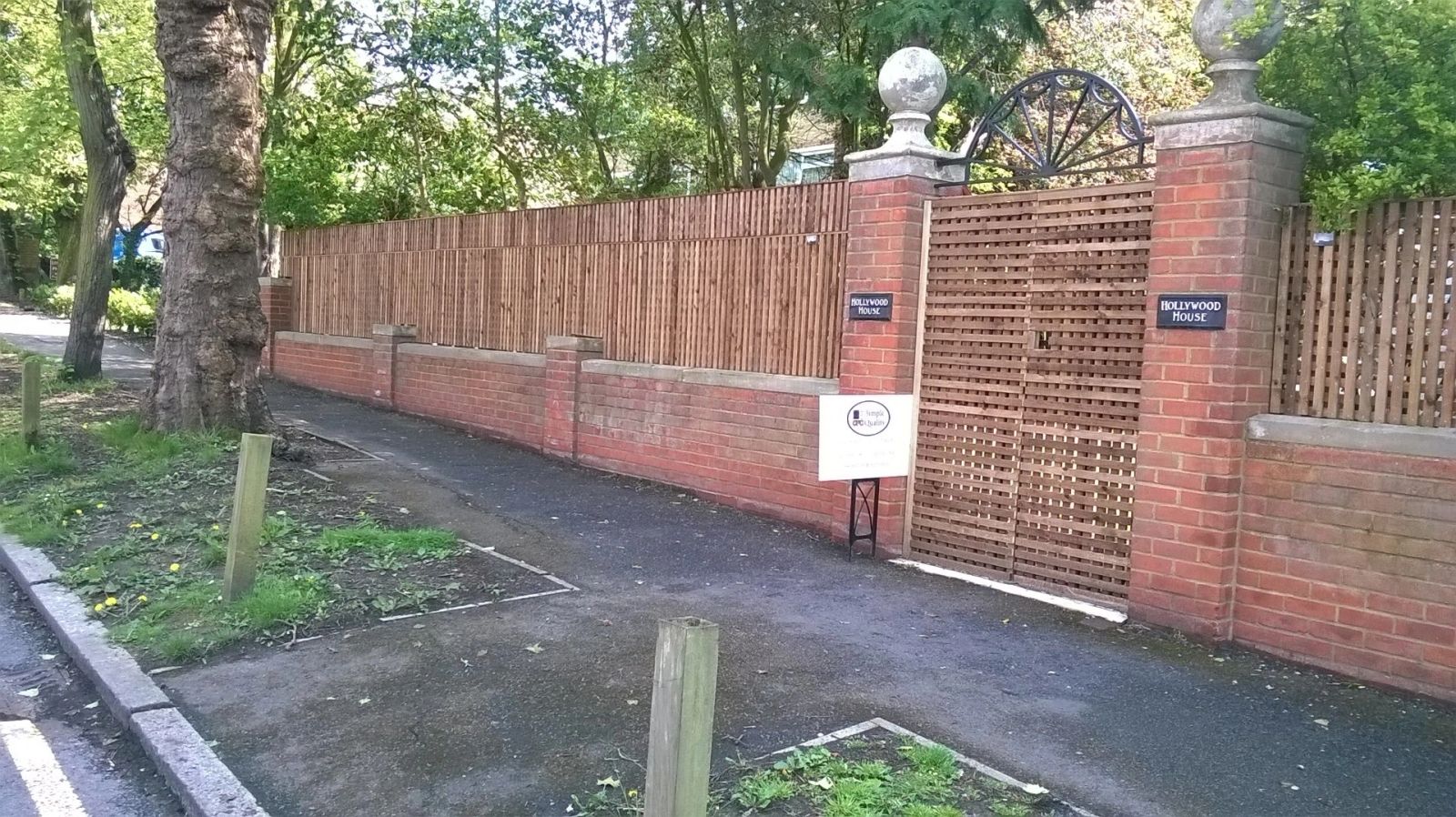
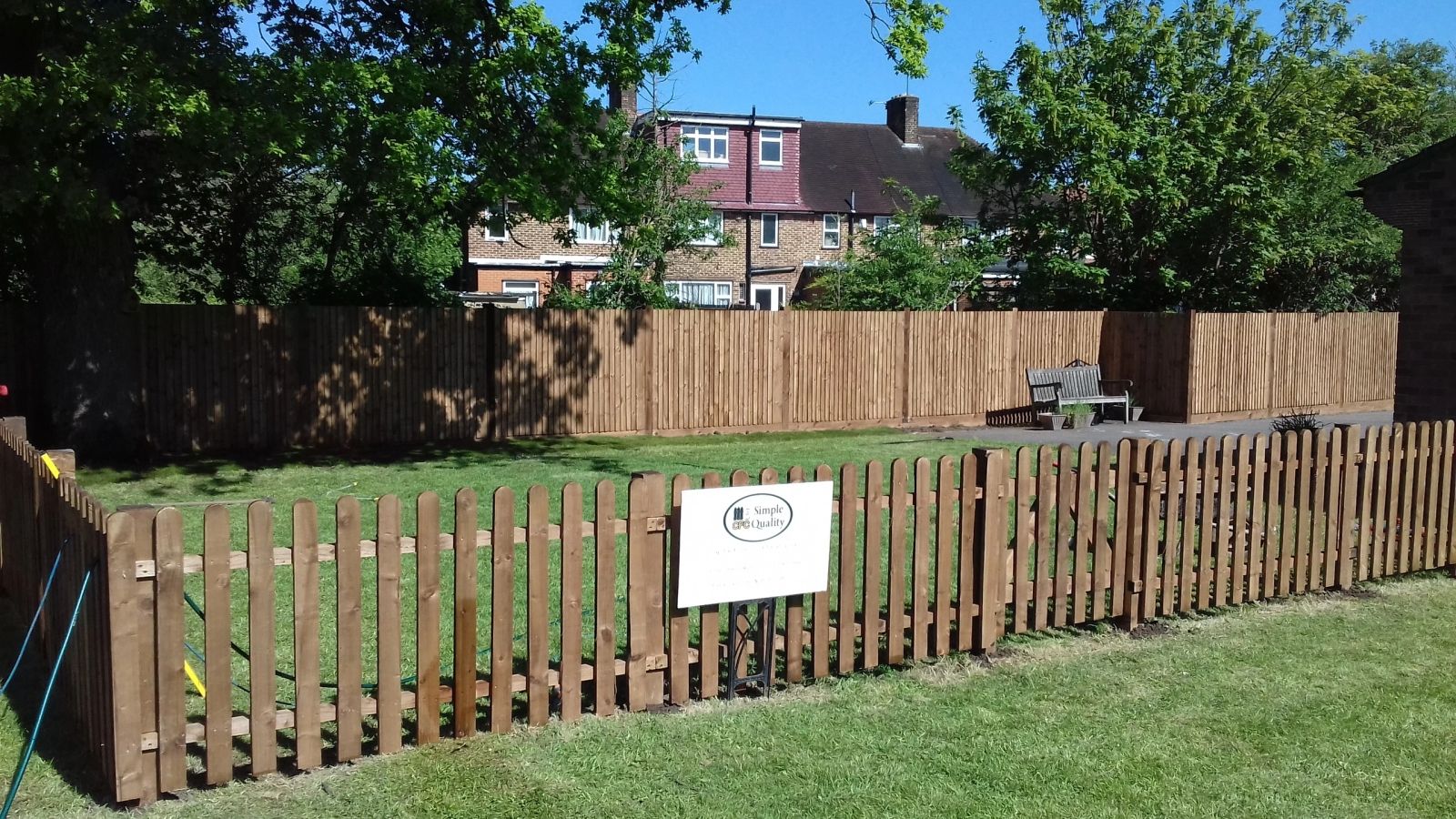
Closeboard fencing is built from overlapping feather-edge boards nailed vertically to horizontal arris rails, each board tapered so the thick edge overlaps the thin edge of its neighbour and sheds water outward.
That overlap is what gives closeboard its strength and privacy compared with a pre-made panel — there's no single failure point, so a split board can be replaced individually without dismantling the run.
The trade-off is labour: it's built on site board by board rather than lifted into place, so it costs more in time than a lap panel of the same length.
Temporary hoarding during other building work
Where fencing or gate work runs alongside a wider building project — an extension, a loft conversion with scaffolding, or a full renovation — a temporary hoarding or site fence often needs to go up before the permanent boundary work can start.
Temporary fencing adjoining a public footpath or road has its own public safety considerations, including visibility for pedestrians and vehicles passing the site.
Sequencing matters here — installing the final boundary fence before other trades have finished moving materials through that access point often means damage that has to be repaired before the job can be signed off.
Cranked arm angle for wire toppings
A cranked topping arm angled outward at roughly 45 degrees forces a climber to overcome gravity as well as grip when reaching over the top, which is significantly harder to defeat than a vertical extension of the same height.
Angling the arm inward is sometimes specified instead where the security concern is people leaving a site rather than entering it, such as around a compound holding valuable scrap awaiting collection.
Slatted panels and gap sizing
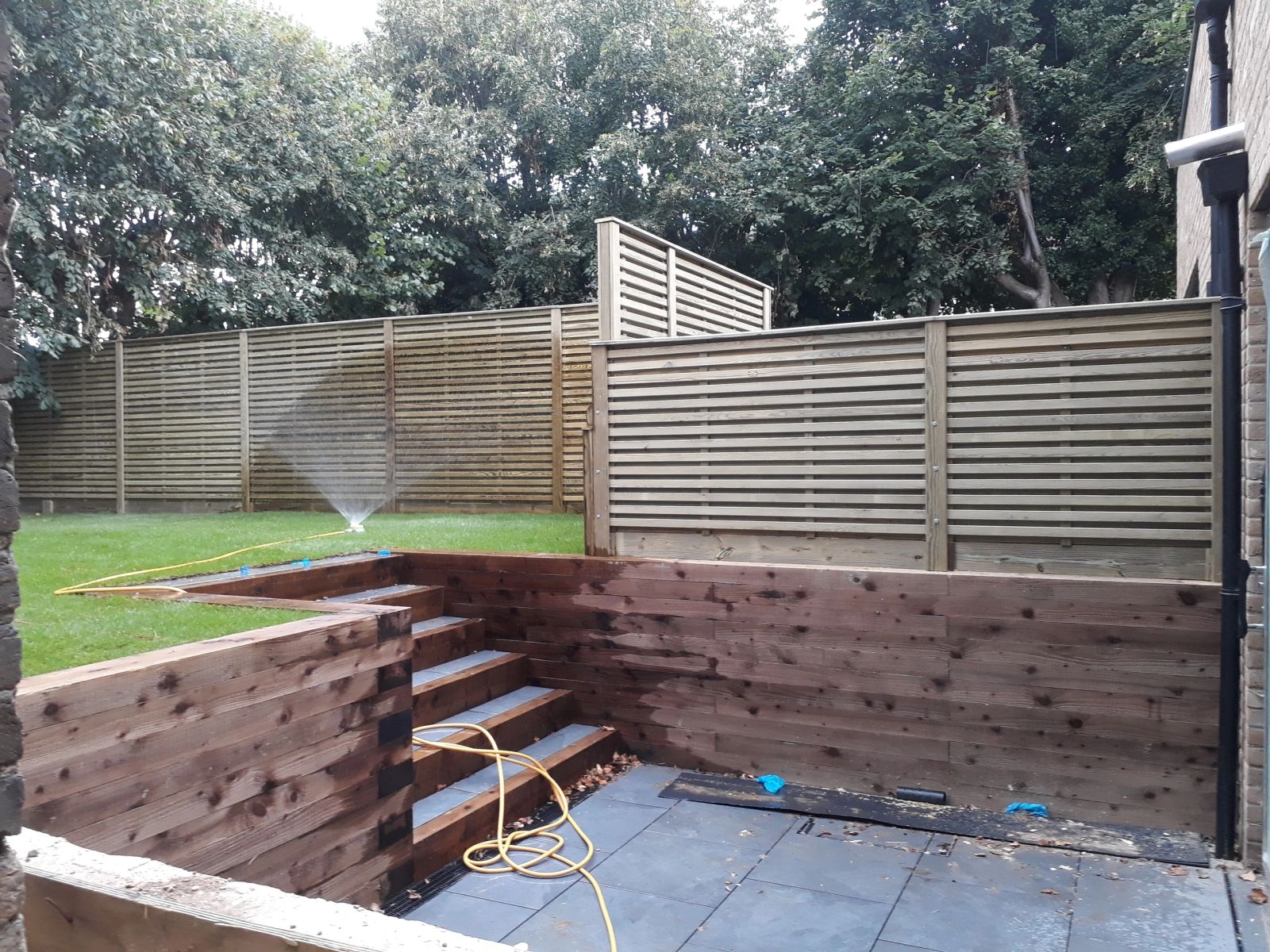
Contemporary slatted panels use horizontal or vertical timber or composite boards with a deliberate gap between them, typically anywhere from a few millimetres up to 20mm or more depending on the level of privacy wanted.
A narrow gap reads as near-solid from a normal viewing distance while still admitting light and airflow; a wider gap gives more of a screening effect than true privacy and lets more wind through, which matters on exposed plots.
Gap sizing is set at design stage rather than adjusted on site, since it affects how many boards and how much fixing timber the run needs, and inconsistent gaps are one of the most visible signs of a poorly set-out job.
RAL colours and UV fade
RAL is a standardised colour matching system widely used for powder coating and factory paint finishes on metal fencing and gates, allowing a specific shade to be reordered consistently years apart.
Darker RAL shades, particularly reds and some greens, tend to fade faster under UV exposure than blacks and greys, since the pigments used to achieve those colours are often less UV-stable.
South-facing runs in direct sun for most of the day will fade noticeably faster than a shaded run of the same colour and coating, which is worth factoring in in when matching an extension to existing fencing.