Chalk ground in south Hertfordshire
South Hertfordshire sits over Chiltern chalk in places, ground that's generally stable and free-draining but can be extremely hard and slow to auger once you're through a thin topsoil layer.
Chalk doesn't shrink and swell the way clay does, so posts set in it are less prone to seasonal loosening, though a shattered or fractured chalk band can still leave voids that need packing rather than assuming solid bearing.
Where chalk is close to the surface, hand tools or a breaker attachment are sometimes quicker than persisting with a standard auger.
Timber sourcing and certification schemes
FSC and PEFC certification track timber back through the supply chain to a managed, legally-harvested source, and UK public sector specifications increasingly require one or the other for any structural or landscaping timber.
For a domestic fence this isn't a legal requirement, but certified stock gives a paper trail on sourcing that some clients specifically ask for, particularly on larger commercial or estate contracts where corporate sustainability policy applies.
Certification is about the chain of custody rather than the treatment or grade of the wood, so it sits alongside, not instead of, checking the timber is correctly treated for its intended use class.
Snagging and sign-off walk-round
A finished fence should be walked end to end with the client before sign-off, checking posts are plumb, panels are level and gates open and close cleanly through their full swing without binding on the ground.
Gaps under gravel boards, exposed fixings, and any concrete splashed onto adjoining paving or planting during the install are the kind of small snags worth catching at walk-round rather than left for the client to notice weeks later.
Where any item is flagged, agreeing a specific date for it to be resolved — rather than a vague 'we'll come back' — is what actually gets snagging closed out.
Stainless fixings in exposed positions
Stainless steel fixings resist corrosion better than galvanised equivalents and don't leave the dark rust streaks that a failing galvanised screw head can bleed into pale or oiled timber.
They're specified more selectively than as a blanket upgrade, typically on coastal or otherwise highly exposed sites, on hardwood where tannins react badly with ordinary galvanised steel, or on visible ironmongery where staining would be obvious.
Grade matters even within stainless — 304 is adequate for most exposed domestic fencing work, while a genuinely coastal or salt-exposed site is better served by the more corrosion-resistant 316 grade.
Strimmer damage at the fence-to-lawn edge
Repeated strimming right up against the base of gravel boards or post bases scars the timber surface and removes any protective coating exactly at the point most exposed to ground moisture.
A mowing strip of paving or gravel along the base of the fence line removes the need to strim that close, protecting both the timber finish and the lawn edge itself.
This is a small design addition worth suggesting on new installs, since the damage it prevents is otherwise mistaken for premature timber failure rather than a maintenance habit.
Matching a discontinued panel style
Panel profiles and slat widths change between manufacturers and over time, so a boundary installed a decade or more ago may use a profile that's no longer produced.
Where an exact match isn't available, the closest equivalent height and style is used and the mismatch is pointed out honestly rather than presented as an exact replacement.
Party fence wall versus an ordinary boundary fence
A 'party fence wall' has a specific meaning under the Party Wall etc. Act 1996 — a structure that stands astride the boundary line, jointly used by both properties, which is distinct from a garden fence panel that simply happens to mark a boundary.
Most timber panel fencing sits on one owner's land and isn't a party structure in that legal sense, even where it visually marks the boundary line.
Genuine party wall situations are more likely with masonry garden walls straddling the line, and those can bring the Act's notice procedures into play, which is worth checking before work starts.
Gust funnelling between semi-detached gaps
The narrow gap between two semi-detached or terraced houses can accelerate wind passing through it, in the same way air speeds up through a nozzle, so a fence sitting at the mouth of that gap sees higher gusts than the open garden either side.
This is easy to miss on a site visit if the wind isn't blowing that day, but it shows up over a few winters as one particular bay of panelling failing repeatedly while the rest of the run stays sound.
Reinforcing just that section with a heavier post or a part-slatted panel is usually enough, rather than upgrading the whole run.
Spirit level versus laser level for checking a run
A spirit level checks a single post is plumb and a single panel is level, but confirming that an entire run stays level or follows a consistent fall over 20 or 30 metres is far quicker and more reliable with a rotating laser level set at a fixed height.
On a stepped run, a laser also makes it straightforward to confirm each step drops by the same consistent amount rather than checking each post in isolation and hoping the cumulative effect looks even.
A basic spirit level remains the more practical tool for quick checks during a single post's installation, since setting up a laser for every individual post would slow the job without adding useful accuracy at that scale.
Dealing with buried debris uncovered while digging out a repair footing
Old post stubs, broken glass, hardcore or builder's rubble from a previous era of the garden's use sometimes turn up when digging out a footing for repair, particularly on older plots that have been through several changes of use.
Where this happens, it's worth clearing enough of the obstruction to get a clean footing rather than working around it, and flagging anything unexpected — old drainage, buried cabling, unusually large rubble — to the client before continuing.
Outbuildings casting permanent shade onto a fence run
A shed, greenhouse or garage built close to a boundary casts a fixed shadow over part of the adjoining fence run for some or all of the day, creating the same slower-drying conditions as a north-facing aspect regardless of the fence's actual orientation.
This localised shading is easy to overlook when assessing a whole boundary's exposure, since the rest of the run a few metres away may be in full sun.
It's worth treating the shaded section as its own microclimate for treatment and inspection purposes rather than assuming uniform conditions along the full length.
Arris rails and rail counts by height
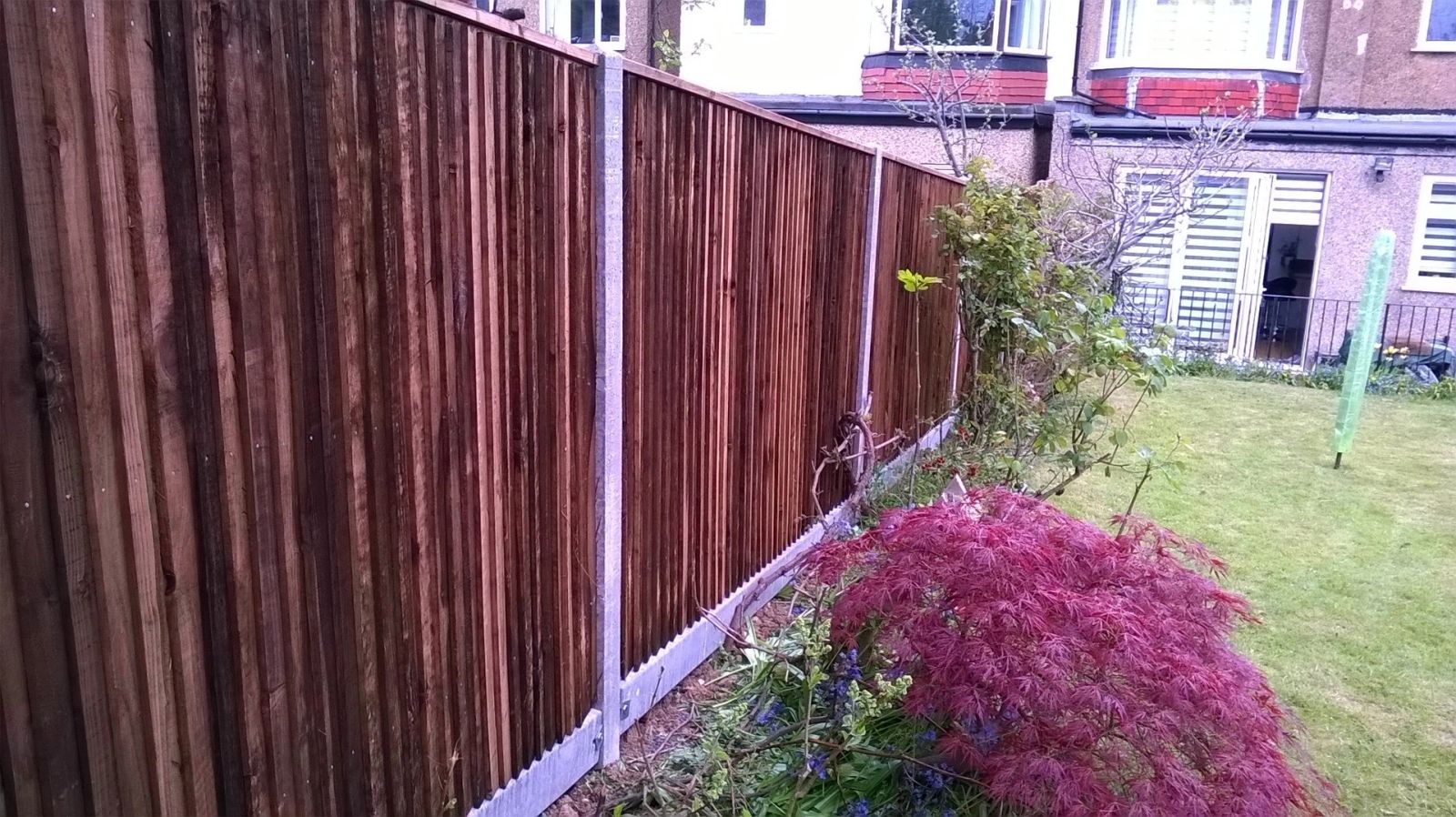
Arris rails are the triangular-section horizontal timbers that run between posts and carry the vertical boards in a closeboard fence, and how many are used per bay is set by the finished height rather than fixed at two everywhere.
A fence up to around 1.2m typically runs on two rails, but anything taller — particularly 1.8m closeboard — needs a third rail roughly at mid-height to stop the boards bowing outward under wind pressure.
Morticing the rail ends into the post rather than merely nailing them on gives a stiffer, longer-lived joint, which matters more as the number of rails and the height of the fence both increase.
Gaps at party walls and stepped brickwork
Where a fence meets a party wall or a stepped brick boundary, an ill-fitting junction leaves a gap that undoes the security of the whole run, so infill panels or a scribed timber closer are cut to follow the step rather than left square.
On an older terrace the brickwork step is rarely uniform along its length, so each junction is measured on site instead of assuming a standard offset.
Letterbox and parcel provision in a secure gate
A fully secured pedestrian gate can leave deliveries with nowhere to leave post or parcels, so a secure gate-mounted letterbox or a parcel box positioned outside the locked line is worth planning at design stage.
Positioning it so it can be reached without opening the gate keeps the boundary genuinely closed while still allowing routine deliveries.
Rights of way and access easements
An easement giving a neighbour or utility a right of way across part of a garden — commonly a rear access strip or shared side passage — survives a change of ownership and restricts what can be built across it, including fences and gates.
A gate across an easement is sometimes acceptable if it's left unlocked or a key is provided to the dominant owner, but a solid fence that blocks the route entirely is a breach even if the current beneficiary rarely uses it.
The Land Registry title register will usually record a formal easement, so it's worth checking before fencing off any access strip that looks unused, since 'unused' and 'extinguished' are legally different things.
Aligning capping rail over a stepped run
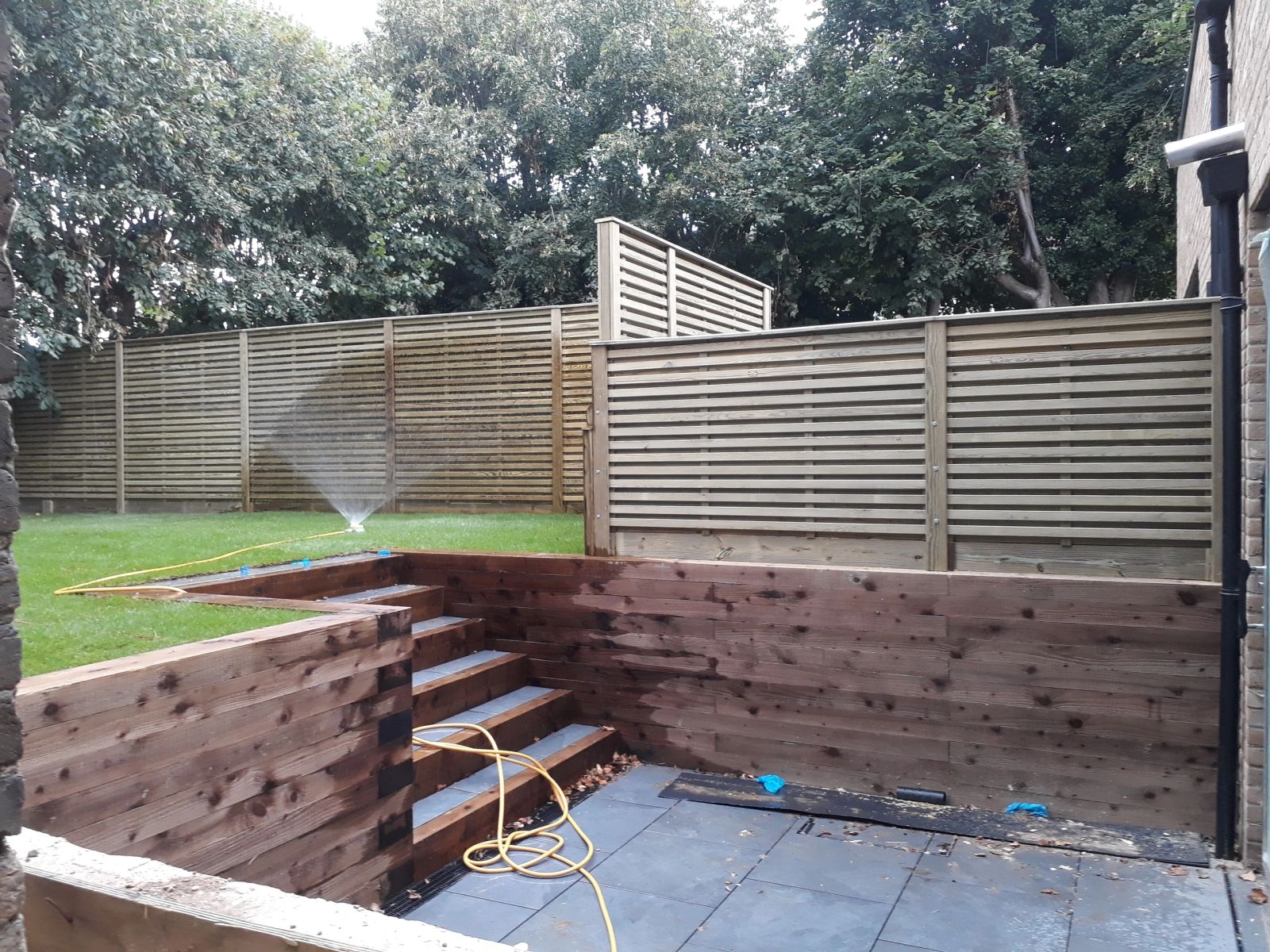
Capping rail fitted along the top of a level fence run is a straightforward continuous fix, but on a stepped run each panel sits at its own level, so the capping has to be cut and joined at each step rather than run through in one length.
A clean joint at the step usually means mitring or scarfing the capping ends rather than butting them square, since a square joint leaves an open gap where the two levels meet.
Where the steps are shallow, some fitters run the capping level in short horizontal sections with a visible small drop at each post, which is faster to fit but reads as more obviously stepped than a mitred joint.
Hinge screw pull-out and through-bolting
Screws pulling out of a timber hinge post is one of the most common gate faults, usually caused by repeated leverage working the fixing loose in the grain over time rather than a single overload event.
Through-bolting the hinge with a coach bolt and washer plate on the far side of the post gives a mechanical fixing that doesn't rely on the timber's grip the way a screw does.
Welded joint failure on metal gates
A cracked or failed weld at a metal gate's frame corner is usually a fatigue failure from repeated flexing rather than a one-off impact, particularly on a gate that's been slightly out of square for some time before the weld gave way.
Re-welding without first correcting the underlying rack or misalignment tends to fail again at the same point.
When deeds don't say who owns a boundary
It's common for older title deeds to be entirely silent on which side owns a given boundary, especially on properties built before detailed conveyancing plans became standard practice.
In that situation there's no single automatic rule that applies in every case, and long-standing practical evidence — who has always maintained the fence, existing physical features — can carry real weight.
Where ownership genuinely isn't clear, we'd always suggest raising it with the neighbour and, if needed, a conveyancing solicitor, rather than assuming a default answer.
Highways not yet adopted on newer estates
On newer housing estates, roads and footways can remain unadopted by the council for a period after construction, sometimes maintained instead under a bond by the developer.
This can affect whether the 1m road-facing fence height limit strictly applies yet in the same way, since the technical definition of a highway used by vehicles depends partly on adoption status.
Checking with the council whether a specific new estate's roads have been formally adopted is worth doing before assuming which height limit applies to a road-facing boundary.
Matching gate infill to the adjoining fence
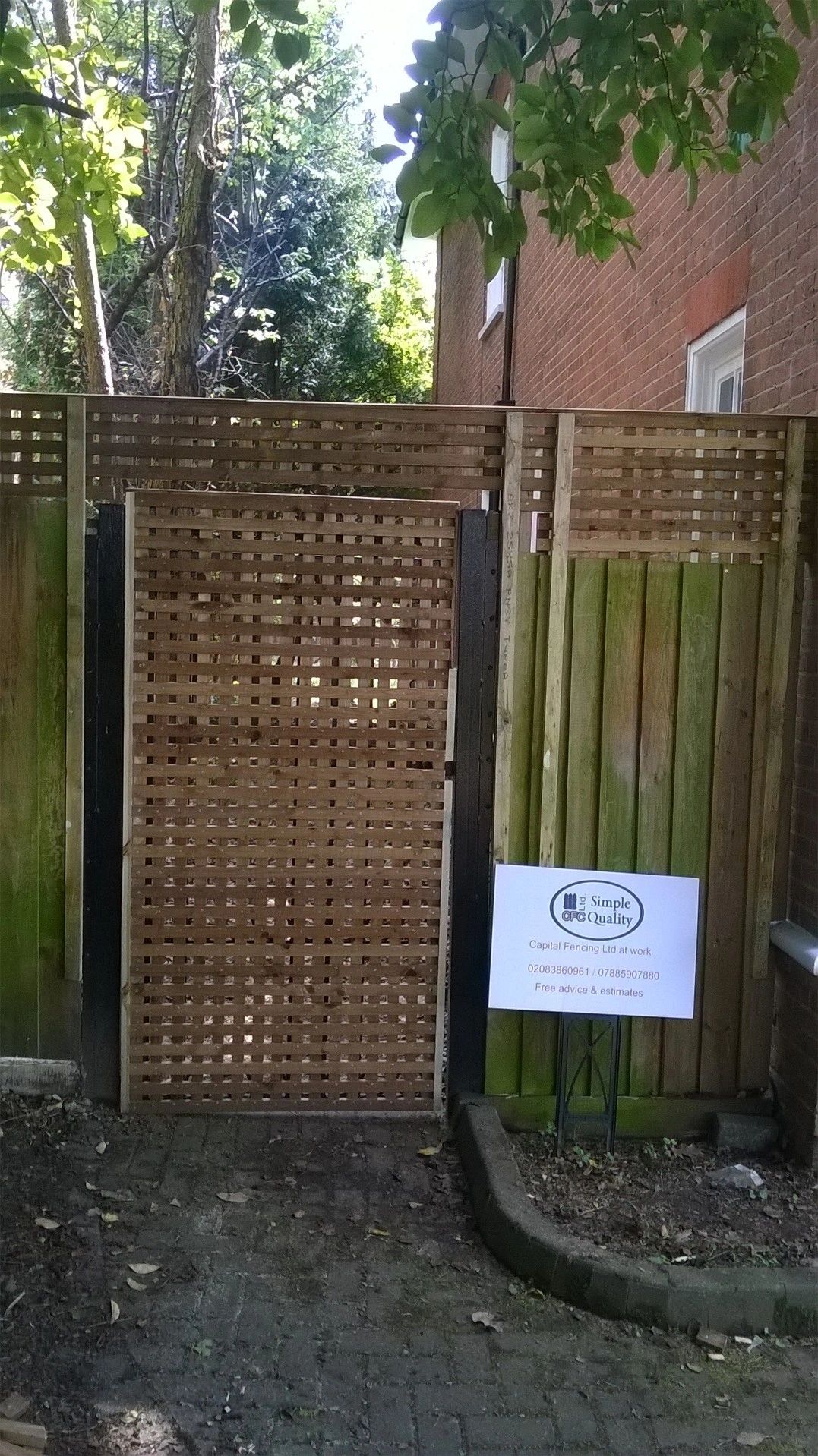
A gate with a different infill pattern to the fence either side is a visible weak point as well as an inconsistency, because an intruder targets the section that looks different from the rest of the run.
Matching pale spacing, mesh aperture or panel style across the gate and fence keeps the whole perimeter to one standard rather than leaving the gate as the obvious soft spot.
Hit-and-miss fencing for windy plots
Hit-and-miss fencing alternates boards on either side of the rails so each gap on one face is covered by a board on the other, giving privacy from both sides while leaving narrow gaps through the panel itself.
Those gaps let a proportion of wind pass through rather than loading the whole panel face, which is why it's a common recommendation on exposed boundaries where a solid closeboard run would need heavier posts and shorter bays.
It uses more timber than a single-skin boarded fence for the same run length, so it's priced accordingly, but the reduced wind load can offset that in post and repair costs over time.