
Comparisons
Estate Fencing vs Post and Rail: Which Suits Your Boundary?
Last updated
The short answer
Estate fencing uses slim steel rails with a protective finish, while post and rail uses timber for a warmer, traditional enclosure. Both preserve views and can be built on slopes. Choose from the animals, impact risk, maintenance and appearance involved; either needs suitable mesh to contain many dogs or smaller animals.
At a glance
- Estate fencing
- Slim steel rails with a protected finish
- Post and rail
- Traditional timber with local repair options
- Shared benefit
- An open boundary that preserves views
- For dogs
- Usually add properly designed mesh
Estate fencing uses steel horizontal rails for a slim, durable open boundary; post and rail uses timber for a warmer, more traditional enclosure.
Both systems mark a boundary without building a visual wall. They suit larger gardens, paddock edges and places where a solid panel fence would hide the view or take too much wind. From a distance they can appear to do the same job.
Up close, their construction, upkeep and the way they handle animals are quite different. This guide compares them by use rather than by a universal winner, so the boundary can be chosen for what it actually needs to do.
How each fence is constructed
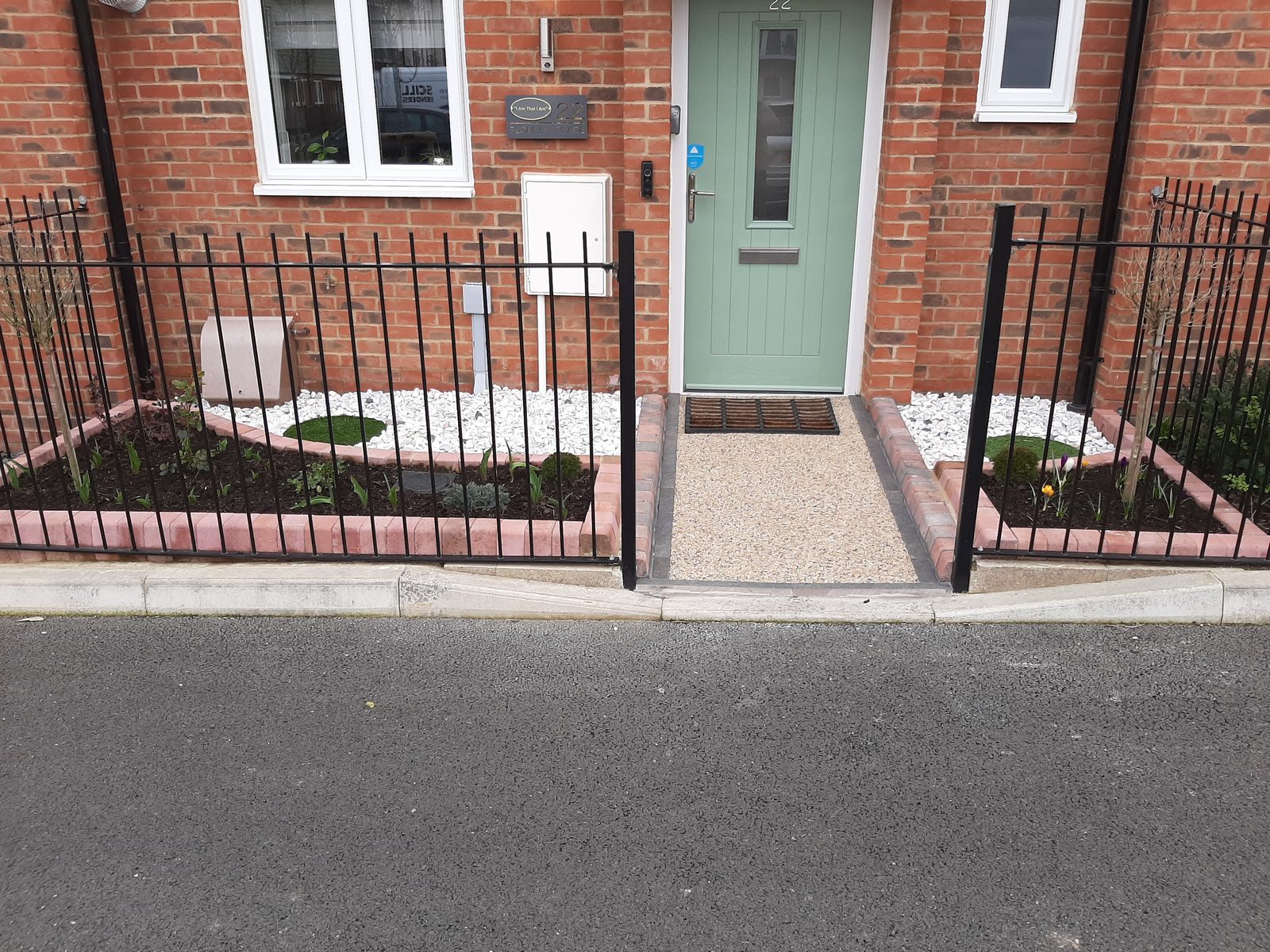
Estate fencing is a steel arrangement of horizontal rails carried on upright posts, fabricated to follow the run. Its slim sections keep the boundary visually light. The steel is normally galvanised and powder coated to protect it outdoors and provide the finished colour.
Post and rail uses upright timber posts with two or more horizontal timber rails fixed between or across them. Sawn rails give a regular appearance, while cleft timber has a more rustic character. The posts and rails are individually repairable.
The view and character of the property
Steel estate rail has a formal, restrained look that works well across long open frontages and parkland style settings. Because the uprights can be relatively slender, the fence recedes into the view rather than becoming the main feature.
Timber post and rail feels more rural and tactile. It sits comfortably beside orchards, paddocks and traditional garden planting. The rails are visually thicker, so the fence has a stronger horizontal presence even though the gaps remain open.
Containing horses and larger animals
The number and position of rails, the strength of the posts and the animal using the enclosure all matter more than the material label. A boundary that merely looks like a paddock fence is not automatically a suitable equine specification.
Discuss the animals, their behaviour and any adjoining public route before choosing. Infill mesh may be needed for smaller animals, and gates must be planned as part of the enclosure rather than treated as a convenient gap afterwards.
Dogs and smaller animals
Neither an open estate fence nor a basic two or three rail timber fence will reliably contain a dog. The spaces are simply too generous for many animals. Mesh can be added to suitable systems, with the bottom edge detailed to reduce digging and squeezing underneath.
The mesh changes both the look and wind behaviour of the fence. Its height, opening size and fixing need to suit the animal and the structure, rather than being attached loosely as an afterthought.
Weather, rot and maintenance
Steel does not rot, but cut edges, welds and damaged coating need appropriate protection. A galvanised and powder coated finish avoids the routine repainting associated with bare steel. Occasional inspection still matters at fixings and places that receive impacts.
Timber can be repaired with ordinary carpentry, but posts remain vulnerable at ground level and rails can weather where water collects. Ground contact treatment, protected cut ends and vegetation control are central to keeping it sound.
Slopes, curves and long runs
Both systems can be designed for changing ground. Steel bays can be fabricated to step or rake according to the setting, while timber rails can be cut and arranged around variations on site. Curves are generally resolved as a sequence of straight sections rather than pretending a rigid rail bends freely.
Long runs place extra importance on post positions, corners and gates. These are the structural points that keep the fence aligned, so they deserve as much attention as the rail style itself.
Impact, repair and replacement
A vehicle or falling branch affects the two systems differently. Timber may snap locally, allowing a post or rail to be changed without replacing a complete bay. Steel may bend or damage a fabricated section, requiring repair or remaking of that part.
The right choice can therefore reflect what is likely to hit the fence. A quiet field edge and the border of a busy drive place very different demands on apparently similar open boundaries.
Choosing for your own land
Begin with the animals or people the fence must manage, then consider the view and upkeep. Photographs along the entire boundary, including corners, gates and changes in level, allow both options to be assessed realistically.
We can prepare a written estimate for the appropriate system with posts, rails, any mesh and gates clearly listed. There is no need to make the whole property match: a more private fence can be used elsewhere while the open boundary stays light.
Want an open boundary without guessing?
Tell us what the fence must contain and show us the ground. We can compare steel and timber in one clear written specification.
Frequently asked
Is estate fencing stronger than post and rail?
Strength depends on the actual steel or timber sections, post spacing, bases and use. Neither name alone specifies a suitable strength for animals, vehicles or public access.
Which needs less maintenance?
Properly galvanised and powder coated steel avoids timber rot and routine surface treatment. Timber offers straightforward local repairs but needs attention to ground contact, weathering and vegetation.
Can mesh be added to either fence?
Yes, where the system is designed or adapted to carry it properly. Mesh is often needed for dogs and smaller animals because the open rails alone do not contain them.
Do both work on sloping ground?
Yes. Steel bays can be stepped or raked, and timber rails can be set out to follow variations. The best treatment depends on the gradient and desired appearance.