
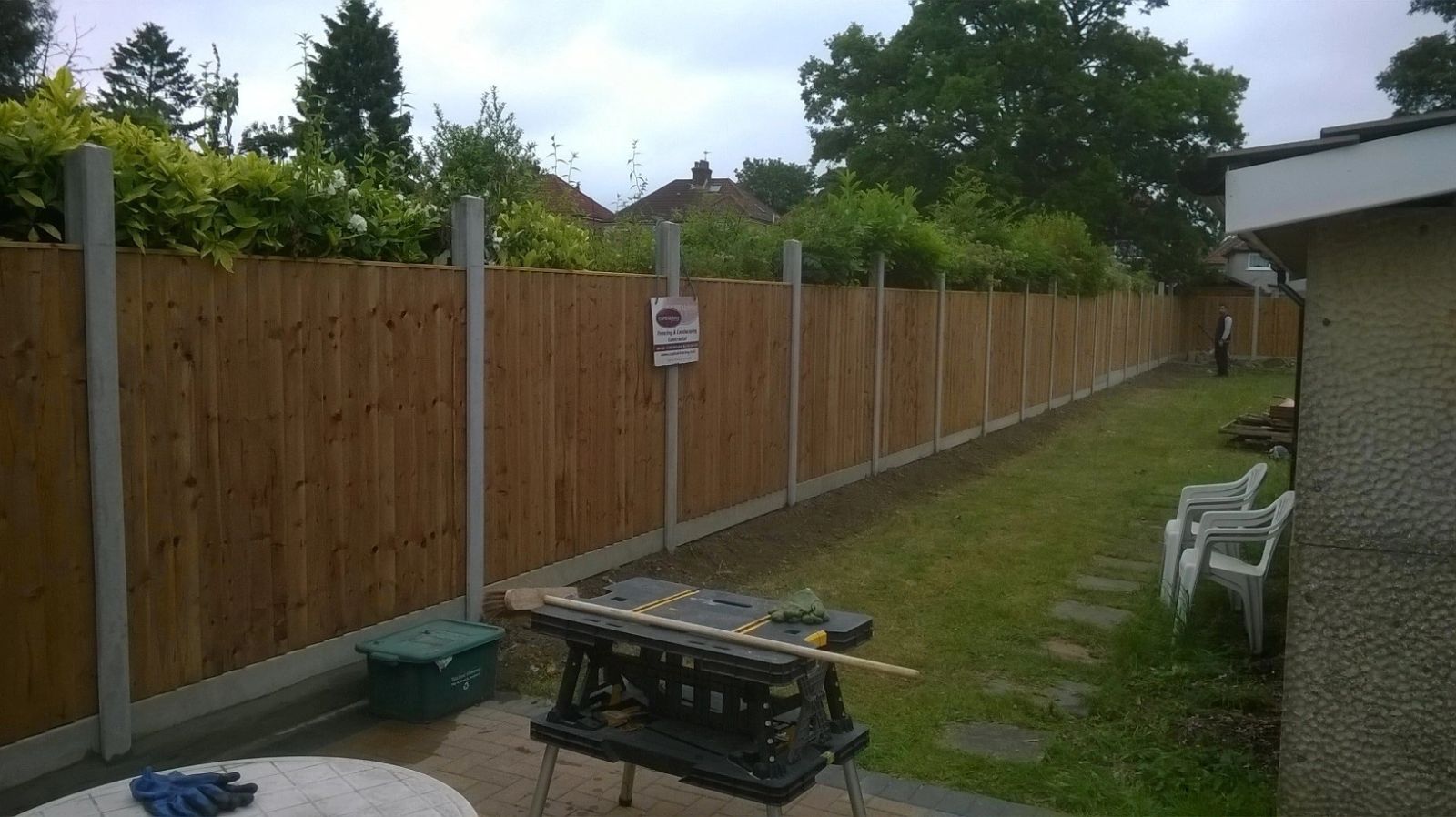
Panel fencing is the quickest way to put up a good-looking boundary, and the easiest to maintain because a damaged panel can be swapped out on its own. What decides how long it lasts is not the panel itself but what holds it: the posts, the gravel boards and how the run has been set out.
We supply and fit fence panels as a complete job. We do not sell panels on their own for self-fitting.
Panel types we fit
Standard panels are 1.83m wide. Heights run from low front garden panels up to around 1.8m, and trellis can be added on top where rules and neighbours allow.
- Lap panels: overlapping boards, the classic good value garden fence
- Closeboard panels: vertical feather-edge boards on rails, stronger and more private
- Decorative panels: trellis-top, arched and slatted styles
- Bespoke panels made up for a feature wall or an awkward bay
Cut to size at the end of the run
Almost no garden boundary is an exact number of panels long. Rather than leave a gap or force a panel in, the last bay is cut down and re-framed so it sits cleanly between its posts. On slopes the panels are stepped so each one stays level, with the gravel board taking up the fall below.
Concrete posts and gravel boards
We set panels into slotted concrete posts, concreted into the ground, with concrete gravel boards along the bottom. That keeps the timber off wet soil, which is where panels rot first, and it means a panel blown out in a storm usually slides back in rather than taking the post with it. Timber posts are available where you prefer the look, typically 100 by 100.
What the job includes
- Free site visit and written quote
- Old fence and posts removed and taken away
- Posts set in concrete, gravel boards fitted
- Pressure treated panels, fitted and checked for line and level
- Payment by card, bank transfer or cash
Replacing one or two panels
If only a panel or two has gone and the posts are sound, we can replace just those. If the posts are rotten or leaning, replacing panels alone will not last, and we will tell you that on the visit.