Aftercare once the fence is up
After installation we walk the finished line with the client, checking every gate closes and locks properly and that no section has been left with a gap at post or ground level, since that's exactly where a security spec fails first if it fails at all.
Any snag identified at that walk-round is fixed before the job is signed off, not left for a return visit.
Moss and damp on shaded boundaries
A boundary shaded for most of the day by a building, high hedge or overhanging trees dries far more slowly after rain than an open, sunlit run, and that prolonged dampness is what allows moss and algae to establish on timber.
Beyond the cosmetic green staining, sustained damp accelerates fungal decay in untreated or lightly treated softwood, shortening its service life compared with an identical fence in a sunnier position.
Species and treatment choice matter more on these boundaries — a naturally durable timber or a heavier preservative treatment earns its cost back in reduced maintenance on a permanently shaded run.
Spectator segregation fencing at a sports ground boundary
Beyond the outer perimeter, many sports grounds use internal segregation fencing to separate spectator areas, and this internal fencing is usually a different specification to the outer boundary, prioritising crowd safety and sightlines over anti-intrusion detailing.
Any internal fencing used for crowd control needs to allow rapid emergency evacuation, so gate positions and opening widths are checked against relevant safety guidance rather than set purely by the site's security brief.
Working over a neighbour's flowerbed
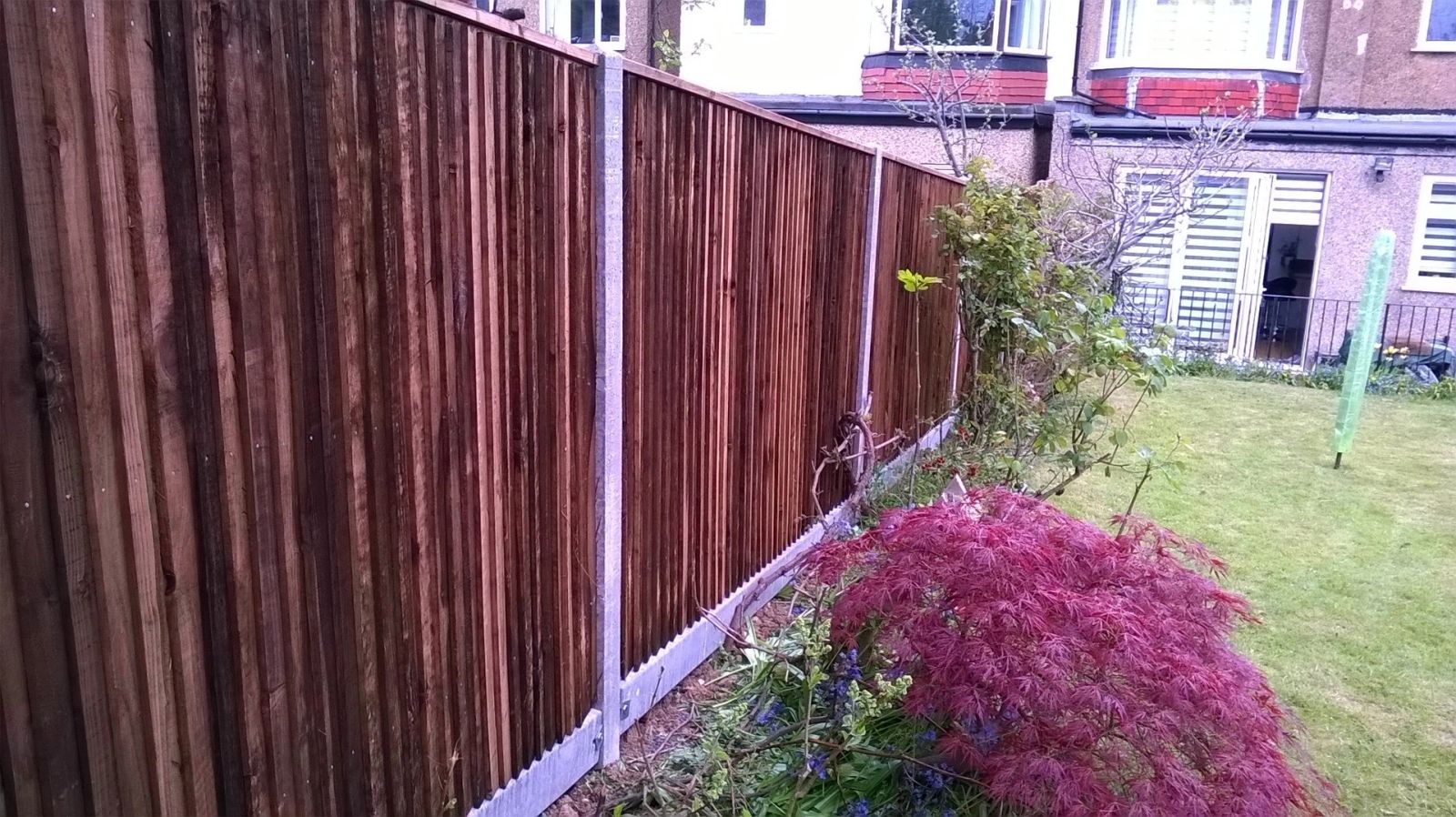
Repairing a shared boundary sometimes means working from the neighbour's side, particularly where the fence faces that way or access from the owner's side is blocked, and that access should be agreed with the neighbour before work starts.
Protecting planting beds and lawn on the working side during the repair avoids turning a fence job into a wider dispute over incidental damage.
Self-closing pedestrian gates
A self-closing hinge or spring closer on a pedestrian gate stops it being left open by accident, which matters on a boundary where the fence is only as secure as the gate that's routinely used.
On a school, nursery or pool boundary a self-closing, self-latching gate is often a specific requirement rather than an optional extra, and the closer needs enough force to shut fully without slamming.
Mews and courtyard properties
Mews and courtyard developments typically share a single vehicle access route and sometimes a communal boundary treatment around the whole courtyard rather than individual garden fences.
Because the courtyard is often cobbled or block-paved right up to the building line, there's frequently no soil to dig a conventional post hole into, and fixings need to go into a paved base plate or bolted shoe instead of a concreted post.
Any alteration to a shared courtyard boundary usually needs the agreement of the other mews owners, since the fence is commonly held in joint ownership rather than allocated to one property.
Relocating a builders' compound fence as a project phases
A builders' compound fence is often installed in stages as a construction project progresses, with the secure line moving inward as completed areas are handed over and outward again if the site boundary expands into an adjoining phase.
Because compound fencing is frequently relocated, panel systems with reusable feet or block-based supports are generally favoured over concreted posts, even though a concreted post gives a more permanent fixing where the boundary line is fixed for the whole project.
Repositioning a post slightly off its original line
Where an original post position has proven to be a recurring failure point — sitting in a wet hollow, or close to a tree root that keeps disturbing it — repositioning it a short distance along the run can solve a problem that repeated resets in the same spot haven't.
This needs agreement on the boundary line first if the shift is more than a token amount, since moving a post changes where the fence physically sits relative to the boundary rather than just repairing it in place.
Wheeling barrows over lawn without lasting damage
Repeated barrow runs over the same strip of lawn compact the soil and flatten the grass, and on wet ground a laden barrow can rut the turf enough that it doesn't recover without reseeding.
Laying scaffold boards or trackway matting along the barrow route spreads the load and protects the same strip from repeated single-wheel pressure, which is worth doing on any job running more than a day or two.
Choosing a slightly longer but firmer route — along a path rather than across open lawn — often does less lasting damage than the shortest direct line, even though it takes a little longer per trip.
Concreted posts against bolted baseplates for a semi-permanent compound
A concreted post gives a stronger, more permanent fixing appropriate to a fence expected to stay in place indefinitely, but it's disruptive and costly to remove if the boundary line needs to move later, such as when a leased yard's layout changes.
A bolted baseplate fixed to an existing hardstanding trades some ultimate strength for the ability to relocate or remove the fence relatively cleanly, which suits a semi-permanent compound on a leased site better than a fully concreted installation.
Fox digging beneath chicken runs and fence lines
Foxes are capable diggers and will exploit any soft ground at the base of a fence or run, particularly around poultry enclosures, so a below-ground barrier matters as much as the fence height itself.
An L-shaped buried apron of mesh, turned outward from the base of the fence rather than straight down, stops digging by making the animal hit an obstruction before it reaches the fence line itself, which is more reliable than depth alone.
This detail is worth specifying separately from the fence quote for anyone keeping poultry or small livestock, since standard fence installation doesn't normally include a buried predator barrier.
Protecting a shared alley during material delivery
A shared rear alley used by several households for bin access can't be blocked completely for a full day without agreement, so materials are often moved through in stages between other residents' access needs rather than left stacked across the full width.
Trailing cables, tools and offcuts left in a shared passage are a trip hazard for neighbours as well as the crew, so keeping the alley clear at the end of each working day matters even if the job isn't finished.
Any damage to the alley surface itself — cracked paving, a scraped wall corner from a wide panel — is worth flagging to the client immediately, since a shared area often has joint liability that's harder to unpick after the event.
Play-safe detailing near a boundary
Where a fence runs alongside a play area, sharp pale tops, low horizontal rails that invite climbing, and gaps that could trap a limb are all avoided in favour of rounded caps and rail spacing that doesn't create a ladder.
This detailing sits alongside, rather than instead of, the security spec — a boundary can still be climb-resistant and impact-rated while removing the specific hazards that matter next to children.
Boundary fencing for HMOs and multi-occupancy buildings
Houses in multiple occupation often have higher footfall through shared external areas than a single-family home, which points toward more durable gate hardware and fencing specified for frequent use rather than the lighter fittings suited to a quiet family garden.
Bin and cycle storage for several households sharing one plot needs more space and more robust screening than a single-household equivalent, and is worth planning at the same time as any boundary work.
Landlords managing several such properties often prefer a single consistent spec across their portfolio, both for cost predictability and so that future repairs use readily available standard parts.
Widening an existing gate opening
Widening a driveway opening to take a larger vehicle usually means moving or replacing both hanging and slamming posts, not just fitting a wider gate to the existing gap, since the posts themselves define the usable width.
Ground and drainage either side of the widened opening are checked at the same time, since regrading the entrance often follows a widening job.
Repair-versus-replace decision based on how many posts have failed
Where only one or two posts in a run have failed, individual repair is usually the more sensible option, but once roughly a third or more of the posts along a run show the same rot or movement, a full run replacement often ends up more reliable and no more disruptive.
Counting failed posts as a proportion of the run, rather than judging each one in isolation, gives a clearer basis for that decision than reacting to whichever post has failed most recently.
Post-support metal spikes and why they loosen
A drive-in metal spike relies entirely on ground compaction around the socket for stability, so any repeated wind loading or ground softening after heavy rain gradually works the socket wider and the post starts to rock.
Once a spike has loosened it rarely re-tightens on its own; the usual fix is a larger spike bedded in fresh concrete or a switch to a concreted timber post if the ground repeatedly won't hold a spike.
Terraced housing and rear access
Victorian and Edwardian terraces were rarely built with side access, which means materials for a rear garden fence often have to go through the house, over a shared side return, or down a narrow rear alley shared with several other properties.
That access constraint changes the practical choice of materials — full concrete gravel boards and long panels are harder to move through a narrow hallway than shorter timber sections carried in and built up on site.
It's also why timing matters on these jobs: a delivery that blocks a shared alley for half a day needs agreeing with neighbours in advance, not discovering on the morning of the job.
Gates on a shared boundary between neighbours
A gate set into a boundary shared between two properties, rather than fully on one side, benefits from a clear understanding between both parties about who maintains it and who holds keys, since disputes over a shared gate are common when this isn't agreed early.
This is separate from the physical repair work, but it's worth raising with the client where a gate clearly serves or affects an adjoining property.
Detached plots with a paddock or field edge
Detached properties backing onto a paddock, field or grazing land need a boundary that does two jobs at once — keeping the garden private and, if livestock use the adjoining land, keeping animals off the garden side.
A standard close-boarded fence isn't stock-proof on its own; where horses or cattle are present on the other side, a stock fence or post-and-rail set slightly inside the garden fence is the usual belt-and-braces approach.
Field boundaries also see more vegetation growth and root pressure from hedgerows than a typical suburban fence line, so posts often need resetting or straightening more often than an equivalent garden boundary.
Dropped kerbs and boundary gate positions
A dropped kerb is authorised for a specific width and position, and a gate or fence opening that doesn't line up with it can create a technically unauthorised vehicle crossing over the footway.
Where a driveway gate is being repositioned or widened, it's worth checking whether the dropped kerb needs to be extended or moved to match, which is a separate application to the council's highways department.
Parking a vehicle over a kerb that hasn't been properly dropped, even briefly during works, can also draw attention from the local authority in some areas.
Siberian larch as a fencing timber
Siberian larch grows slowly in a cold climate, which produces a dense, tight-grained timber with better natural durability than most fast-grown European softwoods, without needing pressure treatment in many applications.
It's noticeably harder to nail and screw without pre-drilling than typical treated pine, and a nail driven in at the wrong angle is more likely to split the board than sink cleanly.
Left unfinished it weathers to a silvery grey similar to cedar, though its higher density means it holds up somewhat better to knocks and general handling on site.