London & Hertfordshire Free Site Visit
closeboard fence run installed by Capital Fencing in Edgware (HA8)
Edgware · HA8

Dog-Proof Fencing in Edgware — Built for how the finish sits next to the neighbour's existing boundary

Capital Fencing installs dog-proof fencing across Edgware and out toward mill hill and bushey. What separates a dog-proof fencing job from a standard boundary is the detail: closeboard set into a shallow concrete kicker so a small breed can't dig underneath. That's the work, not the marketing. Roads such as Hale Lane and Whitchurch Lane are typical of the local layout. Edgware bus station is a useful local reference point. Canons Park, on the town's edge, was once part of the grounds of Canons House and retains covenants affecting some streets.

Capital Fencing installs dog-proof fencing across Edgware and out toward mill hill and bushey. What separates a dog-proof fencing job from a standard boundary is the detail: closeboard set into a shallow concrete kicker so a small breed can't dig underneath. That's the work, not the marketing. Roads such as Hale Lane and Whitchurch Lane are typical of the local layout. Edgware bus station is a useful local reference point. Canons Park, on the town's edge, was once part of the grounds of Canons House and retains covenants affecting some streets.

Default spec

How we build dog-proof fencing in Edgware

1.8m closeboard, no gaps under 40mm, 150mm concrete kicker or 300mm buried mesh apron, closing gate with drop-bolt into a socket. On Edgware jobs we adjust for side-return access on edgware semis is genuinely narrow — long panels often have to come up over the garage.

Property mix locally: 1930s semis built around the Tube extension, plus newer flats near the town centre. Typical gardens: rectangular suburban gardens, mostly flat, often with mature fruit trees. Postcodes we regularly service: HA8.

Why this spec, for dog owners

  • no gaps at ground level — the single most common escape point on standard fencing
  • hinges and drop-bolts sized so a dog leaning on the gate can't work it open
  • buried mesh apron stops digging without spoiling the finished look above ground

Where dog-proof fencing isn't the right answer

  • very small terrier breeds that can squeeze under 40mm — full mesh apron is the right answer
  • conservation frontages where a mesh apron is not permitted; a brick kicker course is the alternative

Typical dog-proof fencing briefs in Edgware

  • 1.8m solid boundary with anti-climb top so a larger breed can't jump or scramble
  • gap-free gate lines with a drop bolt and a low kicker plate to stop nose-under escapes

Dog-Proof Fencing FAQs — Edgware

Are hit-and-miss fences OK for dog gardens?

On dog-proof fencing jobs in Edgware (HA8), our default answer is: 1.8m closeboard, no gaps under 40mm, 150mm concrete kicker or 300mm buried mesh apron, closing gate with drop-bolt into a socket. The honest trade-off is leaving standard 100mm gap between gate and paving — a determined terrier is through it in a week — which is exactly what our default spec designs out.

How do I stop a dog digging under the fence?

Across Edgware we spec around side-return access on edgware semis is genuinely narrow — long panels often have to come up over the garage, so on dog-proof fencing that usually means closeboard with kicker plate. We'll walk you through no gaps at ground level — the single most common escape point on standard fencing on the site visit before you commit.

What height fence will stop a Labrador jumping?

Barnet coverage means we can survey most HA8 addresses inside a week — dog owners needing a boundary a dog can't dig under, climb or push through. For context: hinges and drop-bolts sized so a dog leaning on the gate can't work it open. Measured, quoted and installed by the same small crew.

How do you gap-proof a garden gate for a dog?

Practically: closeboard set into a shallow concrete kicker so a small breed can't dig underneath. That's the Edgware version of this job, not a generic one. For context: hinges and drop-bolts sized so a dog leaning on the gate can't work it open. Measured, quoted and installed by the same small crew.

Is a buried mesh apron worth the extra cost?

On dog-proof fencing jobs in Edgware (HA8), our default answer is: 1.8m closeboard, no gaps under 40mm, 150mm concrete kicker or 300mm buried mesh apron, closing gate with drop-bolt into a socket. For context: hinges and drop-bolts sized so a dog leaning on the gate can't work it open. Measured, quoted and installed by the same small crew.

Recent dog-proof fencing work
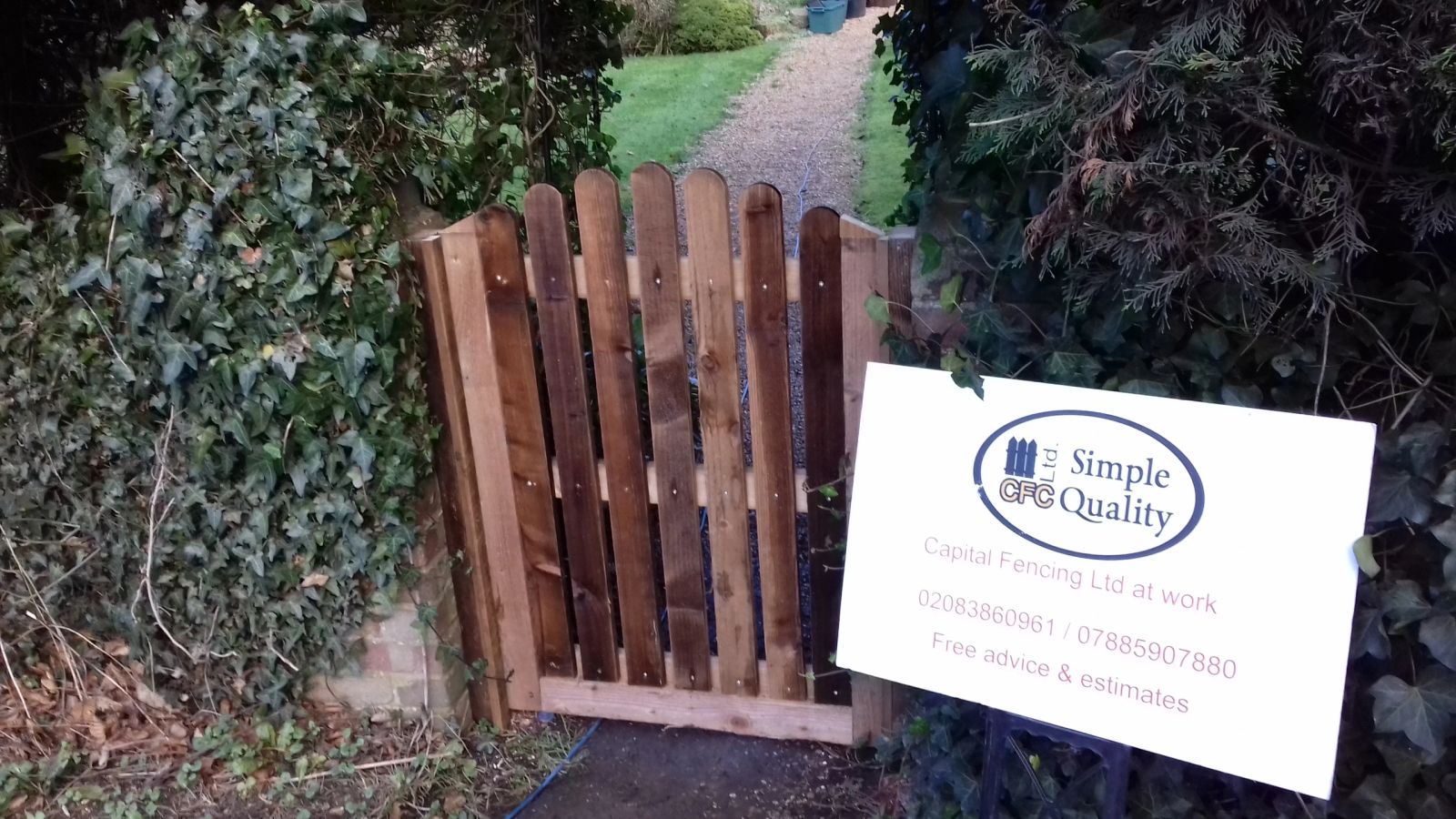
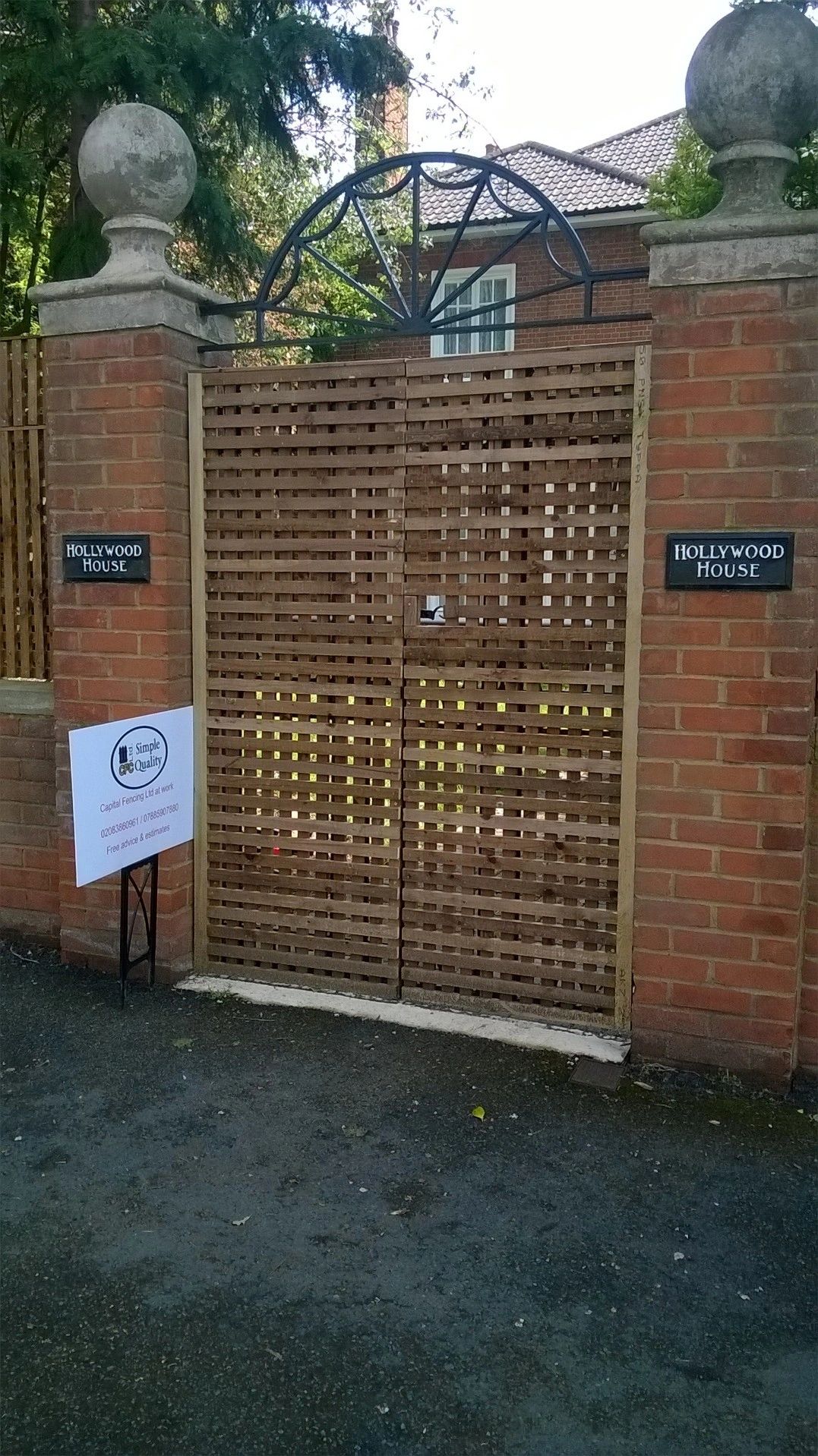
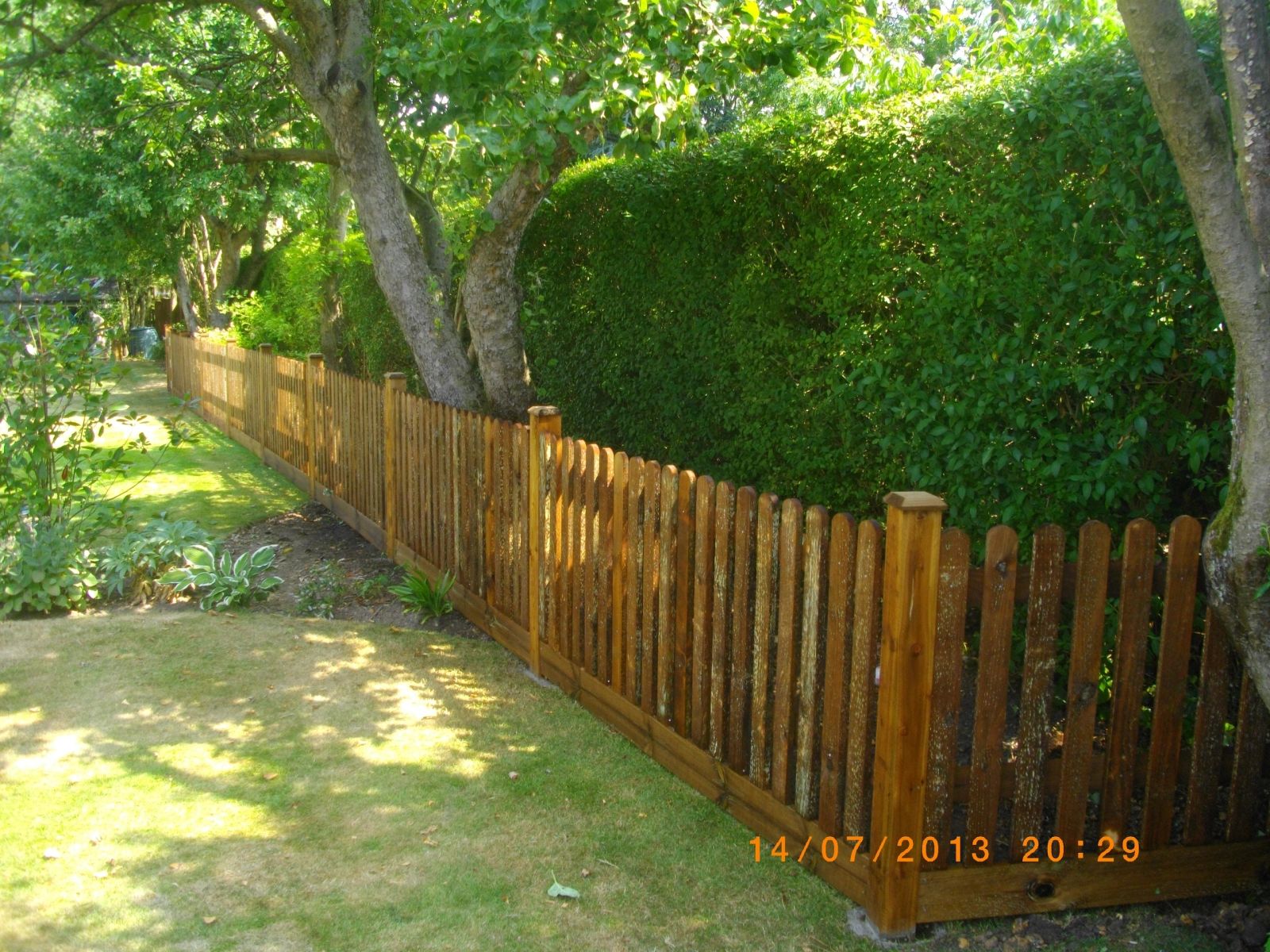
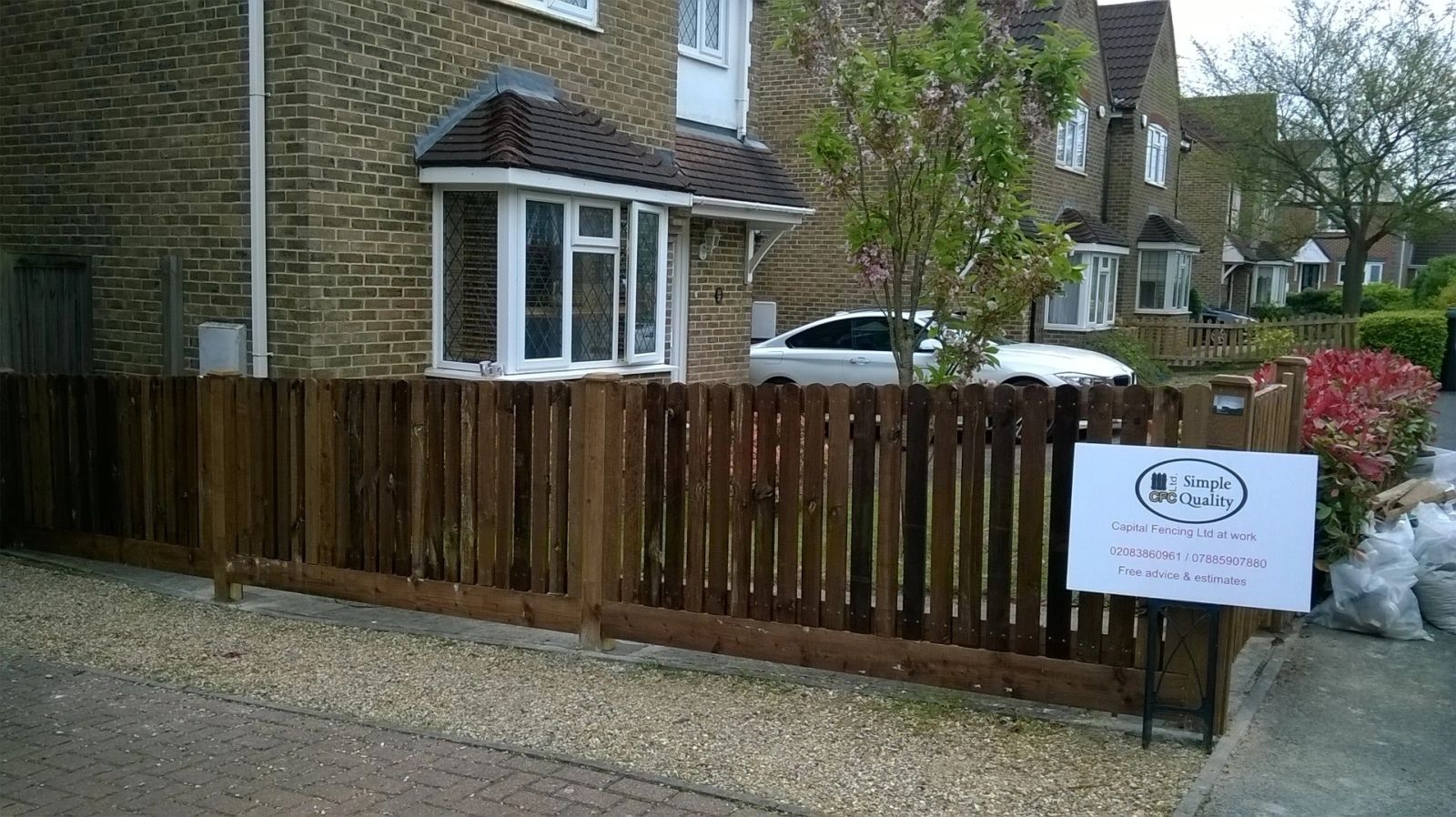
closeboard fence run installed by Capital Fencing in Edgware (HA8)panel fence install installed by Capital Fencing in Edgware (HA8)trellis-topped fence installed by Capital Fencing in Edgware (HA8)bespoke decorative fence installed by Capital Fencing in Edgware (HA8)

Before you book dog-proof fencing in Edgware

Gravel boards in timber and concrete

A gravel board sits at the base of a fence, between the ground and the lowest board or panel, taking the ground contact and splash-back so the panels above it don't have to.

A timber gravel board is cheaper and easier to cut to length but is the component most likely to need replacing within a few years, since it sits closest to damp ground; a concrete gravel board costs more up front but essentially removes that recurring repair.

Either type should sit slightly proud of finished ground level with a stone bed beneath it, rather than being buried, so water can drain away instead of sitting against the timber or panel edge.

Garden orientation and post-rain drying time

A south or west-facing garden dries out after rain considerably faster than a north or east-facing one, purely because it receives more direct sun through the day, which has a real effect on how long timber sits wet and therefore how fast rot and mould can establish.

This is worth factoring into treatment choice as much as species choice — a slower-drying orientation benefits more from a breathable stain that lets residual moisture escape than from a heavier film-forming coating that traps it in.

Two identical fences in the same postcode but opposite orientations can have meaningfully different realistic maintenance intervals for this reason alone.

Water company build-over positions

Public sewers can run beneath private gardens, and water companies generally require notice, and sometimes formal approval, before any structure — including some fence post foundations — is built close to or over them.

The exact rules and required clearance distances vary by water company, but ignoring a known public sewer line when positioning posts risks a dispute or requirement to remove work later.

A free sewer map is normally available from the relevant water company, which is worth requesting before finalising post positions on any plot with an older or shared drainage system.

Stainless fixings in exposed positions

Stainless steel fixings resist corrosion better than galvanised equivalents and don't leave the dark rust streaks that a failing galvanised screw head can bleed into pale or oiled timber.

They're specified more selectively than as a blanket upgrade, typically on coastal or otherwise highly exposed sites, on hardwood where tannins react badly with ordinary galvanised steel, or on visible ironmongery where staining would be obvious.

Grade matters even within stainless — 304 is adequate for most exposed domestic fencing work, while a genuinely coastal or salt-exposed site is better served by the more corrosion-resistant 316 grade.

Seasonal ground heave

Ground heave is the upward or lateral movement of soil as it absorbs water and expands, most pronounced in clay-rich ground after a wet autumn following a dry summer.

A post that was plumb in August can be measurably out of true by the following spring purely from this cycle, without any external damage to the fence.

Where heave is a known issue on a plot, deeper posts and a looser granular surround give the soil room to move without directly loading the post, rather than locking post and ground rigidly together.

Distinguishing frame twist from in-plane rack

A racked frame has gone out of square within its own plane, like a rectangle leaning into a parallelogram, while a twisted frame has warped out of flat so that one corner sits proud of the plane the other three corners define — the two look similar from a distance but need different corrections.

Sighting along the top rail from the hinge side is a quick way to spot twist that a simple diagonal measurement for racking won't reveal.

Galvanised versus stainless fixings

Hot-dip galvanised fixings are the standard for most timber fence repairs and resist corrosion well in normal ground and weather conditions at a lower cost than stainless.

Stainless fixings are worth specifying near the coast or where treated timber with a high copper content accelerates corrosion of standard galvanised fittings, since that combination corrodes noticeably faster than inland, untreated timber.

Resin anchor fixings for a bolted baseplate post

A resin anchor sets a threaded stud into a drilled hole in existing concrete or masonry using a two-part chemical resin, giving a strong fixing for a bolted baseplate post where excavating a new footing isn't practical, such as on an existing hardstanding.

Anchor depth and resin cure time both need to match the manufacturer's data for the load expected, and a resin anchor installed into damp or dusty concrete without proper hole cleaning will pull out well below its rated capacity.

Drainage as a repeat cause of failure

Where a post has failed at the base, poor drainage around that specific spot is often the underlying reason rather than simple age — a low point that collects rainwater rots a post from the ground up years before the timber above shows any sign of it.

A repair that resets the post without addressing the drainage at that point risks the same failure recurring within a few seasons.

Drilling into engineering brick or dense blockwork

Engineering brick and dense concrete block are far harder than ordinary facing brick, so standard masonry drill bits blunt quickly and a hammer-action drill with a carbide-tipped bit designed for dense material is needed to make progress without excessive heat.

Drilling slowly with intermittent withdrawal to clear dust keeps the bit cooler and the hole cleaner than forcing continuous pressure, which tends to glaze the hole and reduce the fixing's grip.

Where a wall is engineering brick specifically because it's load-bearing or below damp-proof course, it's worth checking that the fixing depth and pattern doesn't compromise the wall's structural role before drilling a run of holes into it.

Surface preparation before re-coating

Re-coating over an existing failed or flaking finish without preparation traps whatever is underneath — old paint fragments, algae, or degraded stain — and the new coat fails at the same points within a season.

A light sand or wire-brush pass to remove loose material, followed by a full dry-out period, gives a fresh coat something sound to key into rather than a film sitting over compromised timber.

Timing matters as much as preparation: coating damp timber traps moisture under the new film and is one of the most common reasons a re-coat fails faster than the original application.

Checking an unstable adjacent structure before repairing the fence against it

Where a fence panel is fixed to or sits hard against a garden wall, shed or outbuilding that's itself showing signs of movement, repairing the fence without addressing the structure it depends on risks the same failure recurring.

This is worth flagging to a client as a separate issue rather than working around it silently, since a fence repair fixed to an unstable wall is only as reliable as that wall.

Repair-versus-replace where the original installation was poor

A fence that's failed early because of shallow footings, undersized posts or poor timber grading in the original build is a weaker candidate for like-for-like repair, since fixing the immediate damage doesn't address why it failed in the first place.

In that situation it's worth being upfront that a repair matching the original spec may fail again on a similar timescale, and that a modest upgrade in post size or footing depth at repair time is often better value than repeating the original approach.

Courtyard gates and proportion

A courtyard gate typically spans a wider opening than a standard garden gate while still being a pedestrian rather than vehicle gate, which means its frame needs extra bracing to resist racking over that wider span without the benefit of a narrower opening's inherent stiffness.

Getting the proportion of stiles, rails and bracing right at this scale matters more than on a narrow gate, where the frame is naturally stiffer regardless of detailing.

Hitting shallow services and CAT scanning

Electricity, gas and water connections into a house are often shallower than people expect, sometimes under 300mm in an older garden, well within reach of a hand auger let alone a mechanical one.

A cable avoidance tool (CAT scan) before digging a new post line is standard practice near any suspected service run, and is far cheaper than the cost and risk of striking a live cable or a gas pipe.

Where a scan can't rule out a service with confidence, hand-digging trial holes to confirm depth and position before committing to auger the rest of the line is the safer approach.

Use Class 4 versus Use Class 3 timber

The European use-class system grades timber by the exposure it's treated to withstand: Use Class 3 covers timber above ground but exposed to weather, such as capping or fascia boards, while Use Class 4 covers timber in ground contact or fresh water, such as posts.

A Use Class 4 post buried in soil needs a deeper, longer-lasting retention of preservative than a Use Class 3 rail bolted between two posts, because the ground contact zone stays damp for far longer than an exposed but well-drained horizontal timber.

Specifying the wrong class isn't always obvious at installation, since both can look identical when new, but it shows up years later as premature rot concentrated at ground level rather than along the whole length.

Buried rubble and old foundations

Gardens that once held an outbuilding, air-raid shelter or earlier boundary wall often still have its foundation strip sitting just below turf level, invisible until an auger or spade hits it.

A shallow concrete strip footing crossing the fence line usually needs breaking out locally rather than working around it, since a post can't be reliably set on top of a narrow buried footing.

Where old foundations run the length of a boundary, it's worth probing the full run before quoting rather than assuming one trial hole represents the whole job.

UV stabilisers in composite and PVC fencing

UV stabiliser additives are blended into composite and PVC fencing products during manufacture to slow the surface degradation and colour fade that ultraviolet exposure otherwise causes in polymer materials over time.

Products with a lower proportion of UV stabiliser, often reflected in a lower price point, tend to show chalking, a dusty faded surface, and colour loss earlier than better-stabilised equivalents exposed to the same sunlight.

South and west-facing runs receive substantially more cumulative UV exposure than shaded or north-facing runs, so the same product can visibly fade at different rates depending purely on orientation and surrounding shade.

Public liability considerations on a shared boundary

Work that takes place on or near a shared boundary inherently affects two properties, which is one reason contractors carry public liability insurance covering damage or injury arising from the works, generally quite separate from any specific job guarantee.

Clients are entitled to ask to see a contractor's current public liability certificate before work starts, and for jobs involving excavation near a neighbour's structure or a shared wall it's reasonable practice to confirm cover explicitly rather than assume it.

This is a generic industry consideration rather than a claim about any particular policy, and the details of cover, exclusions and limits vary between insurers and should be checked directly with the provider.

Gaps at party walls and stepped brickwork

Where a fence meets a party wall or a stepped brick boundary, an ill-fitting junction leaves a gap that undoes the security of the whole run, so infill panels or a scribed timber closer are cut to follow the step rather than left square.

On an older terrace the brickwork step is rarely uniform along its length, so each junction is measured on site instead of assuming a standard offset.

Diagnosing an uneven gap between gate and post

A gap that's wider at the top than the bottom, or vice versa, between a gate and its latch post usually indicates the gate has racked out of square rather than simply dropped evenly, which is a frame issue rather than a hinge-height issue.

Measuring the gap at both top and bottom before starting a repair helps distinguish a racking fault from a straightforward drop, since the two need different corrections.

Securing a rear alley boundary behind terraced housing

A rear alley boundary sees different pressure to a front garden fence, because it's typically unwatched, runs the full length of several properties, and is the route used to approach a back door or shed unseen from the street.

Consistent height and topping along the whole alley matters more here than on an individual plot, since a single weaker section among several stronger ones simply redirects the attempt rather than stopping it.

On dog-proof fencing in Edgware you get the same crew from first site visit to hand-over. That's the whole model — small team, match-what-you-have spec, written quote before we start. Roads such as High Street and Hale Lane are typical of the local layout. Edgware bus station is a useful local reference point. Edgware developed rapidly after the Northern line was extended to the area in the 1920s, and much of its housing dates from that period of suburban expansion.

Get In Touch

Get My Free Quote — 24h Response

No callout fee · Free site visit · Friendly local team covering London & Hertfordshire.

Call us
07885907880
or 02036484746
Email
capital_fencing@yahoo.com
WhatsApp
Message us anytime
Area
London & Hertfordshire
Payment
Card payments accepted

Pay by debit or credit card, bank transfer or cash once the work and price are agreed. No deposit taken online.

Request a Free Quote

We'll get back to you within 24 hours.

Free Site Visit No Callout Fee
Call WhatsAppQuote