London & Hertfordshire Free Site Visit
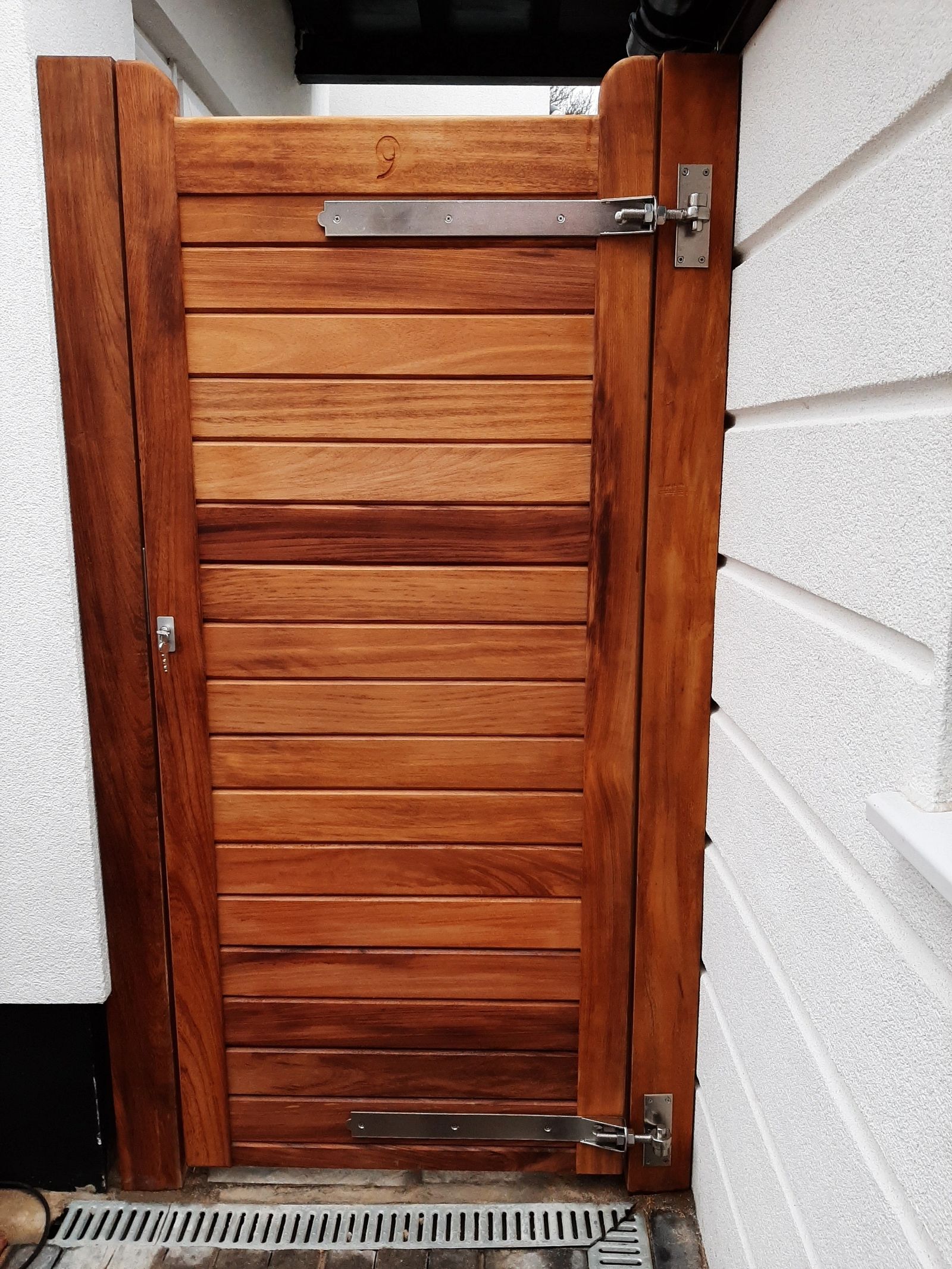
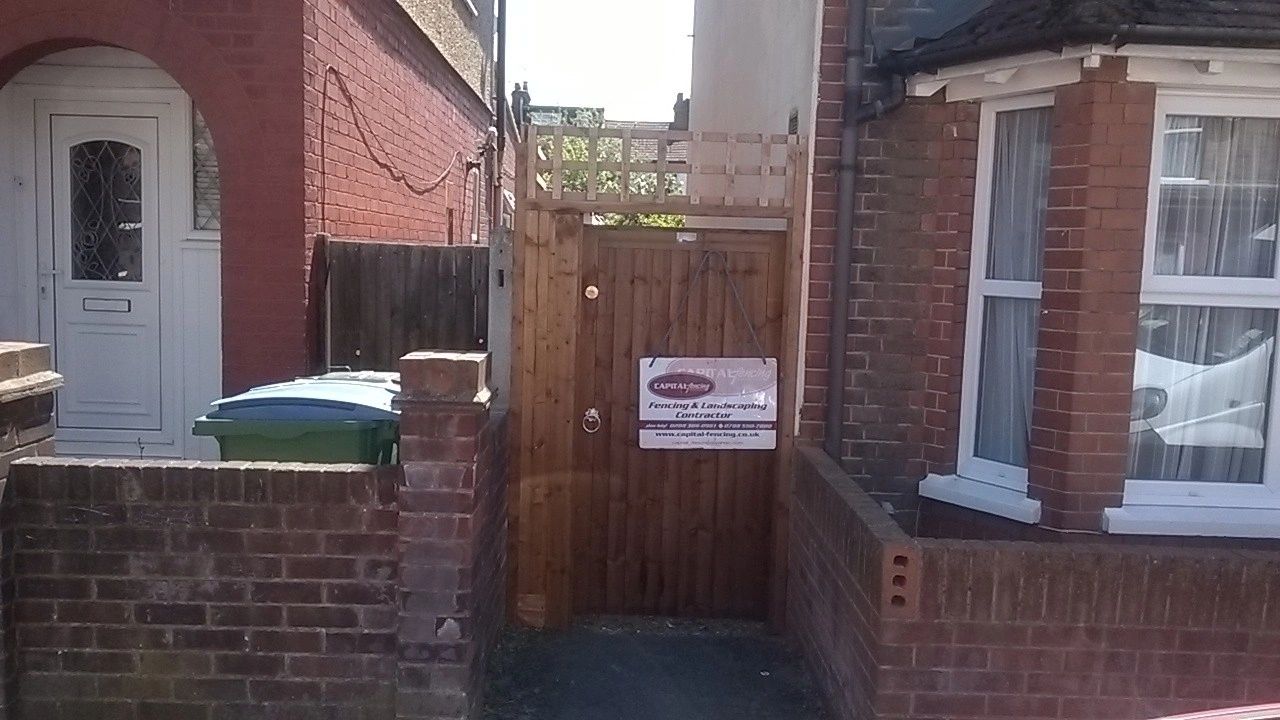
bespoke wooden gate installed by Capital Fencing in Stevenage (SG1)
Stevenage · SG1 / SG2

Driveway double gates across Stevenage — Stevenage Borough

Driveway double gates in Stevenage is one of our regular briefs — homes with off-street parking wanting matched double vehicle gates, manual or automated. On post-war planned housing across chells with modest rectangular plots, the failure mode we see most often is the one we design out first. Roads such as Shephall Way and Six Hills Way are typical of the local layout. Stevenage Old Town is a useful local reference point. Six Hills Way runs alongside the Six Hills, a scheduled ancient monument comprising a row of Roman-era burial mounds.

Driveway double gates in Stevenage is one of our regular briefs — homes with off-street parking wanting matched double vehicle gates, manual or automated. On post-war planned housing across chells with modest rectangular plots, the failure mode we see most often is the one we design out first. Roads such as Shephall Way and Six Hills Way are typical of the local layout. Stevenage Old Town is a useful local reference point. Six Hills Way runs alongside the Six Hills, a scheduled ancient monument comprising a row of Roman-era burial mounds.

Why this spec, for homes with off-street parking wanting matched double vehicle gates, manual or automated

  • measured on site off the actual brick piers, not a builder's plan set
  • prepared for future automation even when you're not fitting it yet — cabling ducts under the drive, hinges rated for it
  • matched pedestrian gate carried in the same visit so alignment and finish are identical

Typical driveway double gates briefs in Stevenage

  • 4.0m composite-faced double gates prepared for underground automation
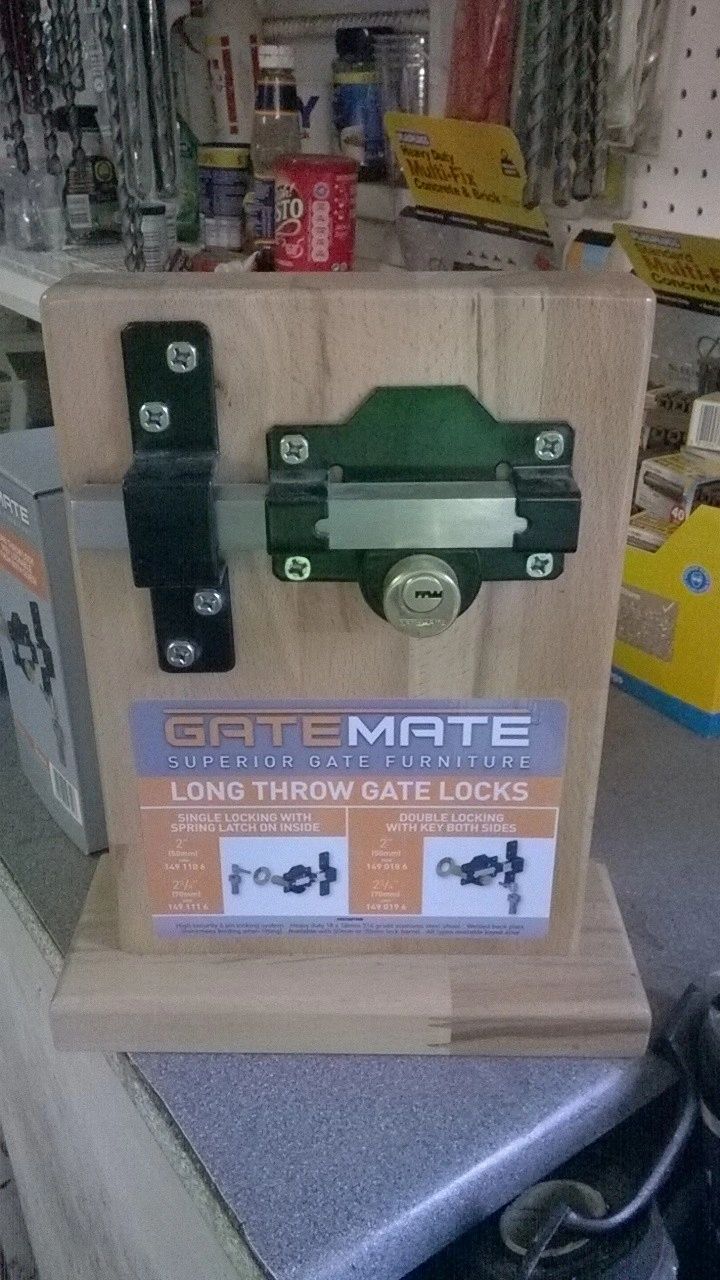
  • 3.0m opening hardwood double gates on ball-race hinges with drop bolt and top slide bolt
Default spec

How we build driveway double gates in Stevenage

44mm framed, tongue-and-groove or composite infill, hot-dip galvanised or stainless ironmongery, sized to the actual masonry opening not the drawing. On Stevenage jobs we adjust for shared-with-neighbour fence runs are the norm — quotes need to cover boundary checks first.

Property mix locally: post-war planned housing across Chells, Shephall and Bedwell, plus older properties in Stevenage Old Town. Typical gardens: modest rectangular plots, typically flat, with rear access alleyways on the planned estates. Postcodes we regularly service: SG1, SG2.

What goes wrong

Common failure modes on driveway double gates

  • not levelling the closing point — one leaf drags on the drive within a year
  • under-sized posts or brickwork — automation loads pull them out of plumb inside a season

Driveway Double Gates FAQs — Stevenage

How do you stop a heavy gate dropping on the closing point?

On driveway double gates jobs in Stevenage (SG1), our default answer is: 44mm framed, tongue-and-groove or composite infill, hot-dip galvanised or stainless ironmongery, sized to the actual masonry opening not the drawing. For context: prepared for future automation even when you're not fitting it yet — cabling ducts under the drive, hinges rated for it. Structural spans and post depths calculated, not guessed.

Softwood, hardwood or composite for double gates?

Across Stevenage we spec around shared-with-neighbour fence runs are the norm — quotes need to cover boundary checks first, so on driveway double gates that usually means iroko hardwood on galvanised ironmongery. For context: prepared for future automation even when you're not fitting it yet — cabling ducts under the drive, hinges rated for it. Structural spans and post depths calculated, not guessed.

Do you fit into existing brick piers or install new?

Stevenage Borough coverage means we can survey most SG1 addresses inside a week — homes with off-street parking wanting matched double vehicle gates, manual or automated. We'll walk you through measured on site off the actual brick piers, not a builder's plan set on the site visit before you commit.

What's the widest span before double gates need a wheel or cantilever?

Practically: 3.0m opening hardwood double gates on ball-race hinges with drop bolt and top slide bolt. That's the Stevenage version of this job, not a generic one. The honest trade-off is not levelling the closing point — one leaf drags on the drive within a year — which is exactly what our default spec designs out.

Can wooden driveway gates be automated later?

On driveway double gates jobs in Stevenage (SG1), our default answer is: 44mm framed, tongue-and-groove or composite infill, hot-dip galvanised or stainless ironmongery, sized to the actual masonry opening not the drawing. For context: prepared for future automation even when you're not fitting it yet — cabling ducts under the drive, hinges rated for it. Structural spans and post depths calculated, not guessed.

Recent driveway double gates work
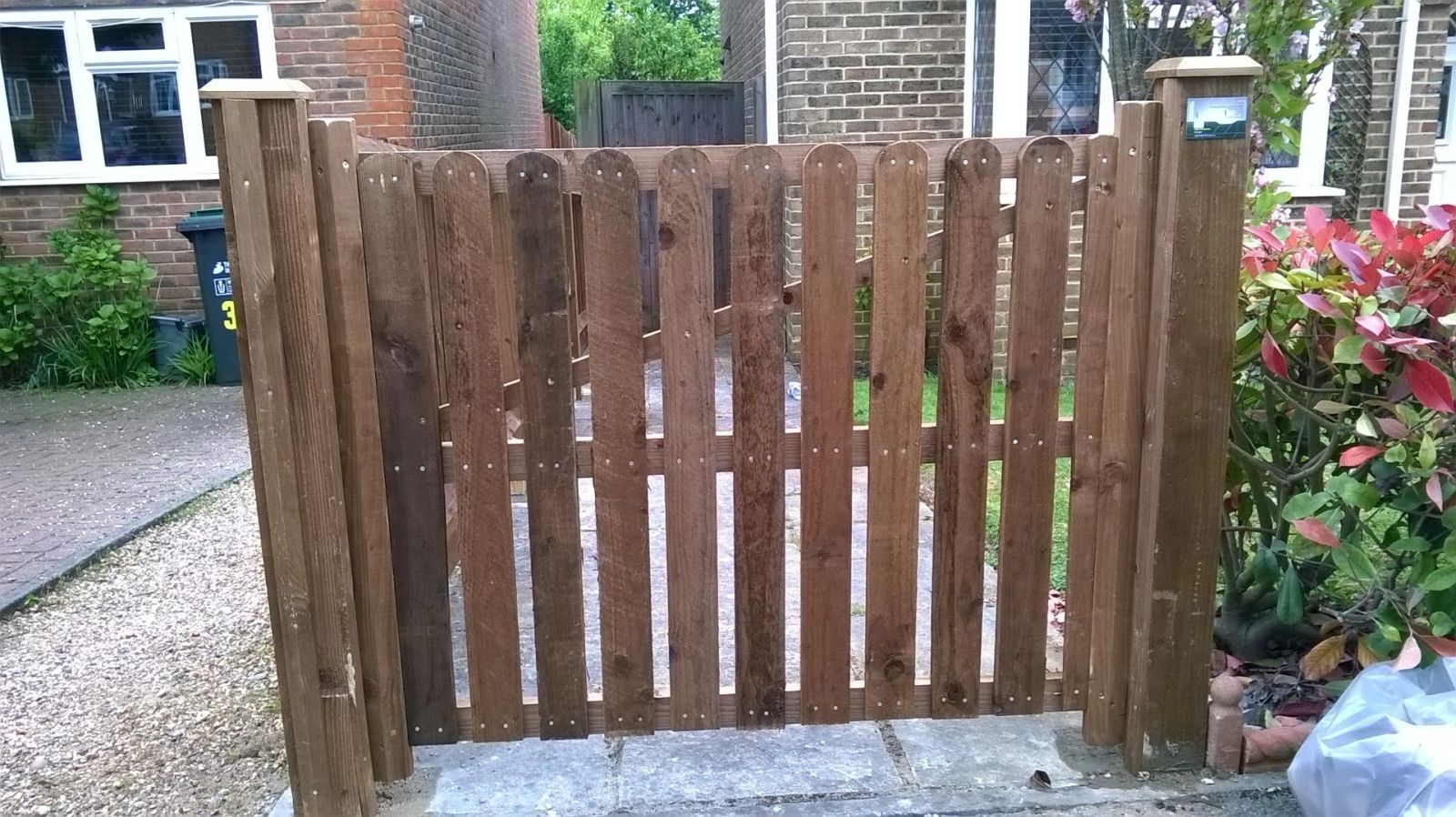
bespoke wooden gate installed by Capital Fencing in Stevenage (SG1)double driveway gates installed by Capital Fencing in Stevenage (SG1)hardwood side gate installed by Capital Fencing in Stevenage (SG1)metal entrance gate installed by Capital Fencing in Stevenage (SG1)

How we approach driveway double gates on Stevenage properties

Protecting a shared alley during material delivery

A shared rear alley used by several households for bin access can't be blocked completely for a full day without agreement, so materials are often moved through in stages between other residents' access needs rather than left stacked across the full width.

Trailing cables, tools and offcuts left in a shared passage are a trip hazard for neighbours as well as the crew, so keeping the alley clear at the end of each working day matters even if the job isn't finished.

Any damage to the alley surface itself — cracked paving, a scraped wall corner from a wide panel — is worth flagging to the client immediately, since a shared area often has joint liability that's harder to unpick after the event.

Working within narrow plot access

Some plots simply don't have a route wide enough for a wheelbarrow, let alone a van, which means every post, board and bag of aggregate goes in by hand across a longer distance than usual.

That changes both the time a job takes and, sometimes, the choice of materials — favouring shorter, lighter sections that two people can carry over long single panels that need mechanical handling.

It's worth flagging access constraints at the quote stage rather than on the day, since they're one of the most common reasons a job takes longer than a straightforward driveway-access equivalent.

Metal panel systems as an alternative on very exposed sites

On sites where timber panel failure from wind loading is a recurring problem despite heavier posts and shorter bays, a powder-coated steel or aluminium panel system offers a genuinely different approach, since the material doesn't flex, crack or delaminate the way a timber panel eventually does under repeated wind load.

These systems cost more than timber upfront and have a different aesthetic that not every client wants, but on a genuinely difficult exposed boundary they remove the recurring panel-replacement cycle entirely.

It's worth presenting as an option specifically where a client has already replaced timber panels on the same exposed run more than once, rather than as a default first suggestion.

Parking and material handling on site

Fencing, gates and decking all involve moving bulky, heavy material — concrete posts, gravel boards, decking joists — from a van to the working area, and how far that has to be carried has a real effect on labour time.

On streets with permit parking, no off-street loading bay, or restricted delivery hours, we plan the drop-off around those restrictions rather than assuming a van can sit outside all day.

Where a plot has a driveway or side gate wide enough for a barrow run, that alone can shave a meaningful amount of time off a job compared with hand-carrying everything round the front.

Boundary marking after installation

Once a new line is up, marking its exact position against the title plan — rather than relying on where the old fence happened to sit — avoids a future dispute if the new run has shifted slightly from the original.

A simple record of post positions relative to a fixed point on site is worth keeping, particularly where the new boundary is more solid or permanent than what it replaced.

Gate hinge material and load ratings

Gate hinges are rated by the load they can bear without excessive wear or sag, and that rating depends on the hinge's material, its pin diameter and the bearing surface area between the moving parts.

A heavy timber gate on a lightweight hinge designed for a garden gate will wear the pin and bushing far faster than the same hinge on a lighter gate, eventually developing a visible droop at the latch side.

Stainless steel or greased bronze bushings resist wear better than plain steel-on-steel hinges, particularly on gates opened frequently, where repeated friction is the main driver of hinge wear rather than corrosion.

Ventilation requirements under a deck

A low-level deck with boxed-in sides and no airflow underneath traps moisture against the joists and the underside of the boards, which is one of the most common causes of premature timber rot on an otherwise well-built deck.

Leaving gaps in the skirting, or fitting purpose-made ventilation grilles, allows air to circulate beneath the structure and lets the timber dry out between wet periods rather than staying permanently damp.

Decks built very close to ground level with minimal void beneath them are particularly at risk and sometimes need a raised design specifically to allow enough clearance for airflow.

Boundary rules in National Parks and AONBs

Properties within a National Park or an Area of Outstanding Natural Beauty can have reduced permitted development rights for boundary structures, reflecting the additional planning protection these areas carry.

Material and colour choices are often more tightly guided in these areas too, even where the height itself would otherwise be permitted.

The relevant National Park authority or council planning department is the right first point of contact for confirming what applies before ordering materials.

Concrete, timber and steel posts compared

Concrete posts don't rot, warp or need re-treating, which makes them the default for a long-life boundary, but they're heavier to handle, harder to cut on site, and can crack if struck hard rather than bending.

Timber posts are lighter, easier to notch and fix ironmongery to, and match a fully timber run visually, but they're the first component to fail through rot even when the boards above them are sound.

Steel posts (box section or RSJ) suit gates, very exposed runs or where a slim sightline matters, and they're galvanised or powder-coated rather than treated, but they need a compatible fixing method for timber infill panels rather than simple nailing.

Waste carrier duty of care for site waste

Anyone removing fencing, decking or building waste from a client's property in the course of business needs to be a registered waste carrier with the Environment Agency, and should be able to provide a waste transfer note showing where the material was taken.

Treated timber, in particular, is classed differently to plain untreated offcuts and generally can't simply go on a bonfire or into general household waste, since some older preservatives fall under hazardous waste rules.

Asking a contractor for their waste carrier registration number and a transfer note isn't excessive caution — the householder can be liable if waste is later found fly-tipped and traced back to the job.

Waste carrier duty of care for old fencing

Under the Environmental Protection Act 1990, anyone arranging removal of construction waste such as old fence panels and posts has a 'duty of care' to ensure it's handled by a registered waste carrier.

Asking to see a waste carrier's registration number, and requesting a waste transfer note for larger quantities, is a reasonable and legitimate request rather than an unusual one.

Householders can be held responsible if waste from their property is later found fly-tipped, even where they paid someone else to take it away, which is why checking credentials matters.

Keeping treated timber offcuts away from food-growing areas

Offcuts of pressure-treated fencing timber shouldn't be left lying in or used to edge a vegetable bed or fruit cage, since preservative can leach out of cut ends into adjacent soil over time.

Keeping offcuts on a hard surface or sheeting rather than directly on a border during the works avoids this becoming an issue even temporarily while the job is ongoing.

Where a client specifically wants to reuse leftover timber for raised beds, it's worth flagging that treated fencing stock isn't the right material for that purpose regardless of how convenient the offcuts seem.

Board thickness and deflection

A thin board fixed across a wide unsupported span will visibly bow or deflect under its own weight or a light push long before it's anywhere near breaking, because deflection increases sharply as thickness decreases.

Doubling a board's thickness roughly increases its stiffness eightfold for the same span, which is why panel manufacturers specify a maximum bay width for a given board thickness rather than treating thickness as purely a durability choice.

On wider bays it's usually cheaper overall to add an intermediate rail or reduce the bay width than to over-specify board thickness across the whole run to compensate.

Recycled mixed-plastic lumber composition

Recycled plastic lumber differs from wood-plastic composite in that it's typically made entirely from reprocessed plastic waste with no wood fibre content, giving it complete immunity to rot and insect attack but a distinctly plastic rather than timber-like appearance.

Because it contains no wood fibre, it doesn't absorb moisture in the way composite or timber boards do, but it's also generally more flexible and prone to visible sagging over a wide unsupported span unless internally reinforced.

It's more commonly specified for ground-contact components like gravel boards and low retaining edges, where rot resistance matters most, than for larger structural fencing elements.

Working around overhead power or telecoms lines during repair

A post repair beneath an overhead service line limits how tall equipment or extended tools can be used safely, and any post reset in that position needs the same overhead clearance considered as it would during a new installation.

Where a line runs close to the repair, checking clearance and, if needed, contacting the network operator before starting is worth doing even for what looks like a routine single-post job.

Gate stop positioning for correct swing angle

A gate stop set into the ground or fixed to the post limits how far a gate can swing open, protecting the hinges from being forced past their working range by wind or an over-enthusiastic push.

Positioning the stop correctly against the gate's actual swing arc, rather than a generic distance from the post, avoids the stop being struck at an angle that damages the gate's bottom rail.

Choosing between timber, concrete and steel posts

Timber posts are the cheapest and easiest to work with but are the first part of a fence to rot, particularly at ground level where they sit in permanently damp soil or concrete.

Concrete slotted posts cost more upfront and are harder to cut or adjust on site, but don't rot and hold panels rigidly without needing separate fixings, which suits a long, exposed or heavily-used run.

Steel posts, either box section or RSJ, are mostly reserved for commercial, security or very heavy-load applications where timber or concrete wouldn't cope with the weight or vandal-resistance required.

Checking mesh tension across seasonal temperature changes

Steel mesh infill expands and contracts slightly with temperature across the year, and a mesh tensioned tight in cold winter conditions can develop a visible sag by the height of summer if the original tensioning didn't allow for that movement.

A seasonal tension check, particularly after the first full year following installation, catches this early and allows a simple re-tensioning before a sagging mesh starts to create a usable foothold or gap at the base.

Made ground and buried rubble

Plots built on old industrial land, demolished outbuildings or infilled yards often have a layer of brick, concrete or hardcore sitting a foot or two down rather than natural subsoil.

An auger that hits rubble at 300-400mm usually means hand-digging or breaking out that layer rather than fighting it, because a post set on top of loose fill will rock within a year regardless of how much concrete goes round it.

It's worth budgeting extra time for this on any plot with a known history of redevelopment, rather than assuming a standard dig will go to plan.

Conservation covenants affecting boundary land

A relatively newer legal tool, the conservation covenant, allows landowners to agree binding restrictions on land use for conservation purposes, which can in principle extend to boundary treatments on affected plots.

These are still uncommon on ordinary residential properties but more likely on larger plots, smallholdings, or land near protected habitats.

Checking the title register for any registered covenant of this kind is worth doing on larger or more unusual plots before assuming standard rules apply.

Salvaging reusable timber during a repair

Not every board or rail on a damaged run needs replacing — sound timber from a section being taken down for other reasons can sometimes be reused elsewhere on the same boundary.

Reused timber is checked for rot and fixing damage before refitting, since timber that looks sound from one face can be split or split-prone where an old fixing has been removed.

Balancing delivery scheduling with retail service yard security

A retail service yard often needs its security gate open for scheduled delivery windows through the day, which creates a predictable gap in the site's perimeter security that opportunist theft can exploit if the yard isn't otherwise supervised during those hours.

A visitor or delivery intercom paired with a smaller pedestrian gate lets staff manage vehicle access without leaving the main gate open for the full delivery window, reducing the time the yard is left unsecured.

Driveway Double Gates across SG1, SG2 is a regular run for us. We'll quote honestly, tell you if driveway double gates isn't the right answer for your site, and book the job in within a week or two of a signed quote. structural spans and post depths calculated, not guessed. Roads such as Bedwell Crescent and Six Hills Way are typical of the local layout. Stevenage Old Town is a useful local reference point. The pedestrian underpass network built into the New Town design means much of Bedwell and Chells has limited rear vehicle access.

Get In Touch

Get My Free Quote — 24h Response

No callout fee · Free site visit · Friendly local team covering London & Hertfordshire.

Call us
07885907880
or 02036484746
Email
capital_fencing@yahoo.com
WhatsApp
Message us anytime
Area
London & Hertfordshire
Payment
Card payments accepted

Pay by debit or credit card, bank transfer or cash once the work and price are agreed. No deposit taken online.

Request a Free Quote

We'll get back to you within 24 hours.

Free Site Visit No Callout Fee
Call WhatsAppQuote