Access constraints on a repair job
A repair to a single post or panel deep in a rear garden with no side access still needs materials and tools carried through rather than dropped at the boundary, which is worth factoring into the timeline on a tight terraced plot.
On a multi-property repair — several gardens sharing a rear boundary — coordinating access across neighbours can be the more awkward part of the job than the repair itself.
Restrictor arms and stays for wind-prone double gates
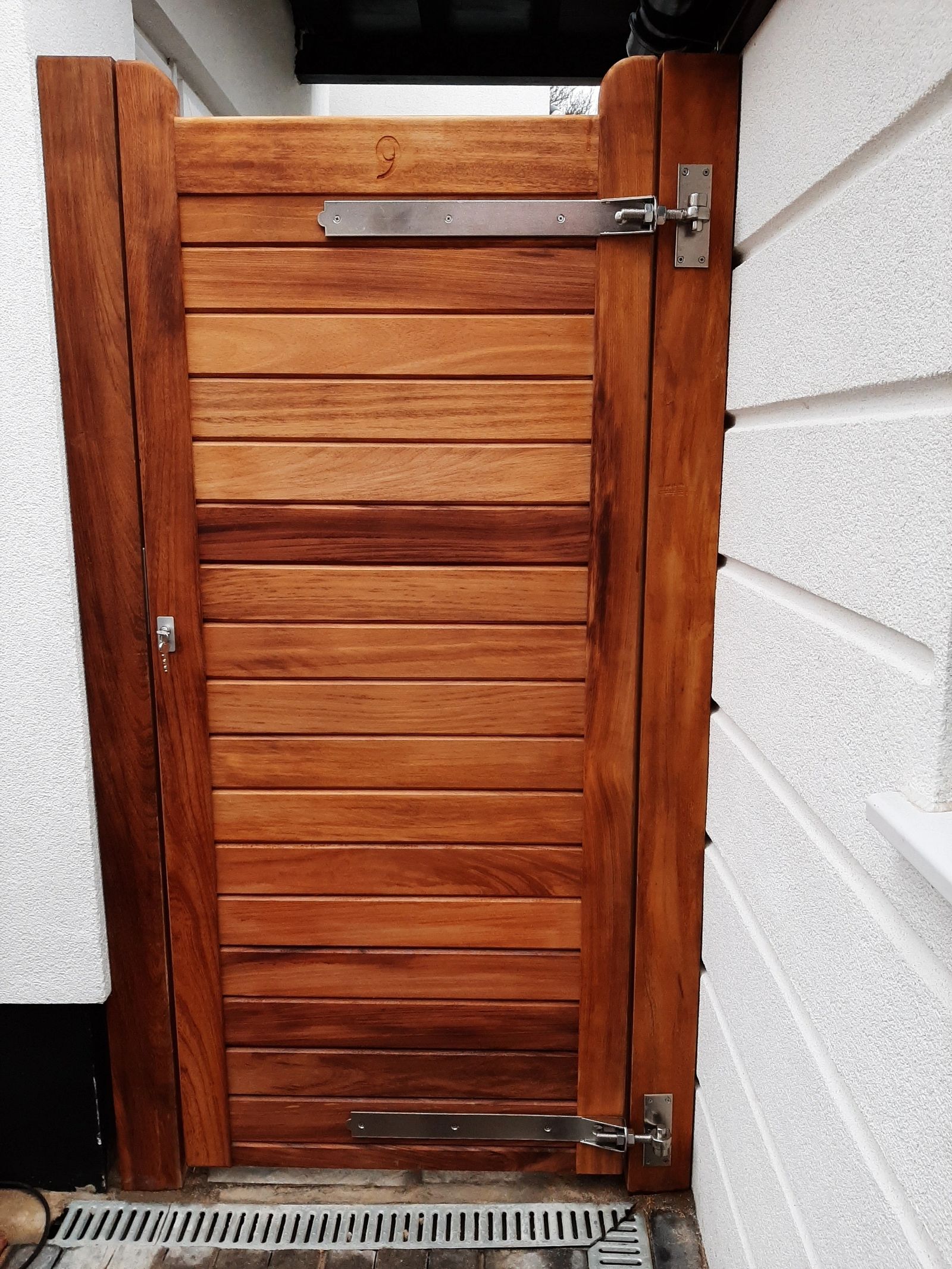
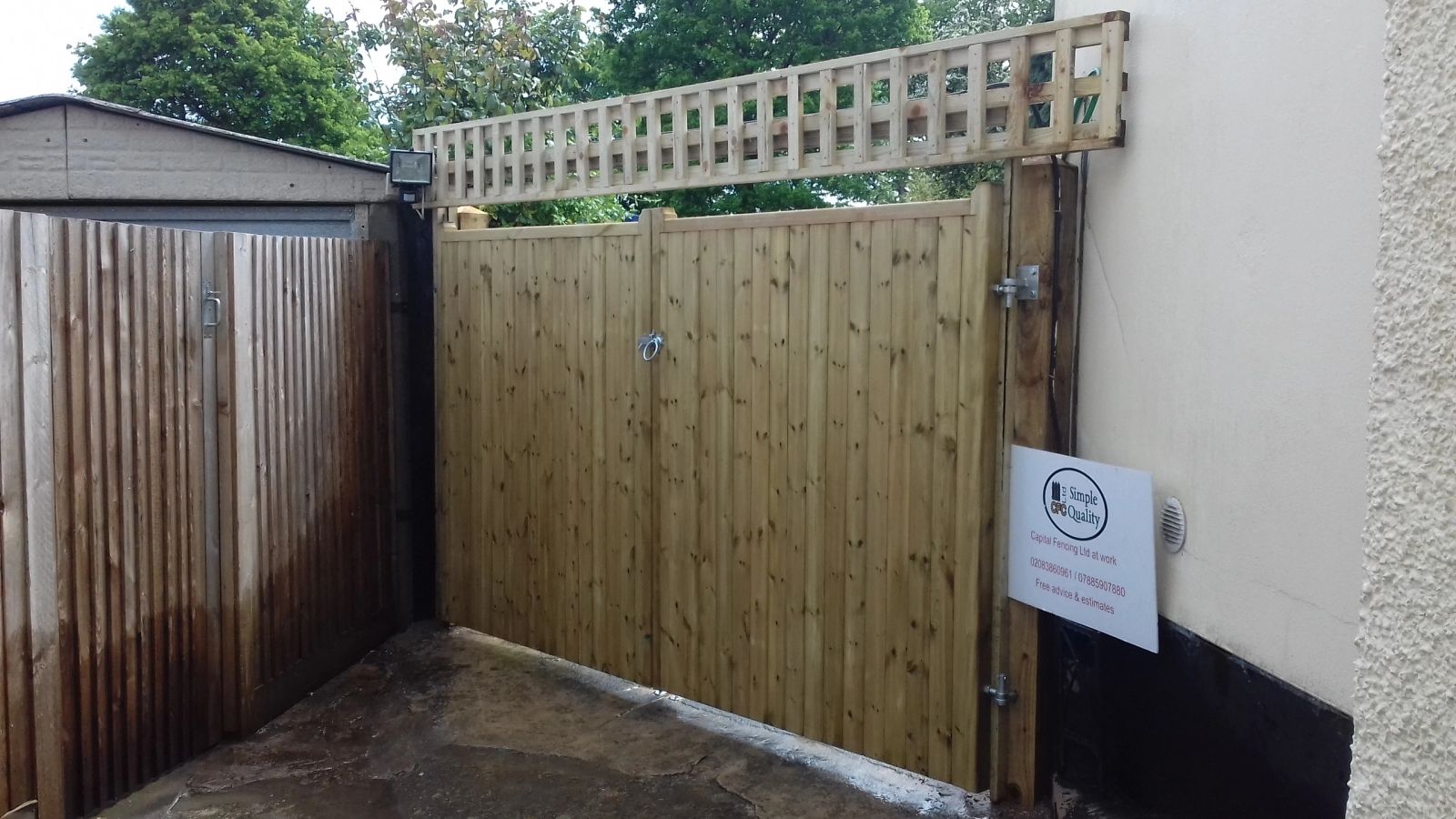
A restrictor arm or stay holds a double gate leaf open at a set angle, preventing it from swinging shut or being blown further open by wind while a vehicle passes through, which is particularly useful on an exposed driveway entrance.
Without a stay, an open gate leaf left unsecured in wind can swing back and strike a vehicle or a person passing through the opening.
Why frost affects the timing of a post repair
Concrete poured around a post footing in freezing conditions can suffer frost damage before it's cured enough to resist it, leaving a weaker footing than the same mix poured in mild weather, so hard frosts are a reason to delay rather than push a repair through.
Ground that's frozen solid is also harder to dig cleanly, and posts reset into ground that later thaws unevenly can move again within the same season, so timing a repair around a settled mild spell reduces the risk of redoing it.
Copper-based timber preservatives
Modern timber preservatives commonly use copper compounds as the primary biocide, since copper is effective against fungal decay and is less toxicologically hazardous than the older chromated copper arsenate formulations largely phased out for domestic use.
Copper-treated timber can accelerate corrosion in fixings made from certain metals, particularly plain steel and some aluminium alloys, in a similar way to oak's tannic acid reaction, which is why treated timber often specifies compatible fixing types.
Hot-dip galvanised and stainless steel fixings both perform acceptably with copper-treated timber, whereas untreated mild steel or some aluminium fixings can corrode noticeably faster in direct, damp contact with it.
Fixing new fencing to existing walls and piers
Bolting a new fence panel or post bracket to an existing wall or brick pier depends on the wall's own condition — a soft or unstable pier can't safely take the lateral load a fence puts on a fixing point.
Where a wall is sound, resin-fixed bolts into brick or masonry give a secure end point without a new post footing; where it isn't, a freestanding post just inside the wall line is the safer option.
Movement joints in timber cladding
Timber cladding boards fixed edge to edge without any allowance for seasonal expansion can buckle or split as the boards swell in wet weather and have nowhere to expand into.
A small gap left between board ends, or a slightly loose fixing pattern that allows a board to expand slightly within its fixing slots, accommodates this movement without transferring stress into the board itself.
The required gap varies by species and board width, since wider boards and more moisture-reactive species move more in absolute terms than narrow boards of a stable species for the same change in humidity.
Deciding the scope of a part-run rebuild
A part-run rebuild replaces a defined stretch of bays back to sound posts at either end rather than patching individual failures within a longer run, which gives a cleaner, more consistent result where damage is clustered.
Setting the boundaries of a part-run rebuild means checking the posts just outside the visibly damaged section too, since a post that looks fine next to an obviously failed one can still be borderline and best included in the same piece of work.
Who owns which boundary
Boundary ownership in England isn't settled by which side the posts face — it's set by the title deeds, and where the deeds are silent the presumption (a T-mark on old Ordnance Survey-derived plans, or the 'ad medium filum' rule for some hedges) only gets you so far.
Before any post goes in we ask to see the deed plan, or at minimum agree the line and height with the neighbour in writing, because replacing a fence in the wrong place is a genuinely common and avoidable dispute.
Where ownership is contested we'll fit on the client's own side of the line rather than guess, even if that means a slightly narrower run.
Keeping fence design clear of utility meter access points
Gas, electric and water meter boxes set into or near a boundary wall or fence line need to remain accessible for reading and emergency isolation, so a new fence or gate design shouldn't block or panel over an existing meter box without providing an equivalent access route.
This is occasionally missed on a full boundary replacement where the new design closes up an old gap that happened to give meter access, leading to a return visit to cut an access panel back in.
Checking for meter boxes and stopcock covers along the boundary line during survey avoids this rework.
Supplementing a hedge line boundary with security fencing
A mature hedge gives limited security on its own because gaps at the base and thin patches higher up both offer a way through, so a low stock fence or mesh run installed within or just behind the hedge line closes those gaps without removing the hedge's screening value.
The supporting fence is set back enough from the hedge to allow future trimming access, since a fence built hard against the hedge line makes routine maintenance of the hedge itself far harder.
Routing deck lighting cable away from standing water
Low-voltage deck lighting cable run beneath boards needs to be kept clear of any point where water is likely to pool, since even low-voltage cable connectors degrade faster in permanently wet conditions than in the intermittent dampness the rest of the substructure sees.
Routing cable along the higher side of a deck's fall, rather than through the lowest point where water naturally collects, is a simple planning step that extends the life of an otherwise reliable lighting installation.
Any cable joints beneath a deck should use fully waterproof-rated connectors rather than standard household connectors, given the substructure environment is functionally outdoors and damp regardless of overall deck condition.
Trading off fence height against site visibility from outside
Increasing a boundary's height improves resistance to climbing but also reduces visibility into the site from the street, which can work against security by giving an intruder who does get over the fence more concealment once inside.
A part-solid, part-mesh design, or a solid lower section topped with an open mesh upper section, is one way to gain height without losing all visibility, balancing the climbing deterrent against the loss of natural surveillance from passers-by.
Timber versus metal for a replacement gate
A timber gate is easier to match to an existing fence line and easier to repair in sections, while a metal gate holds its shape better against warping and racking but is harder to alter once fabricated.
We recommend based on what the existing boundary is built from and what the client actually wants to maintain over time, not a single default material.
Repairing an end post fixed against a house or garage wall
An end post bolted to masonry rather than set in its own footing fails differently — usually at the wall fixings rather than at ground level — and repair means checking whether the wall fixing itself has corroded or worked loose in the masonry.
Where the original fixing type has degraded, refitting with a heavier-duty or better-protected fixing is generally worth the small extra effort over simply replacing like-for-like into the same drilled holes.
Timber moisture content testing
A pin-type moisture meter measures electrical resistance between two probes pushed into the timber's surface, giving a reasonably reliable reading of moisture content near the surface but not necessarily reflecting the core of a thick section.
Fencing timber delivered at above roughly 20% moisture content is more prone to significant post-installation shrinkage and movement than timber closer to its long-term equilibrium moisture content for outdoor use.
Because timber left stacked outdoors and uncovered reabsorbs moisture from rain and humidity, a moisture reading taken on delivery can differ significantly from the same stack a fortnight later if it hasn't been kept covered.
Ivy growth as a structural load
Established ivy doesn't just sit on a fence for appearance — its woody stems and aerial roots add real dead weight, and a mature growth can add the equivalent of several boards' worth of load to a panel over years of unchecked growth.
Ivy also holds moisture directly against the timber or brickwork it covers, which accelerates rot or mortar erosion underneath even though the visible growth looks healthy.
Removing mature ivy from a fence intended to stay in place needs care, since cutting the base and letting it die back gradually avoids suddenly exposing timber that has been softened by long-term dampness underneath.
Kiln-dried versus green timber movement
Green, or unseasoned, timber still holds a significant amount of moisture from milling and will keep shrinking as it dries out in situ, which can open gaps, twist boards or loosen fixings within the first year.
Kiln-dried timber has already been brought down to a stable moisture content under controlled heat, so it moves far less once installed, though it costs more to produce and can be less forgiving if left stacked in wet conditions on site.
Feather-edge and featheredge-style fencing is particularly sensitive to this, since green boards fitted tight can shrink into visible gaps by the following summer even though they looked fully overlapped on the day of installation.
Reading a T-mark on a title plan
A 'T' mark on the inside of a boundary line on a Land Registry title plan is a conventional (though not conclusive) indication of who owns and is responsible for that particular boundary feature.
Where two T marks meet to form an 'H', that usually points to a shared responsibility, such as a party fence wall between two gardens.
The mark is only ever a starting point for a conversation, not a legal guarantee, so we'd always suggest checking the actual title register wording or asking a solicitor if ownership genuinely matters for a job.
Sherardised nails and fixings
Sherardising coats small steel fixings in zinc through a low-temperature diffusion process using zinc dust rather than a molten bath, giving a matt grey, evenly distributed coating well suited to fasteners with fine threads.
Because the process doesn't build up excess zinc at edges and threads the way hot-dip galvanising can, sherardised nails and screws keep a cleaner, more precise fit than galvanised equivalents of the same size.
The coating is thinner than typical hot-dip galvanising, so sherardised fixings are generally specified for above-ground, moderate-exposure use rather than permanent ground contact.
Composite wood-polymer ratios
Wood-plastic composite fencing boards are made from a blend of wood fibre and polymer, and the ratio between the two materially affects the finished product's stiffness, weight and how closely it resembles real timber grain.
A higher wood-fibre content generally gives a more timber-like appearance and feel but can also make the board more absorbent and slightly more prone to swelling at cut edges than a polymer-dominant mix.
Composite boards from different manufacturers aren't interchangeable even when nominally similar in size, since differing ratios change how the board expands with temperature and how it should be fixed and spaced.
Removing an old panel without damaging sound posts
Panels are usually fixed to posts with clips, brackets or nails through the frame, and levering a panel out with a bar without first locating and releasing those fixings risks splitting a post that would otherwise have been reusable.
Cutting through corroded nails with a reciprocating saw, rather than forcing the panel free, is often quicker and safer for the post than sustained levering.
Where only one panel in a run has failed, working carefully to free just that panel's fixings keeps the neighbouring panels and their posts undisturbed rather than loosening more of the run than necessary.
Balustrades and handrails on raised decking
Decking raised more than around 600mm above the ground typically needs a balustrade under Building Regulations Part K, with baluster gaps narrow enough that a 100mm sphere can't pass through, to stop a child slipping between rails.
Handrail height and the strength of the newel post fixings both matter more on a raised structure than a ground-level deck, since the loads involved in someone leaning on a rail are higher than most people assume.
Steps down from a raised deck need their own handrail treatment where the rise is significant, and non-slip tread nosing is worth specifying for anywhere used year-round.