Access through a house for a rear repair
Where a rear garden has no side access, materials and tools sometimes have to be carried through the house itself, which needs agreeing with the client in advance and protecting flooring and doorways along the route.
This is more common on terraced properties than detached ones, and it's worth factoring into how a repair is scheduled and priced.
Restrictive covenants on open-plan frontages
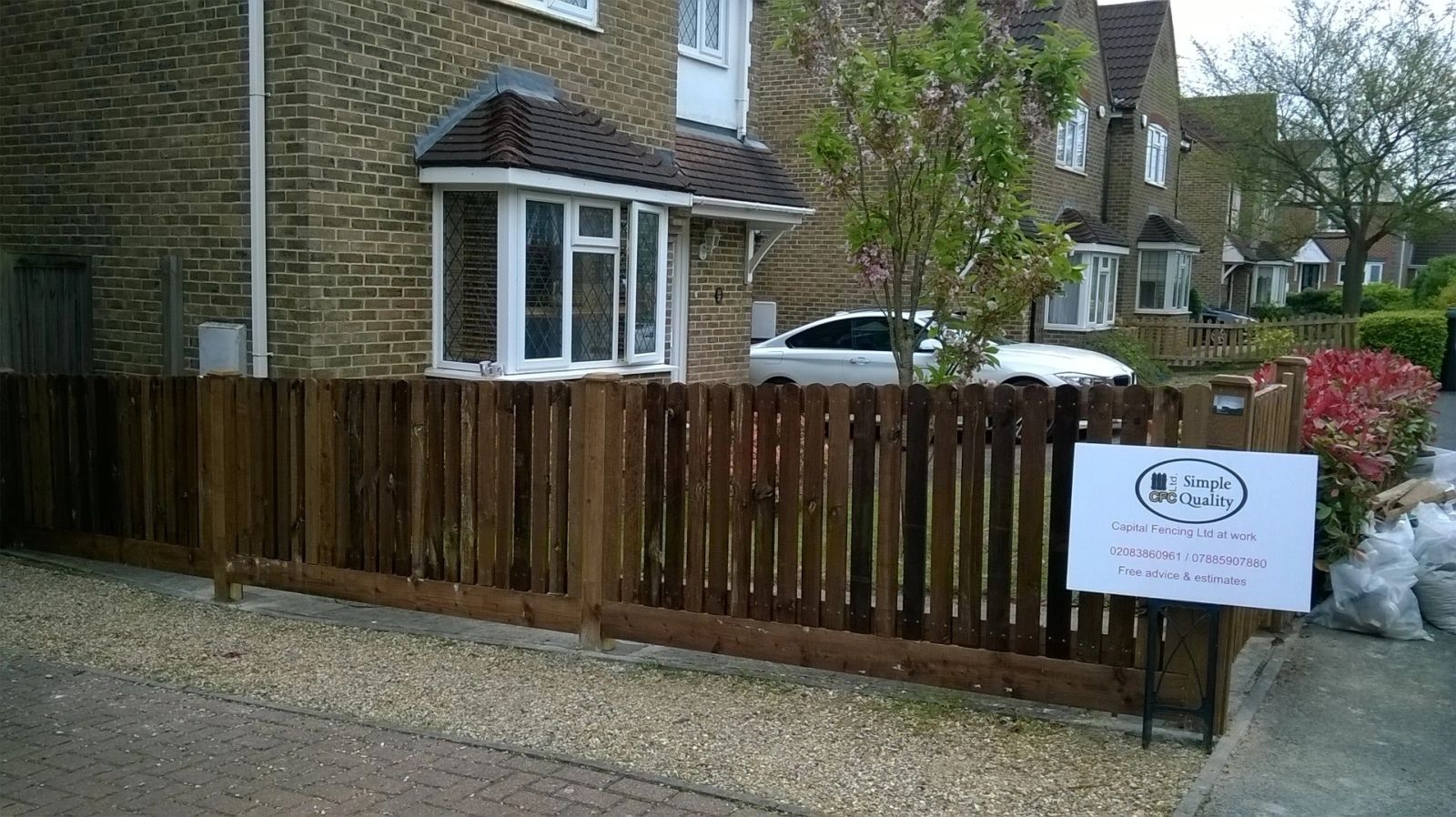
Many post-war estates were built with an explicit covenant in the title deeds preventing front garden fences or walls above a low height, intended to preserve an open-plan street appearance.
These covenants are private legal obligations between landowners rather than planning rules, and breaching one can in principle be enforced by whoever holds the benefit of the covenant, sometimes a management company.
Checking the title register for this kind of restriction before fitting a front boundary fence avoids finding out about it after the work is done.
Setting out a straight run with string lines
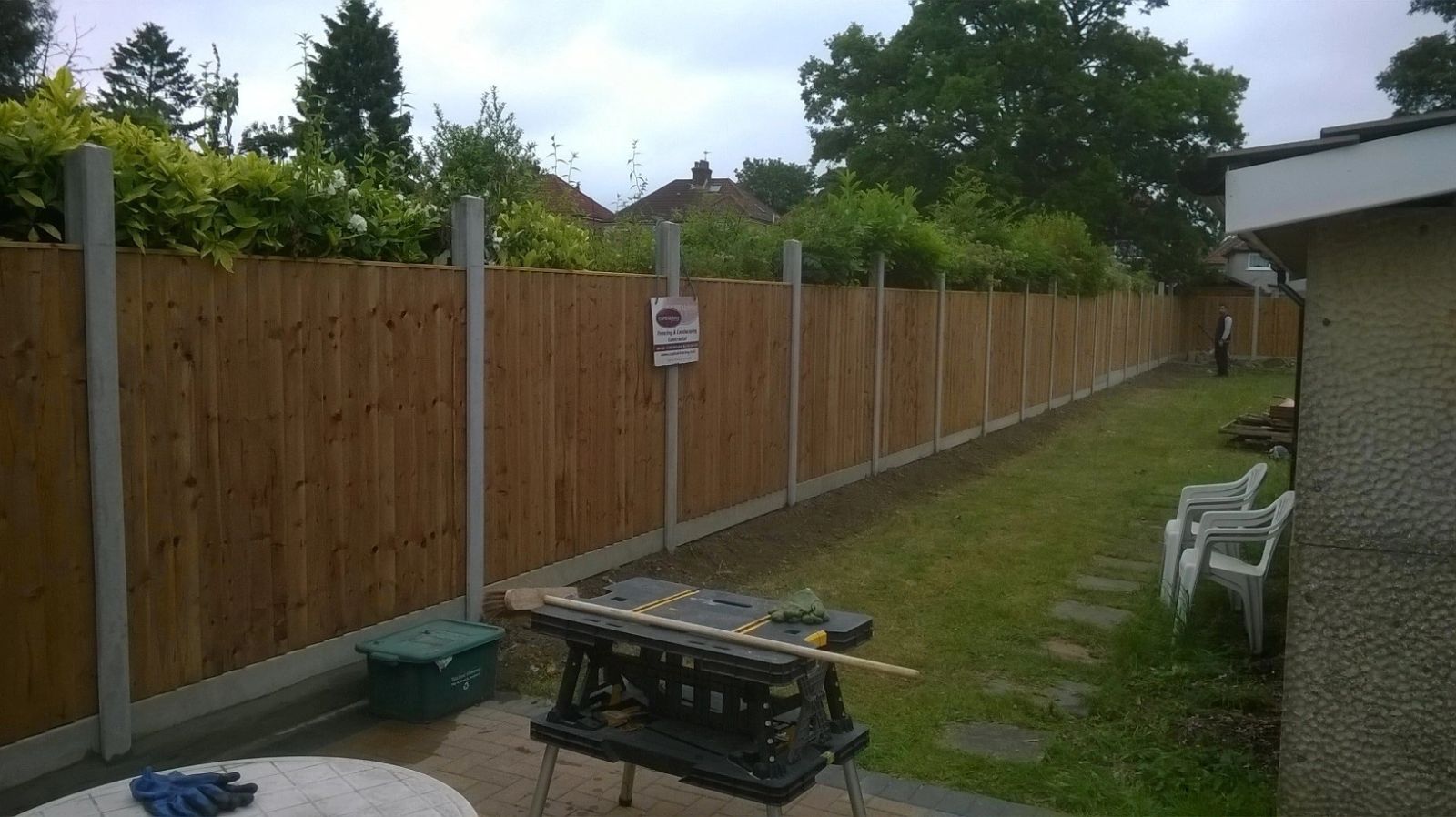
A straight fence line starts with two fixed end points and a string line pulled taut between them, usually run just above where the posts will sit rather than at ground level where it snags on grass or debris.
On a long run the string sags under its own weight, so an intermediate profile or peg is needed every few bays to keep the sight line true rather than trusting a single span.
Any post that's set even 10-15mm off that line becomes visible once panels go in, because the eye picks up a wander in a boundary far more readily than a small step in level.
Powered auger versus hand-digging post holes
A petrol or hydraulic auger speeds up digging significantly on open, obstruction-free ground, but is the wrong tool near known services, tree roots or previous hardstanding, where it can't tell the difference between soil and something it shouldn't hit.
Access also decides the method — an auger needs room to manoeuvre and, for larger machines, a route wide enough to bring it onto site, which isn't always available on a narrow rear plot.
Hand-digging costs more in labour time but gives far more control in tight, obstructed or sensitive ground, which is why most quotes specify the method appropriate to the actual site rather than assuming the fastest option by default.
Using a post hole auger effectively
A petrol or manual auger clears loose, stone-free ground far faster than hand-digging, but it works by shearing soil rather than levering it, so it struggles the moment it meets a root, a buried stone or compacted rubble.
Lifting the auger clear and clearing spoil from the flutes every 150-200mm of depth keeps it cutting efficiently; forcing it deeper without clearing spoil just packs the hole and stalls the motor.
On heavy clay an auger can also polish and seal the hole's sides, which reduces drainage around the base — a quick scoring of the sides with a spade before concreting helps break that glazed surface.
End-grain sealing on cut timber
End grain is far more absorbent than a timber's long faces because it exposes the open ends of the wood's vascular cells, so a post or rail cut to length on site can soak up moisture many times faster at the cut end than elsewhere.
Leaving a fresh cut untreated is one of the more common ways a pressure-treated timber ends up rotting from the middle outwards, since the factory treatment doesn't extend to a cut made after the fact.
A brush-applied end-grain preservative or sealant on every site-cut post base and rail end restores some of that lost protection, and takes only a few minutes per cut relative to the risk it avoids.
Victorian terraces with rear alley access
Many Victorian and Edwardian terraces back onto a shared rear alley or 'twitten' rather than opening onto a private access road, and boundary fencing along that line is often a mix of ownership — some panels the householder's, some historically shared with the alley itself.
Alley gates onto these routes need to open inward or be set back, since a gate swinging out over a shared right of way can obstruct neighbours and bin collection.
Where the alley is council-adopted, replacing a boundary fence that fronts it can also need a look at any local byelaws on gate height and lockable access before ordering materials.
Checking which face of a panel should face outward
Many panel styles have a clear 'good' face with a neater finish and a reverse face showing the frame, battens or rail ends, and getting this the wrong way round means the less tidy side ends up facing the client's own garden or the neighbour's, depending on convention and agreement.
Where a boundary is shared, it's worth agreeing in advance which side the good face should present, since local convention varies and assuming it defaults toward the neighbour without discussion can cause an avoidable dispute.
Checking panel orientation before fixing, rather than after several panels are already up, saves having to unfix and turn a run of panels that all went in the wrong way round.
Dust and noise control in a tight garden
Cutting timber, breaking out old concrete bases or using a petrol auger all generate noise and dust that carries further in a small enclosed garden between close-set houses than on an open plot.
Local authorities can restrict noisy work hours under the Control of Pollution Act, and even where no formal restriction applies, starting before a reasonable hour or working into the evening is one of the fastest ways to draw a neighbour complaint.
Sheeting off concrete-cutting dust and keeping cut ends away from a neighbour's washing line or open windows is a small step that avoids most of the friction on a shared boundary job.
Timber grading marks
Structural and treated timber is typically stamped with a grading mark showing the strength class, treatment use class, and sometimes the treatment company's code, which is the practical way to verify what was actually supplied rather than taking a description on trust.
For fencing, the marks that matter most day to day are the use class (confirming it's rated for the ground or above-ground exposure intended) and a visible batch or treatment date, useful if a defect needs tracing back to a supplier.
Unmarked or unstamped 'treated' timber from an unclear source is harder to verify and is one of the more common shortcuts on cut-price quotes.
Pool and hot tub enclosure fencing logic
While UK regulations don't mandate pool fencing the way some other countries do, insurers and safety guidance still recommend a self-closing, self-latching gate and a barrier without easy footholds around any domestic pool or hot tub, particularly where young children have access to the garden.
The latch or lock should sit high enough that a small child can't reach it even standing at the gate, and the gate should swing away from the pool area rather than toward it so it can't be propped open accidentally.
A solid or closely-spaced barrier at least 1.2m high with no horizontal rails low enough to climb is the general standard worth applying even without a specific legal requirement to do so.
Repairing post damage caused by an added light fitting or wiring
A post drilled to carry a solar light, festoon wiring or a mounted fitting has extra penetration points that can let water into the timber, accelerating rot at a spot that wouldn't otherwise be a weak point on that post.
Repair means addressing both the rot and, ideally, resealing or relocating the fitting so the same penetration doesn't cause the same damage again once the post section has been renewed.
Compression versus tension fixing of infill panels
Some panel systems clip into a compression-fit channel between posts, relying on the panel being cut to a precise size to stay in place under load; others are bolted under tension to the post face, which tolerates more variation in panel size but adds visible fixing points.
Compression-fit systems look cleaner but are harder to make tamper-resistant, since a panel that can be removed without tools for maintenance can usually also be removed without tools by someone else.
Setting corner posts before intermediate posts
Corner and end posts are normally set first and their positions checked and finalised before any intermediate post along the run, since every other post's position is measured relative to those fixed points.
Setting intermediate posts first and corners last risks a corner ending up slightly off the true line established by the string, which then means either accepting a visible kink or redoing intermediate posts to correct it.
This sequence matters even more on a run with two changes of direction, where getting one corner wrong compounds the error along the whole of the next leg.
Small gaps for garden wildlife
A small gap, roughly 13cm square, cut into the base of a fence panel lets hedgehogs and other small wildlife move between connected gardens without needing to climb or dig, which matters where fencing has fragmented a previously open row of gardens.
This kind of gap doesn't meaningfully weaken a fence's structure or security when it's cut cleanly and positioned away from a post, and can be added to an existing fence as well as specified on a new one.
Where a client has an interest in garden wildlife, it's a low-cost addition worth mentioning at quote stage rather than something usually offered unprompted.
A survey checklist for ground conditions
A useful pre-quote ground check covers a short list of practical questions: what does a trial hole show in the first 300-450mm, is there any standing or seeping water, are there visible roots or a stump near the line, and does the ground rise or fall noticeably along the run.
It's also worth asking the client directly about anything not visible on the surface — a known soakaway, an old outbuilding, a buried oil tank or a recent extension — since owners often know details that a visual survey alone won't reveal.
Recording these findings against each section of the run, rather than a single note for the whole boundary, is what allows post depth and base type to be specified accurately rather than uniformly guessed.
Resin anchor fixings for a bolted baseplate post
A resin anchor sets a threaded stud into a drilled hole in existing concrete or masonry using a two-part chemical resin, giving a strong fixing for a bolted baseplate post where excavating a new footing isn't practical, such as on an existing hardstanding.
Anchor depth and resin cure time both need to match the manufacturer's data for the load expected, and a resin anchor installed into damp or dusty concrete without proper hole cleaning will pull out well below its rated capacity.
Choosing a fence stain or paint finish
Fence stains range from clear or lightly tinted preservatives that let the timber grain show through, to fully opaque paints that behave more like a coating than a stain and hide the wood's natural texture.
Darker stains show dust and cobwebs less but can absorb more heat in direct summer sun, which slightly increases how much the timber expands and contracts through the day.
Whatever finish is chosen, re-application intervals differ significantly between a thin stain and a heavier paint system, which is worth factoring into the long-term maintenance plan rather than just the initial look.
Arris rail brackets and rail-end repairs
The triangular arris rail commonly rots or splits where it meets the post, since that mortise or bracket joint traps water against end grain more than any other point on the rail.
A rail-end repair usually involves cutting back to sound timber and refitting with a galvanised arris rail bracket rather than re-cutting a new mortise into an already-weakened post.
Ironmongery checks during a fence repair
A repair visit is a natural point to check any gate ironmongery on the same boundary, since hinges and latches wear on a similar timescale to the timber around them and a worn hinge left unaddressed puts extra strain on a newly repaired gate post.
We flag any ironmongery that's due for replacement rather than only fixing the panel or post that prompted the call-out.
Ivy growth as a structural load
Established ivy doesn't just sit on a fence for appearance — its woody stems and aerial roots add real dead weight, and a mature growth can add the equivalent of several boards' worth of load to a panel over years of unchecked growth.
Ivy also holds moisture directly against the timber or brickwork it covers, which accelerates rot or mortar erosion underneath even though the visible growth looks healthy.
Removing mature ivy from a fence intended to stay in place needs care, since cutting the base and letting it die back gradually avoids suddenly exposing timber that has been softened by long-term dampness underneath.
Temporary fencing while a permanent boundary is rebuilt
Removing an old boundary fence before the new one is built leaves a gap that matters for security, for keeping pets or children contained, and for site safety around an open excavation.
A simple temporary screen — netting on stakes, or hurdles wired together — bridges that gap without committing to a full second install, and is worth agreeing with the client if the job will span more than a day.
On a site backing onto a road, path or shared area, a temporary barrier around open post holes overnight is also a basic precaution against someone stepping into an unmarked hole in the dark.