Access constraints on a repair job
A repair to a single post or panel deep in a rear garden with no side access still needs materials and tools carried through rather than dropped at the boundary, which is worth factoring into the timeline on a tight terraced plot.
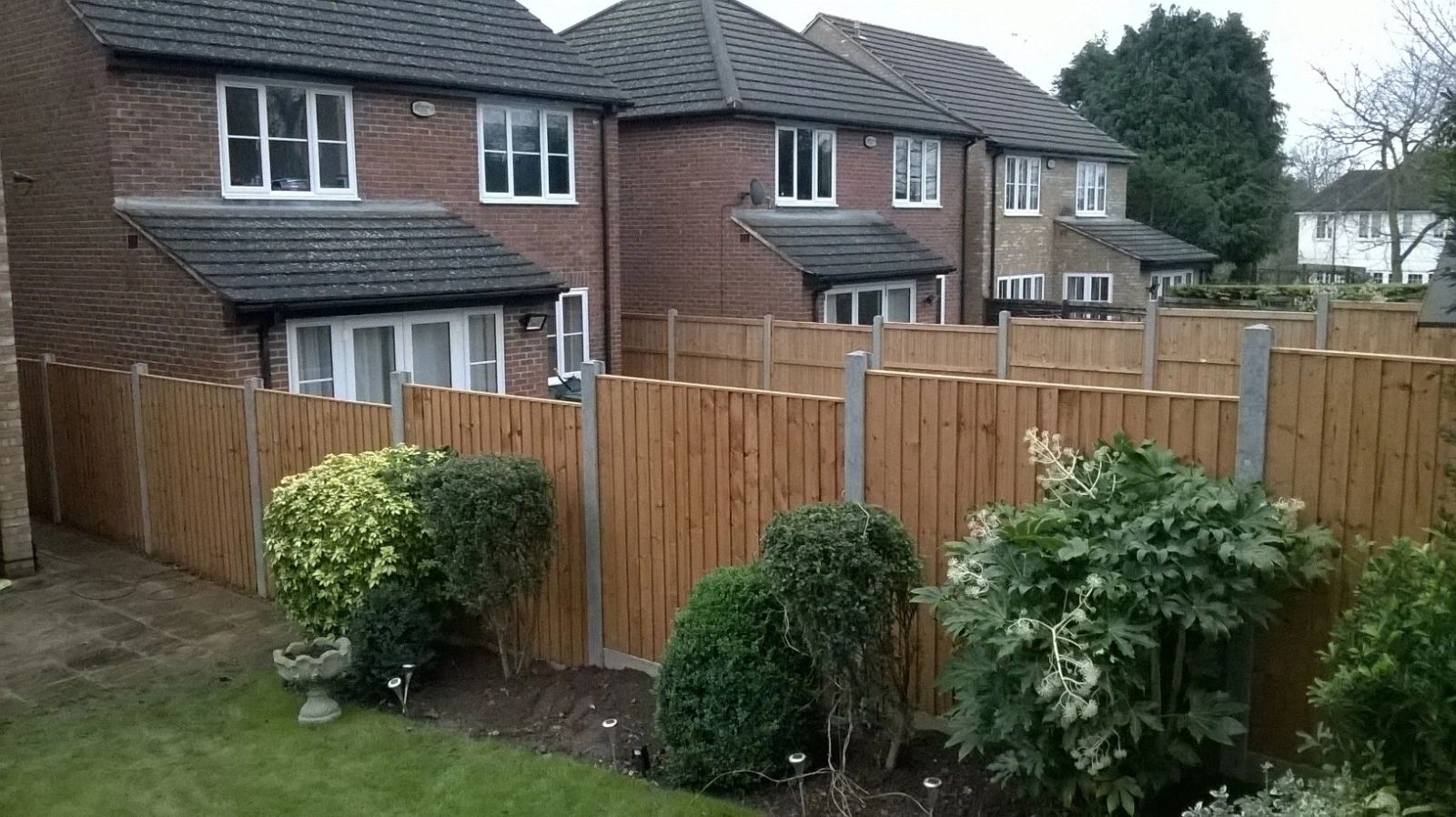
On a multi-property repair — several gardens sharing a rear boundary — coordinating access across neighbours can be the more awkward part of the job than the repair itself.
Aftercare once the fence is up
After installation we walk the finished line with the client, checking every gate closes and locks properly and that no section has been left with a gap at post or ground level, since that's exactly where a security spec fails first if it fails at all.
Any snag identified at that walk-round is fixed before the job is signed off, not left for a return visit.
Corner plots and highway sightlines
A boundary fronting a road used by vehicles is limited to 1m under permitted development, but corner plots have a second constraint: the highway authority's visibility splay, which can require even lower boundary treatment near a junction so drivers can see pedestrians and oncoming traffic.
These splays are measured as a triangle from a set point back along both roads and are sometimes fixed by a planning condition on the original build rather than by the general permitted development rules.
A solid fence built to the letter of the 1m rule can still be a highway safety problem on a tight corner, so it's worth checking the local plan or asking planning before finalising height on a corner boundary.
Repairing a fence near a tree protected by a Tree Preservation Order
Digging a new post hole or footing close to a protected tree's root zone can be restricted even where the fence itself needs no permission, since the restriction is about protecting the tree's roots rather than the fence.
Where root heave from a nearby tree has caused the damage being repaired, it's worth checking whether the tree is protected before digging anywhere near it, since hand-digging around roots or repositioning the post slightly may be required instead of a standard footing.
British Standards relevant to fencing
BS 1722 covers specifications for fences and gates across a range of types including chain link, wooden palisade, and estate fencing, setting out minimum post spacing, wire gauges and timber dimensions for each category.
These standards aren't legally mandatory on a private domestic job in the way building regulations are, but they're the reference point used in commercial specifications, school and public sector tenders, and by insurers assessing whether a boundary structure was reasonably built.
Where a job is speculatively described as 'to British Standard', it's worth confirming which specific part of BS 1722 is meant, since the standard covers a wide family of very different fence types.
End-grain sealing on cut timber
End grain is far more absorbent than a timber's long faces because it exposes the open ends of the wood's vascular cells, so a post or rail cut to length on site can soak up moisture many times faster at the cut end than elsewhere.
Leaving a fresh cut untreated is one of the more common ways a pressure-treated timber ends up rotting from the middle outwards, since the factory treatment doesn't extend to a cut made after the fact.
A brush-applied end-grain preservative or sealant on every site-cut post base and rail end restores some of that lost protection, and takes only a few minutes per cut relative to the risk it avoids.
Fixings into a party wall during a fence repair
Where a timber fence butts up against a party wall shared between two properties, repair work touching the wall itself — drilling new fixings, removing old brackets — can fall under party wall considerations separate from the fence repair.
In practice this mostly matters for anything beyond reusing existing fixing points; a straightforward like-for-like refit into the same holes rarely raises an issue, but a new fixing pattern into the wall is worth flagging to the client first.
Matching fence specification to a site-specific threat assessment
Not every commercial boundary needs the same specification — a compound holding cash or controlled substances warrants a different height, mesh and topping to a low-value storage yard, and starting a quote from a fixed catalogue spec rather than the specific threat can lead to over- or under-specifying the job.
A short threat assessment covering what's inside the boundary, who has legitimate access, and what's happened on similar sites nearby gives a more defensible basis for the chosen spec than a generic default.
Sequencing a multi-day install
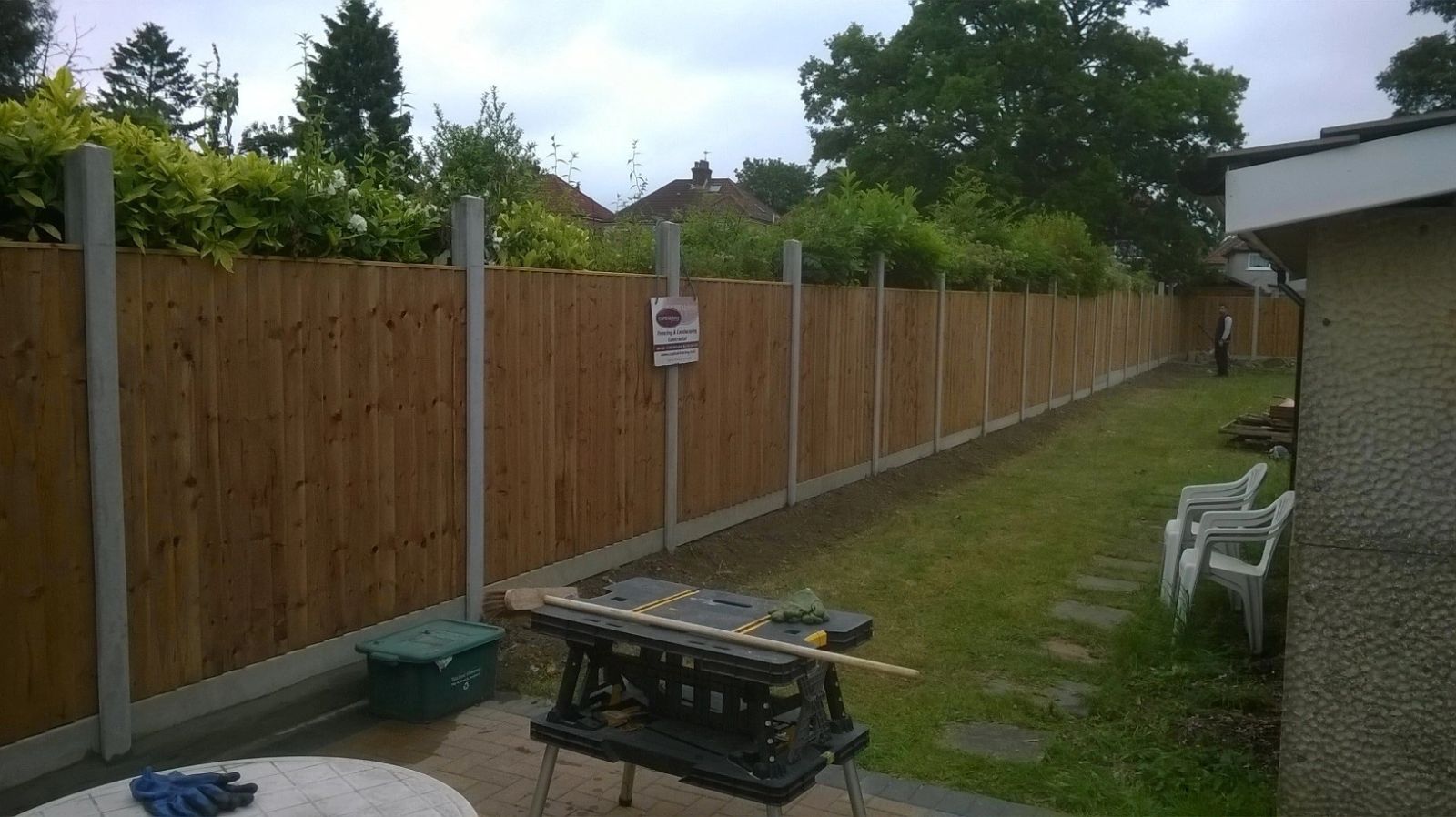
A typical multi-day fence installation runs old fence removal and waste clearance first, then post setting with time for concrete to go off, then panels, gravel boards and capping once posts are firm enough to take a load.
Rushing panels onto posts before the concrete has cured enough — particularly in cold weather when curing slows down — is a common cause of a fence leaning within its first few weeks.
On a longer run it often makes sense to work in sections so part of the boundary is never left fully open overnight, rather than removing the entire old fence before any new posts are in.
Vegetation growing through or over a shared fence
Plants growing from one garden through, over or against a shared fence — a spreading shrub, an overhanging branch, a self-seeded sapling in the fence line itself — sit in a grey area between garden maintenance and boundary structure that isn't always covered by a simple 'good neighbour' agreement.
A sapling that germinates directly against a post and is left to grow can eventually distort or crack the post as its trunk thickens, which is a slow-motion structural problem rather than a purely cosmetic one.
Flagging seedlings growing in or immediately against a fence line at an early stage, before root or trunk growth causes structural distortion, avoids a much larger repair later.
Composite colour fade realism
Composite boards do fade slightly in their first year or two of UV exposure before settling to a stable colour, which is a normal part of the material rather than a fault, but it means a newly added run will look a shade brighter than an older adjoining one for a while.
Darker composite colours fade proportionally more than lighter ones and also run hotter in direct sun, which can matter for boards used on south-facing screening close to seating areas.
Manufacturers typically quote colour consistency rather than a fixed fade-free guarantee, so matching an extension to an existing composite run several years old is unlikely to be an exact colour match regardless of the batch ordered.
Snagging checklist items on a completed security run
A snagging check on a finished security boundary covers gate alignment and latch engagement, gap sizes at ground level and junctions, fixing torque on any tamper-proof bolts, and that capping or gravel boards sit flush along the whole run.
Any item that's marginal on day one — a slightly sticking latch, a small ground gap — is worth fixing immediately rather than left as a wear item, since these are exactly the points a determined attempt will test first.
Timber species and on-site workability
Workability describes how easily a timber can be sawn, planed, nailed and screwed without splitting, tearing or blunting tools excessively, and it varies considerably between species independent of durability or strength.
Straight-grained, moderate-density softwoods like redwood pine are generally easier to work on site than dense hardwoods or highly figured timber with interlocked or wavy grain, which can tear out during cutting or planing.
A timber chosen purely for durability or appearance without considering workability can significantly slow on-site fitting, particularly where a lot of site cutting and drilling is needed rather than factory-machined components.
Solid panel screening against wind loading and neighbour impact
A solid-faced security panel gives better visual screening and blocks a would-be intruder's view of what's inside a compound, but it also catches significantly more wind than an open mesh or picket design of the same height, requiring stronger posts and closer spacing to stay stable.
Where a solid screen also sits close to a neighbouring property, its impact on that neighbour's light and outlook is worth considering alongside the loading calculation, since a taller solid screen can raise a separate boundary dispute even where it's structurally sound.
Repairing where two adjoining fence styles meet at a corner
A corner where one owner's closeboard fence meets a neighbour's panel fence is a common awkward point for repair, since damage at the corner post can affect both runs but only one owner may be instructing the work.
Where only one side is being repaired, the corner post and its fixings into both runs need checking so the finished repair doesn't leave the untouched neighbouring fence with a weaker connection than before.
Dealing with concealed or unusual legacy fixings
Older fence runs sometimes used fixings that aren't common today, such as coach-screws recessed and pelleted over, which take longer to locate and remove than a standard exposed nail or screw.
Identifying the fixing type before starting a repair avoids damaging surrounding sound timber by forcing a component free with the wrong method.
Driveway gate sizing and swing arc
A driveway gate needs its swing arc checked against the car actually parked behind it, not just the opening width, since a gate that clears a small hatchback can still clash with a larger estate or a roof box.
Outward-opening gates onto a public footway are generally avoided because they can obstruct pedestrians and pushchairs, which is why most residential driveway gates are hung to open inward onto the drive itself.
Sliding gates are a practical alternative on a short or sloping driveway where there isn't room for a swing arc, though they need a level track run and enough side clearance to slide fully open.
Recycled mixed-plastic lumber composition
Recycled plastic lumber differs from wood-plastic composite in that it's typically made entirely from reprocessed plastic waste with no wood fibre content, giving it complete immunity to rot and insect attack but a distinctly plastic rather than timber-like appearance.
Because it contains no wood fibre, it doesn't absorb moisture in the way composite or timber boards do, but it's also generally more flexible and prone to visible sagging over a wide unsupported span unless internally reinforced.
It's more commonly specified for ground-contact components like gravel boards and low retaining edges, where rot resistance matters most, than for larger structural fencing elements.
LOLER-adjacent inspection duties on powered gates
Automated or powered gates fall under machinery safety regulations rather than lifting equipment rules directly, but the same discipline of scheduled inspection applies — force limiting, safety edges and photocell alignment on a powered gate need periodic checking, not a one-off commissioning test.
Where a fencing contractor supplies the mechanical gate leaf but not the automation, responsibility for these checks is usually split contractually, and it's worth confirming who's covering what before the gate goes live.
Diagnosing a fence problem before quoting
A repair quote starts with identifying which of the usual failure points is actually responsible — post, panel, gravel board or a full run — because pricing a full replacement for what's actually a single post repair costs the client far more than necessary.
We probe timber at ground level and check the whole run for related stress, not just the section that's obviously failed.
Building decking over an existing patio or hardstanding
Decking built directly over a sound existing patio saves the cost and disruption of breaking out the old surface, provided the substructure can be securely fixed to it and a fall is built in for drainage rather than trapping water underneath.
A patio with a slope toward the house, rather than away from it, needs correcting in the decking substructure rather than simply built over as-is, since a deck can't fix a drainage problem it's built directly on top of.
Ventilation gaps around the edge of a deck built over solid paving matter just as much as one built over soil, since trapped moisture and poor airflow cause the same rot risk to the substructure timber either way.
Why repaired sections sometimes weather differently
New timber fitted into an older run will weather at a different rate to the surrounding boards for the first year or two, simply because the existing timber has already taken its first few seasons of treatment and UV exposure.
This settles down over time and isn't a sign of a poor repair — we explain this at the point of quoting so it isn't a surprise later.