Ongoing access rights reserved under a utility wayleave
A recorded wayleave or easement for utility apparatus usually reserves an ongoing right for the utility company to access and maintain their equipment, which can mean a fence built across the strip needs a lockable gate or removable section.
Building an entirely fixed fence over an area subject to this kind of reserved access can lead to the utility company needing to remove part of it later at the owner's inconvenience.
Checking the title register for any registered wayleave before finalising a fence design avoids this kind of retrofit.
Clearing debris from a sliding gate track
Leaves, gravel and windblown litter collect in a ground-level sliding gate track over time, and a build-up is one of the most common reasons a gate that used to run smoothly starts binding or stalling partway along its travel.
Regular clearing of the track, particularly after autumn leaf fall or after a period of wind, prevents debris from being repeatedly crushed into the track and becoming harder to remove.
Hinge types found on garden gates
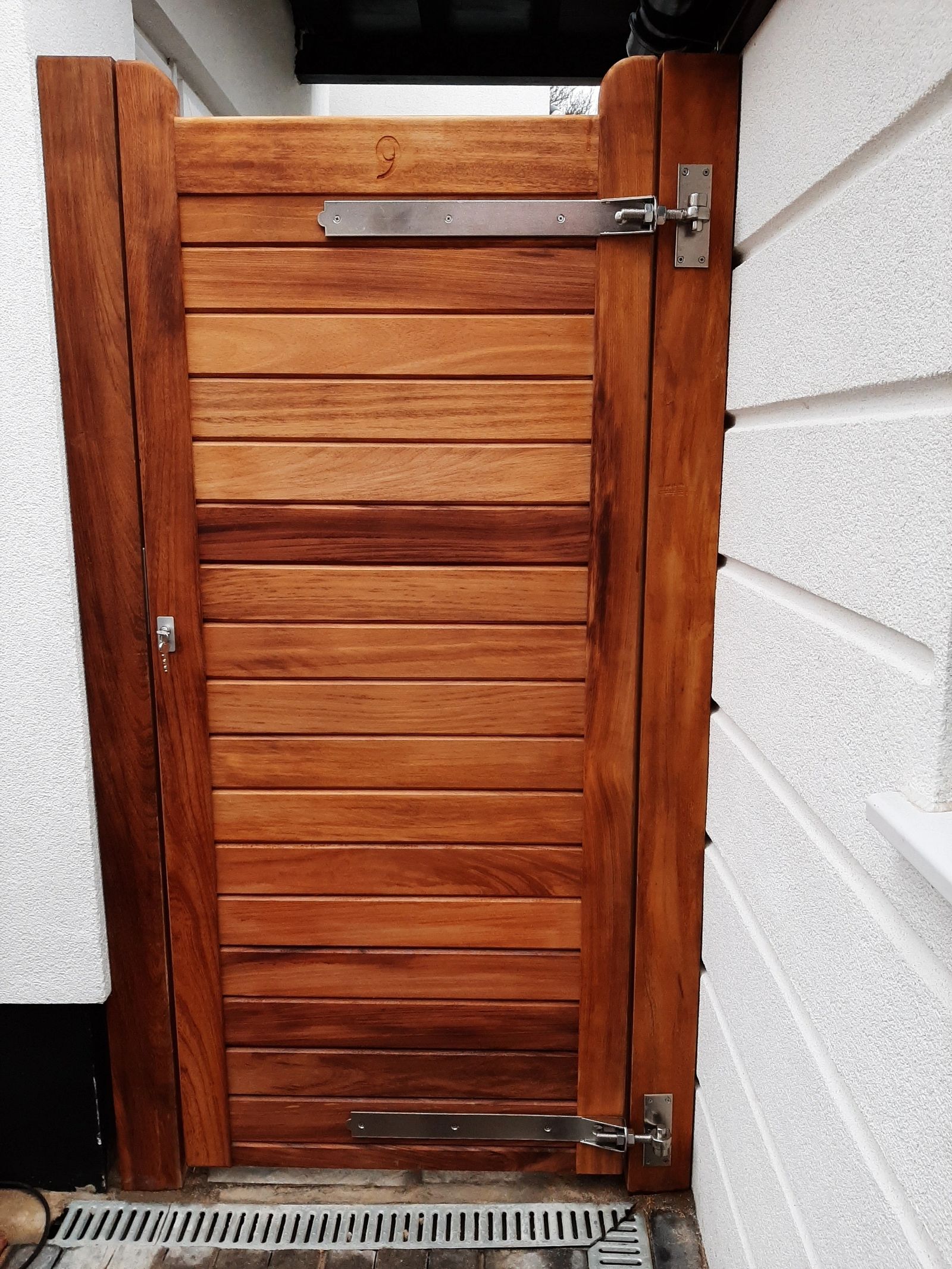
Band-and-gudgeon hinges, tee hinges, plain butt hinges and adjustable bolt-on hinges each suit a different gate weight and post material, and fitting the wrong type for the gate's weight is a common cause of early hinge failure.
A heavy timber gate needs a band-and-gudgeon or heavy-duty tee hinge rather than a light butt hinge sized for an internal door.
Agreeing a shared contribution to a boundary fence
There's no automatic legal requirement in England for a neighbour to contribute to the cost of a boundary fence, even where both sides benefit from it, unless the deeds specifically say otherwise.
Many boundary fences are replaced by agreement between neighbours splitting the cost informally, but this is a private arrangement rather than something either side can compel.
Getting any agreed contribution, choice of style, and who instructs the contractor written down in an email beforehand avoids a common source of friction once the invoice arrives.
Culverted watercourses running beneath a boundary
Some older boundaries have a small watercourse culverted — enclosed in a pipe — beneath them, often unnoticed until groundworks reveal it or a drainage problem develops.
Ordinary watercourses, even culverted ones, can carry maintenance obligations and sometimes require consent from the local authority or Environment Agency before altering anything above or around them.
Where an old map or local knowledge suggests a watercourse might run beneath a boundary, checking with the council's land drainage team before digging is a sensible precaution.
Ecology checks and protected species on boundary sites
Removing a mature hedge, dense scrub or an old fence with ivy growth can disturb species protected under the Wildlife and Countryside Act, and on larger or commercial sites a preliminary ecological appraisal is often required before consent is granted for the works.
Bats in particular can roost in gaps behind old fascia boards, dense ivy or timber sheds attached to a boundary, and disturbing a roost is an offence regardless of whether it was known about in advance.
Where a boundary feature shows signs of established wildlife use, a short ecological check before removal is a reasonable precaution on any job larger than a routine domestic fence swap.
Tangential shrinkage and cupping
Wood shrinks more in the direction that runs tangentially to the growth rings than along the grain's length, and boards cut close to the outer edge of a log (flat-sawn) show this most, curling into a dish shape known as cupping as they dry.
A board with growth rings running roughly parallel to its face is far more prone to cupping than one cut through the centre of the log, where rings run closer to perpendicular to the face.
Fixing boards with two nails or screws per bearer rather than one resists cupping better, since a single central fixing lets the edges lift and curl relatively freely.
Certificates of lawfulness for existing boundary structures
A Certificate of Lawfulness of Existing Use or Development can formally confirm that an existing boundary structure was lawfully built, which is useful where there's uncertainty or a dispute about historic permissions.
This is different from planning permission itself — it's a factual confirmation of lawful status, often sought before a property sale to resolve a conveyancing query.
Where a long-standing boundary fence's planning history is unclear, applying for this kind of certificate can settle the question more reliably than relying on assumption.
Specification driven by an insurer's boundary requirements
Some commercial and high-value premises have boundary security requirements set by an insurance policy — a minimum fence height, mesh type or lock standard — that the fencing spec has to meet regardless of what would otherwise be chosen.
Where a specific requirement applies, it's worth getting it in writing from the policy documents before quoting, since fitting to a general standard when a stricter one is required can leave a gap the client didn't expect.
Fencing a marina or boatyard compound
A marina or boatyard compound combines standard perimeter security with exposure to salt air and standing water, so galvanising specification and fixing hardware are upgraded from a typical inland commercial job to resist accelerated corrosion.
Gate access often needs to accommodate trailered boats and cradles passing through, which pushes toward a wide sliding gate or a removable section rather than a fixed-width pedestrian-scale opening.
Obstruction offences under the Highways Act
The Highways Act 1980 makes it an offence to obstruct a public highway, including the footway, without lawful authority, which is the underlying reason fencing, skips or materials on a pavement need proper authorisation.
This applies regardless of whether the obstruction is temporary for a delivery or intended as a permanent boundary feature encroaching onto highway land.
Where any part of planned boundary work might extend onto or over a public footway or verge, checking with the highway authority first avoids a straightforward enforcement issue later.