London & Hertfordshire Free Site Visit
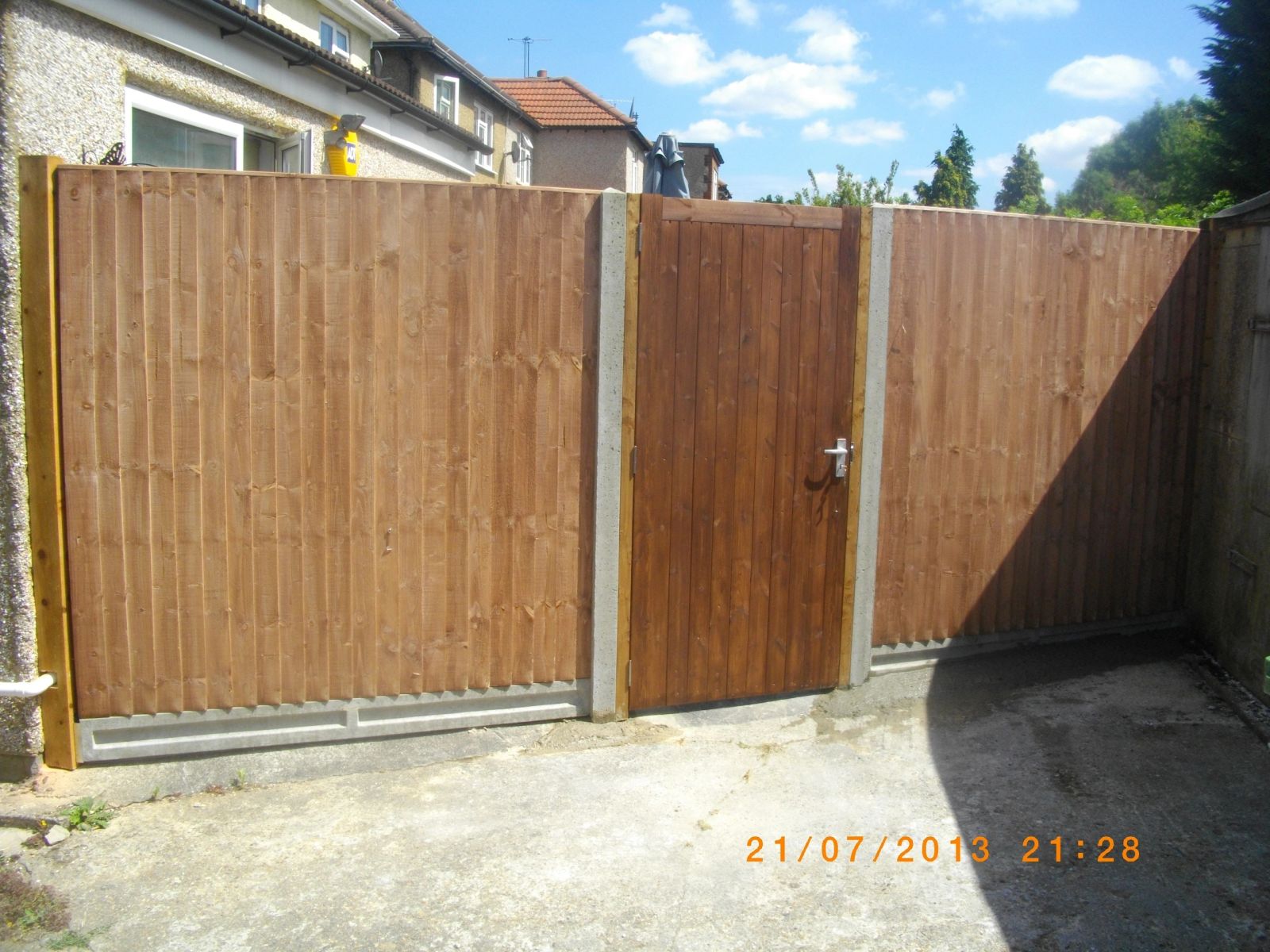
bespoke wooden gate installed by Capital Fencing in Enfield (EN1)
Enfield · EN1 / EN2 / EN3

Local side-return gates specialist covering Enfield & waltham cross

Side Return Gates in Enfield is a specific brief for us — London terraces and semis with a narrow alley between the house and the neighbouring wall. The default local answer isn't a stock catalogue drop: it's 44mm framed hardwood or planed softwood, tongue-and-groove infill, adjustable ball-race hinges, closing stop and drop-bolt. On Enfield sites we also spec around high winds funnelled down the lea valley regularly knock over weaker panel fences, which is where a lot of side-return gates jobs quietly fail two years in. Roads such as Carterhatch Lane and Baker Street are typical of the local layout. Forty Hall is a useful local reference point. Enfield spans a wide area from the Victorian terraces of EN1 town centre through the mature suburbs of EN2 to the industrial estates near Brimsdown in EN3, close to the Lee Valley.

Side Return Gates in Enfield is a specific brief for us — London terraces and semis with a narrow alley between the house and the neighbouring wall. The default local answer isn't a stock catalogue drop: it's 44mm framed hardwood or planed softwood, tongue-and-groove infill, adjustable ball-race hinges, closing stop and drop-bolt. On Enfield sites we also spec around high winds funnelled down the lea valley regularly knock over weaker panel fences, which is where a lot of side-return gates jobs quietly fail two years in. Roads such as Carterhatch Lane and Baker Street are typical of the local layout. Forty Hall is a useful local reference point. Enfield spans a wide area from the Victorian terraces of EN1 town centre through the mature suburbs of EN2 to the industrial estates near Brimsdown in EN3, close to the Lee Valley.

Typical side-return gates briefs in Enfield

  • tongue-and-groove side gate framed on adjustable ball-race hinges to cope with seasonal timber movement
  • matched pedestrian and bin-store gate serving a shared side alley between two flats

Why this spec, for London terraces and semis with a narrow alley between the house and the neighbouring wall

  • framed builds don't drop the way board-and-batten side gates do in year two
  • adjustable hinges handle the seasonal timber movement every London side gate experiences
  • made to the exact opening — no packing pieces, no gaps for burglars or foxes
Default spec

How we build side-return gates in Enfield

44mm framed hardwood or planed softwood, tongue-and-groove infill, adjustable ball-race hinges, closing stop and drop-bolt. On Enfield jobs we adjust for high winds funnelled down the lea valley regularly knock over weaker panel fences.

Property mix locally: interwar semis, 1960s estates and pockets of Georgian housing around Forty Hill. Typical gardens: medium-depth gardens that often back onto alleyways — access is the deciding factor. Postcodes we regularly service: EN1, EN2, EN3.

Where side-return gates isn't the right answer

  • openings under 700mm where a person can't comfortably pass with a bin — a fixed panel is often the honest answer
  • shared alley gates where freehold consent from both parties hasn't been agreed

Side Return Gates FAQs — Enfield

How wide can a single side gate span before it needs a wheel?

On side-return gates jobs in Enfield (EN1), our default answer is: 44mm framed hardwood or planed softwood, tongue-and-groove infill, adjustable ball-race hinges, closing stop and drop-bolt. The honest trade-off is fitting a full-weight hardwood gate on domestic pin hinges — drops within six months — which is exactly what our default spec designs out.

Softwood or hardwood for a London side gate?

Across Enfield we spec around high winds funnelled down the lea valley regularly knock over weaker panel fences, so on side-return gates that usually means iroko hardwood on galvanised ironmongery for 15+ year service. We'll walk you through framed builds don't drop the way board-and-batten side gates do in year two on the site visit before you commit.

Is a drop-bolt necessary as well as a lock?

Enfield coverage means we can survey most EN1 addresses inside a week — London terraces and semis with a narrow alley between the house and the neighbouring wall. The honest trade-off is fitting a full-weight hardwood gate on domestic pin hinges — drops within six months — which is exactly what our default spec designs out.

Do you handle the wall fixing on both sides?

Practically: hardwood side gate between a rendered wall and a brick pier, 780mm opening, drop-bolt into a concrete slab socket. That's the Enfield version of this job, not a generic one. The honest trade-off is fitting a full-weight hardwood gate on domestic pin hinges — drops within six months — which is exactly what our default spec designs out.

Can bin-store and pedestrian access share one gate?

On side-return gates jobs in Enfield (EN1), our default answer is: 44mm framed hardwood or planed softwood, tongue-and-groove infill, adjustable ball-race hinges, closing stop and drop-bolt. For context: adjustable hinges handle the seasonal timber movement every London side gate experiences. Measured, quoted and installed by the same small crew.

Recent side return gates work
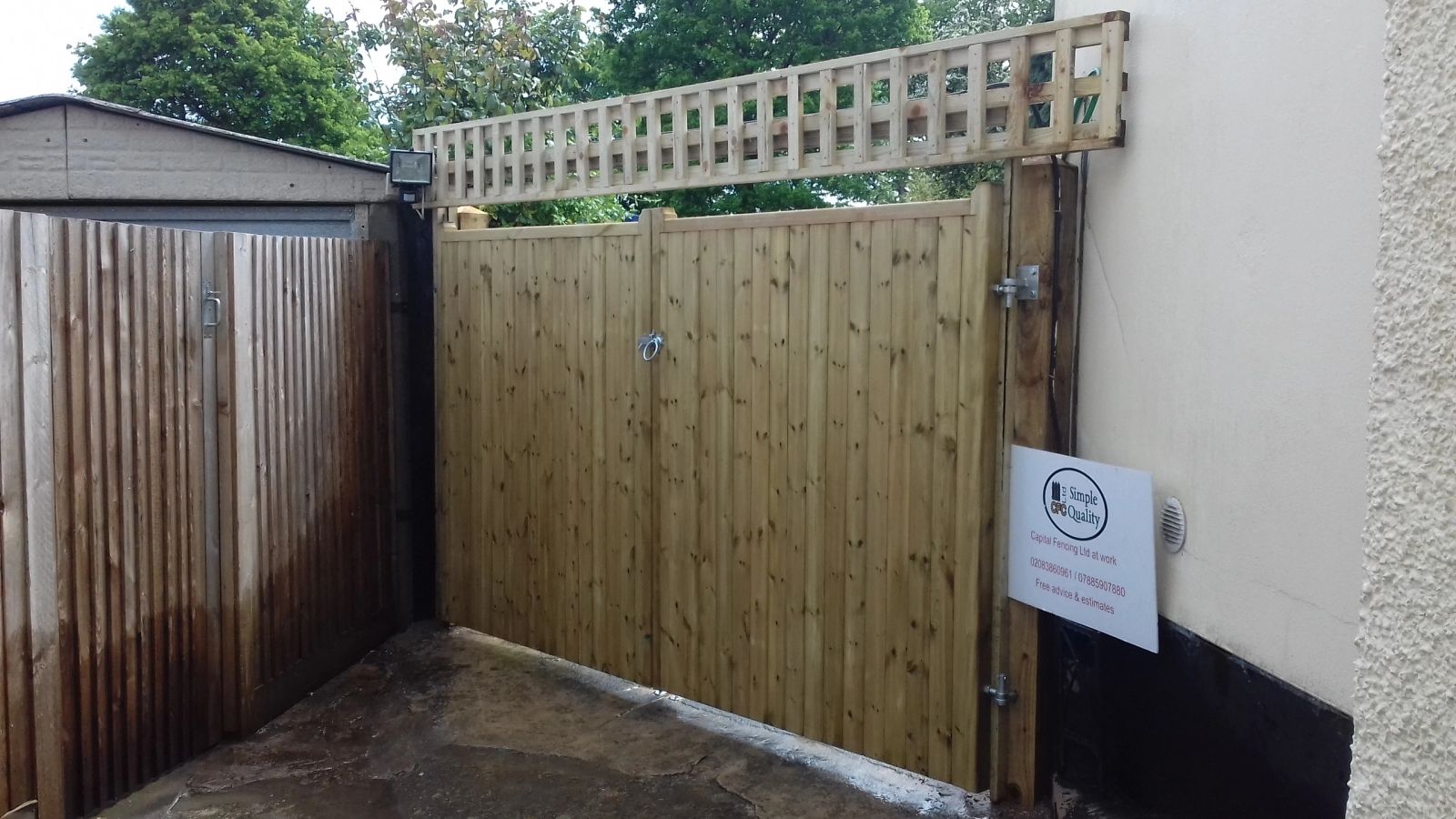
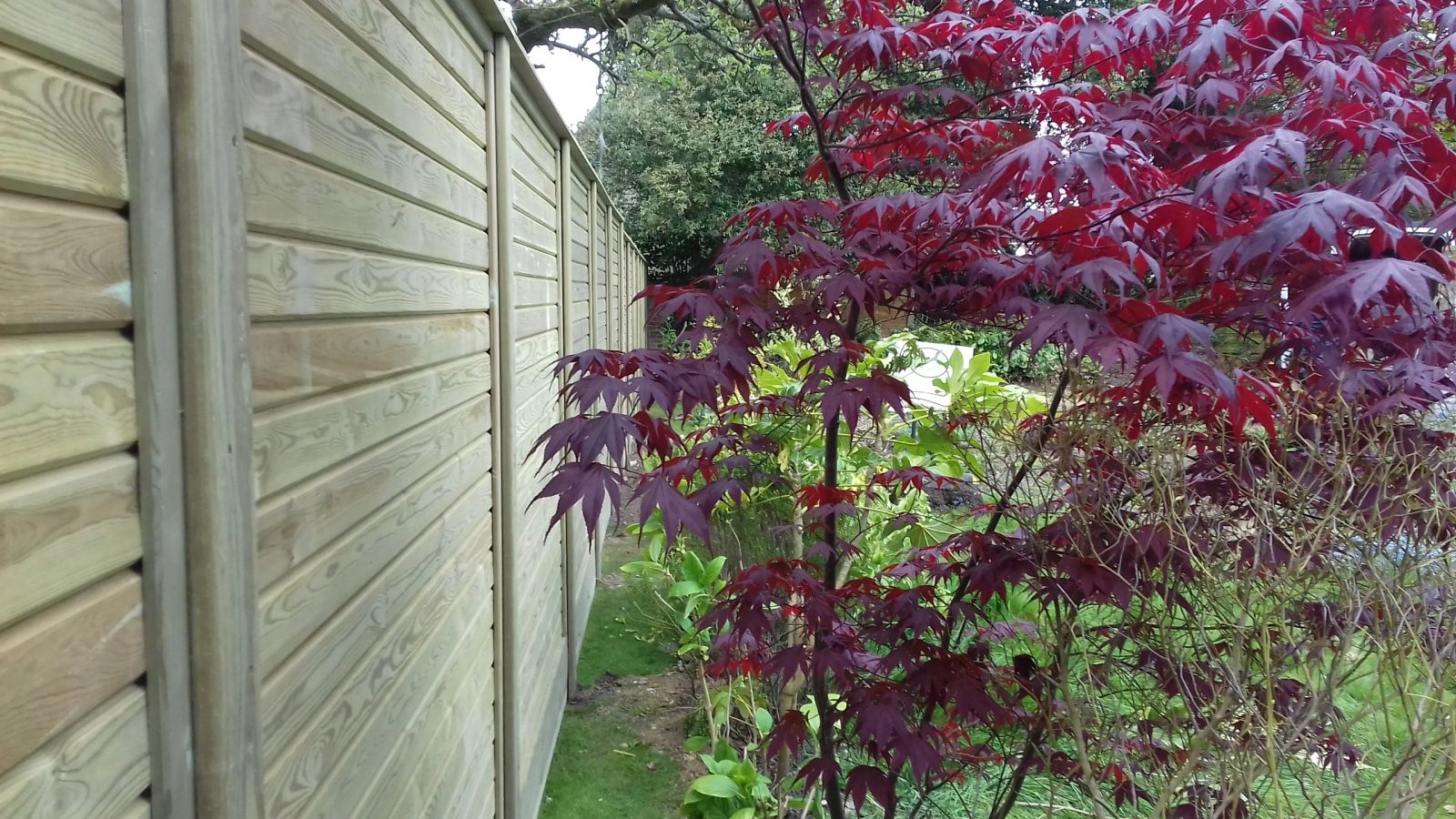
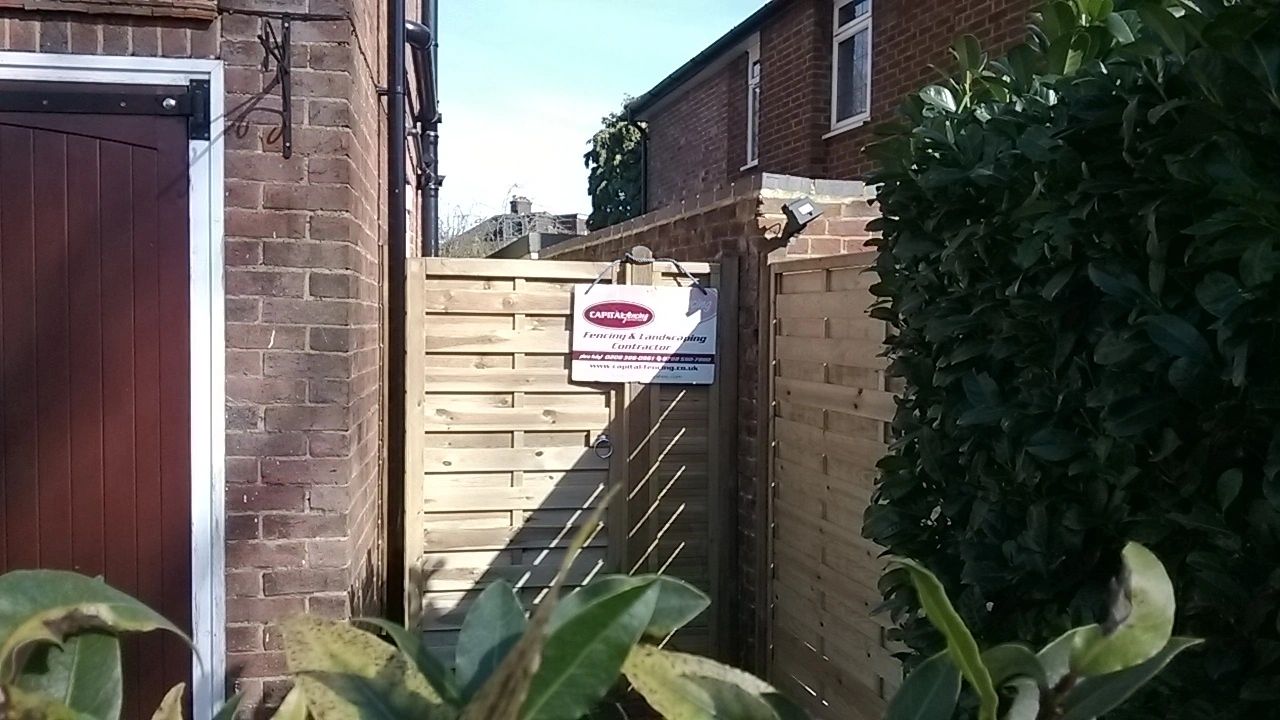
bespoke wooden gate installed by Capital Fencing in Enfield (EN1)double driveway gates installed by Capital Fencing in Enfield (EN1)hardwood side gate installed by Capital Fencing in Enfield (EN1)metal entrance gate installed by Capital Fencing in Enfield (EN1)

How we approach side return gates on Enfield properties

Drainage fixes as part of a repair

Where poor drainage caused or contributed to the original failure, a repair that doesn't also address the drainage — regrading a low spot, adding a small soakaway, or fitting a concrete gravel board — risks the same failure recurring.

Addressing drainage at repair time is usually more cost-effective than repeating the same panel or post repair every few years.

Ground anchors on hardstanding

Where a post can't be dug into soil — a concrete yard, a roof terrace, or a surface that can't be broken — a mechanical or resin ground anchor bolted through a base plate provides the fixing instead.

Anchor capacity has to match the loading of the fence height and any expected impact, and manufacturer pull-out figures are checked against the specific slab thickness before anchors are relied on for a taller run.

Self-closing spring hinges and tension setting

A self-closing spring hinge pulls a gate shut automatically after use, which matters where a gate must not be left open — around a pool, a road-facing boundary or a play area — but the spring tension needs setting so the gate closes fully without slamming.

Tension that's too light leaves the gate ajar in a headwind; tension that's too strong accelerates wear on the latch and keep from repeated hard closing.

Why a night-time visual check adds value to a security survey

A daytime survey shows the fence's physical condition but not how it actually performs after dark, when most intrusion attempts happen, so a short evening visit to check lighting coverage, shadow lines and visibility from the street can reveal gaps a daytime walk-round misses entirely.

This isn't always practical for every job, but it's worth offering on a higher-value commercial site where lighting and fencing are both being reviewed together.

Deadlocks fitted to timber gate doors

A deadlock fitted to a solid timber gate door needs a keep let into a post or frame that's substantial enough to resist forcing, since a deadlock is only as strong as the timber and keep it engages with.

Outdoor use also means the lock case and keep need weather protection or a corrosion-resistant finish that an equivalent internal door lock wouldn't require.

Overhanging roofline drip lines onto a boundary

A fence running close to a house or outbuilding without gutters, or with a gutter that overshoots during heavy rain, can sit directly under a concentrated drip line that soaks one section of the run far more than the rest.

Over time this shows up as a localised patch of accelerated rot or algae growth that doesn't match the general weathering pattern of the rest of the boundary.

Where this can't be resolved by fixing the guttering itself, a slightly increased offset from the wall or a more resistant board section at that specific point avoids repeat localised failure.

Sports-pitch ground with irrigation

Perimeter fencing around a sports pitch or playing field often runs over ground with an engineered drainage or irrigation system just below the surface, including sand-slit drains or pop-up sprinkler lines that aren't always accurately recorded.

Damaging a drainage lateral while setting posts can cause localised waterlogging on the pitch itself long after the fencing work is finished, which is a far more costly problem to fix than the original fence job.

Liaising with the groundskeeper or facilities manager over exact drain and irrigation layout before digging is standard practice on this type of site, rather than relying on a general services scan alone.

Handling heavy gate posts and large timbers safely

A large hardwood or oversized gate post can be too heavy to lift and position safely by hand, particularly into a deep hole, so a simple lifting aid such as a sack truck, roller bars or a block and tackle reduces the risk of a manual handling injury.

Lowering a heavy post into a hole under control, rather than dropping the last stretch, also protects the hole's sides from collapsing under the impact just as it's being positioned.

Where a post genuinely needs mechanical assistance to move safely, planning that equipment into the job at the outset avoids improvising with inadequate lifting methods on the day.

Deck height relative to the house damp-proof course

Building guidance generally recommends decking be kept at least 150mm below the house's damp-proof course, since a deck built level with or above the DPC risks bridging it and allowing damp to track into the house wall.

This is a common issue on a sloping plot where the natural ground level near the house is already close to the DPC, leaving very little room to build a deck without breaching that clearance.

Where the clearance genuinely can't be achieved without lowering the deck excessively, a drained gap or a change in construction detail near the house wall is a better solution than ignoring the clearance altogether.

Post shoe drainage detailing

A metal post shoe supports a timber post above a concrete or paved surface, and the shoe's base plate needs a way for water to drain away rather than pooling directly under the post's end grain.

Shoes with a raised or perforated base, rather than a flat solid plate, let water that does reach the post's foot drain or evaporate rather than sitting trapped between metal and timber.

Even a well-designed shoe underperforms if it's set into a low point that collects surface water, so the surrounding ground or paving level, not just the shoe detail itself, needs to shed water away from the post base.

Security fencing directly alongside a public footpath

A fence running hard against a public footpath needs anti-climb toppings avoided or set back for pedestrian safety, and any gate opening onto the footpath must not swing out into it, since an outward-opening gate on a shared path is both a trip hazard and often a rights-of-way issue.

Where the footpath is well used, sightlines along the path are kept open at any pinch point rather than allowed to be blocked entirely by a solid fence, partly for personal safety of path users after dark.

Clearing old gate hardware and frames

Old hinges, latches and, where a frame is beyond repair, the timber itself are removed and taken off site as part of the job, rather than left for the client to dispose of separately.

Where original ironmongery is salvageable and still serviceable, we reuse it rather than replacing parts that don't need it.

Allotment and paddock ground

Allotment and paddock boundaries are often on ground that's been cultivated, grazed or left rough for decades, with a topsoil layer that's deeper and looser than a typical garden lawn but can also conceal old cultivation debris, buried irrigation pipe or fencing stobs from previous boundaries.

Paddock ground grazed by livestock compacts unevenly, with poached, churned patches near gateways sitting very differently underfoot from the firmer ground a few metres away.

Post specifications on this kind of ground usually need to account for stock leaning or rubbing on the fence line, which is a different load case from a garden boundary that just needs to withstand weather and general wear.

Deciding between adjustment and rebuild

Most gate faults can be corrected by adjusting hinges, replacing a latch or hardening a loose joint, but a frame that's racked badly enough to have opened its joints permanently, or timber that's rotted through a structural member, generally needs rebuilding rather than adjusting.

Establishing which category a gate falls into early avoids repeated small adjustments on a frame that's already past the point where adjustment alone will hold.

Discontinued panel styles

Panel fencing ranges get discontinued or reformulated by manufacturers more often than solid boarded fencing components, since panels are a proprietary product rather than built from generic stock timber sizes.

A ten- or fifteen-year-old panel range is often simply no longer made, which means a single damaged panel in an otherwise sound run may need the whole run replaced, or a mismatched panel accepted as a compromise.

Closeboard and picket fencing, built from standard boards, rails and posts rather than a proprietary panel, are generally easier to repair piecemeal decades later precisely because the components aren't tied to one manufacturer's product cycle.

Height restrictions on a fence directly fronting a public footpath

A boundary that fronts directly onto a public footpath is often subject to a lower permitted height than a rear or side boundary under general planning rules, since a tall solid structure close to a pavement can affect sightlines and pedestrian safety.

Where security needs push toward a taller specification than the footpath frontage rule allows, planning permission is sought explicitly rather than assumed to fall under permitted development, and a mesh or picket design can sometimes reach greater height than a solid panel under the same visual-impact assessment.

Downpipe discharge points near a fence base

A downpipe discharging directly onto open ground near a fence line, rather than into a proper drain or soakaway, concentrates a large volume of roof water at one specific point along the boundary during heavy rain.

Over time this creates a permanently saturated patch that behaves like a high water table locally, even though the rest of the garden drains normally.

Redirecting the discharge with a short length of pipe or a small soakaway a metre or two from the fence line resolves the issue far more effectively than trying to compensate with a more resistant post base.

Choosing a self-closing mechanism for pool or drive gates

A spring-loaded hinge, hydraulic closer, or gravity-hinge design (where the hinge itself is angled so the gate swings closed under its own weight) each achieve self-closing in a different way, with different maintenance needs and different feel in use.

Gravity hinges are mechanically simple and low-maintenance but rely on the gate post and hinge post staying accurately set, since any settling changes the closing behaviour.

Hydraulic or spring closers give a more consistent, adjustable close but are an additional mechanical component that itself needs occasional servicing or replacement over the gate's life.

Sequencing a multi-bay repair

On a repair spanning several bays, work generally runs from the soundest end toward the most damaged, so the newly fixed sections provide a stable reference line for the rest of the work rather than starting from the worst-affected point.

Where a repair is linked to an insurance claim, documentation is completed at each stage rather than only at the end.

Fixing a fence run to an existing masonry wall

Tying a timber fence into an existing brick or block wall usually means fixing a timber post or batten flat to the wall face with masonry bolts or heavy-duty frame fixings rather than digging a post hole hard against the footing.

The wall's own condition matters before any fixing goes in — loose pointing, spalled brick faces or a wall already leaning shouldn't be relied on to carry lateral load from a fence panel.

Where the wall belongs to a neighbour or is shared, fixing into it without agreement can be a boundary matter in its own right, separate from the fencing work itself.

Sizing gates for specific vehicle types

A driveway gate wide enough for a family car may still be too narrow for a van, motorhome or trailer, which is worth checking against the actual vehicles a household owns or plans to own rather than a generic standard opening.

Turning circle matters as much as raw width on a tight driveway, since a gate that technically fits a vehicle's width can still be unusable if there isn't room to straighten up before passing through it.

For a household with mixed vehicle needs, a wider single gate or double gates with an off-centre split (one narrow, one wide leaf) can give flexibility that two equally-sized leaves don't.

Checking and shakes as timber dries

Checking refers to small surface splits that open along the grain as the outer face of a timber dries and shrinks faster than the still-damp core, and it's a normal, largely cosmetic feature of drying softwood rather than a structural fault.

Shakes are a related but distinct defect present in the standing tree or log itself, such as a separation between growth rings, and can run deeper into a section than surface checking.

A moderate amount of surface checking on a post or rail doesn't usually compromise strength, but a shake running the length of a load-bearing post is worth inspecting before use, since it can concentrate stress along that plane.

Side Return Gates across EN1, EN2, EN3 is a regular run for us. We'll quote honestly, tell you if side-return gates isn't the right answer for your site, and book the job in within a week or two of a signed quote. measured, quoted and installed by the same small crew. Roads such as Lancaster Road and Carterhatch Lane are typical of the local layout. Lee Valley Park is a useful local reference point. Enfield spans a wide area from the Victorian terraces of EN1 town centre through the mature suburbs of EN2 to the industrial estates near Brimsdown in EN3, close to the Lee Valley.

Get In Touch

Get My Free Quote — 24h Response

No callout fee · Free site visit · Friendly local team covering London & Hertfordshire.

Call us
07885907880
or 02036484746
Email
capital_fencing@yahoo.com
WhatsApp
Message us anytime
Area
London & Hertfordshire
Payment
Card payments accepted

Pay by debit or credit card, bank transfer or cash once the work and price are agreed. No deposit taken online.

Request a Free Quote

We'll get back to you within 24 hours.

Free Site Visit No Callout Fee
Call WhatsAppQuote