London & Hertfordshire Free Site Visit
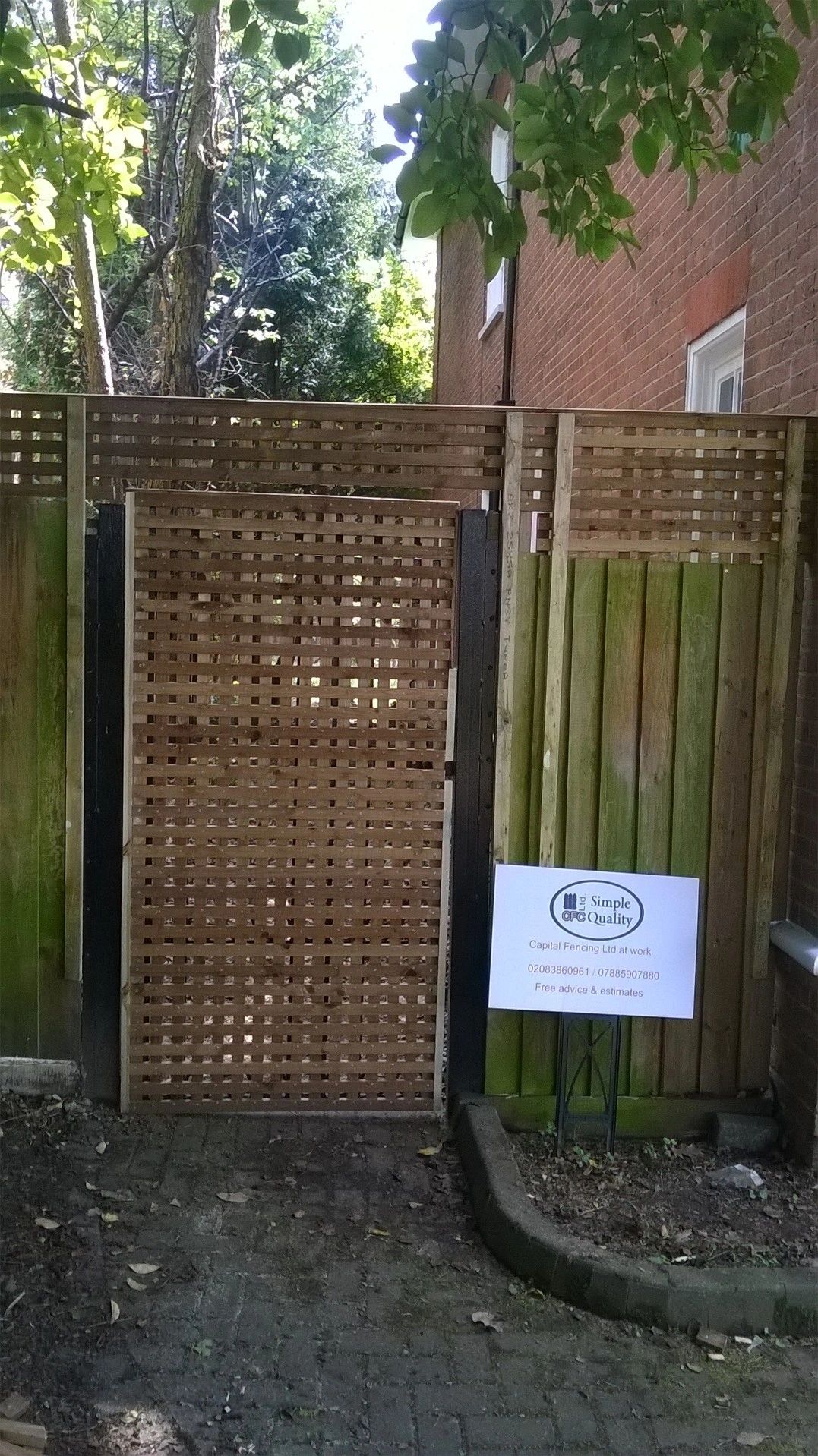
bespoke wooden gate installed by Capital Fencing in Cheshunt (EN7)
Cheshunt · EN7 / EN8

Side Return Gates in Cheshunt — Built for how the finish sits next to the neighbour's existing boundary

Capital Fencing installs side-return gates across Cheshunt and out toward waltham cross and enfield. What separates a side-return gates job from a standard boundary is the detail: hardwood side gate between a rendered wall and a brick pier, 780mm opening, drop-bolt into a concrete slab socket. That's the work, not the marketing. Roads such as Turners Hill and Crossbrook Street are typical of the local layout. Lee Valley Regional Park is a useful local reference point. Goffs Oak, on higher ground to the west, has larger detached plots and a different topography from the valley floor.

Capital Fencing installs side-return gates across Cheshunt and out toward waltham cross and enfield. What separates a side-return gates job from a standard boundary is the detail: hardwood side gate between a rendered wall and a brick pier, 780mm opening, drop-bolt into a concrete slab socket. That's the work, not the marketing. Roads such as Turners Hill and Crossbrook Street are typical of the local layout. Lee Valley Regional Park is a useful local reference point. Goffs Oak, on higher ground to the west, has larger detached plots and a different topography from the valley floor.

Typical side-return gates briefs in Cheshunt

  • tongue-and-groove side gate framed on adjustable ball-race hinges to cope with seasonal timber movement
  • hardwood side gate between a rendered wall and a brick pier, 780mm opening, drop-bolt into a concrete slab socket
Default spec

How we build side-return gates in Cheshunt

44mm framed hardwood or planed softwood, tongue-and-groove infill, adjustable ball-race hinges, closing stop and drop-bolt. On Cheshunt jobs we adjust for ground water near the lee valley means post bases need extra care to prevent rot.

Property mix locally: mid-century semis and bungalows, plus newer riverside developments toward Goffs Oak. Typical gardens: long flat gardens — many back onto the Lee Valley with high-water-table conditions. Postcodes we regularly service: EN7, EN8.

Why this spec, for London terraces and semis with a narrow alley between the house and the neighbouring wall

  • framed builds don't drop the way board-and-batten side gates do in year two
  • adjustable hinges handle the seasonal timber movement every London side gate experiences
  • made to the exact opening — no packing pieces, no gaps for burglars or foxes
What goes wrong

Common failure modes on side-return gates

  • fitting a full-weight hardwood gate on domestic pin hinges — drops within six months
  • not shooting a drop-bolt into a concrete socket — kicked or pried open too easily

Side Return Gates FAQs — Cheshunt

How wide can a single side gate span before it needs a wheel?

On side-return gates jobs in Cheshunt (EN7), our default answer is: 44mm framed hardwood or planed softwood, tongue-and-groove infill, adjustable ball-race hinges, closing stop and drop-bolt. For context: adjustable hinges handle the seasonal timber movement every London side gate experiences. Measured, quoted and installed by the same small crew.

Can you match the gate to my existing side-return fencing?

Across Cheshunt we spec around ground water near the lee valley means post bases need extra care to prevent rot, so on side-return gates that usually means iroko hardwood on galvanised ironmongery for 15+ year service. The honest trade-off is fitting a full-weight hardwood gate on domestic pin hinges — drops within six months — which is exactly what our default spec designs out.

Can bin-store and pedestrian access share one gate?

Broxbourne Borough coverage means we can survey most EN7 addresses inside a week — London terraces and semis with a narrow alley between the house and the neighbouring wall. The honest trade-off is fitting a full-weight hardwood gate on domestic pin hinges — drops within six months — which is exactly what our default spec designs out.

Softwood or hardwood for a London side gate?

Practically: hardwood side gate between a rendered wall and a brick pier, 780mm opening, drop-bolt into a concrete slab socket. That's the Cheshunt version of this job, not a generic one. We'll walk you through framed builds don't drop the way board-and-batten side gates do in year two on the site visit before you commit.

How do you stop a side gate dropping over time?

On side-return gates jobs in Cheshunt (EN7), our default answer is: 44mm framed hardwood or planed softwood, tongue-and-groove infill, adjustable ball-race hinges, closing stop and drop-bolt. The honest trade-off is fitting a full-weight hardwood gate on domestic pin hinges — drops within six months — which is exactly what our default spec designs out.

Recent side return gates work
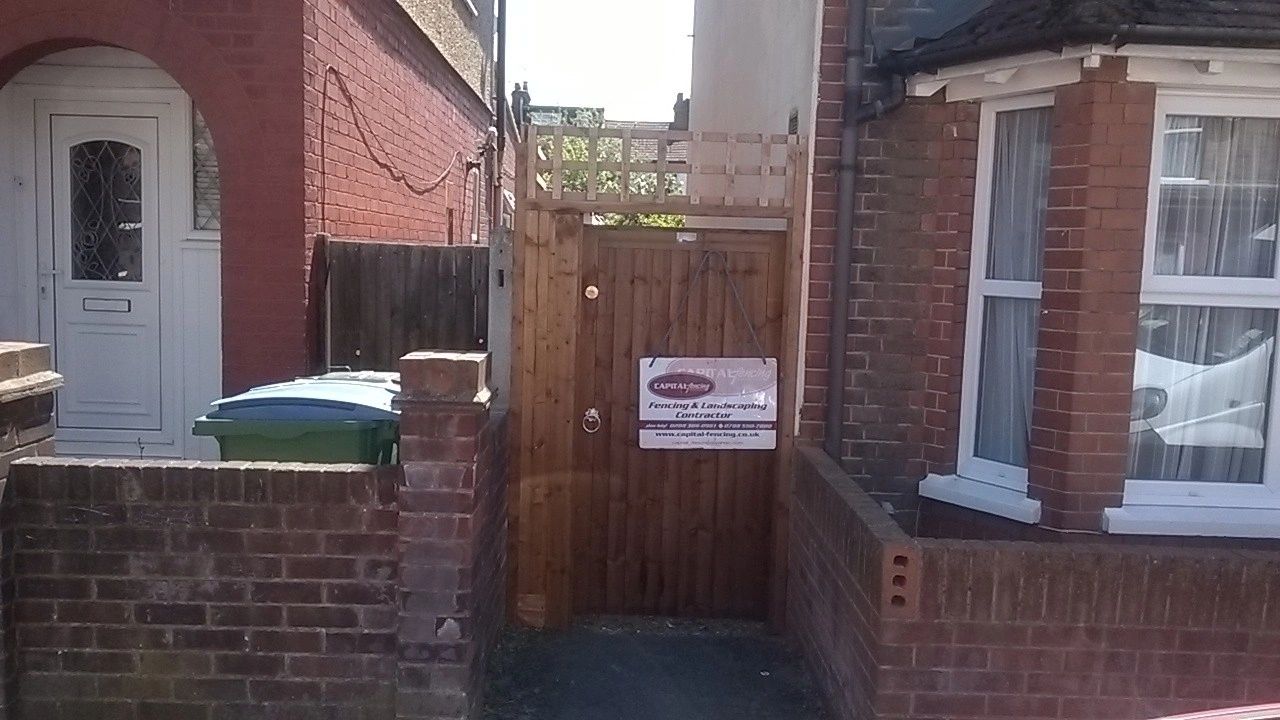
bespoke wooden gate installed by Capital Fencing in Cheshunt (EN7)double driveway gates installed by Capital Fencing in Cheshunt (EN7)hardwood side gate installed by Capital Fencing in Cheshunt (EN7)metal entrance gate installed by Capital Fencing in Cheshunt (EN7)

Local considerations across Cheshunt and waltham cross

Fence height and boundary lighting interaction

A taller solid fence can throw a shadow line that defeats existing security lighting, creating a dark strip right where an intruder would approach the boundary.

Lighting angles are worth reviewing alongside any height change, and a fence contractor should flag an obvious shadow problem even though relocating the light itself is usually a separate trade.

Refitting a panel blown clear of its post clips

Slotted-post clip systems let a panel lift straight up and out under strong gusts once the clip lip has worn or bent slightly, which is a common failure on exposed corner bays rather than a sign the panel itself is faulty.

Refitting usually needs the clips checked for wear and sometimes replaced with a deeper or reinforced pattern before the same panel or a new one is dropped back in, since refitting into a worn clip just repeats the failure.

Arris rail sheared clean at the mortice joint

The morticed pocket cut into a post to take an arris rail end is a weak point in the post itself, and a rail under sustained load can shear off flush at that joint rather than splitting along its own length.

Repair options are a surface-mounted rail bracket that bypasses the damaged mortice entirely, or in more serious cases a new post section, since re-cutting a fresh mortice into an already-weakened post rarely holds long.

Timber fence panel frame construction

A standard lap or overlap fence panel is built around a timber frame, typically with a mortice-and-tenon or simple butt-jointed corner, into which the individual overlapping boards are stapled or nailed.

The frame's own timber section size and joint quality do more to determine a panel's racking resistance in wind than the thin overlap boards themselves, since the boards carry little structural load on their own.

A panel with a lightweight, thin frame section will flex and rack under wind load even if the boards look identical to a panel built on a heavier frame, which is one reason nominally similar panels vary noticeably in longevity.

Post splitting from over-driven fixings

Driving a nail or coach screw too close to a timber post's edge, particularly near the end grain, concentrates stress in a narrow section of fibres and can split the post along the grain rather than simply seating the fixing.

Pre-drilling a pilot hole for larger fixings, especially near board or post ends, relieves that concentrated stress by giving the fixing a path that doesn't have to force the surrounding fibres apart.

Species with straighter, more even grain generally resist this kind of splitting better than timber with interlocked or knotty grain near the fixing point, where existing weaknesses in the fibre structure make a split more likely to propagate.

Metal panel systems as an alternative on very exposed sites

On sites where timber panel failure from wind loading is a recurring problem despite heavier posts and shorter bays, a powder-coated steel or aluminium panel system offers a genuinely different approach, since the material doesn't flex, crack or delaminate the way a timber panel eventually does under repeated wind load.

These systems cost more than timber upfront and have a different aesthetic that not every client wants, but on a genuinely difficult exposed boundary they remove the recurring panel-replacement cycle entirely.

It's worth presenting as an option specifically where a client has already replaced timber panels on the same exposed run more than once, rather than as a default first suggestion.

Iroko and tropical hardwood density

Iroko is a dense West African hardwood sometimes used as a substitute for teak in gates and structural fencing components, valued for a natural durability that doesn't rely on chemical treatment.

Its density makes it heavier to handle and slower to work than softwood equivalents, and it typically needs pre-drilling for screws to avoid splitting.

Because it's naturally oily, some finishes and glues bond to it poorly unless the surface is wiped down with a solvent first, which is a detail that's easy to miss when substituting it into a softwood-designed detail.

Welded mesh panels compared with twin-wire double-mesh panels

A single-skin welded mesh panel is cost-effective and widely used, but a twin-wire double-mesh panel sandwiches two offset mesh layers so that the apertures never align, making the panel far harder to get a foothold or cutting tool through cleanly.

Double-mesh panels are generally specified for a higher-security compound or a site with a known history of attempted intrusion, while single-skin panels remain the standard choice for a general commercial boundary.

Disposing of rotten timber and green waste from a repair

Rotten fence timber is general waste rather than green waste, and larger quantities from a full-run repair usually need a licensed waste carrier or a permitted tip run rather than a domestic green bin, which only takes garden material.

Treated timber in particular shouldn't be burned on site, since older treatments can contain preservatives that produce harmful smoke, so timber waste from a repair should be taken away rather than disposed of on the plot.

North-facing boundaries and slower drying

A north-facing boundary receives little or no direct sun through autumn and winter, so rainfall sits on the timber and in the surrounding ground noticeably longer than on a south-facing equivalent.

This affects concrete curing time as well as timber drying — a post base poured on a north-facing run in cold weather takes longer to reach working strength and shouldn't be loaded or backfilled early just because a south-facing base nearby has already set.

Over the life of the fence, the practical effect is usually a shorter repaint or restain interval on the shaded side than the rest of the same boundary.

Using packers to correct a slightly out-of-true panel fit

A small gap between a panel edge and a post face, caused by a minor inconsistency in post spacing rather than a genuine error, can often be taken up with a thin timber packer rather than re-digging and resetting the post.

Packers need fixing securely rather than simply wedged in, since a loose packer left to rattle under wind load will eventually work its way out and leave the original gap again.

Repeated packing along a run is a sign the underlying setting-out was slightly off rather than a one-off issue, and it's worth checking overall spacing again if more than an occasional panel needs correcting this way.

Garden orientation and post-rain drying time

A south or west-facing garden dries out after rain considerably faster than a north or east-facing one, purely because it receives more direct sun through the day, which has a real effect on how long timber sits wet and therefore how fast rot and mould can establish.

This is worth factoring into treatment choice as much as species choice — a slower-drying orientation benefits more from a breathable stain that lets residual moisture escape than from a heavier film-forming coating that traps it in.

Two identical fences in the same postcode but opposite orientations can have meaningfully different realistic maintenance intervals for this reason alone.

Planning enforcement notices on unauthorised boundaries

Councils have enforcement powers to require unauthorised boundary structures to be altered or removed, usually triggered by a neighbour's complaint or a routine site visit for unrelated work.

There are time limits on enforcement action for most breaches, though these vary by the type of breach and don't apply to work within a conservation area or affecting a listed building in the same way.

Responding promptly and cooperatively to any enforcement contact from a council generally leads to a better outcome than ignoring it.

Gate swing clearance where a dropped kerb serves vehicle access

A security gate installed behind a dropped kerb needs enough setback from the highway boundary that an opening gate leaf never swings into the public footway or carriageway, which local authorities generally require as a condition of the dropped kerb itself.

A sliding gate avoids this swing clearance problem entirely and is often the preferred choice where the plot is shallow, though it needs a clear running track free of obstruction along its full travel length.

Quiet hours and noise considerations for works

Most local authorities publish informal guidance or byelaws on acceptable working hours for noisy construction activity, often something like weekday daytime hours with reduced or no work on Sundays.

While a single day of fence post digging rarely needs a formal noise permit of the kind larger construction sites require, persistent early or late working can still attract a noise complaint under general nuisance law.

Checking the council's standard hours guidance, and simply letting immediate neighbours know when noisier work like post drilling will happen, tends to avoid most complaints before they start.

Vertical picket infill on top of a mesh security panel

Adding a row of vertical steel pickets above a mesh panel gives extra height without the wind loading of a full-height solid mesh extension, and the picket spacing is kept tight enough that it doesn't create a new set of usable footholds.

This detail is common where a boundary needs to reach a taller overall height for a later phase of a site's security review without replacing the mesh panels already installed at the lower level.

Spur repair material choice

A concrete or timber spur bolted alongside a rotted post base lets the sound upper section of the post be retained while replacing only the failed section near ground level, avoiding a full post replacement.

A concrete spur resists the ground moisture that caused the original rot far better than a timber spur repeating the same material in the same failure-prone zone, though it's heavier and less forgiving to align precisely.

The repair is only as good as the connection between spur and post, and coach bolts through both members, rather than screws alone, are needed to transfer wind load reliably across the joint.

Galvanic corrosion between dissimilar metals

Galvanic corrosion occurs when two dissimilar metals are in direct contact in the presence of moisture, with the less noble metal corroding preferentially as electrons flow between the two through the electrolyte formed by the damp.

Aluminium fixed directly to steel, or stainless steel fixings used with certain aluminium alloys, are a commonly cited combination worth checking, since the galvanic reaction can accelerate corrosion of the aluminium component well beyond what it would experience alone.

Isolating dissimilar metals with a plastic washer, sleeve or compatible coating breaks the direct contact and largely prevents the reaction, which is a standard detail on aluminium gate fittings using steel fixings.

Using a post level clamp for solo plumb-checking

A post level that clips onto two adjacent faces of a post at once lets one person check plumb in both directions simultaneously without needing a second pair of hands to hold a separate level against each face.

This is particularly useful when bracing a post alone, since the clamp stays attached and visible while adjustments are made, rather than needing to remove and reposition a standard spirit level after every small correction.

It's worth checking the clamp itself is seated flat against the post with no debris or splinters holding it proud, since a level that isn't sitting flush will give a false reading regardless of how carefully the post is actually adjusted.

Automation compatibility checks and specialist referral

Before a gate is automated, its weight, swing clearance and frame rigidity need to suit the motor type being considered, and a gate that's sound for manual use isn't automatically suitable for automation without checking.

We check the gate itself is fit for automation and refer the motor, control-board and sensor installation to a specialist automation engineer.

Fox digging and mesh skirts

Foxes commonly dig at the base of a fence line where the ground is soft, undermining a gravel board or creating a gap large enough to pass through underneath an otherwise intact fence.

A buried mesh skirt fitted along the base at repair time, angled outward below ground, is a more durable fix than repeatedly backfilling the same dug-out gap.

Replacing a post without dismantling the whole run

A single post can often be replaced by supporting the panels either side on temporary props, cutting the old post out at ground level, and fitting the new post into a fresh footing without lifting the neighbouring panels out.

This depends on the panel fixing type — nailed panels are harder to free without damage than panels held with clips or brackets, which come apart more cleanly.

London terraces and semis with a narrow alley between the house and the neighbouring wall — that's who this page is for. In Cheshunt and out to Broxbourne Borough, we run the side-return gates spec that survives ground water near the lee valley means post bases need extra care to prevent rot. Roads such as Crossbrook Street and Windmill Lane are typical of the local layout. Lee Valley Regional Park is a useful local reference point. Cheshunt sits on the Lea floodplain east of the A10, and ground conditions in the lower-lying areas mean surface water is a recognised local issue.

Get In Touch

Get My Free Quote — 24h Response

No callout fee · Free site visit · Friendly local team covering London & Hertfordshire.

Call us
07885907880
or 02036484746
Email
capital_fencing@yahoo.com
WhatsApp
Message us anytime
Area
London & Hertfordshire
Payment
Card payments accepted

Pay by debit or credit card, bank transfer or cash once the work and price are agreed. No deposit taken online.

Request a Free Quote

We'll get back to you within 24 hours.

Free Site Visit No Callout Fee
Call WhatsAppQuote