Boundary fencing between church grounds and an adjoining graveyard
Church grounds fencing often has to distinguish between an actively used graveyard area, where ground disturbance for post holes needs careful checking against known burial plots, and a wider grounds boundary where standard fixing methods apply without restriction.
A lychgate or similar traditional entrance feature is frequently retained as the visual and ceremonial entry point even where a plainer security fence is added around the rest of the boundary for practical reasons.
Post cross-section and wind load resistance
A post's resistance to bending under wind load increases with the square of its cross-sectional depth in the direction the load is applied, meaning a modest increase in post thickness gives a disproportionately larger gain in stiffness.
This is why taller fences and larger gate leaves, which present more surface area to the wind, are specified with noticeably thicker posts rather than simply the same section set deeper, since depth alone doesn't address bending strength above ground.
Orientating a rectangular post section with its greater dimension facing the prevailing wind direction, where the panel design allows it, makes better use of the timber's strength than an arbitrary orientation chosen for appearance alone.
Adjusting closing force on a self-closing gate
A spring or hydraulic closer set too strong can slam a gate hard enough to damage the latch or frame over repeated cycles, while one set too weak may not fully latch, especially into a headwind on an exposed boundary.
Closers are adjustable and should be tuned on site after fitting rather than left at a factory default, with a final check that the gate reliably latches under the worst wind condition it's likely to face.
Slip resistance and board grooving
Grooved decking boards are often assumed to be more slip-resistant than a smooth reeded board, but grooves can actually hold water, algae and leaf debris that make the surface more slippery if it isn't cleaned regularly, rather than less.
A smooth board kept clean and free of algae, or a textured composite surface designed specifically for grip, often performs better in practice than a grooved timber board left unmaintained.
Orientation of grooves relative to the main walking direction, and a regular cleaning routine, matter more to actual slip performance than the board profile alone.
Listed and period properties
A listed building's curtilage can bring garden walls, railings and even historic fence posts within the scope of listed building consent, regardless of the general permitted development rules that would apply to an unlisted house next door.
Cast iron railings removed during wartime salvage are a common feature many period properties never had reinstated, and some conservation officers now encourage sympathetic replacement rather than modern panel fencing on street-facing boundaries.
Consent applications for listed curtilage work typically want a heritage-appropriate material and jointing method specified up front, so it's worth involving the conservation officer before, not after, a design is finalised.
Community-wide hedgehog gap linking across multiple boundaries
A single hedgehog gap in one fence achieves little if the neighbouring boundaries along the same row of gardens remain solid, since the animal still can't move beyond the first connected garden.
Some local wildlife groups now coordinate gap positions across a terrace or street so that a continuous corridor is created through several gardens rather than isolated single gaps.
Where a client is enthusiastic about this, it's worth suggesting they mention it to neighbours early, since agreeing gap positions in advance avoids gaps that don't line up once each fence is finished.
Staple and clout corrosion
Wire staples and clout nails used to fix wire mesh or thin capping are among the first fixings to corrode, since their small cross-section and shallow galvanising thickness give them less protection than a heavier fixing.
A repair that replaces the mesh or board but reuses corroded staples is only a partial fix, since the corroded fixings will fail again well before the new material does.
Matching a discontinued panel style
Panel profiles and slat widths change between manufacturers and over time, so a boundary installed a decade or more ago may use a profile that's no longer produced.
Where an exact match isn't available, the closest equivalent height and style is used and the mismatch is pointed out honestly rather than presented as an exact replacement.
Fence or gate height near roof-mounted solar panels
A tall fence, gate, or dense trellis topper built close to a boundary can cast shade onto a neighbouring roof-mounted solar array during parts of the day, which isn't usually a planning matter but can become a point of neighbourly friction worth being aware of.
This is a relatively new consideration compared with the traditional daylight and boundary height concerns, but is increasingly relevant as more households install solar panels close to shared boundaries.
Discussing height and position informally with a neighbour before installing a particularly tall boundary feature near their south-facing roof avoids a dispute that has no clear formal regulation to resolve it.
Land registered as a town or village green
Land formally registered as a town or village green carries strong legal protection against enclosure or obstruction, including from fencing, under the Commons Act 2006.
This status can sometimes apply to open spaces that don't look obviously like a traditional village green, following a successful community application to register them.
Checking the relevant register before fencing land bordering an open green space avoids inadvertently obstructing protected land.
UV stabilisers in composite and PVC fencing
UV stabiliser additives are blended into composite and PVC fencing products during manufacture to slow the surface degradation and colour fade that ultraviolet exposure otherwise causes in polymer materials over time.
Products with a lower proportion of UV stabiliser, often reflected in a lower price point, tend to show chalking, a dusty faded surface, and colour loss earlier than better-stabilised equivalents exposed to the same sunlight.
South and west-facing runs receive substantially more cumulative UV exposure than shaded or north-facing runs, so the same product can visibly fade at different rates depending purely on orientation and surrounding shade.
Fallen branch impact damage
A falling branch typically damages a localised section — one or two panels and sometimes the post beneath the point of impact — rather than the whole run, so repair can usually be confined to the affected bay.
The bays either side are still worth checking, since the same impact can rack a neighbouring post even where the panel there shows no visible damage.
DBS-relevant site rules on sensitive sites
Sites such as schools, nurseries and some healthcare premises commonly require anyone attending, including contractors, to hold or provide evidence of an enhanced DBS check, or to be directly supervised at all times if they don't.
This is a site management requirement set by the school or institution rather than a universal legal rule for tradespeople in general, and requirements vary between individual sites and local authority policies.
Where a job is known in advance to be on this type of site, confirming the DBS or supervision requirement before booking the work avoids a contractor turning up unable to proceed on the day.
Tenancy and landlord repair responsibilities
Responsibility for a garden boundary at a rented property depends on the tenancy agreement, but where it's silent, the general position is that a landlord is responsible for structural boundary features while day-to-day garden maintenance often falls to the tenant.
A tenant generally can't authorise permanent alterations like a new fence line or wall without the landlord's consent, even where they're happy to pay for it, since it affects the property the landlord owns.
Storm or accidental damage to a boundary fence at a let property is usually the landlord's repair obligation, arranged directly or through a managing agent, rather than something the tenant is expected to fund unless they caused the damage.
Hardwood versus composite decking movement
Hardwood decking boards, like any solid timber, shrink and swell across their width with moisture changes, which is why they're laid with a consistent gap between boards rather than tight-butted, and why that gap can look different in a dry summer compared with a wet winter.
Composite boards move less with moisture but expand and contract more with temperature than timber, so the gapping and fixing method used has to account for a different kind of movement rather than assuming timber spacing rules apply directly.
Both need their end cuts sealed or capped where boards are cut to length on site, since a cut end is the point most likely to take on water and start to degrade first.
Widening an existing gate opening
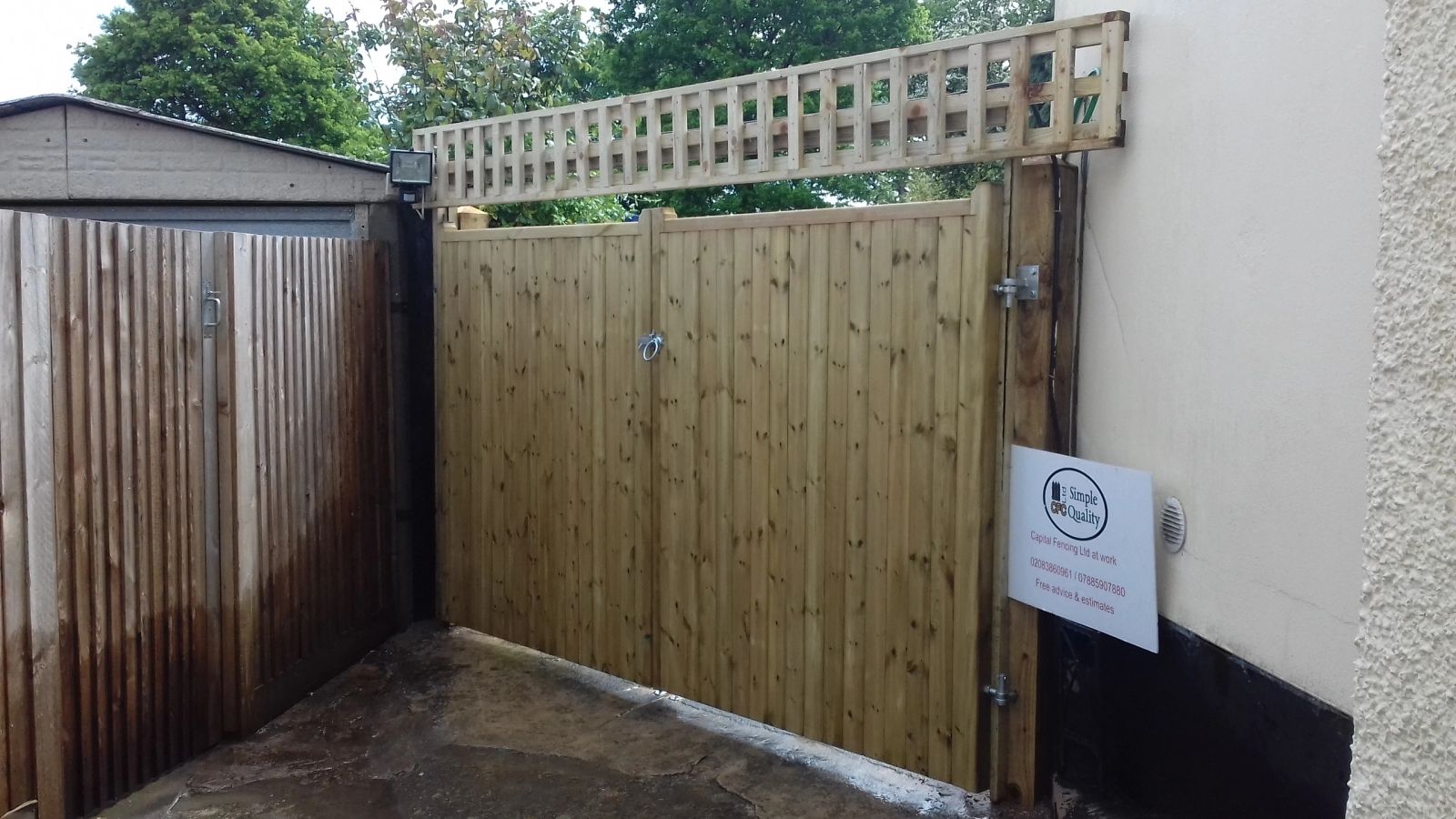
Widening a driveway opening to take a larger vehicle usually means moving or replacing both hanging and slamming posts, not just fitting a wider gate to the existing gap, since the posts themselves define the usable width.
Ground and drainage either side of the widened opening are checked at the same time, since regrading the entrance often follows a widening job.
Planed versus sawn timber faces
Sawn timber retains the rough, slightly fibrous surface left by the mill saw, which holds paint and stain better initially but can also hold moisture and dirt in the surface fibres for longer after rain.
Planed, or PAR (planed all round), timber has a smooth, machined finish that looks tidier and is more pleasant to handle, but its closed surface can mean stain sits on top rather than soaking in, needing more frequent reapplication.
Fencing components are commonly specified as sawn for structural parts like posts and rails and planed for visible features like capping, reflecting the balance between weathering performance and finished appearance.
Bearer support on adjustable pedestals
Adjustable plastic pedestals supporting deck bearers let each support point be levelled individually, which is useful over an uneven concrete base, a sloped patio, or ground that isn't practical to excavate level.
Pedestal spacing still needs to follow the same span logic as timber joists, since an adjustable base doesn't change how far the bearer above it can safely span before it needs another support point.
Pedestals also raise the whole deck slightly, which is worth checking against a threshold or step height at the house before committing to the system.
Fire escape routes and non-lockable egress
A secure gate on a fire escape route or final exit path must allow people to get out without a key, even if it stays locked against entry from outside — a simple push-bar or thumb-turn release satisfies this on the inside face.
This is checked against the building's fire strategy before a lockable gate is fitted on any route marked as an escape path, because a fully keyed gate on both faces is a genuine life-safety fault.
Perimeter fencing around a school playing field
A playing field perimeter separate from the main school building boundary is usually lower and more open than the building line itself, since its job is containing pupils during use and deterring casual trespass out of hours rather than resisting a determined intrusion.
Gates onto a playing field are positioned to give staff a clear sightline for supervision, and a field boundary shared with a public path often needs a stock-proof rather than fully solid design to keep sightlines open both ways.
Scoping a repair linked to an insurance claim
Where a repair follows an insured event, the scope of work is agreed and documented before starting, since insurers typically require a clear description of what failed and what's being replaced rather than a general like-for-like statement.
Photographs and a written note of the failure are kept alongside the repair record, which is useful if further questions come up later in the claims process.
Insurance paperwork after storm damage
Most household policies distinguish between storm damage to a fence, which is often covered subject to policy wording and excess, and general wear or rot, which typically isn't, so insurers commonly ask for photographs of the damage and sometimes of the fence's prior condition.
A dated photo of the boundary from before the storm, even an incidental one, can materially help a claim where the insurer disputes whether failure was storm-related or simply due to age.
This is a general description of how these claims are typically assessed rather than a statement about any specific insurer's policy, and terms, excesses and definitions of 'storm' vary between providers and should be checked in the policy document.