London & Hertfordshire Free Site Visit
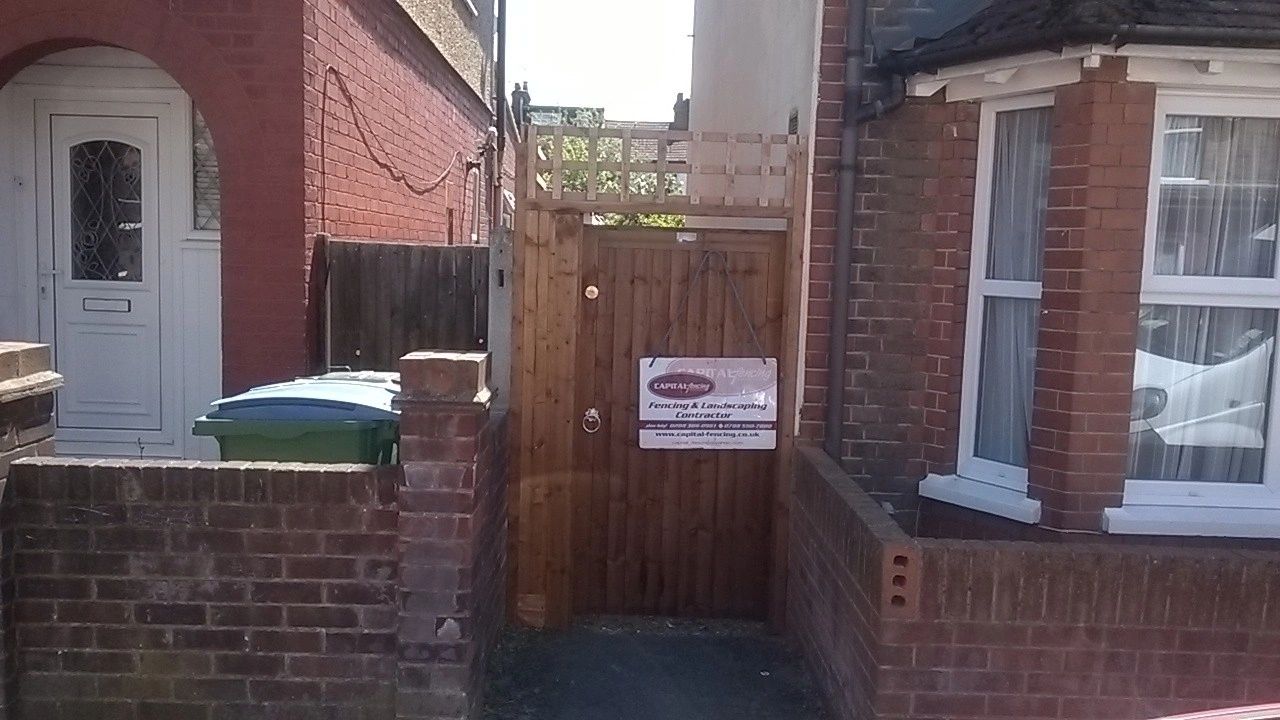
bespoke wooden gate installed by Capital Fencing in Hoddesdon (EN11)
Hoddesdon · EN11

Side Return Gates, Hoddesdon: match-what-you-have spec for 1930s and 1950s semis

We approach side-return gates in Hoddesdon from the failure end backwards. Fitting a full-weight hardwood gate on domestic pin hinges — drops within six months — that's the single most common thing we're called back to fix, and it's the first thing our spec addresses. Roads such as Middlefield Road and Burford Street are typical of the local layout. Lowewood Museum is a useful local reference point. The town sits close to the River Lea and Spitalbrook, and the lower-lying streets nearest the water have a documented flood-risk history.

We approach side-return gates in Hoddesdon from the failure end backwards. Fitting a full-weight hardwood gate on domestic pin hinges — drops within six months — that's the single most common thing we're called back to fix, and it's the first thing our spec addresses. Roads such as Middlefield Road and Burford Street are typical of the local layout. Lowewood Museum is a useful local reference point. The town sits close to the River Lea and Spitalbrook, and the lower-lying streets nearest the water have a documented flood-risk history.

Default spec

How we build side-return gates in Hoddesdon

44mm framed hardwood or planed softwood, tongue-and-groove infill, adjustable ball-race hinges, closing stop and drop-bolt. On Hoddesdon jobs we adjust for older fence runs in the old town often hide rotted posts under cement skirts — full removal is usually required.

Property mix locally: 1930s and 1950s semis, with Victorian cottages toward the Old Town. Typical gardens: mid-sized flat gardens; properties near Rye Park often have direct alley access. Postcodes we regularly service: EN11.

Why this spec, for London terraces and semis with a narrow alley between the house and the neighbouring wall

  • framed builds don't drop the way board-and-batten side gates do in year two
  • adjustable hinges handle the seasonal timber movement every London side gate experiences
  • made to the exact opening — no packing pieces, no gaps for burglars or foxes

Where side-return gates isn't the right answer

  • openings under 700mm where a person can't comfortably pass with a bin — a fixed panel is often the honest answer
  • shared alley gates where freehold consent from both parties hasn't been agreed

Typical side-return gates briefs in Hoddesdon

  • matched pedestrian and bin-store gate serving a shared side alley between two flats
  • tongue-and-groove side gate framed on adjustable ball-race hinges to cope with seasonal timber movement

Side Return Gates FAQs — Hoddesdon

Softwood or hardwood for a London side gate?

On side-return gates jobs in Hoddesdon (EN11), our default answer is: 44mm framed hardwood or planed softwood, tongue-and-groove infill, adjustable ball-race hinges, closing stop and drop-bolt. For context: adjustable hinges handle the seasonal timber movement every London side gate experiences. Measured, quoted and installed by the same small crew.

Can bin-store and pedestrian access share one gate?

Across Hoddesdon we spec around older fence runs in the old town often hide rotted posts under cement skirts — full removal is usually required, so on side-return gates that usually means iroko hardwood on galvanised ironmongery for 15+ year service. The honest trade-off is fitting a full-weight hardwood gate on domestic pin hinges — drops within six months — which is exactly what our default spec designs out.

How wide can a single side gate span before it needs a wheel?

Broxbourne Borough coverage means we can survey most EN11 addresses inside a week — London terraces and semis with a narrow alley between the house and the neighbouring wall. We'll walk you through framed builds don't drop the way board-and-batten side gates do in year two on the site visit before you commit.

How do you stop a side gate dropping over time?

Practically: hardwood side gate between a rendered wall and a brick pier, 780mm opening, drop-bolt into a concrete slab socket. That's the Hoddesdon version of this job, not a generic one. For context: adjustable hinges handle the seasonal timber movement every London side gate experiences. Measured, quoted and installed by the same small crew.

Do you handle the wall fixing on both sides?

On side-return gates jobs in Hoddesdon (EN11), our default answer is: 44mm framed hardwood or planed softwood, tongue-and-groove infill, adjustable ball-race hinges, closing stop and drop-bolt. For context: adjustable hinges handle the seasonal timber movement every London side gate experiences. Measured, quoted and installed by the same small crew.

Recent side return gates work
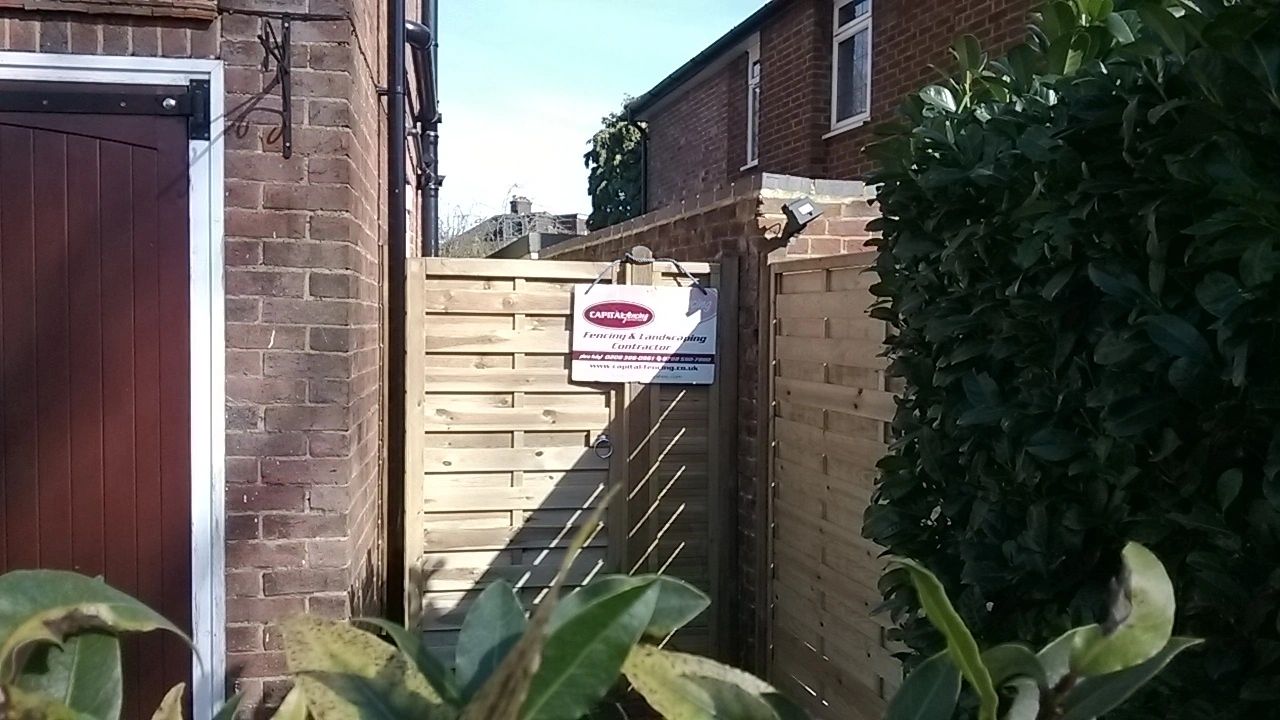
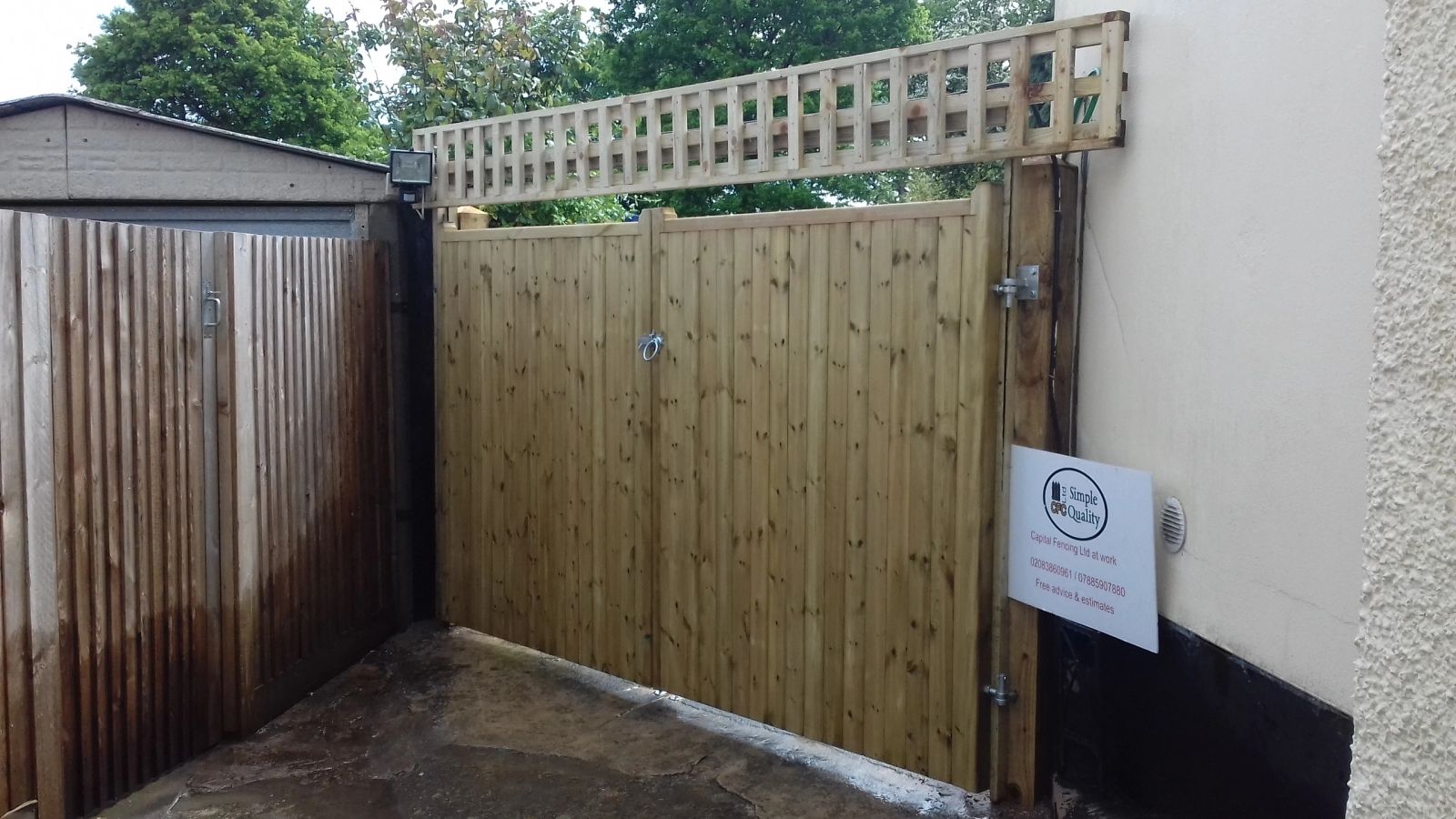
bespoke wooden gate installed by Capital Fencing in Hoddesdon (EN11)double driveway gates installed by Capital Fencing in Hoddesdon (EN11)hardwood side gate installed by Capital Fencing in Hoddesdon (EN11)metal entrance gate installed by Capital Fencing in Hoddesdon (EN11)

What actually matters for side return gates around Hoddesdon

Closing gaps and finger-trap risk

A gap left between a closing gate and its post or an adjacent leaf can trap fingers, particularly at a height a child would reach, and this is worth checking on any gate serving a garden used by young children.

Closing plates or adjusted hinge geometry can reduce the gap without replacing the gate itself.

Vehicle and impact loading on perimeter fencing

A boundary next to a car park, loading bay or farm track needs posts and panels sized for accidental impact loading, not just wind and climbing loads, because a reversing vehicle applies a very different force to the same run.

Where impact is a realistic risk, a kerb, bollard or heavier-gauge post is used to take the hit rather than relying on the fence panel itself to absorb it.

Establishing who owns the boundary

Title deeds don't always mark ownership clearly, and a security upgrade is exactly the kind of work that surfaces a dispute if the existing line is assumed rather than checked. Where a boundary is shared, we recommend confirming ownership and getting neighbour agreement in writing before work starts, particularly on a line that's being made taller or more solid than what's there now.

On terraced rows this matters more than on a detached plot, because a shared rear boundary can affect several neighbours at once.

Land registered as a town or village green

Land formally registered as a town or village green carries strong legal protection against enclosure or obstruction, including from fencing, under the Commons Act 2006.

This status can sometimes apply to open spaces that don't look obviously like a traditional village green, following a successful community application to register them.

Checking the relevant register before fencing land bordering an open green space avoids inadvertently obstructing protected land.

Permitted development height limits

Under the General Permitted Development Order, a fence, wall or gate can normally go up to 1m without planning permission where it fronts a highway used by vehicles, and up to 2m elsewhere on the plot.

That 2m figure is measured from the natural ground level, not from the base of a retaining structure, which catches people out on sloping plots where the fence ends up effectively taller on the low side.

Corner plots, listed buildings and land inside a conservation area all tighten these limits, so it's worth checking the local authority's own guidance before ordering materials rather than after.

EV charging cables and boundary fence gates

Where an electric vehicle charge point is fitted near a boundary, cable routing sometimes needs to cross under or through a gate or fence gap, which is worth considering at the design stage rather than retrofitting a channel later.

Trailing a charging cable across a public footway to reach a car isn't permitted in most areas without specific council-approved cable channel provision, which is a separate matter from the fence itself.

Checking the council's position on any cable crossing a footway, alongside the fence and gate design, avoids two separate problems being discovered one after the other.

Gates on a sloped driveway or path

A gate hung across a sloped driveway or path needs a hinge set that allows it to clear the ground through its full swing without dragging at the low end, which sometimes means a different hinge height or a cropped bottom edge compared with a gate on level ground.

We check ground fall across the full swing before fitting, not just at the closed position.

Repairing a fence smothered by a neighbour's overgrown vegetation

Ivy, brambles or an overgrown hedge growing through and over a fence from next door often has to be cut back before the extent of the damage underneath can even be assessed properly, and that cutting back needs the neighbour's agreement if the growth originates on their side.

Vegetation left growing through a repaired section will usually cause the same damage again, so flagging this to the client as an ongoing issue rather than just repairing around it is worth doing.

Feather-edge versus overlap panel construction

Feather-edge fencing uses individual tapered boards nailed vertically to horizontal arris rails, built up on site board by board, which makes it easier to repair a single damaged board without disturbing the rest of the run.

Pre-made overlap or lap panels are faster to install since they arrive as a complete unit, but a single split board usually means replacing the whole panel rather than one board.

Feather-edge also tends to be the sturdier choice on an exposed or long run, since the individual boards and rail structure resist wind loading better than a thinner factory panel.

Waney-edge boards

Waney-edge boards, sometimes called weatherboard, retain the natural, uneven outer edge of the log they were cut from, including some bark-line curvature, rather than being sawn to a straight parallel edge.

They're generally cheaper than feather-edge because more of the log's cross-section can be used, but the irregular edge means overlaps vary along the length of each board and can't be set as precisely.

The rustic appearance is often the main reason they're chosen over feather-edge, particularly for informal or rural boundary fencing where a uniform finish isn't the priority.

Deck boards against a shaded wall building up algae

A deck built hard against a shaded wall, fence, or dense planting on one side often shows a distinct band of algae growth along that edge well before the rest of the deck, since it dries far more slowly after rain.

This uneven wear pattern is normal rather than a sign of a substandard board, but it does mean that edge needs cleaning more often to keep slip resistance consistent across the whole deck.

Where possible, leaving even a narrow gap between the deck edge and an adjoining wall or dense hedge improves airflow along that edge and reduces how quickly algae establishes there.

Agreeing a shared contribution to a boundary fence

There's no automatic legal requirement in England for a neighbour to contribute to the cost of a boundary fence, even where both sides benefit from it, unless the deeds specifically say otherwise.

Many boundary fences are replaced by agreement between neighbours splitting the cost informally, but this is a private arrangement rather than something either side can compel.

Getting any agreed contribution, choice of style, and who instructs the contractor written down in an email beforehand avoids a common source of friction once the invoice arrives.

Small claims court as a route for fencing disputes

Straightforward disputes over the cost or condition of a shared boundary fence can, in principle, be pursued through the small claims track of the county court, which is designed to be accessible without needing a solicitor.

This route is generally reserved for lower-value, relatively clear-cut disagreements rather than complex boundary line disputes, which usually need more specialist legal input.

It's worth exhausting direct discussion and mediation options first, since even a successful small claim can be a slower and more stressful route than reaching agreement directly.

The highway 1m rule in practice

The 1m permitted development limit applies to any boundary that fronts a highway used by vehicular traffic, which in practice includes most adopted roads and many unadopted estate roads that carry regular car use, not just classified A and B roads.

A footpath-only right of way at the front of a plot doesn't trigger the lower limit on its own, but councils interpret 'used by vehicles' broadly, so a shared driveway serving several houses usually counts.

Where it's unclear, checking with the local planning authority before building is cheaper than a retrospective application after a 1.8m fence goes up on what turns out to be a vehicular frontage.

Storm damage to a boundary fence and insurance

Standard buildings insurance policies frequently exclude fences from cover for storm damage, or cover them only up to a modest specified limit, which surprises many homeowners after a bad storm.

Where a fence is shared or ownership is unclear, storm damage can also raise the question of whose policy, if either, is expected to respond.

Checking a policy's specific wording on fences and gates before relying on it for storm repair avoids finding out about exclusions only after a claim is made.

Chain-link and stock fencing for allotments and paddocks

Chain-link is a low-cost, low-maintenance option for allotments, paddocks and utilitarian boundaries where appearance matters less than containment and budget.

Straining wires and correctly tensioned line wire at top and bottom keep chain-link from sagging over a long run, which is the most common complaint about a poorly installed mesh fence.

Where the boundary needs to keep livestock in rather than just mark a line, stock fencing with a smaller mesh at the base stops smaller animals getting through in a way that standard chain-link doesn't.

Round post versus square-sawn post sections

A round, or half-round, post retains more of the log's original strength-giving fibre continuity around its circumference than a square-sawn post cut from the same log, since sawing removes material and can cut across some outer fibres.

Square-sawn posts are easier to fix panels and brackets to flush, since flat faces align with flat rail ends, whereas round posts often need a notched or curved bracket to seat components securely.

Round fencing stock is more common in agricultural post-and-rail and stock fencing where raw strength per log matters most, while square-sawn posts dominate garden and boundary fencing where flush fixing detail matters more.

Dust and noise control in a tight garden

Cutting timber, breaking out old concrete bases or using a petrol auger all generate noise and dust that carries further in a small enclosed garden between close-set houses than on an open plot.

Local authorities can restrict noisy work hours under the Control of Pollution Act, and even where no formal restriction applies, starting before a reasonable hour or working into the evening is one of the fastest ways to draw a neighbour complaint.

Sheeting off concrete-cutting dust and keeping cut ends away from a neighbour's washing line or open windows is a small step that avoids most of the friction on a shared boundary job.

Off-street parking and dropped kerbs

Converting a front garden to off-street parking usually requires a dropped kerb permit from the highway authority, and a boundary fence or gate across that new access has to be positioned clear of the visibility splay the dropped kerb creates.

Where a low front boundary already exists specifically to preserve sightlines onto the new parking, replacing it with a taller or solid fence can undo the safety benefit the dropped kerb approval was granted on.

It's worth checking whether the dropped kerb approval included any conditions on boundary treatment before ordering a new front fence or gate.

Realistic panel replacement frequency on an exposed plot

A standard timber panel on a sheltered suburban plot might reasonably be expected to last a decade or more before replacement; the same panel on a genuinely exposed, wind-loaded boundary can fail in structural terms — cracked rails, a bowed or blown-out panel — well inside that timeframe regardless of treatment quality.

Setting client expectations around this at quote stage, rather than after an early failure, avoids the impression that a product or installation was faulty when the real cause is unmanaged exposure.

Where budget allows, specifying for the exposure from the outset is cheaper over the fence's life than replacing a standard panel repeatedly on the same exposed run.

How a restrictive covenant is actually enforced

A restrictive covenant on a title is enforced privately by whoever holds its benefit — often a neighbour, a management company, or occasionally the original developer — rather than by the council.

This means a fence can be entirely lawful under planning rules and still breach a private covenant, with enforcement coming through a civil claim rather than council action.

Checking who benefits from a known covenant, and whether they're likely to object, is worth doing before assuming a technically 'planning-compliant' fence is automatically fine.

Slat gap ratios in screening fences

Horizontal slatted or louvre fencing is usually specified by a gap-to-board ratio, such as a 20mm gap between 100mm boards, which balances privacy against wind resistance.

A tighter ratio gives more privacy and blocks more wind, which in turn increases the load transferred to posts and foundations during storms, so a very solid-looking slatted screen needs the same foundation attention as a close-boarded panel.

Wider gaps let more wind through and reduce that structural load, while still breaking sightlines enough for most privacy purposes, which is why many slatted designs favour a wider gap than the boards suggest at first glance.

London terraces and semis with a narrow alley between the house and the neighbouring wall — that's who this page is for. In Hoddesdon and out to Broxbourne Borough, we run the side-return gates spec that survives older fence runs in the old town often hide rotted posts under cement skirts — full removal is usually required. Roads such as Middlefield Road and Cock Lane are typical of the local layout. Hoddesdon Clock Tower is a useful local reference point. Hoddesdon's housing splits between the older High Street terraces, which have narrow rear access, and the more spacious Rye Park and Rye House estates further out.

Get In Touch

Get My Free Quote — 24h Response

No callout fee · Free site visit · Friendly local team covering London & Hertfordshire.

Call us
07885907880
or 02036484746
Email
capital_fencing@yahoo.com
WhatsApp
Message us anytime
Area
London & Hertfordshire
Payment
Card payments accepted

Pay by debit or credit card, bank transfer or cash once the work and price are agreed. No deposit taken online.

Request a Free Quote

We'll get back to you within 24 hours.

Free Site Visit No Callout Fee
Call WhatsAppQuote