Working on a gate with restricted access
A side gate in a narrow return often has to be worked on from one side only, which changes how a hinge repair or frame rebuild is approached compared with a driveway gate that can be accessed from both sides.
We plan tool and material access before starting so a repair in a tight space doesn't take longer than it needs to.
Prioritising repairs ahead of the windier months
A post or panel that's borderline rather than fully failed is more likely to come down completely once autumn and winter storms start, so repairs identified in summer are worth scheduling before the exposed season rather than left until something actually blows over.
This is particularly relevant on exposed boundaries or end bays that have already shown signs of movement, since those are the sections most likely to fail first under wind load.
Working safely on a roadside or public-facing boundary
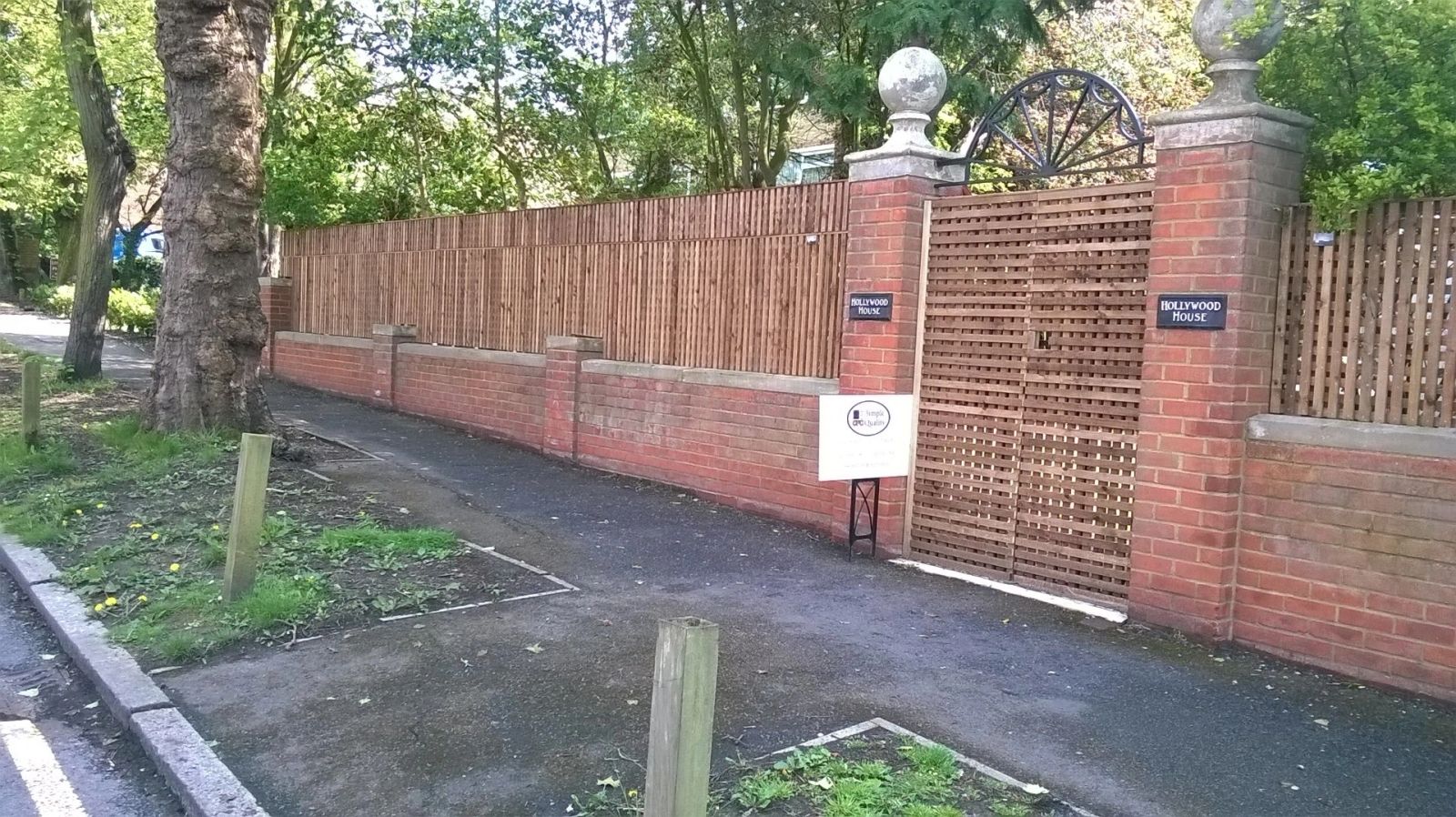
A security fence often runs along a frontage that faces a pavement, a school run or a shared access road, so material storage, tool use and post-hole cover are managed to keep the public side of the works safe throughout.
On a commercial site this extends to keeping a fire route or loading bay clear while the new line goes in.
Boundary questions raised during a property sale
Conveyancing on a property sale routinely asks the seller to confirm boundary ownership and flag any known disputes, which can bring long-dormant boundary questions to the surface.
A fence built or replaced without proper regard to the true boundary line can complicate or delay a sale if it comes up during these enquiries.
Keeping any boundary agreements, planning permissions or correspondence about a garden fence on file makes answering these standard conveyancing questions considerably easier when the time comes.
Striker plate material and post protection
A metal striker plate let into the post protects the timber from repeated latch impact and gives the latch bolt a hard, true surface to engage with, rather than relying on the post timber itself to take that wear.
A post without a striker plate develops a worn, rounded hole around the latch opening over time, which eventually stops the latch holding securely even if realigned.
Retrofit access-control readiness (mechanical side)
A gate can be prepared mechanically for future electronic access control — solid enough hinges, a squared frame and a latch position that suits an electric strike or maglock — without the electrical and control side being fitted at the same time.
We handle this mechanical preparation and refer the electronic access-control installation itself to a specialist.
Sequencing work when more than one person is digging
On a longer run with more than one person digging simultaneously, working from both ends toward the middle rather than each person working independently along the same stretch reduces the risk of small setting-out errors compounding in the middle of the run.
Whoever sets out the string line and corner points needs to communicate any adjustment immediately to everyone digging, since a post dug to an outdated mark before a correction is passed on means redoing that hole.
Checking in at the midpoint, where the two ends meet, catches any accumulated drift before panels are ordered or cut to a spacing that assumed the line stayed perfectly true throughout.
Retrospective planning applications for boundary work
Where boundary work turns out to have needed planning permission that wasn't obtained, it's possible to apply retrospectively, though this carries the real risk of the council refusing and requiring the structure to be altered or removed.
A retrospective application doesn't guarantee approval just because the work is already complete, and the council assesses it on the same planning merits as if it hadn't been built yet.
Checking whether permission is needed before work starts is considerably less stressful and less costly than applying retrospectively after the event.
Matching gate infill to the adjoining fence
A gate with a different infill pattern to the fence either side is a visible weak point as well as an inconsistency, because an intruder targets the section that looks different from the rest of the run.
Matching pale spacing, mesh aperture or panel style across the gate and fence keeps the whole perimeter to one standard rather than leaving the gate as the obvious soft spot.
Ground movement and gate frame problems
Ground movement under a gate post — from clay shrinkage in dry summers or waterlogging in wet winters — is a common cause of a gate that suddenly starts sticking or dropping after years of working fine.
We check whether the post itself has moved before assuming the fault is in the hinges or the gate face.
Replacing a fence on the same line as before
Replacing a fence exactly where the old one stood is generally the lowest-risk approach from a boundary perspective, since it maintains a position both neighbours have already implicitly accepted for years.
It's still worth flagging the planned replacement to a neighbour beforehand, particularly if the new fence will be a different height, material or style to what's there now.
Where the old fence's exact line is unclear because it has leant or shifted over time, marking out the intended new line and briefly confirming it with the neighbour avoids later disagreement.
Digging in waterlogged winter ground
A post hole dug in saturated winter ground can collapse in on itself before concrete goes in, particularly in sandy or silty soils that don't hold a vertical face when wet.
Digging a slightly wider hole and using a temporary former — a section of pipe or shuttering — to hold the sides while concrete is placed can rescue a hole that would otherwise keep sloughing back in.
Where conditions are bad enough that holes won't stay open at all, it's often more efficient to wait for a drier spell than to keep re-digging the same collapsing hole through a single working day.
Levelling ground before building a decking substructure
A decking frame built over uneven ground without first levelling or terracing the site ends up with support posts of wildly inconsistent length, which is harder to get right and more prone to individual post settlement than a site graded roughly level first.
Removing turf and topsoil under the deck footprint rather than building over it also reduces the organic material that would otherwise decompose and settle unevenly under the structure.
Where the ground has a genuine and significant fall, working out whether to terrace the ground itself or simply vary support post heights is a decision made before any joists are cut, since it changes the whole substructure design.
Cantilever gate counterbalance rollers
A cantilever sliding gate has no ground track and instead relies on internal rollers running along a supporting beam set into the ground either side of the opening, with a counterbalanced section extending behind the gate to carry its weight.
Because there's no track to keep clear, faults on this type are more often traced to the internal rollers or the foundation beam settling than to surface debris.
Dealing with a post hole that keeps collapsing in loose or sandy soil
Loose or sandy soil can slump back into a freshly dug post hole before concrete goes in, which is more of a problem on a repair — where the hole is often reopening ground already disturbed by the original failure — than on undisturbed ground.
A sleeve, shuttering, or a wider hole packed with a drier mix that doesn't rely on firm hole walls to hold its shape can get a repair post set securely even where the surrounding soil won't hold a clean-sided hole.
Aligning hinges before final gate fixing
Hinges fixed slightly out of vertical alignment with each other make a gate bind or swing shut under its own weight rather than staying wherever it's left, even if each hinge individually looks correctly fitted.
Propping the gate at the intended finished height and checking the gap is even top and bottom before final fixing catches most alignment problems while they're still easy to adjust.
Loosely fitting the top hinge first, checking swing and clearance, and only then fully fixing both hinges is a more forgiving sequence than fully fixing both at once and finding the gate doesn't swing cleanly.
Decking joist spacing and spans
Joist spacing under a deck is set by the board being used and the load expected, not fixed universally — timber boards typically need joists at closer centres than the equivalent composite board, because composite is generally less stiff across a span.
Manufacturers publish maximum joist spacing for their composite boards, and it's shorter still where boards run diagonally rather than square to the joists, since a diagonal run effectively increases the unsupported span between fixings.
Undersized joist spacing shows up as bounce or long-term sag between joists well before it becomes a safety issue, so it's worth checking spacing against the actual board spec rather than a generic rule of thumb.
Concrete cure time before a post can be loaded
A post set in fast-setting postcrete can usually take light loading within an hour or two, but a full concrete footing needs several days of cure before it should be relied on for the lateral loading a security fence or gate applies.
Fitting a heavy gate leaf to a post before its footing has properly cured can rock the post out of plumb before the concrete has reached working strength, which is a common avoidable cause of an early lean on a new installation.
Supporting neighbouring posts while replacing a single panel
Removing one panel from an established run can momentarily remove lateral support the panel itself was providing to its neighbouring posts, particularly on an older run where posts have relied on the panels bracing each other.
Temporary bracing on the posts either side while the old panel is out and the new one is fitted avoids one of them leaning or shifting during the brief window it's unsupported.
This is more of a concern on taller or more exposed runs than on a short, sheltered garden fence, but it's a quick precaution worth taking on any repair rather than assuming the remaining structure will hold itself steady unaided.
Protecting galvanised coatings on fixings during a repair
Cutting, drilling or hammering a galvanised bracket or bolt during a repair can chip through the zinc coating and expose bare steel underneath, which then corrodes faster at exactly that damaged point than the surrounding coated surface.
Touching up any damaged area with a cold galvanising compound at the time of repair is a small step that meaningfully extends the life of the fixing, rather than leaving bare steel to start rusting immediately.
Handling large panels safely in windy conditions
A solid fence panel acts like a sail once it's lifted clear of the ground, and a moderate gust can catch an unsupported panel and pull it out of a single person's control, particularly on an elevated or exposed plot.
Two people carrying and positioning a panel, with one steadying it against the wind while the other fixes it, is safer than one person trying to hold and fix simultaneously on a breezy day.
Where wind makes handling large solid panels genuinely unsafe, postponing that stage while continuing with digging or post-setting is usually more sensible than pressing on and risking a dropped or wind-caught panel.
Mediation as a step before a formal boundary dispute
Community and property mediation services exist specifically to help neighbours resolve disagreements, including boundary and fencing disputes, without going straight to solicitors or court.
Mediation is generally faster and considerably cheaper than formal legal action, and can preserve a working relationship between neighbours who will, after all, remain neighbours.
Where a boundary disagreement is becoming entrenched, raising the idea of mediation early is often more productive than escalating straight to legal correspondence.