Timber grading and treatment for a security spec
Where timber is used on a security run, a denser, higher-grade section holds up to sustained pressure at gate junctions and pedestrian pinch points better than a standard fence-grade board, and pressure treatment needs to penetrate fully rather than sit on the surface.
We spec the grade to the load the section will actually see, not a single grade across the whole job.
Pergola and screen timbers
Pergola posts generally need a larger section than a fence post of the same height, since they carry a horizontal beam and roof structure rather than just resisting wind on a flat panel, and undersized posts show up as noticeable sway at the top rather than immediate failure.
Softwood pergolas are almost always pressure-treated given the exposure, while a hardwood pergola can be left to weather untreated in the same way an oak gate can, at a higher initial material cost.
Screening timbers fixed to or beside a pergola structure follow the same gap and profile logic as free-standing slatted fencing, so the same trade-offs between privacy, light and wind loading apply.
Why storm damage clusters at certain bays
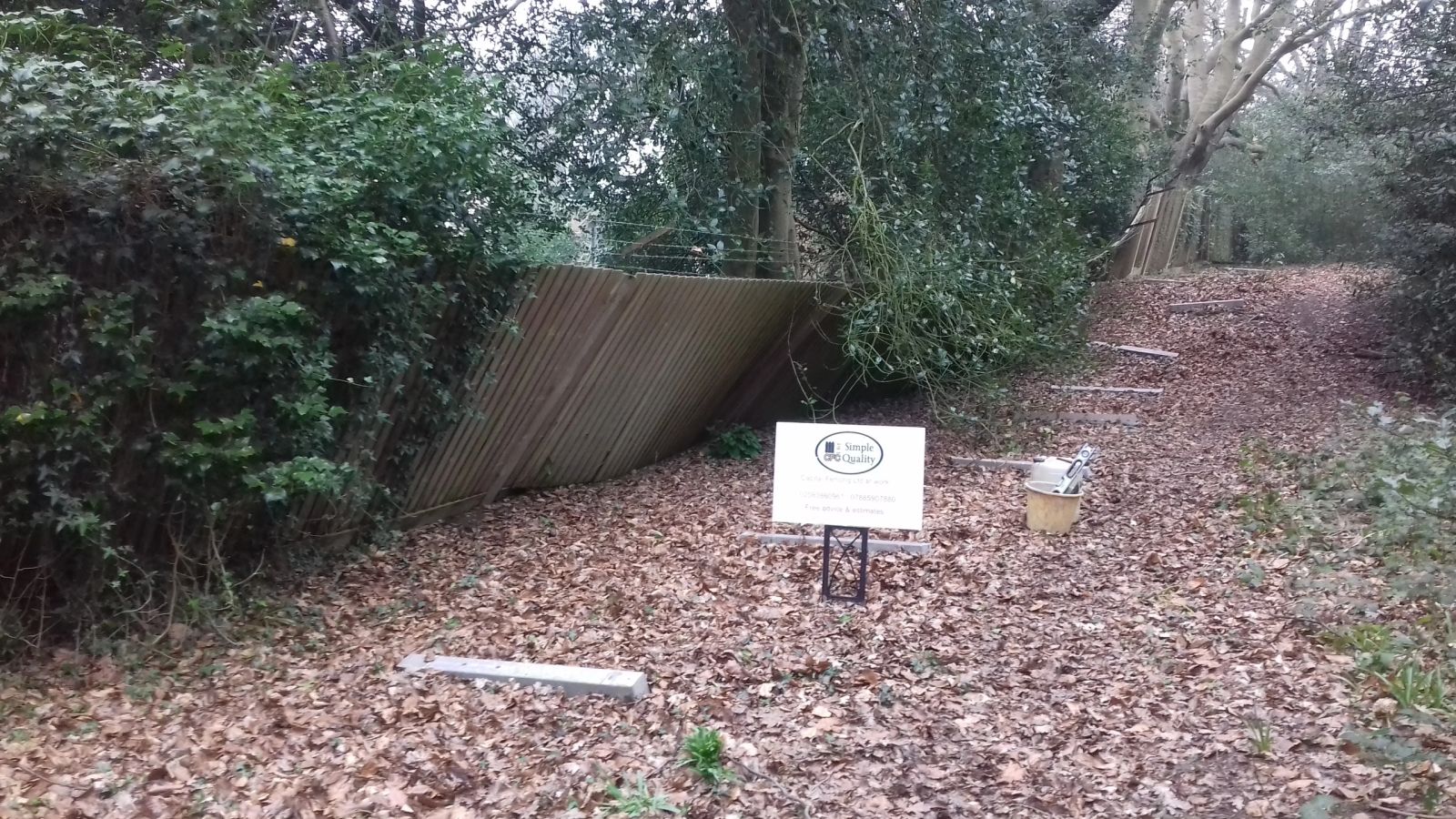
Storm damage rarely hits a run evenly — a bay at the end of a straight run, or one next to a gap such as a gate, usually takes more wind load than the bays either side and fails first.
When repairing storm damage we check the bays either side of the failure too, since a post that's been leaned on hard by a falling neighbour is often compromised even if it's still standing.
Salt-laden air and coastal-adjacent exposure
Gardens within a few miles of open coast, or on a plot regularly exposed to salt spray carried on strong onshore winds, see accelerated corrosion of standard fixings and hinges compared with an inland site.
Stainless steel or heavily galvanised fixings are worth the extra cost in these conditions, since standard zinc-plated screws and hinges can show surface rust within a single season.
Timber itself isn't usually damaged by salt exposure directly, but a finish applied over salt residue left on the surface after a storm won't bond as well as one applied to a clean, rinsed surface.
Arris rail sheared clean at the mortice joint
The morticed pocket cut into a post to take an arris rail end is a weak point in the post itself, and a rail under sustained load can shear off flush at that joint rather than splitting along its own length.
Repair options are a surface-mounted rail bracket that bypasses the damaged mortice entirely, or in more serious cases a new post section, since re-cutting a fresh mortice into an already-weakened post rarely holds long.
Anti-twist shoulder details on post fixings
Some post shoe and anchor systems include a shaped shoulder or collar that grips the post's cross-section rather than relying purely on friction from clamping bolts, resisting the post twisting in the fitting under sustained wind load.
Without that shoulder detail, a smooth-sided post held only by bolted clamp plates can gradually rotate within the fitting as repeated gusts work it slightly each time, loosening the bolts further with each cycle.
This detail matters more on taller, more exposed posts carrying larger panel or gate areas, where the leverage from wind load is greatest, than on short, low-level fencing where twisting force is comparatively small.
Checking battery backup on an automated security gate
An automated gate reliant on mains power for its motor and control panel usually has a battery backup to allow a limited number of open-close cycles during a power cut, and this backup is worth testing periodically rather than trusting it will work when actually needed.
A gate left stuck open or shut during a power outage because an untested backup battery had already failed defeats the purpose of automation entirely, so a manual release mechanism is also checked as part of the same inspection.
Replacing a fence on the same line as before
Replacing a fence exactly where the old one stood is generally the lowest-risk approach from a boundary perspective, since it maintains a position both neighbours have already implicitly accepted for years.
It's still worth flagging the planned replacement to a neighbour beforehand, particularly if the new fence will be a different height, material or style to what's there now.
Where the old fence's exact line is unclear because it has leant or shifted over time, marking out the intended new line and briefly confirming it with the neighbour avoids later disagreement.
Communal gate access arrangements for allotment sites
An allotment site's perimeter fence is usually a lower-cost stock or mesh fence given the modest value at risk, but the communal access gate often gets a disproportionately stronger lock and hinge set, since it's the single point every plot holder and any opportunist intruder both have to pass through.
A keypad or coded padlock at the shared gate avoids the administrative burden of cutting and distributing individual keys to a changing list of plot holders over time.
Weather delays and rescheduling honestly
Concrete won't cure properly in a hard frost, and post holes dug in heavy rain can collapse or fill with water before the post goes in, so a genuinely bad-weather day is a legitimate reason to reschedule rather than push through and risk a poor-quality fix.
Wind strong enough to make handling full panels unsafe is a similarly clear-cut reason to delay, particularly when working at height on taller gates or fence runs.
Being upfront about a weather delay as soon as it's known, rather than on the morning the crew was due, gives the client time to adjust their own plans around the new date.
Prescriptive easements from long use
An easement — such as a right of way or right to run services — can sometimes arise through long, uninterrupted use of land even where nothing was ever formally granted in writing, known as a prescriptive easement.
Establishing whether one genuinely exists is a legal question with specific tests around the nature and duration of the use, not something settled by opinion on site.
Where a longstanding informal path or access crosses a boundary being fenced, it's worth raising the history with a solicitor rather than assuming it can simply be closed off.
Wrought iron versus mild steel gate repairs
Genuine wrought iron on older gates is more corrosion-resistant and easier to work hot than the mild steel used on most modern fabricated gates, but original wrought iron sections are harder to source for a like-for-like weld repair.
We identify which material an older metal gate is actually made from before quoting a repair, since the repair method differs between the two.
The 2m permitted development height limit
Under permitted development rights, a new or replacement fence, wall or gate can generally reach up to 2 metres in height without planning permission, away from a road used by vehicles.
That height is measured from the natural ground level on the lower side where there's a change in level, which can make a fence look and function as taller than 2m when viewed from the raised side.
These are general rights and can be restricted or removed on individual properties, so checking with the local planning authority before installing anything close to the limit is sensible.
Powder coating and galvanising
Galvanising bonds a zinc coating to steel, usually by hot-dip, giving corrosion protection that works even if the surface is scratched because the surrounding zinc sacrifices itself to protect the exposed steel.
Powder coating is a decorative and additional protective layer baked onto the metal, giving a wide choice of colour and a harder finish than paint, but on its own over bare steel it doesn't offer the same self-healing protection as galvanising.
The durable combination for steel gates and railings is galvanising first, powder coating over the top, rather than powder coating alone, which is worth checking on a quote where both are mentioned separately.
Visibility splays at a driveway boundary
Some driveways, particularly on corner plots or busier roads, are subject to a required visibility splay — an area kept clear of tall obstructions so drivers can see pedestrians and other vehicles safely.
A fence built to the usual permitted development height can still breach a specific visibility splay condition attached to the property, especially where one was imposed when the driveway was originally created.
Checking historic planning conditions for the property, or asking the council's highways team, is worth doing before fencing close to any vehicle crossing.
Raised beds built directly against a fence
A raised planting bed built with its back edge against a fence line keeps damp soil and mulch in permanent contact with the lowest boards or gravel board, which accelerates rot at exactly the point most vulnerable to moisture.
Lining the inside face of the bed against the fence with a damp-proof membrane, rather than backfilling soil directly onto the timber, reduces this contact without changing the visible design.
This detail is easy to miss at the planning stage since the bed and the fence are often specified and built by different trades without either flagging the interaction.
Slip resistance and board grooving
Grooved decking boards are often assumed to be more slip-resistant than a smooth reeded board, but grooves can actually hold water, algae and leaf debris that make the surface more slippery if it isn't cleaned regularly, rather than less.
A smooth board kept clean and free of algae, or a textured composite surface designed specifically for grip, often performs better in practice than a grooved timber board left unmaintained.
Orientation of grooves relative to the main walking direction, and a regular cleaning routine, matter more to actual slip performance than the board profile alone.
Compression versus tension fixing of infill panels
Some panel systems clip into a compression-fit channel between posts, relying on the panel being cut to a precise size to stay in place under load; others are bolted under tension to the post face, which tolerates more variation in panel size but adds visible fixing points.
Compression-fit systems look cleaner but are harder to make tamper-resistant, since a panel that can be removed without tools for maintenance can usually also be removed without tools by someone else.
Repairing an end post fixed against a house or garage wall
An end post bolted to masonry rather than set in its own footing fails differently — usually at the wall fixings rather than at ground level — and repair means checking whether the wall fixing itself has corroded or worked loose in the masonry.
Where the original fixing type has degraded, refitting with a heavier-duty or better-protected fixing is generally worth the small extra effort over simply replacing like-for-like into the same drilled holes.
Gate ironmongery on a security boundary
A security fence is only as strong as its weakest gate junction — commercial-grade hinges, drop bolts and hasps matched to the fence spec close the gap that a domestic-grade fitting would leave open.
Where a client wants electronic access control we fit the mechanical hardware to the same spec and refer the electronic side to a specialist, rather than mixing a heavy-duty fence with a light-duty latch.
Consent needed to connect drainage across a boundary
Running a new drainage connection across a neighbouring property's land, sometimes done alongside boundary works, needs the neighbour's consent and possibly a formal easement, not just a friendly verbal understanding.
Water companies can also require notice for new connections joining an existing public sewer, separate from any neighbour agreement about crossing their land.
Where fencing work uncovers or affects a drainage connection crossing the boundary, it's worth pausing to confirm what rights actually exist before proceeding.
Correcting mismatched post spacing discovered during a repair
Occasionally an older run turns out to have inconsistent post spacing from the original build, which only becomes apparent when a panel being fitted during a repair doesn't sit at the expected width against the next post.
Rather than forcing a standard panel into a non-standard gap, options include a site-cut infill panel or slightly repositioning the post if it hasn't already been set, since forcing a fit usually strains the panel's frame and shortens its life.