Use classes for ground-contact timber
Treated timber is graded into use classes according to how much moisture and ground contact it's expected to face, and specifying the wrong class for the job is a common cause of premature rot that isn't obvious until years later.
Use Class 3 covers above-ground timber exposed to the weather, such as boards and rails; Use Class 4 covers timber in direct or near-permanent ground contact, which is what posts and gravel boards should be specified to, not Use Class 3 stock used because it's cheaper or more available.
A supplier's treatment certificate should state the use class achieved, and it's worth asking for it on any job where posts are the expensive, hard-to-replace component of the run.
Where the adopted highway boundary actually sits
The legal edge of an adopted public highway doesn't always match the visible edge of the tarmac or verge, and can extend further onto what looks like private land in some cases.
Erecting a fence, wall or gate on adopted highway land without authorisation is a separate issue from planning permission, and the highway authority can require its removal.
Where there's any doubt about the exact highway boundary, the local highway authority can usually confirm the extent of the adopted highway against its own records.
Thumb latch lever and bar wear
A thumb latch lifts an internal bar via a lever operated from one or both faces of the gate, and wear typically shows up as play at the pivot pin or a lever that no longer lifts the bar high enough to clear the keep.
Because the mechanism is simple, most thumb latch faults can be corrected by re-fixing the pivot or reshaping the bar's resting angle rather than replacing the whole latch.
Splash-back staining from adjacent paving
A fence running alongside a patio, path or driveway picks up rain splash-back off the hard surface, which carries fine grit and, on older paving, residual cement dust that leaves a pale tide-mark along the lowest boards.
This band of discolouration is separate from general weathering and won't fade with the rest of the timber, since it is a surface deposit rather than UV bleaching.
A gravel strip or planting border between paving and fence line reduces the splash distance, and a periodic wash-down of just the lower boards keeps the tide-mark from building up permanently.
Running bamboo and rhizome pressure on boundaries
Running bamboo species spread through underground rhizomes that can travel several metres from the parent plant and push up through gravel boards, path joints or even through weak points in a fence base.
Unlike tree roots, rhizome growth is fast and can reappear within a single growing season after being cut back, so a fence base alone rarely stops it without a physical rhizome barrier buried alongside it.
Where established running bamboo sits on a neighbouring boundary, it's worth flagging to the client that fence replacement won't solve the underlying spread on its own.
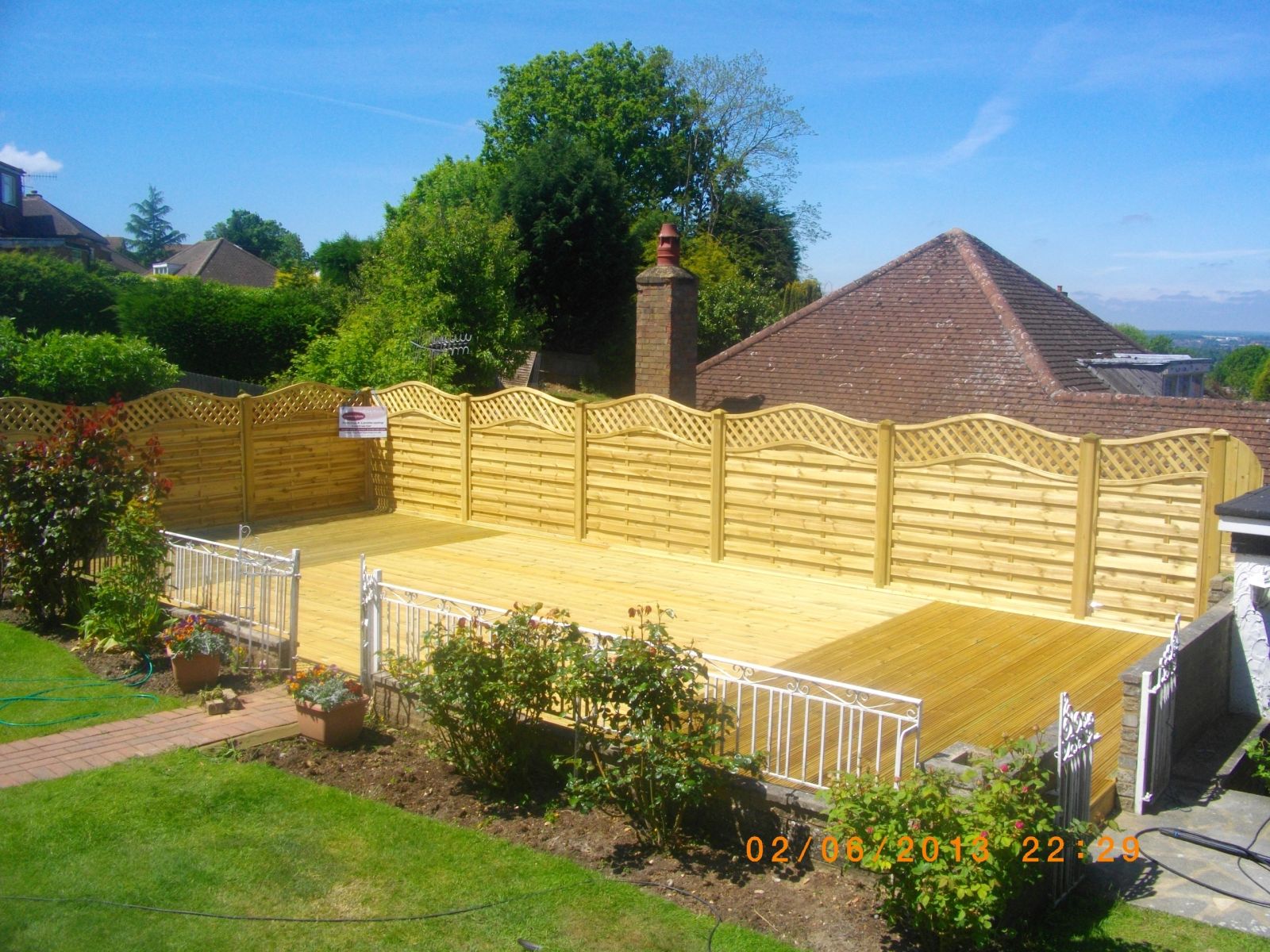
Fall direction and drainage across a deck
A deck built dead level holds standing water after rain, which speeds up algae growth and softens the timber surface faster than a deck with a slight fall built in to shed water away from the house.
The fall is normally built into the joist or bearer heights during construction, angled away from any adjoining wall or door threshold, rather than relying on the boards themselves to slope.
Getting the fall direction right at the design stage also avoids water pooling against a house wall, which risks damp ingress at the threshold over time.
Acoustic fencing compared with planting-based screening
Dense planting alone reduces perceived noise mostly by psychological and visual screening rather than genuine sound-blocking, since a hedge thin enough to see through offers little real acoustic mass.
A solid acoustic fence combined with planting in front of it gets the best of both — genuine sound reduction from the solid barrier, softened by greenery that also helps with dust and visual softening.
Where space is tight, prioritising the solid barrier over depth of planting usually gives a better acoustic result than a wide but thin screen of shrubs.
Wicket gates set within a larger gate
A wicket gate is a small pedestrian door built into one leaf of a larger vehicle gate, allowing foot access without opening the whole gate, and it needs its own hinge, latch and frame within the host leaf.
Because it's a frame within a frame, movement in the main gate can throw the wicket's alignment out even when the wicket's own hardware is sound, so both are checked together.
Carrying 2.4m panels through a domestic hallway
A standard 2.4m fence panel is longer than most internal hallways are wide, so it has to be carried end-on through doorways and pivoted at corners rather than moved flat, which takes two people to control safely.
Door frames, light switches and stair newels are the most common casualties of moving long panels through a house, so a dry run to identify pinch points before committing to carrying a stack of panels through saves repeated near-misses.
Where a hallway genuinely can't take a full panel around a tight corner, the practical fallback is building the run from shorter featheredge boards fixed in place rather than trying to force a pre-built panel through.
Wind loading and bay spans on taller runs
Taller, solid-faced security screens catch more wind than an open panel fence, so bay spans are shortened and post sections are upsized on exposed boundaries rather than kept at a garden-fence default.
On an open plateau or a boundary that runs the full length of a plot with nothing breaking the wind, that adjustment is the difference between a run that stands for years and one that racks at the first proper storm.
Wind loading on a solid gate face
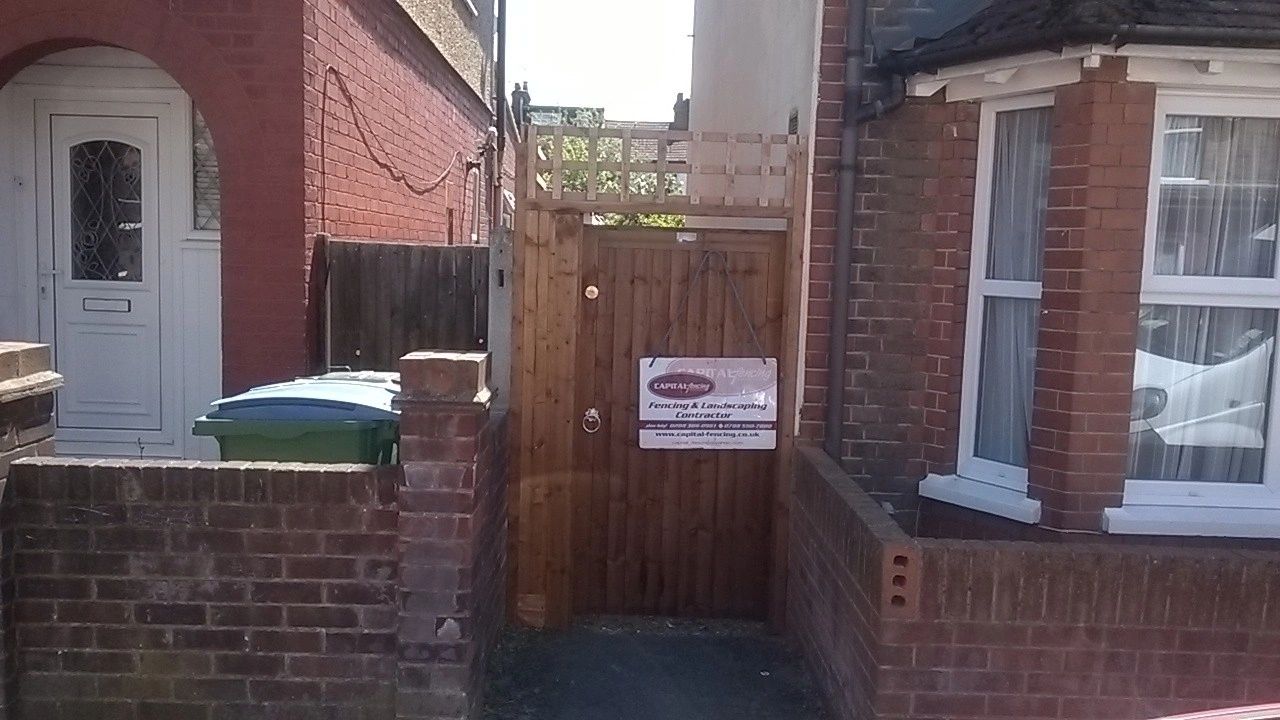
A solid gate face catches far more wind than an open-bar design of the same size, which puts extra strain on the hinge side over time — this is worth factoring in when repairing or replacing a gate on an exposed frontage.
Bracing the frame diagonally helps a solid gate resist that racking force in a way a simple butt-jointed frame doesn't.