London & Hertfordshire Free Site Visit
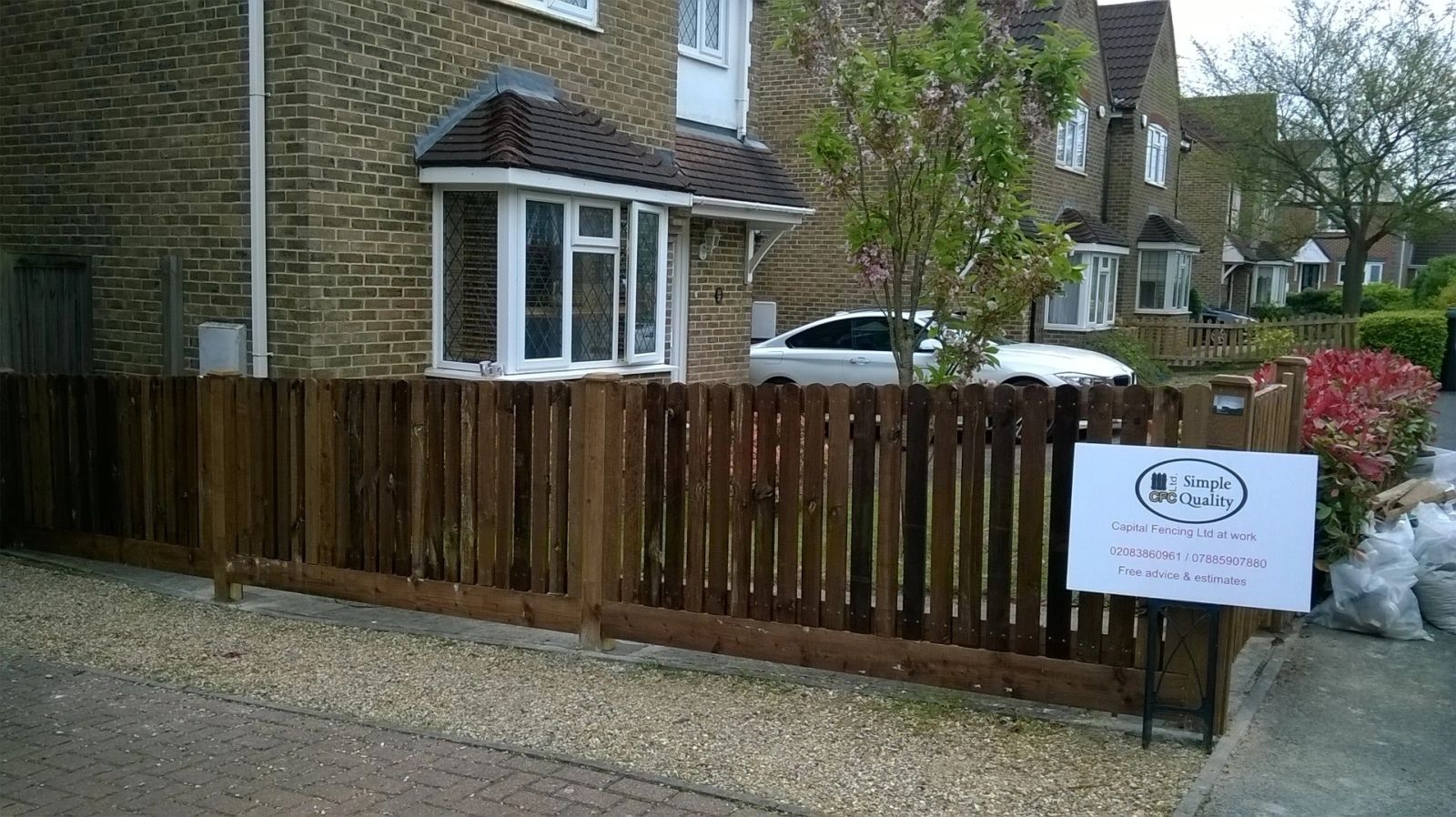
closeboard fence run installed by Capital Fencing in Hertford (SG13)
Hertford · SG13 / SG14

Looking for Composite Fencing in Hertford? Local Specialist Serving East Hertfordshire District

The composite question in Hertford is nearly always cost against effort: it lands 40–60% above a treated timber run, and buys back every future weekend of staining. We set aluminium posts into concrete, slot the boards, and cap the tops so water never sits in an open grain. If you're weighing composite fencing for a property in Hertford, the housing stock — Georgian and Victorian townhouses in the centre, with newer estates on the Bengeo and Sele Farm sides — sets most of the answer. On long, sloping plots dropping toward the River Lea — terracing and retaining work are often part of the job, wood-polymer composite boards on aluminium or steel posts generally makes sense for long rear boundaries where zero maintenance matters more than up-front cost. Where it doesn't, we say so. Recent work on Queens Road and Ware Road. We orient jobs off Hertford Museum.

The composite question in Hertford is nearly always cost against effort: it lands 40–60% above a treated timber run, and buys back every future weekend of staining. We set aluminium posts into concrete, slot the boards, and cap the tops so water never sits in an open grain. If you're weighing composite fencing for a property in Hertford, the housing stock — Georgian and Victorian townhouses in the centre, with newer estates on the Bengeo and Sele Farm sides — sets most of the answer. On long, sloping plots dropping toward the River Lea — terracing and retaining work are often part of the job, wood-polymer composite boards on aluminium or steel posts generally makes sense for long rear boundaries where zero maintenance matters more than up-front cost. Where it doesn't, we say so. Recent work on Queens Road and Ware Road. We orient jobs off Hertford Museum.

Common Hertford briefs

  • rental properties where landlords want a 15-year panel life without staining trips
  • long rear boundaries where zero maintenance matters more than up-front cost

Why composite fencing works here

  • no annual staining or oiling
  • colour-through boards don't fade to grey the way pressure-treated timber does
  • aluminium post system won't rot at ground level, which is where 90% of timber fences fail
Typical spec

How we build composite fencing in Hertford

Wood-polymer composite boards on aluminium or steel posts. Standard build: 6ft × 6ft panels, 2.4m aluminium posts on 700mm concrete bases. On Hertford jobs we adjust for conservation areas and listed buildings around the castle restrict heights and finishes.

Property mix locally: Georgian and Victorian townhouses in the centre, with newer estates on the Bengeo and Sele Farm sides. Typical gardens: long, sloping plots dropping toward the River Lea — terracing and retaining work are often part of the job. Postcodes we regularly service: SG13, SG14.

Composite Fencing FAQs — Hertford

How long does composite fencing last compared to timber?

Composite is heavier than lap panels, so access along long is checked on the visit before we commit to a date. For georgian and victorian townhouses in the centre in SG13, that is where the cost sits. In short: no annual staining or oiling, though up-front cost is roughly double a lap-panel fence.

Can you match a neighbour's existing composite colour?

We keep colour batches together on a single run, so a Hertford boundary reads as one boundary rather than two deliveries. We allow for long when setting out in Hertford. Worth weighing no annual staining or oiling against up-front cost is roughly double a lap-panel fence before you commit.

Can composite panels drop into existing concrete posts?

Post fixing matters more than the boards here: aluminium posts get concrete-set, because a composite run has no give to hide a leaning post in Hertford. Survey slots across SG13 are usually inside a week. Worth weighing no annual staining or oiling against up-front cost is roughly double a lap-panel fence before you commit.

Is composite fencing worth the extra cost?

Post fixing matters more than the boards here: aluminium posts get concrete-set, because a composite run has no give to hide a leaning post in Hertford. We work this patch weekly, from Mead Lane industrial estate out toward ware. Practically, that means colour-through boards don't fade to grey the way pressure-treated timber does — and we're upfront that boards can dent under a football or garden strimmer edge.

How is composite fencing recycled at end of life?

We keep colour batches together on a single run, so a Hertford boundary reads as one boundary rather than two deliveries. For georgian and victorian townhouses in the centre in SG13, that is where the cost sits. In short: no annual staining or oiling, though up-front cost is roughly double a lap-panel fence.

Recent composite fencing work
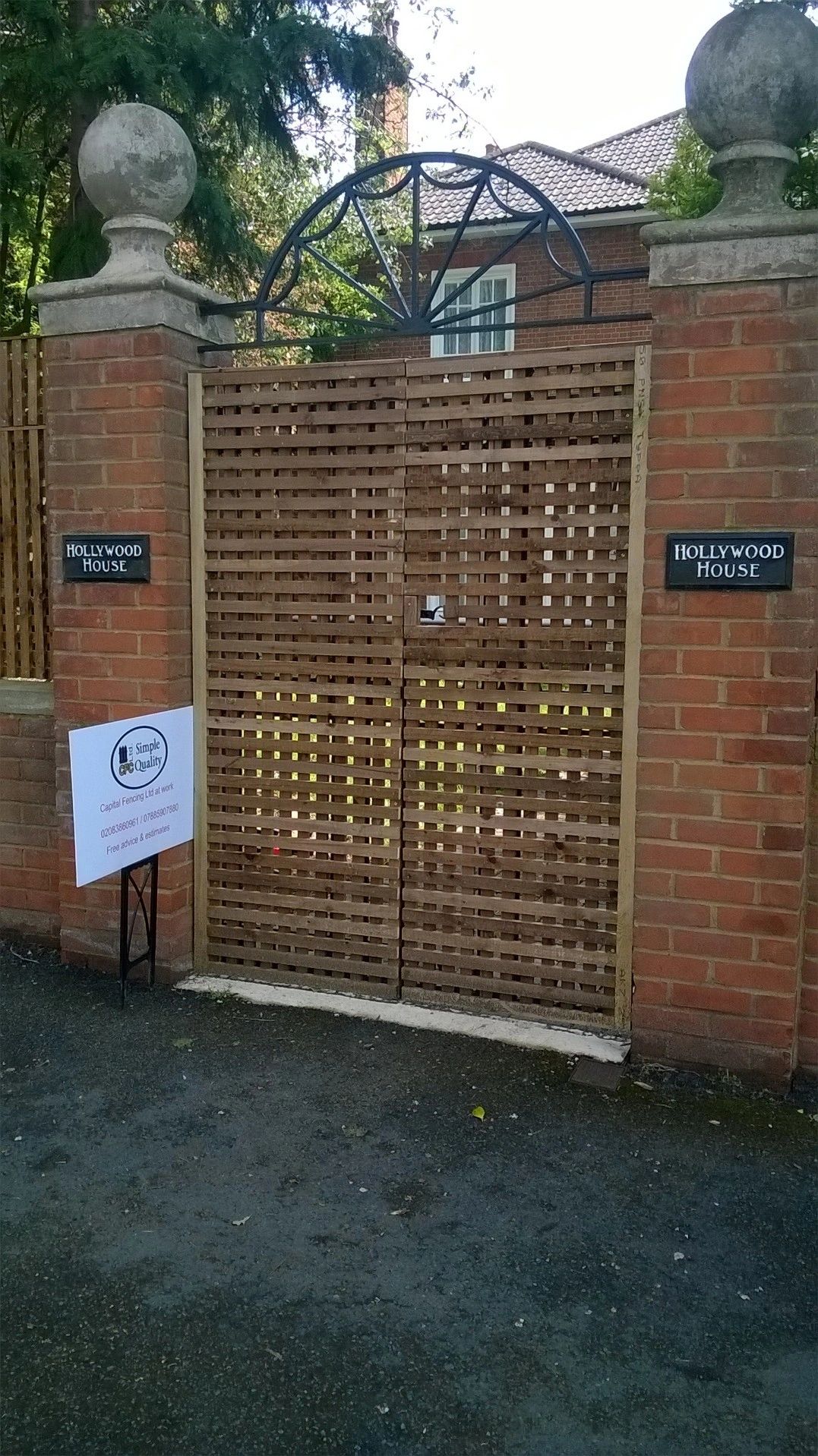
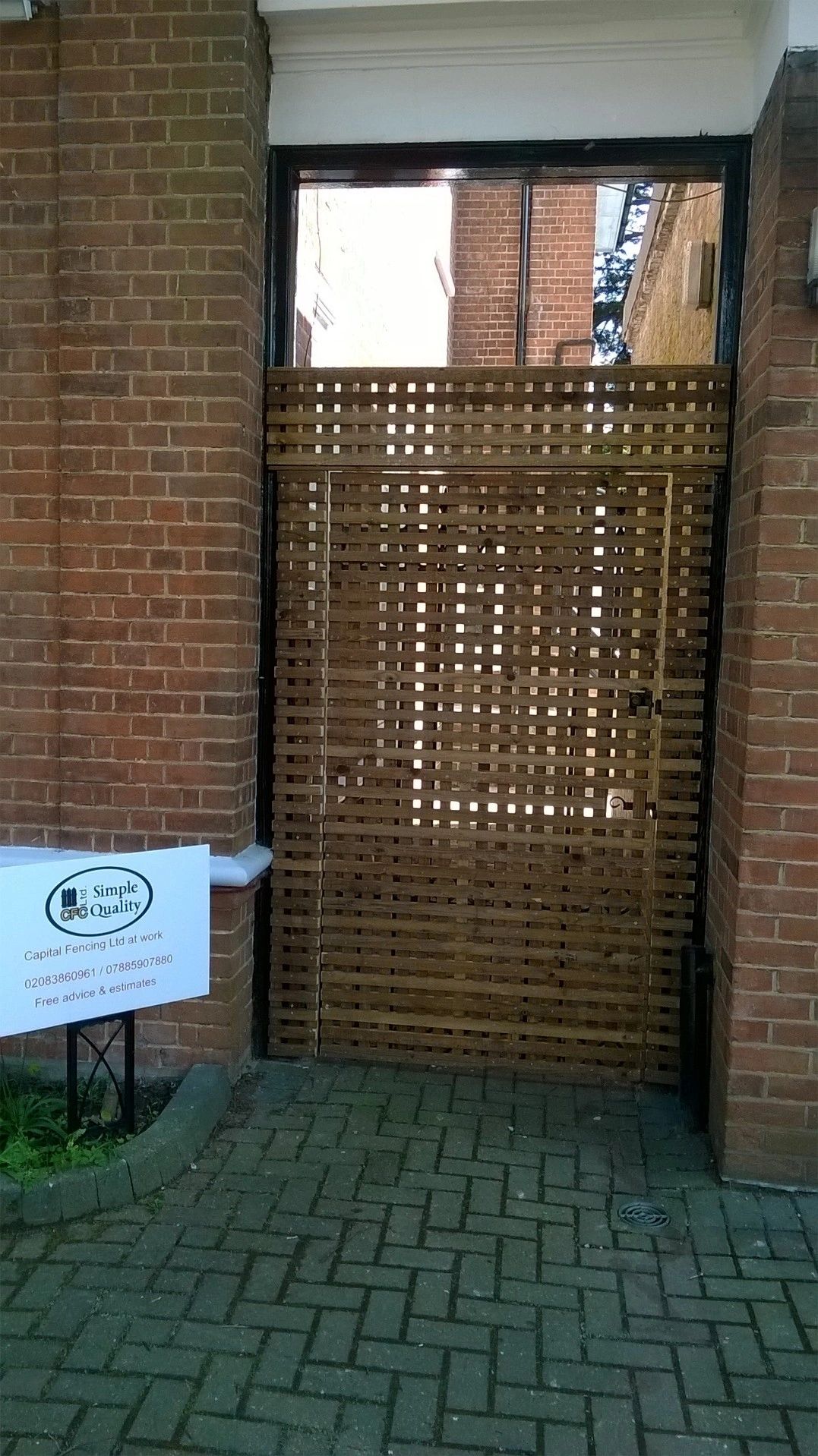
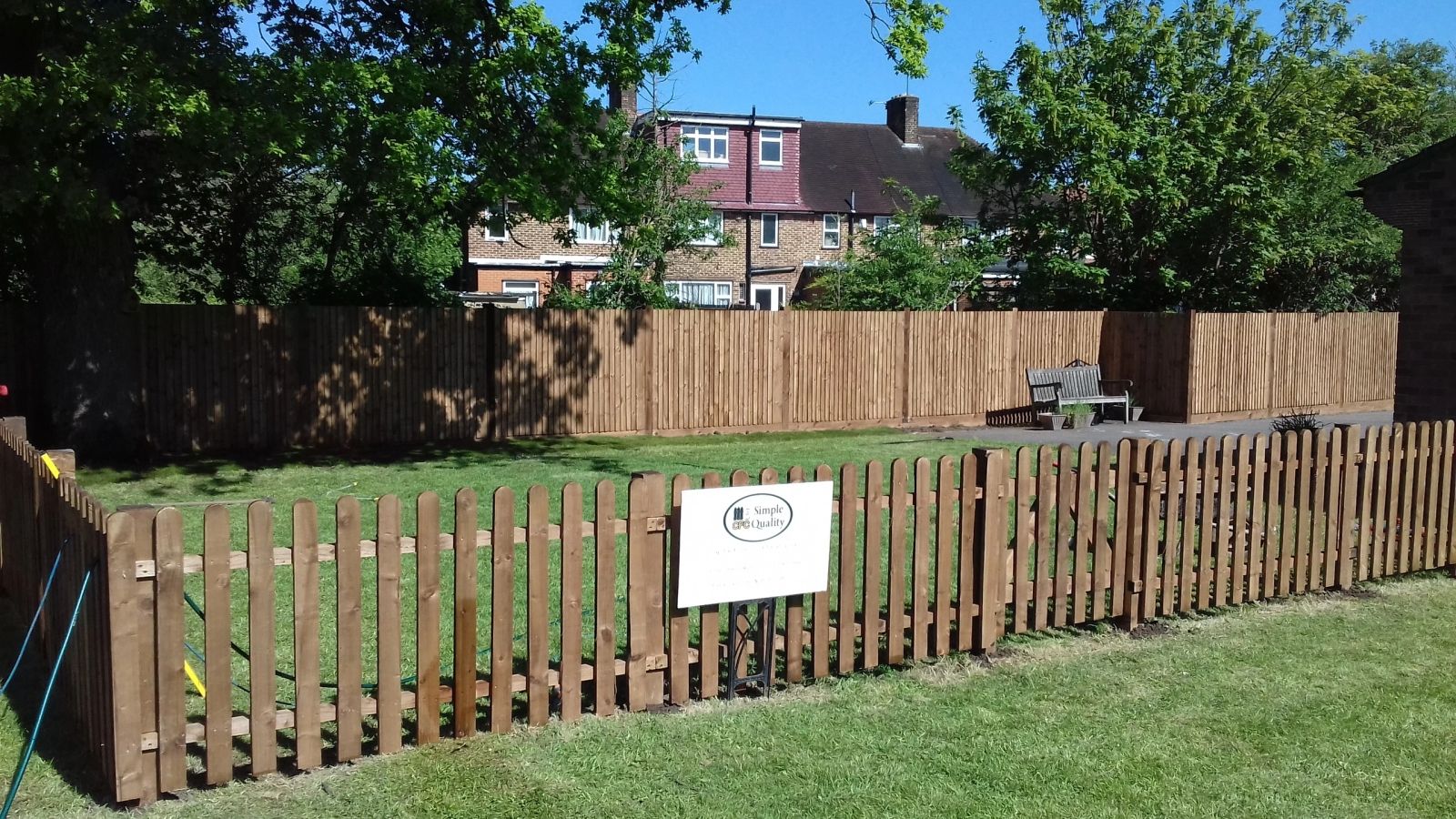
closeboard fence run installed by Capital Fencing in Hertford (SG13)panel fence install installed by Capital Fencing in Hertford (SG13)trellis-topped fence installed by Capital Fencing in Hertford (SG13)bespoke decorative fence installed by Capital Fencing in Hertford (SG13)

Local considerations across Hertford and ware

Extending an acoustic run along a boundary

Where only part of a boundary needs acoustic treatment — the section directly facing the noise source — we match the height and detailing into the standard fencing either side so the transition doesn't leave a weak gap at the join.

On a shared boundary, coordinating with a neighbour who might extend the same treatment later keeps future work compatible.

Recoating a heavy acoustic facing

A timber-faced acoustic panel needs the same kind of periodic stain or paint maintenance as any exterior timber, but access can be more limited where a dense panel sits close to a boundary wall or a neighbour's property.

Planning recoating around that access constraint, and choosing a product suited to a less frequently reachable surface, avoids a situation where one face of the run is maintained less often than the other simply because it's harder to reach.

Board spacing and decking drainage

Decking boards need a consistent gap between them, usually a few millimetres, to let rainwater drain through rather than pool on the surface and accelerate algae growth or rot.

Timber that's fitted too tightly when green will open up gaps as it dries, while composite boards expand and contract with temperature and need the gap specified by the manufacturer, not guessed on site.

A deck built without a fall or slight pitch away from the house risks water sitting against the property's damp-proof course, which is a bigger problem than a slippery deck surface.

Lap panels versus closeboard durability

Overlap (lap) panels are factory-assembled from thin horizontal slats stapled to a light timber frame, which makes them cheap and quick to fit but noticeably shorter-lived than boarded fencing.

The thin slats and lightweight frame flex in wind and the staples pull through over a handful of seasons, especially on an exposed run, whereas closeboard's thicker feather-edge boards and nailed arris rails tolerate the same movement without failing.

Lap panels suit a budget-driven job with modest exposure; anywhere wind-loaded or expected to last well past a decade is better specified as closeboard from the outset.

Preservative penetration envelope thickness

Pressure treatment doesn't necessarily saturate a timber section all the way through, and the depth of genuine preservative penetration, sometimes called the treatment envelope, can be shallower in dense or resistant species than the treated colour suggests.

Cutting a treated post in half reveals this directly, often showing a pale, untreated core surrounded by a darker treated outer band a few millimetres to a couple of centimetres deep depending on species and process.

This is the practical reason cut ends need separate end-grain treatment, since a fresh cut through the envelope exposes untreated core timber that the original pressure treatment never reached.

Acoustic barriers on a raised garden

A garden set above the level of an adjacent road or railway changes the geometry between source and listener, sometimes reducing the barrier height needed because the listener already sits some way above the noise source.

Conversely, a raised garden can also expose a ground-floor window at the source's own height while the fence line sits below, which needs checking rather than assuming height works purely in the garden's favour.

Front boundary choices and kerb appeal

A front boundary is one of the first things anyone sees of a property, and low-key choices — a consistent gate style, tidy capping, a colour that complements the brickwork — do more for kerb appeal than an expensive but mismatched material choice.

Open or low front boundaries tend to suit properties where the frontage itself is attractive and worth showing off, while a higher, more solid front boundary suits a busier road or a desire for more privacy from passers-by.

It's worth thinking about a front boundary as a long-term fixture rather than following short-lived trends, since it's one of the more visible and slower-to-replace elements of a property's exterior.

Acoustic fencing near busy roads or railways

Taller acoustic fencing intended to reduce traffic or railway noise is still subject to the same general permitted development height limits as any other boundary structure, unless it forms part of a formally consented scheme.

Some acoustic fencing along significant infrastructure is installed by the highway or rail authority itself under separate statutory powers, which is different from a homeowner adding their own noise barrier.

A homeowner wanting extra height for noise reasons alone would generally still need to apply for planning permission above the normal limit, the same as for any other reason.

Deck boards against a shaded wall building up algae

A deck built hard against a shaded wall, fence, or dense planting on one side often shows a distinct band of algae growth along that edge well before the rest of the deck, since it dries far more slowly after rain.

This uneven wear pattern is normal rather than a sign of a substandard board, but it does mean that edge needs cleaning more often to keep slip resistance consistent across the whole deck.

Where possible, leaving even a narrow gap between the deck edge and an adjoining wall or dense hedge improves airflow along that edge and reduces how quickly algae establishes there.

Picket profiles and spacing

Picket fencing is defined as much by the top profile of each paling — pointed, rounded, flat or 'gothic' — as by the gap between them, and both are usually specified rather than left to whatever the yard has in stock.

A tighter spacing, close to the paling's own width, gives a more solid boundary marker and better contains small pets; a wider spacing is more open and traditionally cottage-garden in character but does less to define a boundary.

Picket is a low-privacy, low-height fence by design, generally under a metre, and isn't a substitute for a taller closeboard or panel run where genuine screening is the aim.

Board orientation and grain direction

A board fixed with its bark side facing outward tends to cup away from the fixings as it dries, since the outer growth rings shrink tangentially more than the inner ones, pulling the board's edges outward.

Orienting the bark side inward on a fence board means any cupping pulls the edges toward the fixing rather than away from it, which keeps the board flatter and the fixings under less repeated strain.

This detail is easy to overlook when boards are cut from mixed stock without checking growth ring orientation, but it becomes visible within a season or two as boards from the same batch cup in opposite directions.

Replacing a fence on the same line as before

Replacing a fence exactly where the old one stood is generally the lowest-risk approach from a boundary perspective, since it maintains a position both neighbours have already implicitly accepted for years.

It's still worth flagging the planned replacement to a neighbour beforehand, particularly if the new fence will be a different height, material or style to what's there now.

Where the old fence's exact line is unclear because it has leant or shifted over time, marking out the intended new line and briefly confirming it with the neighbour avoids later disagreement.

Salt and de-icing near a pavement

A front boundary fence close to a pavement or road gritted in winter is exposed to salt spray and run-off that a rear-garden fence never sees, and that salt accelerates corrosion in untreated steel fixings and speeds up timber degradation at ground level.

Galvanised or stainless fixings resist this better than standard bright steel, and are worth specifying as standard on any boundary within a few metres of a regularly gritted surface.

Salt-laden ground also tends to stay damp for longer after a thaw, extending the period a post base is sitting in wet conditions each winter.

Ivy growth as a structural load

Established ivy doesn't just sit on a fence for appearance — its woody stems and aerial roots add real dead weight, and a mature growth can add the equivalent of several boards' worth of load to a panel over years of unchecked growth.

Ivy also holds moisture directly against the timber or brickwork it covers, which accelerates rot or mortar erosion underneath even though the visible growth looks healthy.

Removing mature ivy from a fence intended to stay in place needs care, since cutting the base and letting it die back gradually avoids suddenly exposing timber that has been softened by long-term dampness underneath.

Composite is a specification job rather than a supply job: post centres, base depth, drainage gaps and trim details all get set out before boards are ordered for a Hertford garden. We keep the composite fencing process simple for Hertford clients: site visit, written quote, agreed start date, then in and out cleanly. No subcontracted labour, no chasing for an invoice at the end. Recent work on Hagsdell Road and Fanshawe Street. We orient jobs off Hertford Museum.

Get In Touch

Get My Free Quote — 24h Response

No callout fee · Free site visit · Friendly local team covering London & Hertfordshire.

Call us
07885907880
or 02036484746
Email
capital_fencing@yahoo.com
WhatsApp
Message us anytime
Area
London & Hertfordshire
Payment
Card payments accepted

Pay by debit or credit card, bank transfer or cash once the work and price are agreed. No deposit taken online.

Request a Free Quote

We'll get back to you within 24 hours.

Free Site Visit No Callout Fee
Call WhatsAppQuote