London & Hertfordshire Free Site Visit
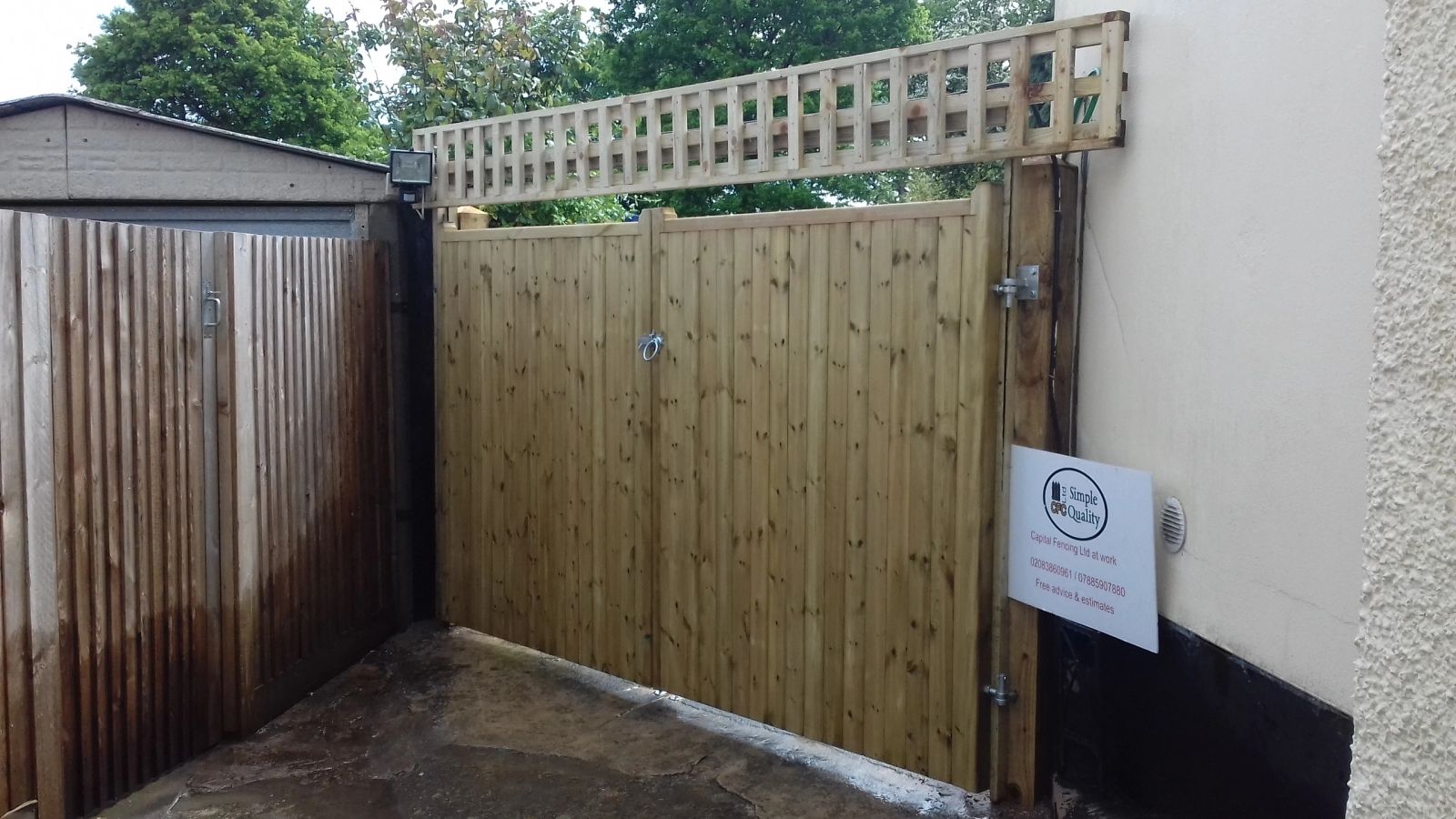
bespoke wooden gate installed by Capital Fencing in Hertford (SG13)
Hertford · SG13 / SG14

Wooden Gates for Georgian and Victorian townhouses in the centre in Hertford

Timber gates are made to the opening, not trimmed to fit. We template the Hertford opening, allow for the fall of the path, and build the frame with a diagonal brace working in compression so the leaf cannot drop. We're a small, time-served wooden gates crew working out of London and Herts, and Hertford is a regular week for us. Most briefs here come down to side gates matching a closeboard or panel boundary — and honestly, whether wooden gates is the right answer at all before we quote. Recent work on Hagsdell Road and Ware Road. We orient jobs off Hertford Museum.

Timber gates are made to the opening, not trimmed to fit. We template the Hertford opening, allow for the fall of the path, and build the frame with a diagonal brace working in compression so the leaf cannot drop. We're a small, time-served wooden gates crew working out of London and Herts, and Hertford is a regular week for us. Most briefs here come down to side gates matching a closeboard or panel boundary — and honestly, whether wooden gates is the right answer at all before we quote. Recent work on Hagsdell Road and Ware Road. We orient jobs off Hertford Museum.

Typical spec

How we build wooden gates in Hertford

Iroko hardwood, oak or planed softwood on hot-dip galvanised ironmongery. Standard build: 44mm framed, tongue-and-groove infill, adjustable ball-race hinges, drop bolt to slabs. On Hertford jobs we adjust for conservation areas and listed buildings around the castle restrict heights and finishes.

Property mix locally: Georgian and Victorian townhouses in the centre, with newer estates on the Bengeo and Sele Farm sides. Typical gardens: long, sloping plots dropping toward the River Lea — terracing and retaining work are often part of the job. Postcodes we regularly service: SG13, SG14.

Why wooden gates works here

  • warm, matches most period and modern properties without looking industrial
  • easily re-sanded and re-oiled to refresh the finish every few years
  • hardwood options like iroko regularly outlast the ironmongery

Common Hertford briefs

  • driveway double gates — softwood or hardwood, manual or automated
  • pedestrian gates set into a brick pier or existing wall opening

Wooden Gates FAQs — Hertford

How do you stop a wooden gate dropping over time?

Adjustable hinges mean the gate can be re-trued in ten minutes years later, without touching the frame. For georgian and victorian townhouses in the centre in SG13, that is where the cost sits. Practically, that means easily re-sanded and re-oiled to refresh the finish every few years — and we're upfront that softwood side gates need re-treating annually to avoid black spot.

Softwood or hardwood — which lasts longer in the London weather?

Adjustable hinges mean the gate can be re-trued in ten minutes years later, without touching the frame. We allow for long when setting out in Hertford. Practically, that means easily re-sanded and re-oiled to refresh the finish every few years — and we're upfront that softwood side gates need re-treating annually to avoid black spot.

How wide can a single wooden gate span before it needs a brace or wheel?

Adjustable hinges mean the gate can be re-trued in ten minutes years later, without touching the frame. Survey slots across SG13 are usually inside a week. Practically, that means easily re-sanded and re-oiled to refresh the finish every few years — and we're upfront that softwood side gates need re-treating annually to avoid black spot.

How do you finish wooden gates to resist rot?

Leaf weight drives the post size — an undersized post is the most common reason a Hertford gate stops closing. We work this patch weekly, from Mead Lane industrial estate out toward ware. Worth weighing warm, matches most period and modern properties without looking industrial against timber moves seasonally — expect small alignment adjustments in year one before you commit.

Do you build gates to match an existing fence?

Adjustable hinges mean the gate can be re-trued in ten minutes years later, without touching the frame. For georgian and victorian townhouses in the centre in SG13, that is where the cost sits. Practically, that means easily re-sanded and re-oiled to refresh the finish every few years — and we're upfront that softwood side gates need re-treating annually to avoid black spot.

Recent wooden gates work
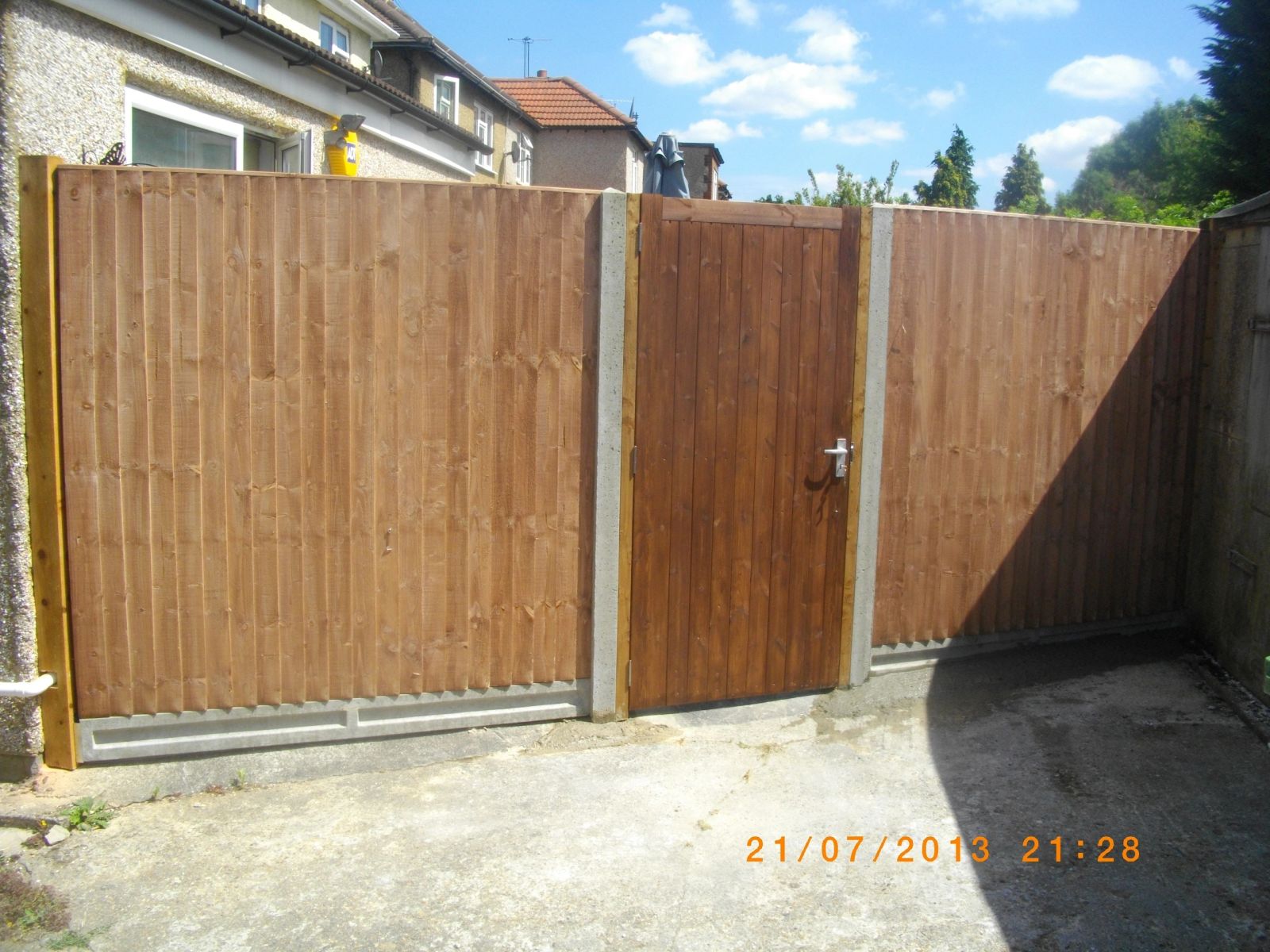
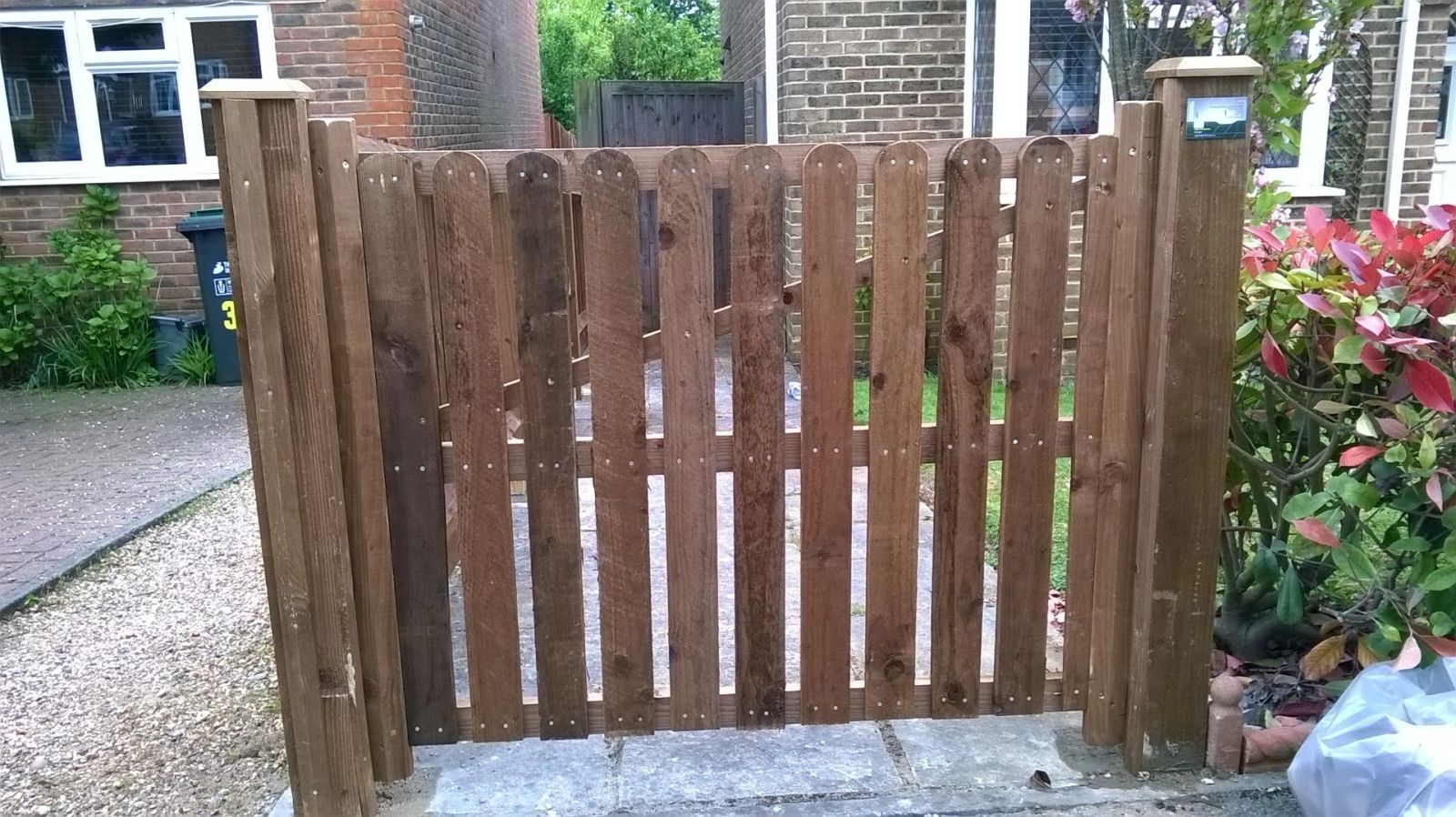
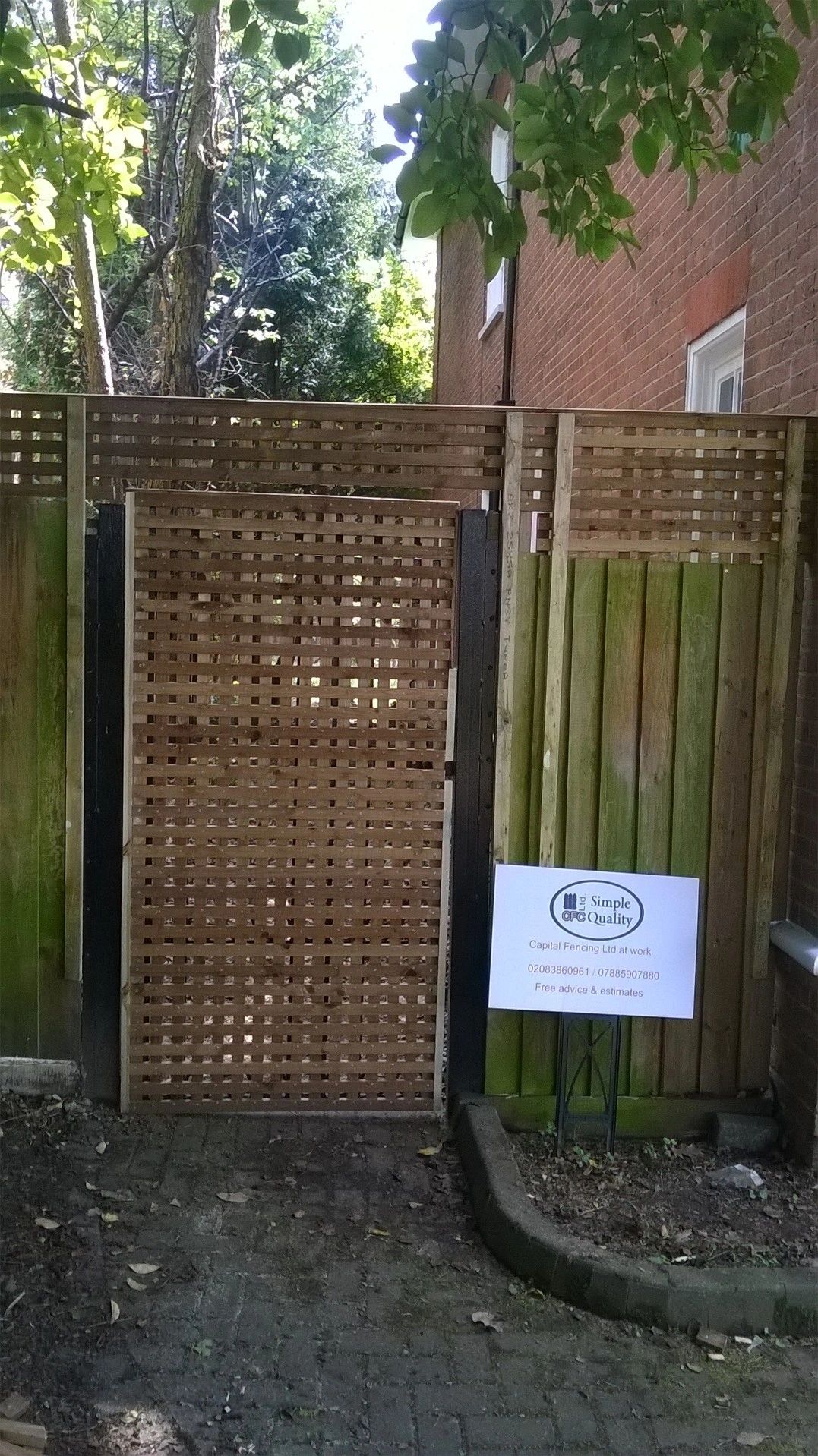
bespoke wooden gate installed by Capital Fencing in Hertford (SG13)double driveway gates installed by Capital Fencing in Hertford (SG13)hardwood side gate installed by Capital Fencing in Hertford (SG13)metal entrance gate installed by Capital Fencing in Hertford (SG13)

Site notes: wooden gates in SG13

Ironmongery corrosion and galvanising

Hinges, latches and bolts left in an ungalvanised or poorly coated finish corrode faster than the timber they're fixed to, particularly on a gate exposed to rain and wind on all sides, and a corroded hinge pin can seize or shear well before the frame itself fails.

Specifying hot-dip galvanised or stainless ironmongery at repair time is usually a small extra cost against a considerably longer service life.

A gate that swings and closes itself on a slope

A gate hung on ground that falls away from the latch post can swing open or shut under its own weight rather than staying where it's left, which is a nuisance rather than a fault in the hardware itself.

Fitting a hydraulic closer, a gravity latch set to hold at the correct point, or re-hanging with a slight counter-lean can correct the tendency without rebuilding the gate.

Gate hardware for a deck-level opening

A gate set into a deck balustrade, for example at the top of external steps or beside a pool, benefits from a self-closing hinge and childproof latch in the same way a pool or driveway gate would, particularly where there's a fall risk beyond it.

Hardware exposed to full weather on an open deck needs the same corrosion-resistant fixings as an exterior fence gate, since a deck gate often sees more direct rain and UV exposure than a gate tucked against a house wall.

The gate frame needs bracing consistent with the balustrade posts either side of it, since a lightweight infill gate hung between two structural posts is only as safe as its own resistance to being pushed or leant on.

Fencing next to a railway line

Gardens backing directly onto an operational railway usually have a boundary that belongs to the railway infrastructure owner rather than the homeowner, and any work near that boundary needs their agreement rather than being treated as a standard garden fence job.

Vibration from passing trains is a genuine consideration for post stability on ground close to the tracks, and residents commonly want additional sound-deadening in the fence specification for the same reason.

Access for maintaining a railway-side boundary is often restricted to the rail side only, which changes which side of the fence a repair crew can realistically work from.

Applying to modify or discharge an old covenant

Where an old restrictive covenant genuinely no longer serves a useful purpose, it's possible to apply to the Upper Tribunal (Lands Chamber) to have it modified or discharged, though this is a formal legal process rather than a quick fix.

This route is generally used where a covenant is preventing otherwise sensible work and informal agreement with whoever benefits from it can't be reached.

Given the legal complexity involved, this is very much a solicitor-led process rather than something to attempt without professional advice.

UV stabilisers in composite and PVC fencing

UV stabiliser additives are blended into composite and PVC fencing products during manufacture to slow the surface degradation and colour fade that ultraviolet exposure otherwise causes in polymer materials over time.

Products with a lower proportion of UV stabiliser, often reflected in a lower price point, tend to show chalking, a dusty faded surface, and colour loss earlier than better-stabilised equivalents exposed to the same sunlight.

South and west-facing runs receive substantially more cumulative UV exposure than shaded or north-facing runs, so the same product can visibly fade at different rates depending purely on orientation and surrounding shade.

Working off a ladder without scaffold on fencing jobs

Most domestic fencing and gate work is low enough to manage from stepladders rather than needing scaffold, but a ladder still needs a firm, level footing and, on soft ground, a board or plate under the feet to stop it sinking unevenly.

Working at the top of a tall gate post or over a wall with a ladder means keeping three points of contact and avoiding overreaching sideways, which is usually the point a ladder starts to slide rather than tip.

Where capping or a top rail needs fixing along an entire run at height, moving the ladder in short, frequent steps is safer and generally faster than overreaching from a single position to save moving it.

When a boundary dispute reaches a solicitor's letter

A formal 'letter before action' from a solicitor is usually a sign that informal resolution has broken down and one party is preparing to escalate a boundary or fencing dispute further.

Receiving one doesn't automatically mean court is inevitable, but it does mean the matter should be taken seriously and responded to, ideally with professional legal advice rather than informally.

Most fencing disputes never reach this stage, but knowing the general process exists helps put an early disagreement into perspective before it escalates unnecessarily.

Matching joist centres to the deck board chosen

Choosing the decking board before finalising joist centres avoids a common sequencing mistake, since a thinner or more flexible board specified after the substructure is already built may need joists closer together than what's already in the ground.

Board thickness, species and orientation (laid along or across the joists) all interact, so a change to any one of them partway through a project can mean revisiting the joist layout rather than just swapping the board.

Getting board specification confirmed before ordering joist timber is a small step that avoids costly rework on a part-built substructure.

Fast-setting post mix performance in cold, exposed conditions

Fast-setting post-fix concrete generates heat as it cures, which normally helps it set reliably even in cool weather, but on a genuinely exposed and cold site that heat can be carried away faster than it's generated, slowing or compromising the cure.

In these conditions a longer undisturbed curing period, or a mix formulated for cold-weather use, gives a more reliable result than assuming a fast-set product will behave the same as it would in a sheltered garden.

Posts loaded too soon after pouring on an exposed site — by wind rather than by the installer — are a genuine risk that doesn't apply in the same way to a sheltered, still garden.

Questions to ask any fencing contractor

Worth asking directly: who owns the boundary being worked on, what happens if buried obstructions are found, and whether waste removal and disposal are included in the price rather than charged separately afterwards.

It's also reasonable to ask what post-setting method will be used for the specific ground conditions on site, since a contractor who hasn't looked at soil type before quoting depth and concrete volume is guessing rather than specifying.

Asking how a contractor handles a shared boundary with a neighbour who hasn't been consulted is a good test of whether they've thought through the ownership question at all, rather than just the fence itself.

Matching an existing run

Extending or partially replacing a fence next to an existing run that's staying in place means matching post spacing, panel height, board profile and finish as closely as the existing materials allow.

Exact colour matching on stained or painted timber that's weathered for a few seasons is rarely possible with a fresh coat, so the realistic aim is a close, deliberate match rather than an invisible join.

Where the existing run uses a discontinued panel size or profile, the practical options are sourcing reclaimed stock, having a bespoke run made to match, or agreeing a visible but tidy transition point with the client upfront.

Planting distances from a new fence line

Shrubs and hedging planted hard against a new fence eventually push against the panel faces as they mature, trapping moisture against the timber and making later maintenance or panel replacement far harder without disturbing established roots.

A gap of a few hundred millimetres, sized to the expected mature spread of the species chosen, keeps airflow behind the fence and leaves room to work if a panel needs replacing years later.

This is worth raising at the design stage, since it is far easier to plan spacing before planting than to relocate mature shrubs once they have grown into the fence line.

Fixing into a rendered wall without cracking the render

Render sits as a relatively thin, brittle coat over the masonry beneath it, so drilling straight through without care can crack or blow a patch of render around the hole rather than leaving a clean fixing point.

Marking and drilling a pilot hole slowly through the render layer first, before switching to full hammer action once through into the masonry, reduces the chance of the render cracking outward from the drill's initial impact.

Where render is already loose or hollow-sounding when tapped near the intended fixing point, it's worth choosing a different spot or repairing that patch of render first rather than fixing into a surface that's already failing.

Side gates, double gates and driveway pairs all get the same treatment — hot-dip galvanised ironmongery, adjustable hinges, and a drop bolt into a slab where it is needed. We keep the wooden gates process simple for Hertford clients: site visit, written quote, agreed start date, then in and out cleanly. No subcontracted labour, no chasing for an invoice at the end. Recent work on Queens Road and Mead Lane. We orient jobs off Hertford Castle grounds.

Get In Touch

Get My Free Quote — 24h Response

No callout fee · Free site visit · Friendly local team covering London & Hertfordshire.

Call us
07885907880
or 02036484746
Email
capital_fencing@yahoo.com
WhatsApp
Message us anytime
Area
London & Hertfordshire
Payment
Card payments accepted

Pay by debit or credit card, bank transfer or cash once the work and price are agreed. No deposit taken online.

Request a Free Quote

We'll get back to you within 24 hours.

Free Site Visit No Callout Fee
Call WhatsAppQuote