Practical points for boundary work in East Finchley
Safety standards for automated gates
Automated gates fall under machinery safety regulations, which means a force-limiting device or safety edge to stop the gate on contact with an obstruction, and photocells or other sensors to detect someone in the gate's path, aren't optional extras.
A risk assessment covering the specific installation — proximity to a public footpath, likely pedestrian use, manual override in a power cut — should be part of any automation job, not an afterthought once the gate's already built.
Annual servicing of the motor, safety sensors and mechanical stops keeps an automated gate compliant and catches wear before it becomes a safety issue rather than just an inconvenience.
Granular base layers under post concrete
A layer of compacted hardcore, crushed stone or pea gravel placed in the bottom of a post hole before concrete gives the post something firm to bear on and stops it sinking slightly as the concrete cures.
On free-draining ground that granular layer also gives water somewhere to go rather than pooling under the post base, which matters most where the water table sits close to the surface.
Skipping this layer on soft or waterlogged ground is a common reason a post that was plumb on installation day settles a few degrees out of true over its first winter.
Reinstating turf strips damaged by tool storage
A pile of tools, offcuts or a mixing tray left in one spot on a lawn for several days can leave a yellowed, compacted patch even after the job is finished and everything is cleared away.
Moving stored items to a slightly different spot every day or two, where the site allows, spreads that pressure rather than concentrating it in a single dead patch that then needs separate attention to recover.
Where a genuinely fixed storage point is unavoidable, laying a board or matting underneath from the start protects the grass far more effectively than trying to revive a flattened patch afterwards.
Protecting a boundary fence during nearby building work
Where building work, an extension or a loft conversion is happening on an adjoining property, existing boundary fences and their footings are sometimes shifted, undermined or damaged by machinery or excavation.
It's reasonable to raise this in advance with a neighbour undertaking major building work, ideally recording the fence's condition beforehand with photographs.
Where a party wall notice has been served for related works, that process can sometimes address boundary condition issues as part of a schedule of condition, which is worth asking about.
Closeboard and feather-edge construction
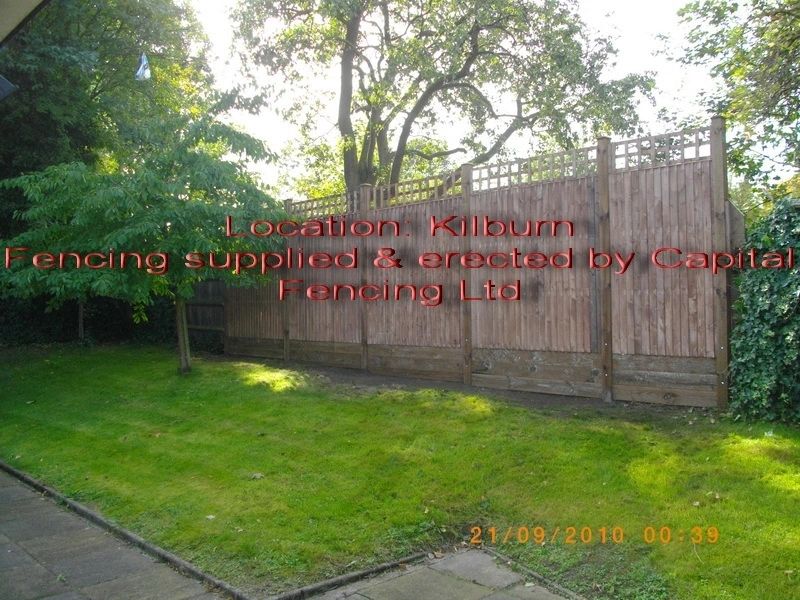
Closeboard fencing is built from overlapping feather-edge boards nailed vertically to horizontal arris rails, each board tapered so the thick edge overlaps the thin edge of its neighbour and sheds water outward.
That overlap is what gives closeboard its strength and privacy compared with a pre-made panel — there's no single failure point, so a split board can be replaced individually without dismantling the run.
The trade-off is labour: it's built on site board by board rather than lifted into place, so it costs more in time than a lap panel of the same length.
Parking and material handling on site
Fencing, gates and decking all involve moving bulky, heavy material — concrete posts, gravel boards, decking joists — from a van to the working area, and how far that has to be carried has a real effect on labour time.
On streets with permit parking, no off-street loading bay, or restricted delivery hours, we plan the drop-off around those restrictions rather than assuming a van can sit outside all day.
Where a plot has a driveway or side gate wide enough for a barrow run, that alone can shave a meaningful amount of time off a job compared with hand-carrying everything round the front.