In Hackney (E5, E8, E9, N1, N16), under Hackney Council, you'll mostly find victorian terraces across stoke newington and de beauvoir, plus post-war estates around homerton and london fields, with gardens usually small rear gardens with mature planting; several plots border the regent's canal or hackney marshes. Most site visits in this patch come back to one thing: many boundaries are shared with three or four neighbours on victorian back-to-backs — clear ownership marks matter. Schedules of condition before nearby works: A schedule of condition is a dated record, often with photographs, of a boundary structure's state before nearby building work begins, used to settle any later dispute about damage caused during that work. Where a neighbour is undertaking significant building work close to a shared boundary, requesting this kind of record beforehand is reasonable and protects both parties. Community Infrastructure Levy and larger boundary projects: The Community Infrastructure Levy is a charge some councils apply to larger new development, and while it rarely touches ordinary domestic fencing, larger boundary projects tied to bigger planning permissions can occasionally interact with it.
Talk through your Hackney brief
We know Hackney's planning rules and this patch's ground conditions — call and we'll talk it through.
Property: Victorian terraces across Stoke Newington and De Beauvoir, plus post-war estates around Homerton and London Fields
Gardens: small rear gardens with mature planting; several plots border the Regent's Canal or Hackney Marshes
many boundaries are shared with three or four neighbours on Victorian back-to-backs — clear ownership marks matter
Under Hackney Council, covering E5, E8, E9, N1, N16. Nearest arterial: A10 Kingsland Road / A107 Mare Street, A406 (10 min) / A102 Blackwall Tunnel Approach. Served from Hackney Central, Dalston Junction, Stoke Newington (Overground). Local commercial anchors: Kingsland Road, Mare Street, Stoke Newington Church Street.
Streets we regularly work on: Kingsland Road, Mare Street, Amhurst Road, Lower Clapton Road. Local anchors: London Fields, Victoria Park (west edge), Hackney Marshes.
Hackney's Victorian terraces, particularly in E8 and E5, tend to have shallower rear gardens than the borough's suburban neighbours. The Regent's Canal and the River Lea both run through the borough, with Hackney Marshes forming a large area of open land on the eastern edge. Broadway Market and London Fields are established local landmarks in the south of the borough.
Practical points for boundary work in Hackney
Schedules of condition before nearby works
A schedule of condition is a dated record, often with photographs, of a boundary structure's state before nearby building work begins, used to settle any later dispute about damage caused during that work.
Where a neighbour is undertaking significant building work close to a shared boundary, requesting this kind of record beforehand is reasonable and protects both parties.
This is distinct from a full party wall agreement but is often produced as part of the wider party wall process where one applies.
Community Infrastructure Levy and larger boundary projects
The Community Infrastructure Levy is a charge some councils apply to larger new development, and while it rarely touches ordinary domestic fencing, larger boundary projects tied to bigger planning permissions can occasionally interact with it.
This is a specialist area mainly relevant to substantial developments rather than a single garden fence, but worth being aware of if boundary work forms part of a larger planning permission.
Anyone unsure whether a larger project's boundary elements might be affected should check with the council's planning or CIL team directly.
Building for flood-prone gardens
Gardens on a known flood plain or with a history of standing water after heavy rain benefit from fence bases designed to let water pass through rather than dam against a solid panel, which can otherwise add pressure to a fence line during a flood event.
Gravel boards set to allow some drainage, and hardware chosen to resist prolonged wet exposure, both reduce the aftermath clean-up and repair cycle that repeat flooding causes.
It's also worth checking the Environment Agency's flood risk mapping for a specific plot before finalising a spec, since risk varies a great deal even within the same postcode.
Composite colour fade realism
Composite boards do fade slightly in their first year or two of UV exposure before settling to a stable colour, which is a normal part of the material rather than a fault, but it means a newly added run will look a shade brighter than an older adjoining one for a while.
Darker composite colours fade proportionally more than lighter ones and also run hotter in direct sun, which can matter for boards used on south-facing screening close to seating areas.
Manufacturers typically quote colour consistency rather than a fixed fade-free guarantee, so matching an extension to an existing composite run several years old is unlikely to be an exact colour match regardless of the batch ordered.
Tall fences, shading and neighbour relations
A tall boundary fence can significantly shade a neighbouring garden depending on orientation, and while there's no general legal right to a set amount of sunlight in a garden, an unusually tall or dark structure close to a shared boundary is a common source of neighbour friction.
Slatted, louvred or partially open designs let some light and air through while still giving privacy, which is often a reasonable middle ground where a fully solid fence would cause a shading complaint.
Discussing height and design with an affected neighbour before building, even where there's no legal requirement to, tends to avoid a dispute that a technically-compliant fence wouldn't otherwise resolve.
Deck board gapping to allow seasonal movement
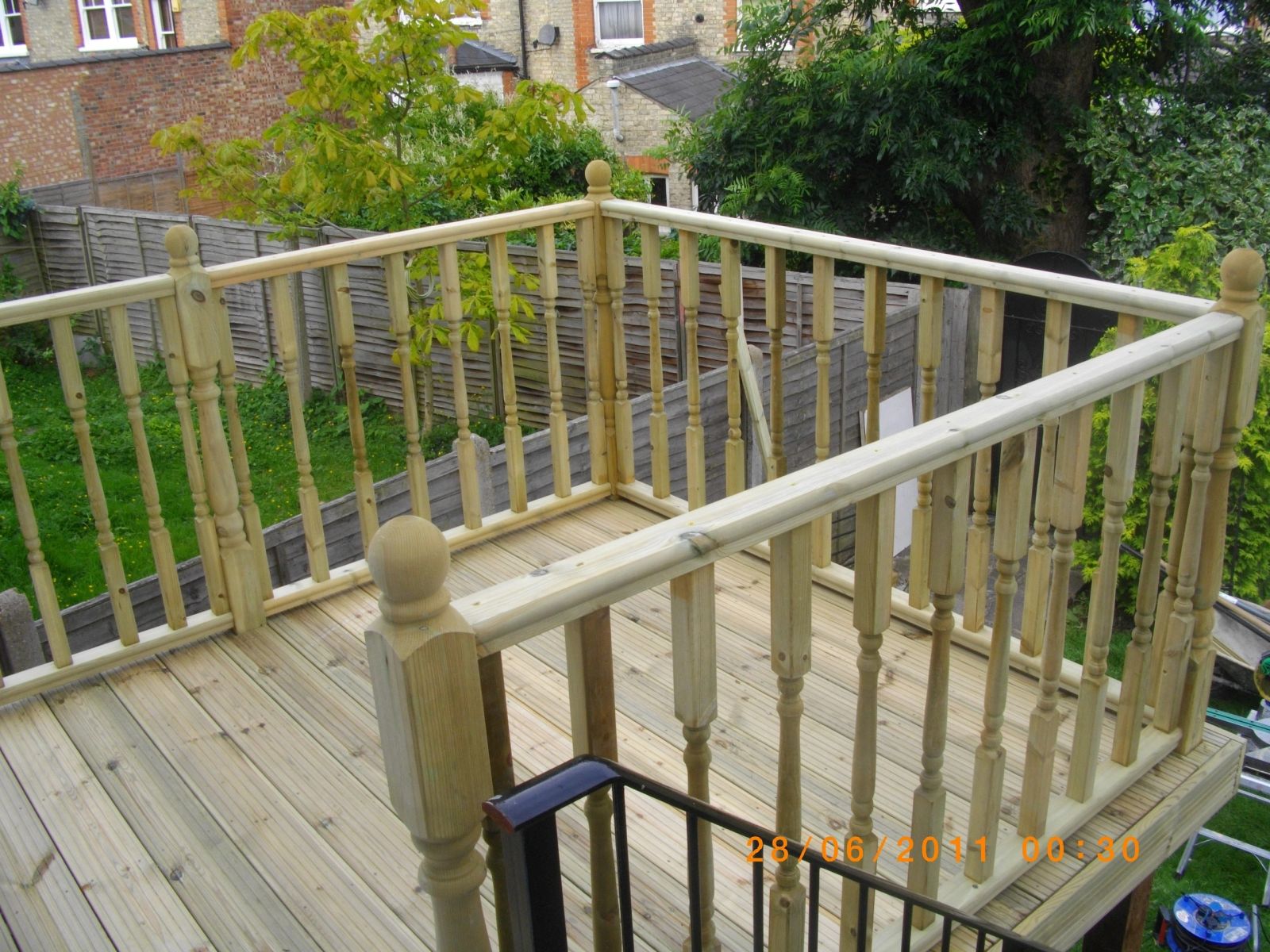
Timber deck boards expand slightly when they absorb moisture and contract as they dry, so boards laid without a small gap between them can cup, bow or push against each other as conditions change through the year.
The correct gap depends on the moisture content of the timber at the time of laying — kiln-dried boards laid tight in winter may need a slightly wider gap than the same boards laid already at a higher moisture content in summer.
Composite boards move with temperature rather than moisture and have their own manufacturer-specified gap and expansion allowance, particularly at butt joints and against fixed edging.
What should I know about tall fences, shading and neighbour relations in Hackney?
Discussing height and design with an affected neighbour before building, even where there's no legal requirement to, tends to avoid a dispute that a technically-compliant fence wouldn't otherwise resolve. A tall boundary fence can significantly shade a neighbouring garden depending on orientation, and while there's no general legal right to a set amount of sunlight in a garden, an unusually tall or dark structure close to a shared boundary is a common source of neighbour friction. Slatted, louvred or partially open designs let some light and air through while still giving privacy, which is often a reasonable middle ground where a fully solid fence would cause a shading complaint.
What areas of Hackney do you cover?
We cover all of Hackney (E5, E8, E9, N1, N16), under Hackney Council.
Is composite colour fade realism something you plan for in Hackney?
Darker composite colours fade proportionally more than lighter ones and also run hotter in direct sun, which can matter for boards used on south-facing screening close to seating areas. Manufacturers typically quote colour consistency rather than a fixed fade-free guarantee, so matching an extension to an existing composite run several years old is unlikely to be an exact colour match regardless of the batch ordered. Composite boards do fade slightly in their first year or two of UV exposure before settling to a stable colour, which is a normal part of the material rather than a fault, but it means a newly added run will look a shade brighter than an older adjoining one for a while.
Is Hackney within your standard travel area?
Yes — Hackney is served from Hackney Central, Dalston Junction, Stoke Newington (Overground), off A10 Kingsland Road / A107 Mare Street, and is inside our regular working patch.
What should I know about building for flood-prone gardens in Hackney?
Gravel boards set to allow some drainage, and hardware chosen to resist prolonged wet exposure, both reduce the aftermath clean-up and repair cycle that repeat flooding causes. It's also worth checking the Environment Agency's flood risk mapping for a specific plot before finalising a spec, since risk varies a great deal even within the same postcode. Gardens on a known flood plain or with a history of standing water after heavy rain benefit from fence bases designed to let water pass through rather than dam against a solid panel, which can otherwise add pressure to a fence line during a flood event.
Deck board gapping to allow seasonal movement — what does that mean for a job in Hackney?
The correct gap depends on the moisture content of the timber at the time of laying — kiln-dried boards laid tight in winter may need a slightly wider gap than the same boards laid already at a higher moisture content in summer. Composite boards move with temperature rather than moisture and have their own manufacturer-specified gap and expansion allowance, particularly at butt joints and against fixed edging. Timber deck boards expand slightly when they absorb moisture and contract as they dry, so boards laid without a small gap between them can cup, bow or push against each other as conditions change through the year.
We work this patch off A10 Kingsland Road / A107 Mare Street, close to A406 (10 min) / A102 Blackwall Tunnel Approach, via Hackney Central, Dalston Junction, Stoke Newington (Overground). Building for flood-prone gardens: Gardens on a known flood plain or with a history of standing water after heavy rain benefit from fence bases designed to let water pass through rather than dam against a solid panel, which can otherwise add pressure to a fence line during a flood event. Gravel boards set to allow some drainage, and hardware chosen to resist prolonged wet exposure, both reduce the aftermath clean-up and repair cycle that repeat flooding causes. Composite colour fade realism: Composite boards do fade slightly in their first year or two of UV exposure before settling to a stable colour, which is a normal part of the material rather than a fault, but it means a newly added run will look a shade brighter than an older adjoining one for a while.
Get In Touch
Get My Free Quote — 24h Response
No callout fee · Free site visit · Friendly local team covering London & Hertfordshire.