Access and material handling on site
Concrete, posts and panels are heavy, and a site with only a narrow side return or no vehicle access changes how a job is priced and sequenced — materials sometimes have to be carried through rather than dropped at the boundary.
On a commercial yard the opposite problem applies: keeping a working site operational around a delivery of steel palisade or mesh panels needs a delivery and storage plan agreed before the first post goes in.
Security fencing around a builders' compound
A builders' compound holding plant, materials and fuel needs a higher standard of fencing than the general site hoarding, since compound contents are a specific theft target and are often left unattended overnight or over a weekend.
Anti-climb toppings, a single monitored access gate and lighting are more commonly justified on a compound than on the wider site perimeter, given the concentration of value inside a relatively small footprint.
Security fencing around a warehouse yard
A warehouse yard boundary typically needs to handle heavy vehicle movement, overnight trailer parking and a concentration of stock value behind a single perimeter, so post spacing, gate width and surface fixing are all driven by HGV manoeuvring room as much as by the security spec itself.
A yard used for trailer drop-and-swap overnight often needs its own internal secure compound within the wider yard fence, since trailers left standing are a target independent of the building's own security.
Bolt-down versus concreted base plates
A bolt-down base plate suits hardstanding such as a concrete yard or car park, using resin or expansion anchors rather than digging a footing, which keeps the surface intact and the fence removable if the layout changes.
A concreted post gives a stiffer, more permanent fixing on soil or made-up ground, but it isn't an option where the surface can't be broken — the choice is driven by the ground, not by preference.
Locks: nightlatch, deadlock, padlock hasps
A nightlatch-style mechanism, a mortice deadlock built into the gate frame, or a simple padlock-and-hasp arrangement each offer a different balance of convenience and resistance to forcing on an outdoor gate.
A mortice lock recessed into a timber frame is more weather-protected than a surface-mounted hasp, but needs a soundly built frame section to sit in.
Checking cumulative ground level change along a long boundary
A gentle, barely perceptible slope checked only between adjacent posts can still add up to a substantial total fall over a long boundary, which is easy to miss without measuring from a single fixed datum along the whole run.
Taking level readings from one datum point at both ends and at intervals along the run, rather than only comparing each post to its immediate neighbour, reveals the true overall fall before panel and post heights are finalised.
This matters most for ordering materials in advance, since a run that turns out to need more steps or a longer rake than first estimated can mean extra cut panels or capping that weren't in the original take-off.
Public liability considerations on a shared boundary
Work that takes place on or near a shared boundary inherently affects two properties, which is one reason contractors carry public liability insurance covering damage or injury arising from the works, generally quite separate from any specific job guarantee.
Clients are entitled to ask to see a contractor's current public liability certificate before work starts, and for jobs involving excavation near a neighbour's structure or a shared wall it's reasonable practice to confirm cover explicitly rather than assume it.
This is a generic industry consideration rather than a claim about any particular policy, and the details of cover, exclusions and limits vary between insurers and should be checked directly with the provider.
Levelling ground before building a decking substructure
A decking frame built over uneven ground without first levelling or terracing the site ends up with support posts of wildly inconsistent length, which is harder to get right and more prone to individual post settlement than a site graded roughly level first.
Removing turf and topsoil under the deck footprint rather than building over it also reduces the organic material that would otherwise decompose and settle unevenly under the structure.
Where the ground has a genuine and significant fall, working out whether to terrace the ground itself or simply vary support post heights is a decision made before any joists are cut, since it changes the whole substructure design.
Timber decking board profiles
Grooved decking boards have a reeded or ribbed surface intended to improve underfoot grip, particularly when wet, compared with a smooth-planed board of the same species and treatment.
The grooves can also trap moisture, algae and debris more readily than a smooth board, meaning a grooved deck often needs more regular cleaning to keep the grip benefit from being offset by a slippery algal film.
Reversible boards with a smooth face on one side and grooved on the other let the fitted orientation be chosen, or later reversed once the first face weathers, extending the usable life of the same boards.
Packing as a repair for an uneven panel gap
Packing uses timber shims between a post and a panel to correct a gap that's opened up as ground has settled unevenly beneath one end of a run, restoring a level top line without lifting or resetting every post along the bay.
It's a reasonable short-term fix for minor settlement, but packing over a gap caused by an actively failing post just delays a proper reset and the packing itself will need adjusting again as the post continues to move.
Being clear about what a repair does and doesn't cover
A repair addresses the specific failure identified at survey, and it's worth being explicit with the client about what wasn't included, particularly where a run has other sections showing early signs of the same problem.
Setting that expectation at the point of agreeing the work avoids confusion later if an unrelated section of the same boundary fails independently.
Gate stops and end buffers
An end stop or buffer at the fully open and fully closed positions of a sliding gate prevents the leaf running off the end of its track or slamming into a post, and a missing or worn buffer is a common cause of impact damage over time.
Checking and replacing worn buffers is a low-cost part of a sliding gate service that prevents more expensive frame damage.
Spoil volume and removal
Digging a full run of post holes generates more spoil than most clients expect, particularly on clay where the dug material swells in volume compared with its compacted state in the ground.
Spoil that can't be spread thinly elsewhere on the plot without smothering lawn or borders usually needs skip or licensed grab-lorry removal, which should be agreed and costed before the dig starts rather than after a pile has built up on the lawn.
Heavy clay spoil left on grass for more than a day or two will usually kill it, so covering or removing arisings promptly matters if the lawn is staying.
Adjusting a gravity latch's catch point
A gravity latch relies on the gate's own weight to drop a weighted bar into a fixed keep as it swings closed, and it stops catching reliably if the gate's resting angle changes even slightly from wear or ground movement.
Re-setting the keep position, rather than replacing the latch, is usually the fix once the gate's resting swing has shifted.
Decking board profiles and grooves
Timber decking boards commonly come grooved (ribbed) on the top face for grip, reversible to a smooth face for a more contemporary look, or with a rounded profile that sheds water more readily but offers less traction underfoot.
Grooved boards trap dirt and moisture in the channels more than a smooth or rounded profile, so they need more regular brushing or washing to avoid becoming slippery with algae, particularly in shaded, damp positions.
Composite boards are usually extruded with a fixed groove or embossed texture rather than milled, and the profile is generally part of a wider system with matching edge trims rather than a feature that can be mixed freely between board types.
Fence panels built around a recessed bin store
A bin store built into or against a fence line needs its own ventilation gaps, since enclosed bin storage without airflow concentrates moisture and odour against the adjoining fence panels far more than open storage would.
The panel section forming the back or side of a bin store also takes more direct contact wear — bins being wheeled in and out, lids catching the timber — than the rest of the run, so a slightly more robust board or a protective kick panel at the contact height extends its life.
These wear patterns are worth designing for at the outset rather than treating the bin store section as identical to the rest of the boundary run.
Threshold and step detailing under a gate
Where a gate crosses a change in ground level, a threshold detail — a shaped cill, a small step, or a sloped paving strip — needs designing in so the gate can swing freely without a permanent gap left underneath for drafts, debris or small pets to pass through.
Retrofitting a threshold detail to an existing gate is more limited than designing it in from the start, since the gate's swing arc is already fixed by its hinges.
Choosing gate ironmongery
A gate is only as good as its hinges and latch — undersized hinges are the single most common reason a timber gate sags and starts dragging on the ground within a year or two.
Heavier gates, especially solid hardwood or wide driveway gates, need hinges rated for the actual weight rather than whatever came in the hardware pack, plus a diagonal bracing batten on the frame to stop it racking out of square.
Galvanised or stainless fixings are worth the small extra cost over standard zinc-plated ones anywhere exposed to weather, since a rusted hinge pin is a common and avoidable reason for an otherwise sound gate to fail.
Iroko and tropical hardwood density
Iroko is a dense West African hardwood sometimes used as a substitute for teak in gates and structural fencing components, valued for a natural durability that doesn't rely on chemical treatment.
Its density makes it heavier to handle and slower to work than softwood equivalents, and it typically needs pre-drilling for screws to avoid splitting.
Because it's naturally oily, some finishes and glues bond to it poorly unless the surface is wiped down with a solvent first, which is a detail that's easy to miss when substituting it into a softwood-designed detail.
Stainless steel grades near salted roads
Grade 304 stainless steel resists general corrosion well but can develop surface pitting when regularly exposed to chloride from de-icing salt spray thrown up by passing traffic.
Grade 316 stainless includes molybdenum, which significantly improves resistance to chloride pitting, and is the more appropriate specification for fixings and fittings on roadside fencing subject to winter gritting.
The cost difference between the two grades is usually small relative to the fitting itself, so specifying 316 near a heavily gritted road is generally worth it for the extended service life alone.
Dog day-care and kennels
Commercial dog day-care and kennel boundaries need to be genuinely dig-proof and jump-proof rather than just visually enclosing, which usually means a below-ground kick board or buried mesh apron along the base as well as adequate fence height.
Licensing under the Animal Welfare (Licensing of Activities Involving Animals) Regulations sets minimum boundary standards for kennels and day-care premises, and an inspector will check fence condition as part of renewal.
Double-gated airlock entries, where an inner and outer gate can't be open at the same time, are a common feature at the perimeter to stop dogs escaping through a single opened gate.
Sleeper edging and planters
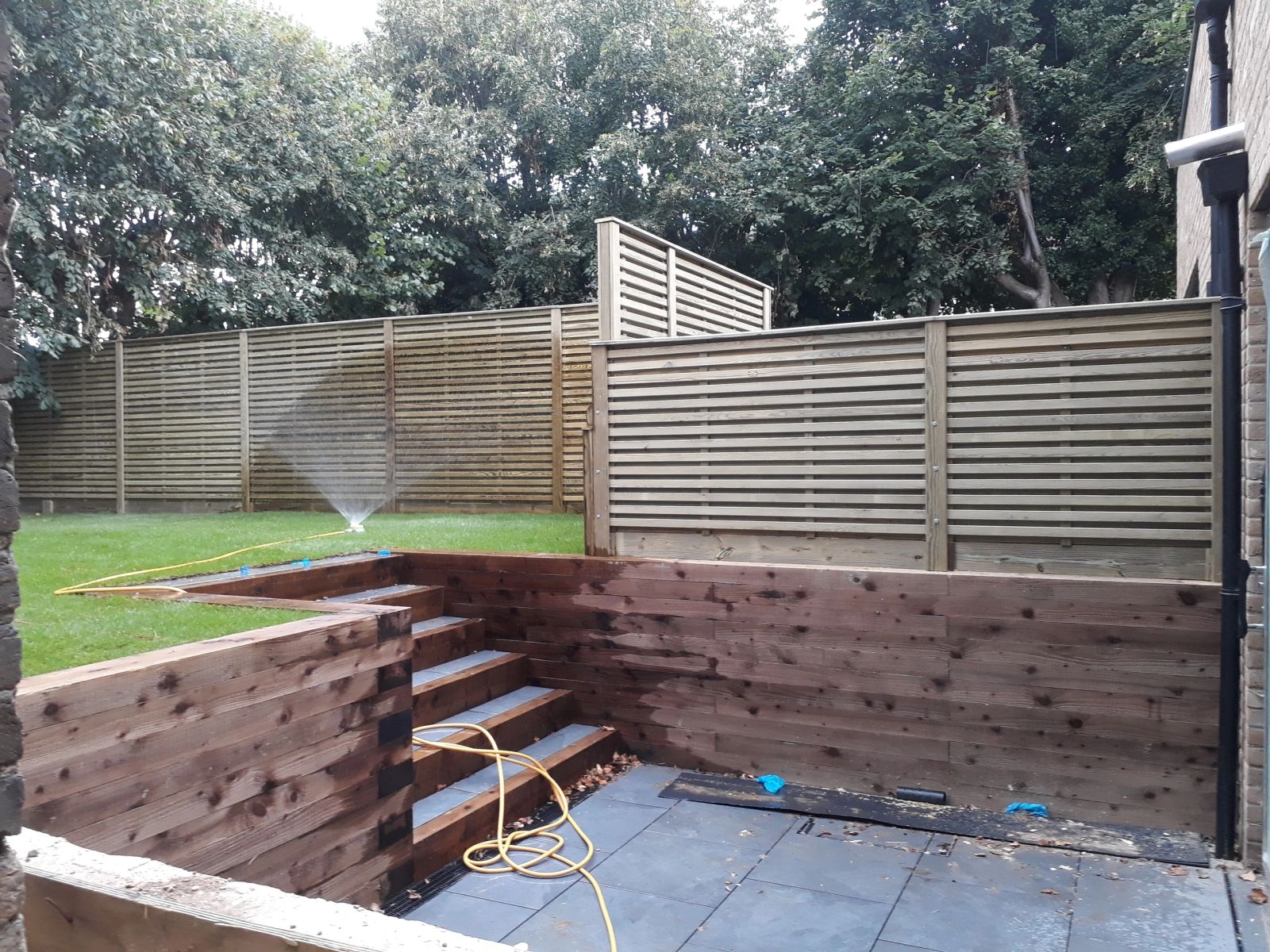
Softwood landscape sleepers are pressure-treated to a ground-contact use class and are generally cheaper and more consistent in size than reclaimed hardwood railway sleepers, which vary in condition and may carry historic residues such as creosote unsuitable for areas near planting or seating.
Sleepers used for raised beds or low retaining edges are usually stacked and pinned with long timber screws or steel rebar driven through pre-drilled holes rather than simply stacked loose, since an unpinned stack can shift as the ground behind it settles.
Where a sleeper structure is also expected to retain a meaningful depth of soil rather than just edge a bed, it moves into proper retaining-wall territory with its own drainage and structural considerations.