London & Hertfordshire Free Site Visit
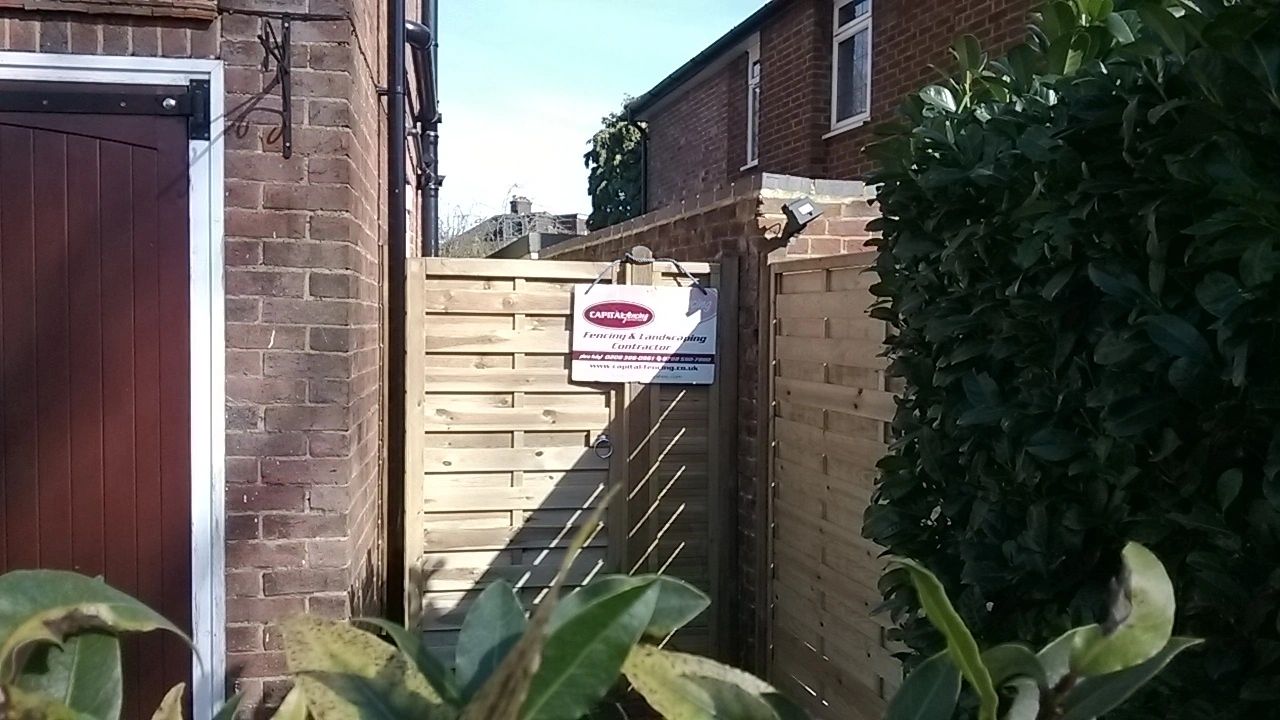
bespoke wooden gate installed by Capital Fencing in Hackney (E5)
Hackney · E5 / E8 / E9 / N1 / N16

Driveway Double Gates in Hackney (E5)

If you're weighing driveway double gates for a property in Hackney, the first thing that matters is how the structure performs under real use, not a showroom drawing — not the material choice. Once that's settled, iroko hardwood on galvanised ironmongery is where most of our driveway double gates work in E5 lands, with softwood tongue-and-groove for matched budget as a considered alternative. Roads such as Broadway Market and Lower Clapton Road are typical of the local layout. Victoria Park (west edge) is a useful local reference point. Broadway Market and London Fields are established local landmarks in the south of the borough.

If you're weighing driveway double gates for a property in Hackney, the first thing that matters is how the structure performs under real use, not a showroom drawing — not the material choice. Once that's settled, iroko hardwood on galvanised ironmongery is where most of our driveway double gates work in E5 lands, with softwood tongue-and-groove for matched budget as a considered alternative. Roads such as Broadway Market and Lower Clapton Road are typical of the local layout. Victoria Park (west edge) is a useful local reference point. Broadway Market and London Fields are established local landmarks in the south of the borough.

Typical driveway double gates briefs in Hackney

  • matched pedestrian gate alongside 3.6m double vehicle gates on a corner-plot driveway
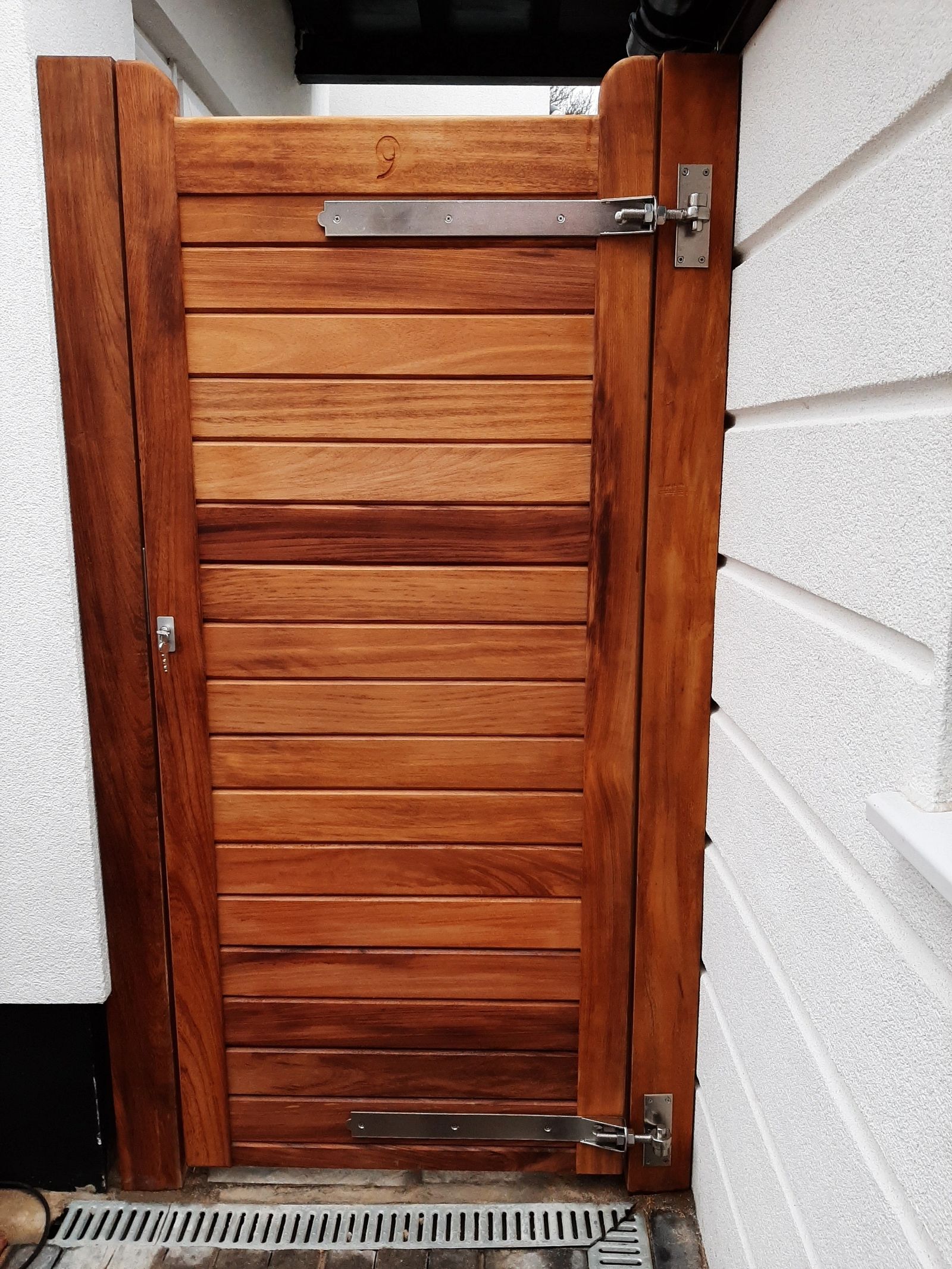
  • 3.0m opening hardwood double gates on ball-race hinges with drop bolt and top slide bolt
Default spec

How we build driveway double gates in Hackney

44mm framed, tongue-and-groove or composite infill, hot-dip galvanised or stainless ironmongery, sized to the actual masonry opening not the drawing. On Hackney jobs we adjust for many boundaries are shared with three or four neighbours on victorian back-to-backs — clear ownership marks matter.

Property mix locally: Victorian terraces across Stoke Newington and De Beauvoir, plus post-war estates around Homerton and London Fields. Typical gardens: small rear gardens with mature planting; several plots border the Regent's Canal or Hackney Marshes. Postcodes we regularly service: E5, E8, E9, N1, N16.

Why this spec, for homes with off-street parking wanting matched double vehicle gates, manual or automated

  • measured on site off the actual brick piers, not a builder's plan set
  • prepared for future automation even when you're not fitting it yet — cabling ducts under the drive, hinges rated for it
  • matched pedestrian gate carried in the same visit so alignment and finish are identical
What goes wrong

Common failure modes on driveway double gates

  • not levelling the closing point — one leaf drags on the drive within a year
  • under-sized posts or brickwork — automation loads pull them out of plumb inside a season

Driveway Double Gates FAQs — Hackney

Can wooden driveway gates be automated later?

On driveway double gates jobs in Hackney (E5), our default answer is: 44mm framed, tongue-and-groove or composite infill, hot-dip galvanised or stainless ironmongery, sized to the actual masonry opening not the drawing. The honest trade-off is not levelling the closing point — one leaf drags on the drive within a year — which is exactly what our default spec designs out.

Can pedestrian and vehicle gates share the same finish and ironmongery?

Across Hackney we spec around many boundaries are shared with three or four neighbours on victorian back-to-backs — clear ownership marks matter, so on driveway double gates that usually means iroko hardwood on galvanised ironmongery. For context: prepared for future automation even when you're not fitting it yet — cabling ducts under the drive, hinges rated for it. Structural spans and post depths calculated, not guessed.

Do you fit into existing brick piers or install new?

Hackney coverage means we can survey most E5 addresses inside a week — homes with off-street parking wanting matched double vehicle gates, manual or automated. For context: prepared for future automation even when you're not fitting it yet — cabling ducts under the drive, hinges rated for it. Structural spans and post depths calculated, not guessed.

Softwood, hardwood or composite for double gates?

Practically: 3.0m opening hardwood double gates on ball-race hinges with drop bolt and top slide bolt. That's the Hackney version of this job, not a generic one. The honest trade-off is not levelling the closing point — one leaf drags on the drive within a year — which is exactly what our default spec designs out.

How do you stop a heavy gate dropping on the closing point?

On driveway double gates jobs in Hackney (E5), our default answer is: 44mm framed, tongue-and-groove or composite infill, hot-dip galvanised or stainless ironmongery, sized to the actual masonry opening not the drawing. For context: prepared for future automation even when you're not fitting it yet — cabling ducts under the drive, hinges rated for it. Structural spans and post depths calculated, not guessed.

Recent driveway double gates work
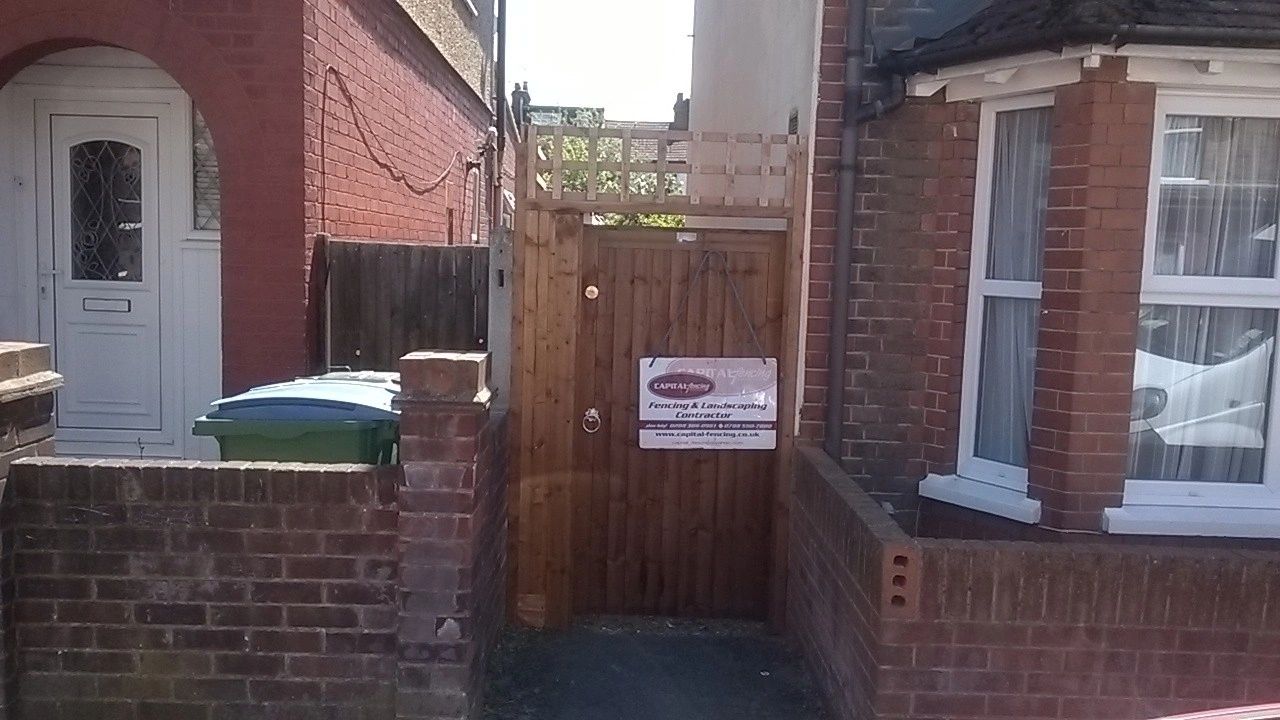
bespoke wooden gate installed by Capital Fencing in Hackney (E5)double driveway gates installed by Capital Fencing in Hackney (E5)hardwood side gate installed by Capital Fencing in Hackney (E5)metal entrance gate installed by Capital Fencing in Hackney (E5)

Before you book driveway double gates in Hackney

Drainage fixes as part of a repair

Where poor drainage caused or contributed to the original failure, a repair that doesn't also address the drainage — regrading a low spot, adding a small soakaway, or fitting a concrete gravel board — risks the same failure recurring.

Addressing drainage at repair time is usually more cost-effective than repeating the same panel or post repair every few years.

Tree root heave near posts

A root growing under or beside a post footing can lift or crack the concrete over several years as the root thickens, distorting the post's alignment even though the timber itself may be sound.

Repairing a post affected by root heave sometimes means offsetting the new footing slightly rather than resetting it in exactly the same spot, particularly where the tree is protected and the root can't be cut.

Backfilling technique around a set post

Backfilling isn't just tipping soil or concrete into the gap around a post — compacting it in stages as it's added, rather than filling the hole in one go, avoids leaving voids that let the post shift later.

Where soil rather than concrete is used as backfill on a lighter garden fence, layering and firming it every 100-150mm gives a noticeably more stable result than one loose fill tamped only at the top.

Overfilling and mounding backfill above ground level around the post, rather than finishing flush or slightly domed for drainage, is a common shortcut that leaves a lip where water collects against the post face.

Rising damp at the gravel board

A timber gravel board sitting flush against damp soil draws moisture upward by capillary action in the same way a wall can suffer rising damp, and it is usually the first component to fail on an otherwise sound fence.

Concrete gravel boards avoid this entirely and are now the standard base for that reason, but where timber boards are kept for appearance, setting them a few millimetres proud of finished ground level makes a real difference.

Backfilling right up against a timber board with topsoil or mulch defeats the point, since it holds moisture directly against the face that most needs to stay dry.

Screw pull-out values in timber

A screw's resistance to being pulled straight out of timber depends on thread depth, shank diameter and the density of the timber it's driven into, with denser hardwoods offering significantly higher pull-out resistance than softwoods for the same screw.

Coarse-thread screws designed for softwood construction generally have deeper, wider-spaced threads than fine-thread screws intended for hardwood or metal, since softwood's lower density needs more thread engagement to achieve comparable grip.

Pre-drilling a pilot hole reduces the risk of splitting dense or knotty timber but also slightly reduces ultimate pull-out resistance compared with a screw self-tapping fully into undrilled timber, which is a trade-off worth balancing against the specific timber and screw.

Hinge pin wear and greasing

A band-and-gudgeon or heavy tee hinge relies on a pin bearing surface that wears over years of use, and a worn pin lets the gate drop slightly at that hinge even when the fixings into the post are still sound.

Greasing the pin periodically slows this wear considerably, and on an older gate that's started to drop, checking pin wear before assuming a post or fixing fault saves an unnecessary repair.

Disposing of rotten timber and green waste from a repair

Rotten fence timber is general waste rather than green waste, and larger quantities from a full-run repair usually need a licensed waste carrier or a permitted tip run rather than a domestic green bin, which only takes garden material.

Treated timber in particular shouldn't be burned on site, since older treatments can contain preservatives that produce harmful smoke, so timber waste from a repair should be taken away rather than disposed of on the plot.

Slotted versus morticed concrete posts

Slotted concrete posts have a continuous groove cast into two or four faces so panels slide down into the slot from above, which makes them fast to erect but means every panel in a run has to come out to replace one in the middle.

Morticed concrete posts have discrete rectangular pockets for arris rail ends instead, matching closeboard or panel construction where individual boards or panels can be replaced without disturbing the rest of the run.

The choice is largely dictated by the fencing system being used — panel fencing wants slotted posts, boarded fencing wants morticed — rather than being a free preference at quote stage.

What aftercare actually covers

A written warranty on fencing, gates or decking should say clearly what's covered — usually workmanship and post stability — versus what naturally weathers over time, like colour fade or minor timber checking, which isn't a defect.

It's worth asking what happens if a panel is damaged by a storm or a fallen branch, since that's typically outside a workmanship warranty and may be a buildings insurance matter instead.

Keeping the original quote, spec sheet and any photos from the day of installation makes any future warranty conversation faster, since it confirms exactly what was fitted and to what standard.

Reinstating the ground surface after post installation

Concreting a post line through a lawn, gravel or paved surface leaves disturbed ground either side that needs reinstating to stop it becoming a trip hazard or a soft spot that later settles unevenly.

On a paved or block-paved surface, cut edges are made clean and matching material is used for reinstatement rather than left as a visible, poorly finished scar along the new fence line.

Pet-proofing a garden boundary

Dogs that dig will often go under a fence line rather than over it, so a gravel board or buried mesh apron at the base does more to keep a determined digger in than extra height above ground.

Gaps at gate thresholds and where a fence meets a wall or building are the most common escape points, and are worth checking specifically rather than assuming a continuous fence line is actually continuous at ground level.

Smaller or younger dogs and cats can fit through gaps that look too small to be a concern, so picket or trellis-style boundaries usually need a solid section or mesh backing if pet containment is the priority.

Sistering a failed post

Sistering bolts a new length of timber alongside a post that's failed only in one section, leaving the sound parts of the original post carrying load alongside the new piece rather than removing it entirely.

It works best where the failure is localised and the panel fixings on the old post are still usable, and it's generally quicker than a full post swap on a run that can't easily be dismantled.

Safeguarding considerations on school and nursery sites

Fencing and gate work on a school or nursery site typically has to be scheduled around supervised access, since contractors are usually required to sign in, wear visible identification, and avoid unsupervised contact with children during term time.

Perimeter security fencing for these sites is often specified with anti-climb profiles and minimum heights well above a typical domestic garden fence, reflecting safeguarding rather than purely boundary-marking needs.

Work is frequently timetabled for holidays or after hours specifically to avoid any overlap between contractors on site and children present, which affects programme length more than the fencing work itself.

Repairing stock fencing pushed over or leaned on by animals

Fencing bordering land grazed by livestock takes a different kind of load to a garden boundary — sustained leaning and rubbing rather than occasional wind load — and posts along that kind of boundary often fail by gradually leaning outward rather than snapping.

Repair on this type of boundary is worth specifying with a stronger post spacing or additional strainer posts at intervals, since a repair matching a garden-fence specification often fails again quickly under the same ongoing pressure.

Estate management schemes and shared rules

Some developments, particularly newer estates, are subject to an estate management scheme or a management company with its own rules covering boundary treatments, materials and even colours.

These schemes usually run alongside normal planning law rather than instead of it, so a fence can need to satisfy both the council and the estate's own management company.

Annual estate charges often fund maintenance of shared boundary features, so it's worth checking what's already covered before commissioning separate work on a shared line.

Bolt-down versus concreted base plates

A bolt-down base plate suits hardstanding such as a concrete yard or car park, using resin or expansion anchors rather than digging a footing, which keeps the surface intact and the fence removable if the layout changes.

A concreted post gives a stiffer, more permanent fixing on soil or made-up ground, but it isn't an option where the surface can't be broken — the choice is driven by the ground, not by preference.

Temporary bracing while concrete cures

A freshly-concreted post has no strength to resist knocks or wind until the concrete has gone off, so it needs temporary raking struts or timber braces fixed to hold it plumb and in line while curing.

Braces are best left in place for at least the manufacturer's stated initial cure time, and longer in cold weather, rather than removed as soon as the concrete looks solid on the surface.

A post nudged out of true during this window is much harder to correct afterwards than one checked and adjusted while the mix is still workable, so the check-and-brace step is worth the extra few minutes per post.

Continuous strip footing compared with individual post holes

A continuous concrete strip footing running the full length of a fence line gives even support and a clean base for a plinth wall or kickboard, and is generally chosen where the boundary also needs a level base to close gaps under the fence.

Individual post holes are quicker and cheaper on a long straight run over consistent ground, but they leave open ground between posts that needs a separate gravel board or infill strip if a continuous barrier at ground level is also required.

Shared private water sources crossing a boundary

Some older rural properties share a private water supply, such as a well or borehole, with pipework running across one or more boundaries under a recorded easement.

Fencing work that might disturb this kind of shared supply pipe needs particular care, since interrupting it can affect a neighbour's water supply entirely, not just a garden feature.

Checking the title for any recorded private water supply arrangement is worth doing on older rural properties before any boundary groundworks proceed.

Party fence wall versus an ordinary boundary fence

A 'party fence wall' has a specific meaning under the Party Wall etc. Act 1996 — a structure that stands astride the boundary line, jointly used by both properties, which is distinct from a garden fence panel that simply happens to mark a boundary.

Most timber panel fencing sits on one owner's land and isn't a party structure in that legal sense, even where it visually marks the boundary line.

Genuine party wall situations are more likely with masonry garden walls straddling the line, and those can bring the Act's notice procedures into play, which is worth checking before work starts.

Using profile boards at corners

Profile boards — a horizontal board fixed between two pegs set back from the actual corner — let a string line be set, removed and reinstated at the exact same point throughout a job without disturbing the corner itself.

They're most useful where a run turns through an angle, since the intersecting lines from two boards mark the true corner point independently of any post already dug.

Leaving the boards in place until the last post is set and checked avoids the common error of the line creeping slightly as pegs get knocked or the string is re-tied.

Thumb latch lever and bar wear

A thumb latch lifts an internal bar via a lever operated from one or both faces of the gate, and wear typically shows up as play at the pivot pin or a lever that no longer lifts the bar high enough to clear the keep.

Because the mechanism is simple, most thumb latch faults can be corrected by re-fixing the pivot or reshaping the bar's resting angle rather than replacing the whole latch.

On driveway double gates in Hackney you get the same crew from first site visit to hand-over. That's the whole model — small team, engineered-to-load spec, written quote before we start. Roads such as Lower Clapton Road and Broadway Market are typical of the local layout. Victoria Park (west edge) is a useful local reference point. Hackney's Victorian terraces, particularly in E8 and E5, tend to have shallower rear gardens than the borough's suburban neighbours.

Get In Touch

Get My Free Quote — 24h Response

No callout fee · Free site visit · Friendly local team covering London & Hertfordshire.

Call us
07885907880
or 02036484746
Email
capital_fencing@yahoo.com
WhatsApp
Message us anytime
Area
London & Hertfordshire
Payment
Card payments accepted

Pay by debit or credit card, bank transfer or cash once the work and price are agreed. No deposit taken online.

Request a Free Quote

We'll get back to you within 24 hours.

Free Site Visit No Callout Fee
Call WhatsAppQuote