London & Hertfordshire Free Site Visit
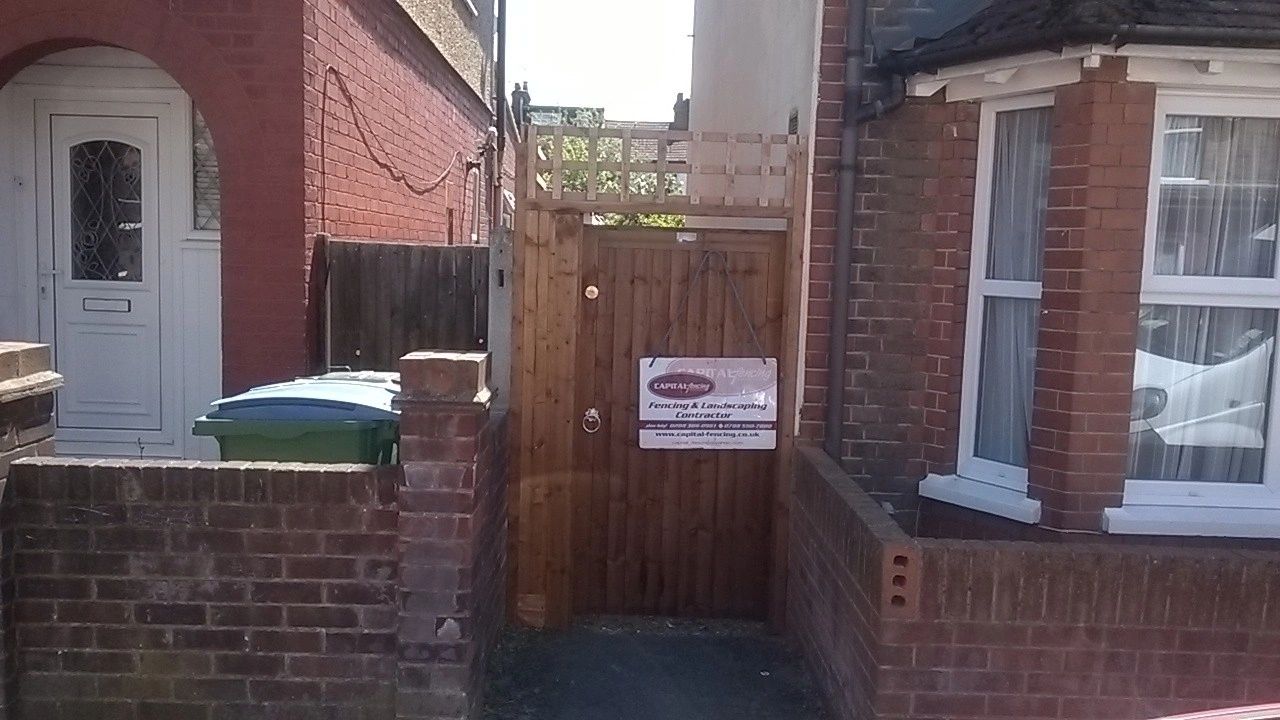
bespoke wooden gate installed by Capital Fencing in Letchworth Garden City (SG6)
Letchworth Garden City · SG6

Side Return Gates in Letchworth Garden City — Built for how the finish sits next to the neighbour's existing boundary

Side Return Gates in Letchworth Garden City is a specific brief for us — London terraces and semis with a narrow alley between the house and the neighbouring wall. The default local answer isn't a stock catalogue drop: it's 44mm framed hardwood or planed softwood, tongue-and-groove infill, adjustable ball-race hinges, closing stop and drop-bolt. On Letchworth Garden City sites we also spec around letchworth heritage foundation design rules dictate fence styles, heights and finishes on most streets, which is where a lot of side-return gates jobs quietly fail two years in. Roads such as Icknield Way and Nevells Road are typical of the local layout. Howard Park is a useful local reference point. Sollershott West and Nevells Road form part of the original 1903 masterplan and are subject to the Foundation's design guidance.

Side Return Gates in Letchworth Garden City is a specific brief for us — London terraces and semis with a narrow alley between the house and the neighbouring wall. The default local answer isn't a stock catalogue drop: it's 44mm framed hardwood or planed softwood, tongue-and-groove infill, adjustable ball-race hinges, closing stop and drop-bolt. On Letchworth Garden City sites we also spec around letchworth heritage foundation design rules dictate fence styles, heights and finishes on most streets, which is where a lot of side-return gates jobs quietly fail two years in. Roads such as Icknield Way and Nevells Road are typical of the local layout. Howard Park is a useful local reference point. Sollershott West and Nevells Road form part of the original 1903 masterplan and are subject to the Foundation's design guidance.

Why this spec, for London terraces and semis with a narrow alley between the house and the neighbouring wall

  • framed builds don't drop the way board-and-batten side gates do in year two
  • adjustable hinges handle the seasonal timber movement every London side gate experiences
  • made to the exact opening — no packing pieces, no gaps for burglars or foxes

Typical side-return gates briefs in Letchworth Garden City

  • hardwood side gate between a rendered wall and a brick pier, 780mm opening, drop-bolt into a concrete slab socket
  • tongue-and-groove side gate framed on adjustable ball-race hinges to cope with seasonal timber movement
Default spec

How we build side-return gates in Letchworth Garden City

44mm framed hardwood or planed softwood, tongue-and-groove infill, adjustable ball-race hinges, closing stop and drop-bolt. On Letchworth Garden City jobs we adjust for letchworth heritage foundation design rules dictate fence styles, heights and finishes on most streets.

Property mix locally: the world's first garden city — Arts and Crafts cottages, planned terraces and consistent street trees. Typical gardens: generous, leafy plots — many gardens contain protected trees with TPOs. Postcodes we regularly service: SG6.

What goes wrong

Common failure modes on side-return gates

  • fitting a full-weight hardwood gate on domestic pin hinges — drops within six months
  • not shooting a drop-bolt into a concrete socket — kicked or pried open too easily

Side Return Gates FAQs — Letchworth Garden City

Do you handle the wall fixing on both sides?

On side-return gates jobs in Letchworth Garden City (SG6), our default answer is: 44mm framed hardwood or planed softwood, tongue-and-groove infill, adjustable ball-race hinges, closing stop and drop-bolt. The honest trade-off is fitting a full-weight hardwood gate on domestic pin hinges — drops within six months — which is exactly what our default spec designs out.

Can bin-store and pedestrian access share one gate?

Across Letchworth Garden City we spec around letchworth heritage foundation design rules dictate fence styles, heights and finishes on most streets, so on side-return gates that usually means iroko hardwood on galvanised ironmongery for 15+ year service. The honest trade-off is fitting a full-weight hardwood gate on domestic pin hinges — drops within six months — which is exactly what our default spec designs out.

Is a drop-bolt necessary as well as a lock?

North Hertfordshire District coverage means we can survey most SG6 addresses inside a week — London terraces and semis with a narrow alley between the house and the neighbouring wall. The honest trade-off is fitting a full-weight hardwood gate on domestic pin hinges — drops within six months — which is exactly what our default spec designs out.

How do you stop a side gate dropping over time?

Practically: hardwood side gate between a rendered wall and a brick pier, 780mm opening, drop-bolt into a concrete slab socket. That's the Letchworth Garden City version of this job, not a generic one. The honest trade-off is fitting a full-weight hardwood gate on domestic pin hinges — drops within six months — which is exactly what our default spec designs out.

How wide can a single side gate span before it needs a wheel?

On side-return gates jobs in Letchworth Garden City (SG6), our default answer is: 44mm framed hardwood or planed softwood, tongue-and-groove infill, adjustable ball-race hinges, closing stop and drop-bolt. For context: adjustable hinges handle the seasonal timber movement every London side gate experiences. Measured, quoted and installed by the same small crew.

Recent side return gates work
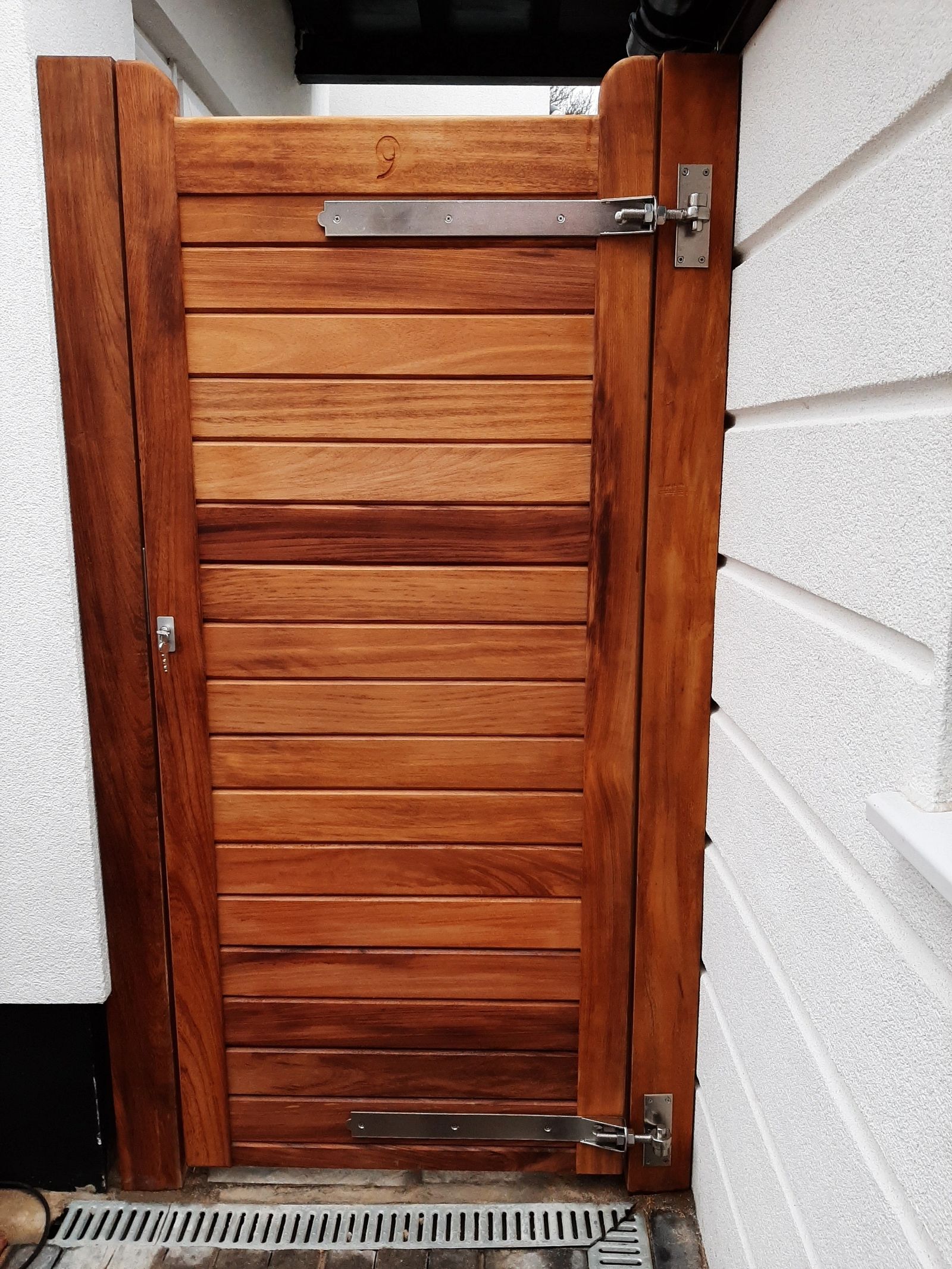
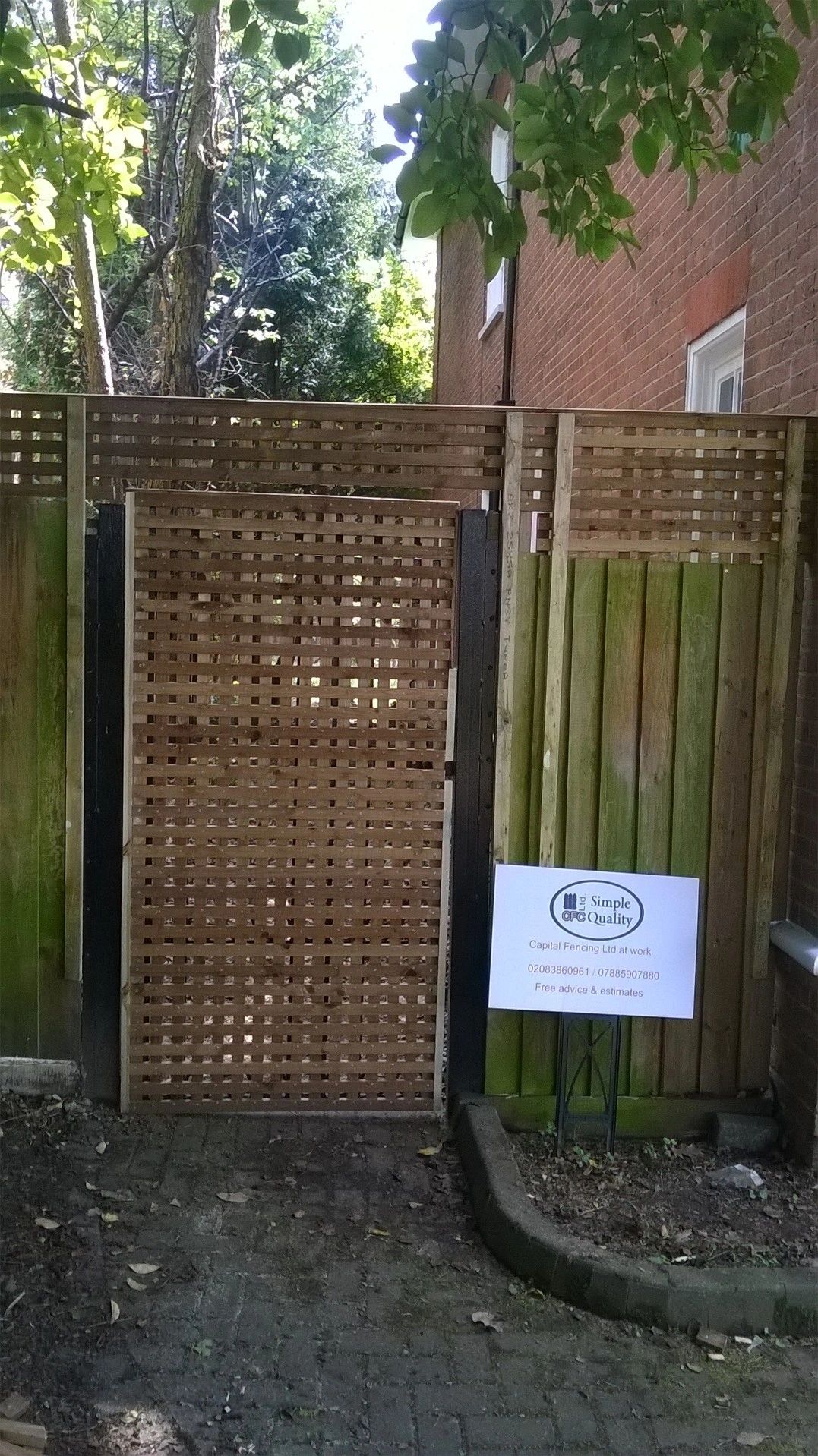
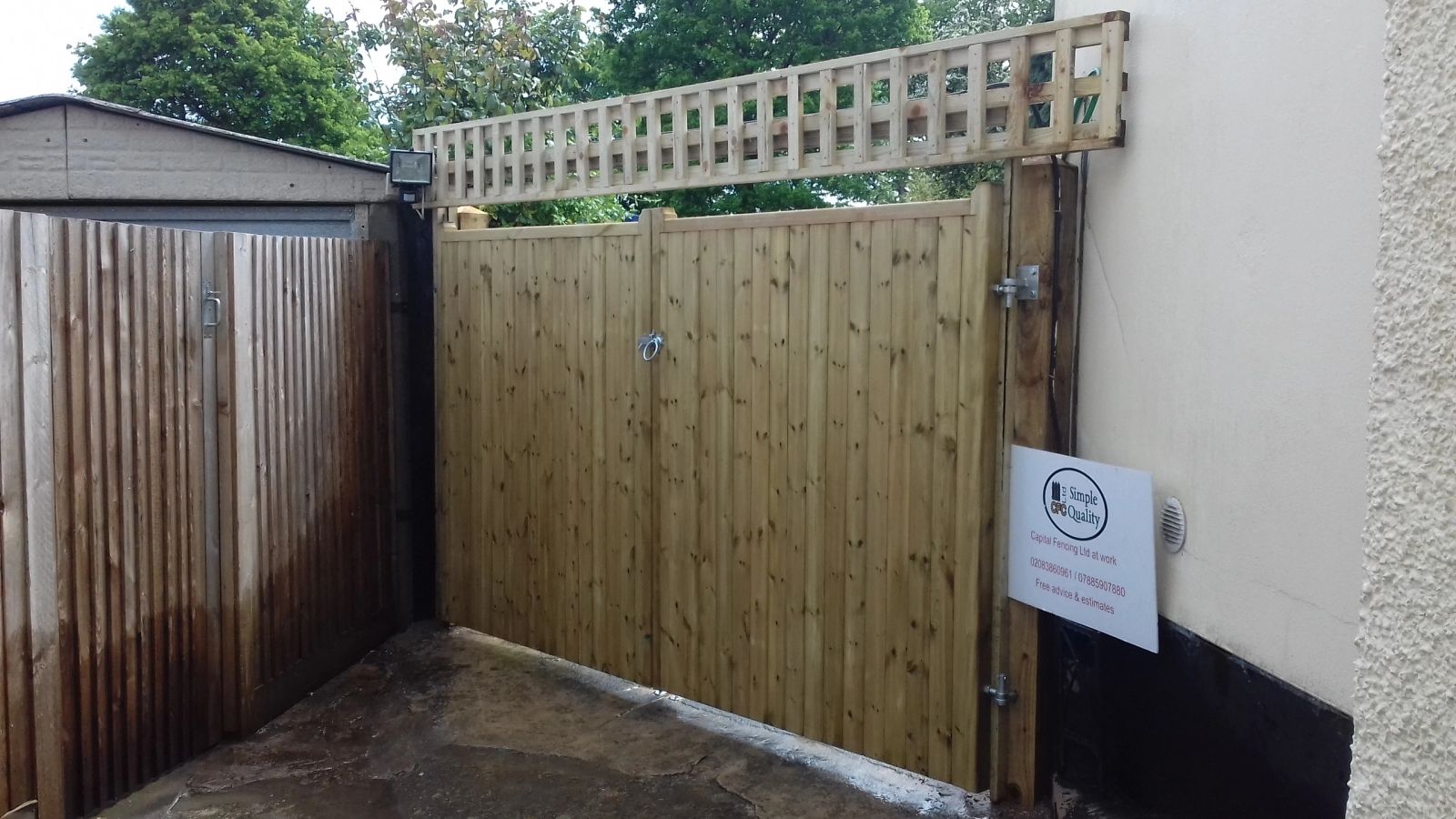
bespoke wooden gate installed by Capital Fencing in Letchworth Garden City (SG6)double driveway gates installed by Capital Fencing in Letchworth Garden City (SG6)hardwood side gate installed by Capital Fencing in Letchworth Garden City (SG6)metal entrance gate installed by Capital Fencing in Letchworth Garden City (SG6)

What actually matters for side return gates around Letchworth Garden City

Security fencing around a warehouse yard

A warehouse yard boundary typically needs to handle heavy vehicle movement, overnight trailer parking and a concentration of stock value behind a single perimeter, so post spacing, gate width and surface fixing are all driven by HGV manoeuvring room as much as by the security spec itself.

A yard used for trailer drop-and-swap overnight often needs its own internal secure compound within the wider yard fence, since trailers left standing are a target independent of the building's own security.

Staple and clout corrosion

Wire staples and clout nails used to fix wire mesh or thin capping are among the first fixings to corrode, since their small cross-section and shallow galvanising thickness give them less protection than a heavier fixing.

A repair that replaces the mesh or board but reuses corroded staples is only a partial fix, since the corroded fixings will fail again well before the new material does.

End-grain sealing on cut timber

Any cut made on site — trimming a post to length or cutting a rail to fit — exposes end grain that draws in moisture far faster than the treated face of the timber, making it a common starting point for rot if left unsealed.

Sealing cut ends with an end-grain preservative at the time of cutting, not afterward, closes off that entry point before the timber is fixed in place.

Sourcing reclaimed or discontinued timber to match an existing run

Older properties sometimes have a fence built from timber sections, profiles or panel sizes no longer in standard production, which makes an exact match difficult without sourcing reclaimed stock or having a bespoke run cut.

Reclaimed timber needs the same checks as new stock — treatment condition, rot, and structural soundness — before reuse, since visually matching timber that's structurally compromised isn't a genuine repair.

Where matching isn't practical, agreeing a deliberate, tidy transition point with the client (a change of panel style at a natural break, like a corner post) usually looks better than trying and failing to blend two slightly different materials seamlessly.

Combining a low concrete plinth wall with fencing above

A low block or concrete plinth wall under a fence panel raises the effective height, resists dig-under and impact better than a timber gravel board, and gives a clean, level starting line on sloped or uneven ground.

The plinth needs its own foundation independent of the fence posts above it, since settling of one shouldn't be allowed to drag the other out of line.

Galvanised versus painted metal fixings in exposed conditions

Hot-dip galvanising bonds a genuine zinc coating into the surface of steel and continues protecting even where the surface is scratched, since the surrounding zinc sacrificially corrodes before the underlying steel does.

A painted finish over mild steel only protects where the paint film remains intact, and once scratched or chipped the exposed steel corrodes at that point with nothing to slow it down.

For fixings, brackets and gate hardware in a genuinely exposed or coastal-influenced location, galvanised (or better, galvanised-and-painted) components noticeably outlast a plain painted finish.

Digging in summer-baked clay ground

Clay that's dried and cracked over a hot summer can be almost as hard as digging through soft rock in the top few hundred millimetres, even though the same ground would be workable a season later once it's rehydrated.

An auger struggles on baked clay in the same way it struggles on rubble, tending to bounce and judder rather than cut cleanly, so a pilot hole broken up with a bar first can make the auger's job easier.

Watering the dig point lightly the day before, where practical, softens the very top layer enough to ease the first stage of digging without turning the hole into a mud pit.

Acoustic fencing near busy roads or railways

Taller acoustic fencing intended to reduce traffic or railway noise is still subject to the same general permitted development height limits as any other boundary structure, unless it forms part of a formally consented scheme.

Some acoustic fencing along significant infrastructure is installed by the highway or rail authority itself under separate statutory powers, which is different from a homeowner adding their own noise barrier.

A homeowner wanting extra height for noise reasons alone would generally still need to apply for planning permission above the normal limit, the same as for any other reason.

Dealing with a post hole that keeps collapsing in loose or sandy soil

Loose or sandy soil can slump back into a freshly dug post hole before concrete goes in, which is more of a problem on a repair — where the hole is often reopening ground already disturbed by the original failure — than on undisturbed ground.

A sleeve, shuttering, or a wider hole packed with a drier mix that doesn't rely on firm hole walls to hold its shape can get a repair post set securely even where the surrounding soil won't hold a clean-sided hole.

Welded joint failure on metal gates

A cracked or failed weld at a metal gate's frame corner is usually a fatigue failure from repeated flexing rather than a one-off impact, particularly on a gate that's been slightly out of square for some time before the weld gave way.

Re-welding without first correcting the underlying rack or misalignment tends to fail again at the same point.

Matching an existing run

Extending or partially replacing a fence next to an existing run that's staying in place means matching post spacing, panel height, board profile and finish as closely as the existing materials allow.

Exact colour matching on stained or painted timber that's weathered for a few seasons is rarely possible with a fresh coat, so the realistic aim is a close, deliberate match rather than an invisible join.

Where the existing run uses a discontinued panel size or profile, the practical options are sourcing reclaimed stock, having a bespoke run made to match, or agreeing a visible but tidy transition point with the client upfront.

Listed building curtilage and garden structures

Listed building protection doesn't stop at the walls of the house — structures within its curtilage that were there at the date of listing, including some garden walls, gate piers and railings, can be treated as part of the listing itself.

That means a wall or gate that looks like an ordinary garden feature can technically need listed building consent for repair or replacement, and unauthorised work is a criminal offence rather than a simple planning breach.

Where a period boundary feature might be curtilage-listed, it's worth confirming with the council's conservation team before any demolition, since consent (or confirmation that it's not required) can usually be obtained in parallel with getting quotes.

Listed building curtilage and garden boundaries

Structures within the curtilage of a listed building — which can include garden walls, gate piers and sometimes fencing — may themselves be treated as part of the listing, even if not mentioned explicitly.

That means listed building consent can be required for work that would otherwise be unremarkable on a non-listed property, and doing work without consent where it's needed is a criminal offence.

Anyone unsure whether their boundary falls within this kind of curtilage should raise it with the council's conservation or listed buildings officer before starting.

Checking an unstable adjacent structure before repairing the fence against it

Where a fence panel is fixed to or sits hard against a garden wall, shed or outbuilding that's itself showing signs of movement, repairing the fence without addressing the structure it depends on risks the same failure recurring.

This is worth flagging to a client as a separate issue rather than working around it silently, since a fence repair fixed to an unstable wall is only as reliable as that wall.

Temporary propping versus a permanent repair

A gate that's failed suddenly, such as a snapped hinge or a post knocked out of the ground, sometimes needs a temporary prop or fixing to secure the opening safely until a permanent repair can be carried out, particularly where the opening needs to remain secure overnight.

It's worth being clear with a client about which stage a repair is at, since a temporary fix isn't intended to be left in place long-term.

Decking joist spacing and spans

Joist spacing under a deck is set by the board being used and the load expected, not fixed universally — timber boards typically need joists at closer centres than the equivalent composite board, because composite is generally less stiff across a span.

Manufacturers publish maximum joist spacing for their composite boards, and it's shorter still where boards run diagonally rather than square to the joists, since a diagonal run effectively increases the unsupported span between fixings.

Undersized joist spacing shows up as bounce or long-term sag between joists well before it becomes a safety issue, so it's worth checking spacing against the actual board spec rather than a generic rule of thumb.

Boundary marking after installation

Once a new line is up, marking its exact position against the title plan — rather than relying on where the old fence happened to sit — avoids a future dispute if the new run has shifted slightly from the original.

A simple record of post positions relative to a fixed point on site is worth keeping, particularly where the new boundary is more solid or permanent than what it replaced.

Tenancy and landlord repair responsibilities

Responsibility for a garden boundary at a rented property depends on the tenancy agreement, but where it's silent, the general position is that a landlord is responsible for structural boundary features while day-to-day garden maintenance often falls to the tenant.

A tenant generally can't authorise permanent alterations like a new fence line or wall without the landlord's consent, even where they're happy to pay for it, since it affects the property the landlord owns.

Storm or accidental damage to a boundary fence at a let property is usually the landlord's repair obligation, arranged directly or through a managing agent, rather than something the tenant is expected to fund unless they caused the damage.

Snow load and drifting against capping

Snow rarely loads a vertical fence face directly, but it drifts and settles along the top of a run, especially against capping or trellis toppers that catch and hold it rather than shedding it.

A sustained thaw-freeze cycle on wet capping timber is a common cause of splitting, since water trapped in the grain expands as it freezes and opens up hairline cracks that widen each winter.

A capping profile with a slight fall to shed water, rather than a flat top, reduces how much moisture sits there in the first place.

Panel versus closeboard repair economics

A panel fence is repaired panel by panel, so a single damaged section is a straightforward swap, whereas a closeboard fence is repaired board by board, which suits a partial repair better but takes longer per linear metre.

Where storm damage has hit a wide section, a panel system is often quicker to put right; where only a handful of boards are affected, closeboard repair wastes far less sound material.

Moisture content before staining or treating

Applying stain or preservative to timber that's still wet from recent rain or from fresh pressure treatment traps moisture under the coating rather than sealing it out, reducing how long the treatment lasts.

Repairs are timed, where possible, to let new or rain-affected timber dry to a suitable moisture level before any coating is applied.

Checking for adjacent drainage runs before excavating

A land drain or perimeter drainage run laid to keep a garden from waterlogging is easy to miss during a routine dig, since it's often shallower and less obviously marked than a mains service.

Digging through one doesn't usually cause an immediate problem visible on the day, but it can quietly reintroduce a waterlogging issue the drain was originally installed to solve, sometimes not noticed until the following wet season.

Where a garden has a known history of standing water that was previously addressed with drainage work, it's worth asking the client what's down there before digging rather than finding out by breaking through a pipe.

London terraces and semis with a narrow alley between the house and the neighbouring wall — that's who this page is for. In Letchworth Garden City and out to North Hertfordshire District, we run the side-return gates spec that survives letchworth heritage foundation design rules dictate fence styles, heights and finishes on most streets. Roads such as Wilbury Road and Pixmore Way are typical of the local layout. Broadway Cinema is a useful local reference point. Hillshott's Arts and Crafts terraces date from the town's earliest development phase.

Get In Touch

Get My Free Quote — 24h Response

No callout fee · Free site visit · Friendly local team covering London & Hertfordshire.

Call us
07885907880
or 02036484746
Email
capital_fencing@yahoo.com
WhatsApp
Message us anytime
Area
London & Hertfordshire
Payment
Card payments accepted

Pay by debit or credit card, bank transfer or cash once the work and price are agreed. No deposit taken online.

Request a Free Quote

We'll get back to you within 24 hours.

Free Site Visit No Callout Fee
Call WhatsAppQuote