Resetting versus replacing a post
A post repair is either a reset in fresh concrete where the timber itself is sound, a concrete spur bolted above a rotten section where enough good timber remains, or a full replacement where rot has reached the panel fixings.
We test each post on site with a probe at ground level rather than deciding from a visual check alone, since a post can look fine above ground and be rotten just below it.
Security fencing around a builders' compound
A builders' compound holding plant, materials and fuel needs a higher standard of fencing than the general site hoarding, since compound contents are a specific theft target and are often left unattended overnight or over a weekend.
Anti-climb toppings, a single monitored access gate and lighting are more commonly justified on a compound than on the wider site perimeter, given the concentration of value inside a relatively small footprint.
Fence junctions above a retaining wall
A fence sitting on top of a retaining wall adds lateral load the wall wasn't necessarily designed for, particularly on a taller solid-faced security screen catching wind, so the wall's condition and the fence's fixing method both need checking before installation rather than assumed to be compatible.
Where the wall can't safely take a bolted post, a freestanding post line set back slightly from the wall edge, tied back if needed, keeps the fence load off the retaining structure entirely.
Overhead cables and clearance for gate operation
A gate installed beneath or near an overhead service cable needs its swing or opening path checked against that cable's height and any sag, particularly for a wider vehicle gate that might otherwise catch a low cable at its highest point of travel.
This is a straightforward site check to make before installation, since moving a gate's position after cables have been identified as a clearance problem is far more disruptive than checking beforehand.
Leylandii hedges and root competition near posts
A mature leylandii hedge planted close to a boundary develops a dense, shallow root mat that competes directly with a post base for space and moisture, often making standard post-hole digging difficult without cutting through live roots.
Leylandii also draws a large amount of water from the surrounding soil in summer, which can locally dry and shrink clay soil right along the fence line even where the wider garden isn't especially exposed.
Where a hedge is being kept, offsetting posts slightly from the direct root zone, or hand-digging around larger roots rather than augering through them, extends post life without needing to remove established planting.
Gate frame timber sizes by width
A gate frame's timber section needs to increase with the width of the opening, since a wider gate has more leverage acting on the hinge side and more unsupported span across the middle before diagonal bracing is added.
A narrow single pedestrian gate can often use a modest frame section, while a wide double-leaf driveway gate needs substantially heavier stiles and rails plus a diagonal brace to stop it dropping or racking out of square at the latch side.
Bracing should run from the top of the hinge side down to the bottom of the latch side, in the direction that actually resists the gate's tendency to sag, not simply corner to corner for appearance.
Checking wall coping condition before fixing into it
Coping stones or brick-on-edge capping along the top of a garden wall are often loosely bedded rather than solidly fixed, so drilling or clamping a fence post bracket into coping without checking it first can dislodge the coping itself.
A quick check by hand-pressure on each coping unit along the intended fixing line identifies any that are already loose, which is worth doing before committing to that wall as a fixing point at all.
Where coping is sound, spreading the fixing load across a bracket plate rather than a single point fixing reduces the chance of cracking the coping under wind load on the panels above.
Sherardised nails and fixings
Sherardising coats small steel fixings in zinc through a low-temperature diffusion process using zinc dust rather than a molten bath, giving a matt grey, evenly distributed coating well suited to fasteners with fine threads.
Because the process doesn't build up excess zinc at edges and threads the way hot-dip galvanising can, sherardised nails and screws keep a cleaner, more precise fit than galvanised equivalents of the same size.
The coating is thinner than typical hot-dip galvanising, so sherardised fixings are generally specified for above-ground, moderate-exposure use rather than permanent ground contact.
Choosing hand tools over power tools on sensitive sites
A petrol auger or breaker finishes a dig far faster than hand tools but brings noise, vibration and exhaust that matter more on a site with close neighbours, a nervous pet next door, or restricted working hours.
Hand tools also give more control in tight spots — close to a wall, a root, or a service — where a powered tool's speed becomes a liability rather than an advantage.
The practical approach on most jobs is powered tools for the bulk of straightforward digging and hand tools kept ready for the awkward sections, rather than committing to one method for an entire run.
Brush application versus spray for treatment
Brush application works the treatment into the grain and end grain more thoroughly, which matters most at cut ends and joints where untreated timber is exposed and most vulnerable to moisture uptake.
Spray application covers a large run far faster and gives a more even surface finish on smooth-planed boards, but relies on good weather and overspray control, and can leave the coating sitting on the surface rather than penetrating as deeply.
A practical approach on a full boundary is spraying the open panel faces for speed and finish, then finishing post tops, end grain and capping joints by hand with a brush.
Boundary fencing for HMOs and multi-occupancy buildings
Houses in multiple occupation often have higher footfall through shared external areas than a single-family home, which points toward more durable gate hardware and fencing specified for frequent use rather than the lighter fittings suited to a quiet family garden.
Bin and cycle storage for several households sharing one plot needs more space and more robust screening than a single-household equivalent, and is worth planning at the same time as any boundary work.
Landlords managing several such properties often prefer a single consistent spec across their portfolio, both for cost predictability and so that future repairs use readily available standard parts.
School and nursery boundary needs
Boundaries around schools, nurseries and other settings used by children are usually specified with child safety in mind first — no horizontal rails that could be used to climb, gaps too narrow to trap a small limb, and self-closing gates with child-safe latches on any pedestrian access.
Height matters both for containment and sightlines: too high and staff lose visibility into a play area from a building; too low and it's not a meaningful boundary at all.
Any work on an occupied site with children present also has practical scheduling implications — most of this work happens outside term time or during holiday closures to avoid disruption.
Relocating a builders' compound fence as a project phases
A builders' compound fence is often installed in stages as a construction project progresses, with the secure line moving inward as completed areas are handed over and outward again if the site boundary expands into an adjoining phase.
Because compound fencing is frequently relocated, panel systems with reusable feet or block-based supports are generally favoured over concreted posts, even though a concreted post gives a more permanent fixing where the boundary line is fixed for the whole project.
Timber decking board profiles
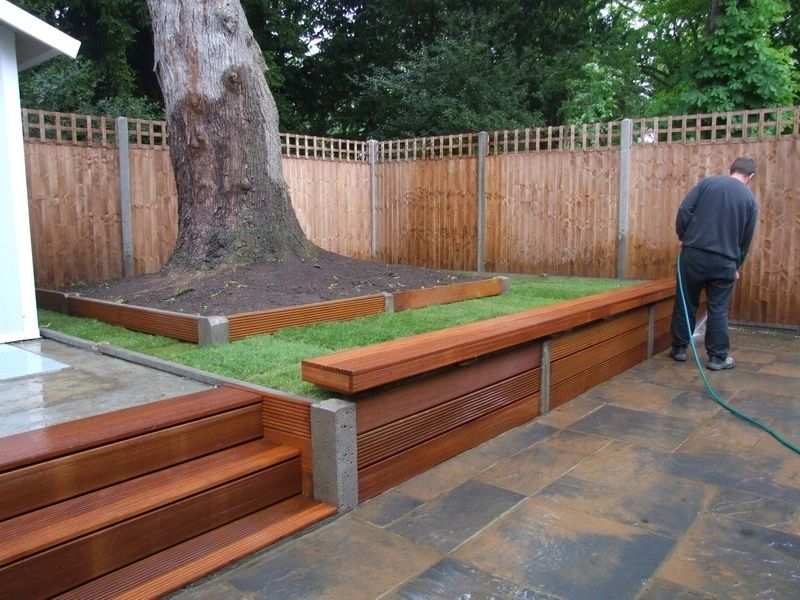
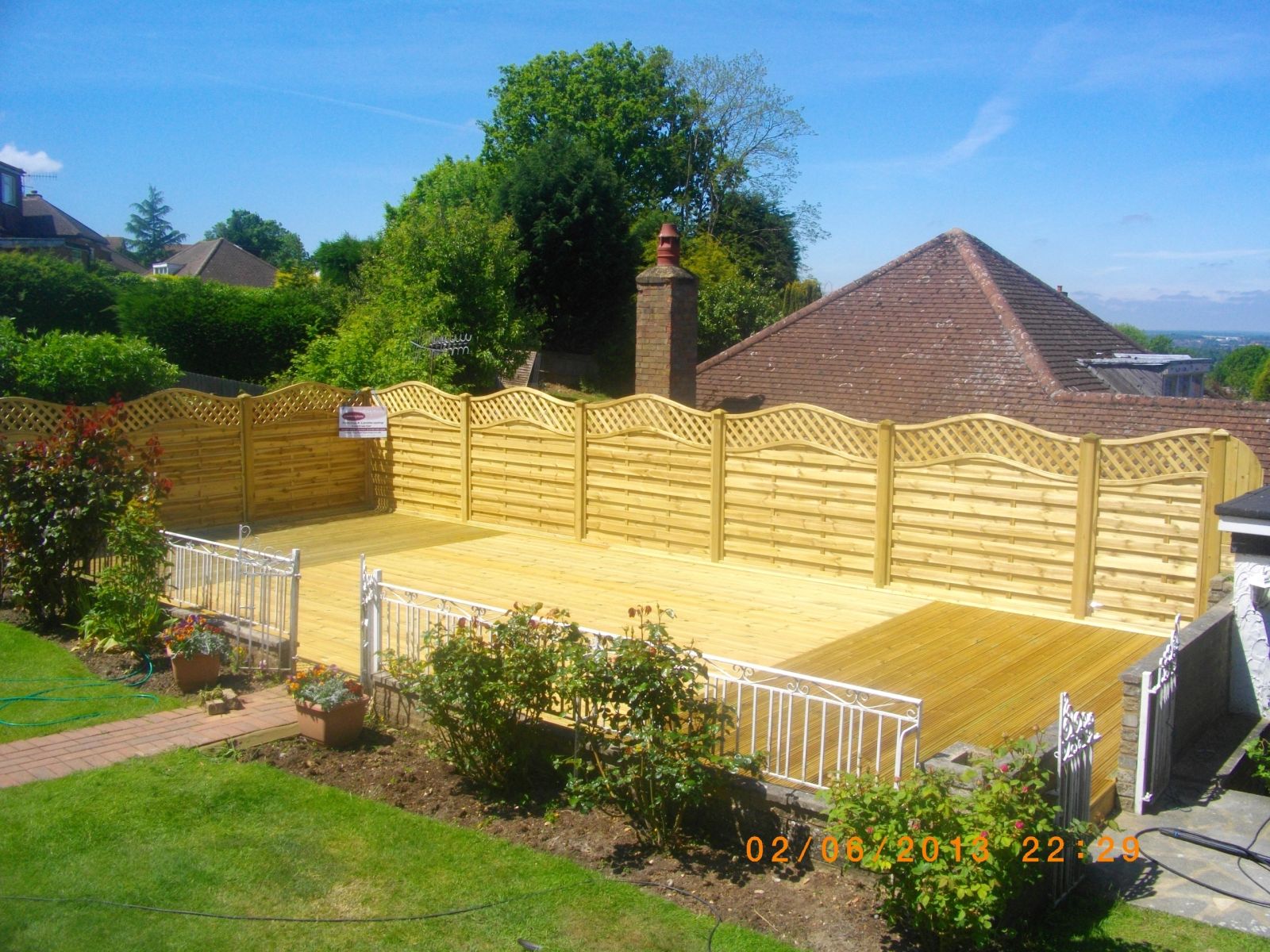
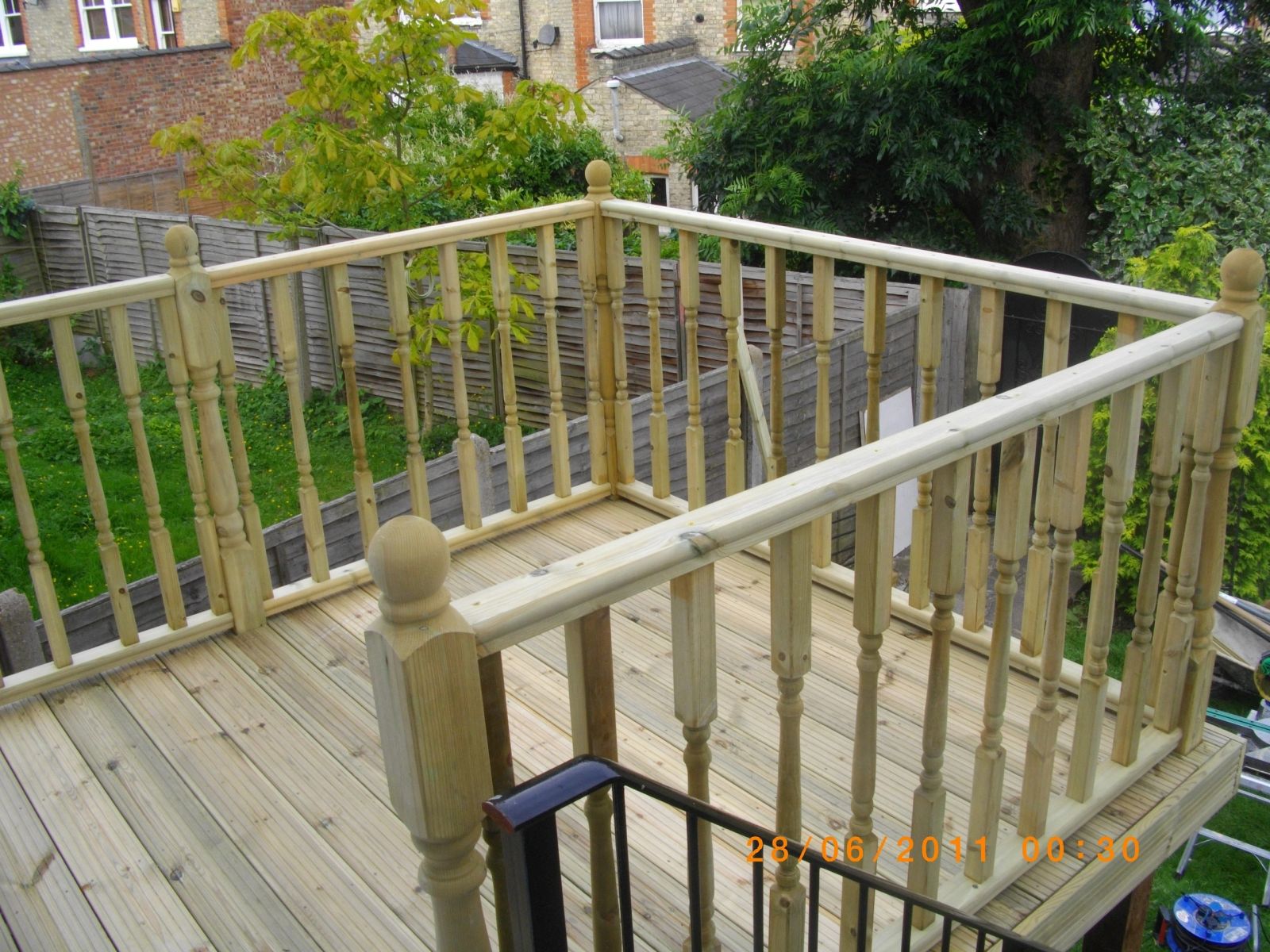
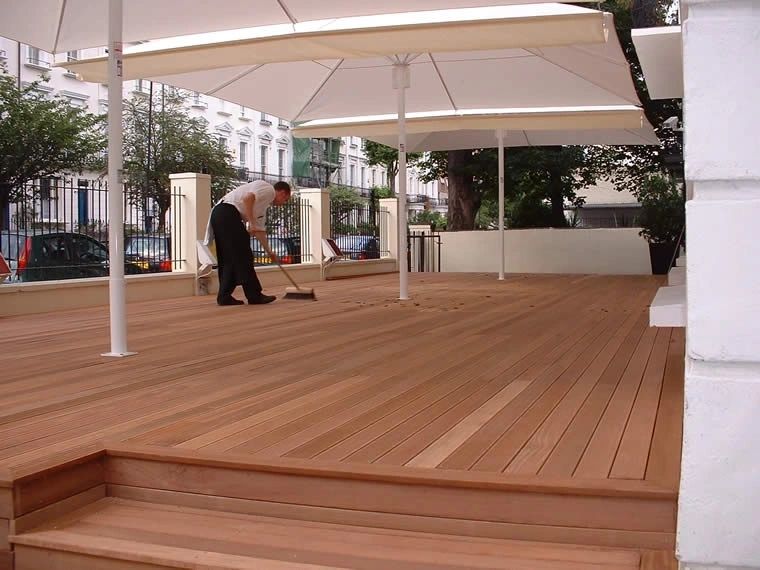
Grooved decking boards have a reeded or ribbed surface intended to improve underfoot grip, particularly when wet, compared with a smooth-planed board of the same species and treatment.
The grooves can also trap moisture, algae and debris more readily than a smooth board, meaning a grooved deck often needs more regular cleaning to keep the grip benefit from being offset by a slippery algal film.
Reversible boards with a smooth face on one side and grooved on the other let the fitted orientation be chosen, or later reversed once the first face weathers, extending the usable life of the same boards.
Gate swing clearance where a dropped kerb serves vehicle access
A security gate installed behind a dropped kerb needs enough setback from the highway boundary that an opening gate leaf never swings into the public footway or carriageway, which local authorities generally require as a condition of the dropped kerb itself.
A sliding gate avoids this swing clearance problem entirely and is often the preferred choice where the plot is shallow, though it needs a clear running track free of obstruction along its full travel length.
Protecting galvanised coatings on fixings during a repair
Cutting, drilling or hammering a galvanised bracket or bolt during a repair can chip through the zinc coating and expose bare steel underneath, which then corrodes faster at exactly that damaged point than the surrounding coated surface.
Touching up any damaged area with a cold galvanising compound at the time of repair is a small step that meaningfully extends the life of the fixing, rather than leaving bare steel to start rusting immediately.
Working safely on a tall or elevated fence repair
A repair on a taller run, or one set on a retaining wall or raised bank, sometimes needs a working platform or trestles rather than simply working from a stepladder against the fence itself.
Where a repair is above head height along its full length, planning safe access before starting reduces both the time on site and the risk of further damage to the fence being used as a support.
Diagnosing a fence problem before quoting
A repair quote starts with identifying which of the usual failure points is actually responsible — post, panel, gravel board or a full run — because pricing a full replacement for what's actually a single post repair costs the client far more than necessary.
We probe timber at ground level and check the whole run for related stress, not just the section that's obviously failed.
Welded versus woven mesh
Welded mesh is formed from wires fused at each intersection, giving a rigid grid that holds its shape well and resists distortion under point loads such as someone leaning or climbing on it.
Woven mesh, including chain link, has wires interlaced rather than fused, which lets the whole panel flex and absorb impact rather than transferring load to a single joint, but it can also sag or distort more visibly over time.
Welded mesh is generally preferred where a crisp, rigid appearance matters, while woven mesh is favoured for larger open areas like sports enclosures where some give under impact is actually beneficial.
Staining versus painting: different maintenance cycles
A translucent or semi-transparent stain penetrates the timber surface and wears gradually, so re-application every two to three years is a top-up rather than a full strip-back, and overlap patches between old and new coats blend reasonably well.
Opaque exterior paint or solid-colour masonry-style coatings sit on the surface as a film, which looks crisper initially but is prone to flaking and cracking as the timber moves seasonally, and once it starts to fail it usually needs full removal rather than a top coat.
Clients choosing paint for a specific colour should budget for that more disruptive maintenance cycle rather than assuming it behaves like a stain with a different finish.
Douglas fir for structural fencing timber
Douglas fir is a stronger, stiffer softwood than typical whitewood or redwood, with a pronounced grain pattern and moderate natural durability in its heartwood, making it a common choice for structural posts and gate framing rather than boarding.
Its resin content is generally lower than pine, which reduces the risk of resin bleed showing through a painted or stained finish.
Because of its strength-to-weight ratio it's often specified for longer unsupported spans, such as wide gate frames, where a lighter section still needs to resist twisting under its own weight.
Letterbox and parcel provision in a secure gate
A fully secured pedestrian gate can leave deliveries with nowhere to leave post or parcels, so a secure gate-mounted letterbox or a parcel box positioned outside the locked line is worth planning at design stage.
Positioning it so it can be reached without opening the gate keeps the boundary genuinely closed while still allowing routine deliveries.