Access and material handling on site
Concrete, posts and panels are heavy, and a site with only a narrow side return or no vehicle access changes how a job is priced and sequenced — materials sometimes have to be carried through rather than dropped at the boundary.
On a commercial yard the opposite problem applies: keeping a working site operational around a delivery of steel palisade or mesh panels needs a delivery and storage plan agreed before the first post goes in.
Simple maintenance that prevents gate failure
Checking hinge screws are still tight and that the gate still closes flush against the frame once or twice a year catches the early stages of sag before it becomes a full repair job.
A gate that's starting to catch on the ground is far cheaper to fix at that stage than after the frame has racked further out of square.
Palisade pale profiles: D-section versus W-section
D-section pales have a rounded face that offers less finger and foot grip than a flat pale, while W-section pales fold the steel into a shallow trough shape that resists bending under a lever without adding weight.
W-section is the more common choice on a taller or higher-security run because the fold adds stiffness across the pale's width, whereas D-section is often reserved for lower, more decorative palisade work.
Allotment and paddock ground
Allotment and paddock boundaries are often on ground that's been cultivated, grazed or left rough for decades, with a topsoil layer that's deeper and looser than a typical garden lawn but can also conceal old cultivation debris, buried irrigation pipe or fencing stobs from previous boundaries.
Paddock ground grazed by livestock compacts unevenly, with poached, churned patches near gateways sitting very differently underfoot from the firmer ground a few metres away.
Post specifications on this kind of ground usually need to account for stock leaning or rubbing on the fence line, which is a different load case from a garden boundary that just needs to withstand weather and general wear.
Non-slip decking finishes
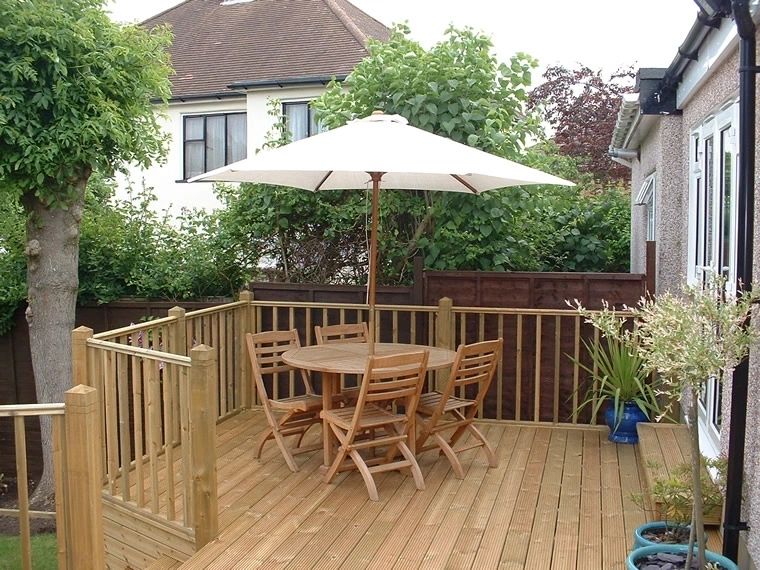
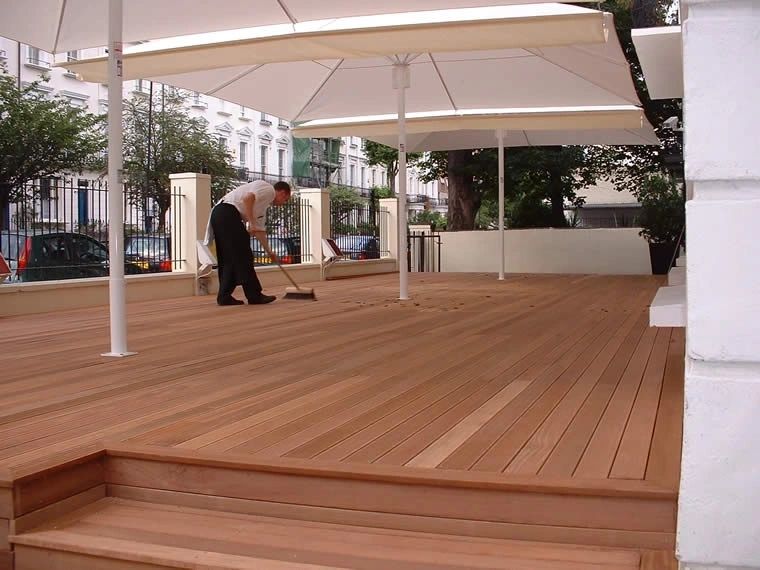
A grooved board profile gives some grip when dry but can still become slippery once algae builds up in a shaded or north-facing spot, which is a maintenance issue rather than something a profile alone solves permanently.
Anti-slip decking strips or grit-impregnated coatings can be added to steps and high-traffic areas as a supplementary measure, and are worth specifying on steps or ramps even where the main deck area doesn't need them.
Some composite ranges are manufactured with a textured or embossed surface aimed specifically at slip resistance, which is worth checking against a wet-slip rating rather than assuming all composite boards perform the same underfoot.
Fixing into a rendered wall without cracking the render
Render sits as a relatively thin, brittle coat over the masonry beneath it, so drilling straight through without care can crack or blow a patch of render around the hole rather than leaving a clean fixing point.
Marking and drilling a pilot hole slowly through the render layer first, before switching to full hammer action once through into the masonry, reduces the chance of the render cracking outward from the drill's initial impact.
Where render is already loose or hollow-sounding when tapped near the intended fixing point, it's worth choosing a different spot or repairing that patch of render first rather than fixing into a surface that's already failing.
Weight distribution on double driveway gates
A pair of driveway gates carries its weight on two separate hinge posts rather than one, so an imbalance between leaves — one heavier, one lighter, or one dropped more than the other — shows up as an uneven meeting line at the centre.
Correcting this usually means addressing each leaf's hinges independently rather than adjusting only the leaf that looks worse.
Timber moisture content testing
A pin-type moisture meter measures electrical resistance between two probes pushed into the timber's surface, giving a reasonably reliable reading of moisture content near the surface but not necessarily reflecting the core of a thick section.
Fencing timber delivered at above roughly 20% moisture content is more prone to significant post-installation shrinkage and movement than timber closer to its long-term equilibrium moisture content for outdoor use.
Because timber left stacked outdoors and uncovered reabsorbs moisture from rain and humidity, a moisture reading taken on delivery can differ significantly from the same stack a fortnight later if it hasn't been kept covered.
Producing an accurate cutting list before ordering materials
An accurate cutting list — exact post count, panel or board lengths, and any bespoke cut sizes for short bays or gate openings — worked out from a proper site survey avoids the delay of a return trip for materials missed on the first order.
Rounding measurements generously rather than precisely is common practice for consumable items like fixings and concrete, but panel and post counts benefit from being counted exactly, since over-ordering large items wastes money and under-ordering stalls the job.
Where a run includes several different bay widths from stepping around obstructions, listing each bay's exact requirement separately rather than assuming an average avoids ordering a batch of identical cut panels that don't actually fit their intended positions.
Properties with no registered title at all
A small proportion of properties in England and Wales, usually those that haven't changed hands or been mortgaged for a very long time, still aren't registered with HM Land Registry at all.
In these cases, boundary questions rely entirely on the original paper deeds held by the owner, which can be less detailed or harder to interpret than a modern registered title plan.
First registration can be triggered voluntarily or by certain transactions, and often brings helpful clarity to boundary questions that were previously only defined by older paper deeds.
Maintenance intervals by material
Untreated or lightly treated softwood fencing generally needs a re-stain or re-oil every one to two years to keep its protective coating intact, while a well-detailed treated softwood fence left to weather naturally can go much longer between any active maintenance.
Composite and uPVC fencing need little more than an occasional wash down, since the material itself doesn't need a protective coating, though fixings and any timber sub-frame beneath it still age on their own separate schedule.
Metal railings and gates need their finish checked periodically for scratches or corrosion starting points, since a small breach in galvanising or powder coating left untreated will spread under the coating rather than staying contained.
Handling a live boundary dispute discovered during a repair
Sometimes a repair call-out uncovers that neighbours actively disagree about where the boundary line sits, which is a different situation to simply not knowing who's responsible for maintenance, and it needs resolving before any post is reset rather than worked around.
In that situation the sensible step is pausing repair work on the disputed section until the neighbours have agreed the line, since resetting a post on a disputed line can itself become evidence in the dispute.
Drainage easements running under a fence line
Some boundaries have a formal drainage easement recorded against the title, protecting a buried pipe or watercourse that a neighbouring property has the right to maintain access to.
Fence posts set directly over or immediately alongside a protected drainage run can technically breach the terms of the easement even if the pipe itself isn't damaged during installation.
Checking the title register, and asking the water company to confirm any known drainage records, is sensible before digging post holes on an older plot with an unclear drainage history.
Terraced gardens and stepped runs
A garden cut into level terraces, common on steeper plots across the Chilterns fringe, usually means the fence has to step down at each change of level rather than run as one continuous raked line.
Each stepped section needs its own post pair set level within that section, with the horizontal joint between sections finished cleanly rather than leaving an open triangular gap under the lower panel.
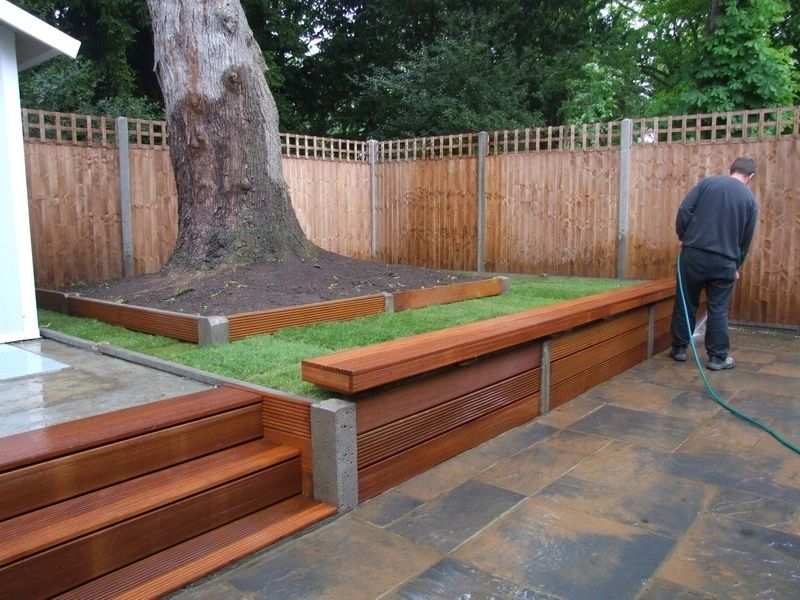
Where the terraces are formed by retaining walls rather than simple grading, the fence posts typically sit on top of the wall structure and need fixings suited to masonry rather than a standard earth-set post.
Certificates of lawfulness for existing boundary structures
A Certificate of Lawfulness of Existing Use or Development can formally confirm that an existing boundary structure was lawfully built, which is useful where there's uncertainty or a dispute about historic permissions.
This is different from planning permission itself — it's a factual confirmation of lawful status, often sought before a property sale to resolve a conveyancing query.
Where a long-standing boundary fence's planning history is unclear, applying for this kind of certificate can settle the question more reliably than relying on assumption.
Thermal cracking in concrete post caps
Concrete post caps and copings can develop fine cracks from repeated freeze-thaw cycling, where water absorbed into small surface pores expands as it freezes and gradually widens existing microcracks.
A denser, lower-porosity concrete mix, or one finished with a sealant, absorbs less water in the first place and is correspondingly more resistant to this kind of frost damage than a porous, untreated finish.
Once a crack has formed, it tends to widen faster in subsequent winters, since the enlarged crack itself now holds more water than the original surface pores did, which is why early repair matters more than it might first appear.
Boundaries against a watercourse and riparian basics
A property boundary running along a stream, brook or ditch usually carries riparian responsibilities regardless of who technically owns the fence, including keeping the watercourse clear of obstruction and not doing anything that would worsen flood risk downstream.
Fence posts set close to a watercourse bank should avoid undermining or destabilising the bank itself, and in many cases installing anything within a set distance of the top of the bank needs consent from the relevant flood or drainage authority.
Ground immediately alongside a watercourse is also more likely to be periodically saturated or subject to erosion, which should factor into post depth and material choice on that section.
Post splitting from over-driven fixings
Driving a nail or coach screw too close to a timber post's edge, particularly near the end grain, concentrates stress in a narrow section of fibres and can split the post along the grain rather than simply seating the fixing.
Pre-drilling a pilot hole for larger fixings, especially near board or post ends, relieves that concentrated stress by giving the fixing a path that doesn't have to force the surrounding fibres apart.
Species with straighter, more even grain generally resist this kind of splitting better than timber with interlocked or knotty grain near the fixing point, where existing weaknesses in the fibre structure make a split more likely to propagate.
Repairing where two adjoining fence styles meet at a corner
A corner where one owner's closeboard fence meets a neighbour's panel fence is a common awkward point for repair, since damage at the corner post can affect both runs but only one owner may be instructing the work.
Where only one side is being repaired, the corner post and its fixings into both runs need checking so the finished repair doesn't leave the untouched neighbouring fence with a weaker connection than before.
Board thickness and deflection
A thin board fixed across a wide unsupported span will visibly bow or deflect under its own weight or a light push long before it's anywhere near breaking, because deflection increases sharply as thickness decreases.
Doubling a board's thickness roughly increases its stiffness eightfold for the same span, which is why panel manufacturers specify a maximum bay width for a given board thickness rather than treating thickness as purely a durability choice.
On wider bays it's usually cheaper overall to add an intermediate rail or reduce the bay width than to over-specify board thickness across the whole run to compensate.
Temporary hoarding during other building work
Where fencing or gate work runs alongside a wider building project — an extension, a loft conversion with scaffolding, or a full renovation — a temporary hoarding or site fence often needs to go up before the permanent boundary work can start.
Temporary fencing adjoining a public footpath or road has its own public safety considerations, including visibility for pedestrians and vehicles passing the site.
Sequencing matters here — installing the final boundary fence before other trades have finished moving materials through that access point often means damage that has to be repaired before the job can be signed off.
Detached plots with a paddock or field edge
Detached properties backing onto a paddock, field or grazing land need a boundary that does two jobs at once — keeping the garden private and, if livestock use the adjoining land, keeping animals off the garden side.
A standard close-boarded fence isn't stock-proof on its own; where horses or cattle are present on the other side, a stock fence or post-and-rail set slightly inside the garden fence is the usual belt-and-braces approach.
Field boundaries also see more vegetation growth and root pressure from hedgerows than a typical suburban fence line, so posts often need resetting or straightening more often than an equivalent garden boundary.