London & Hertfordshire Free Site Visit
bespoke wooden gate installed by Capital Fencing in Cheshunt (EN7)
Cheshunt · EN7 / EN8

Pedestrian Side Gates in Cheshunt — Built for how the finish sits next to the neighbour's existing boundary

Pedestrian side gates in Cheshunt is one of our regular briefs — single-leaf pedestrian gates matched into existing fencing runs. On mid-century semis and bungalows with long flat gardens — many back onto the Lee Valley with high-water-table conditions, the failure mode we see most often is the one we design out first. Roads such as Flamstead End Road and Turners Hill are typical of the local layout. Cedars Park is a useful local reference point. The old nursery and glasshouse land east of the A10 has been redeveloped for housing in phases, so plot sizes vary street by street.

Pedestrian side gates in Cheshunt is one of our regular briefs — single-leaf pedestrian gates matched into existing fencing runs. On mid-century semis and bungalows with long flat gardens — many back onto the Lee Valley with high-water-table conditions, the failure mode we see most often is the one we design out first. Roads such as Flamstead End Road and Turners Hill are typical of the local layout. Cedars Park is a useful local reference point. The old nursery and glasshouse land east of the A10 has been redeveloped for housing in phases, so plot sizes vary street by street.

What goes wrong

Common failure modes on pedestrian side gates

  • hinging off the last post of an old fence run — the post moves and the gate stops closing within weeks
  • specifying a decorative latch not rated for daily use — hardware fatigue inside a year
Default spec

How we build pedestrian side gates in Cheshunt

single leaf on ball-race hinges, thumb-latch and dead-locking hardware, closing stop and drop-bolt where security is a priority. On Cheshunt jobs we adjust for ground water near the lee valley means post bases need extra care to prevent rot.

Property mix locally: mid-century semis and bungalows, plus newer riverside developments toward Goffs Oak. Typical gardens: long flat gardens — many back onto the Lee Valley with high-water-table conditions. Postcodes we regularly service: EN7, EN8.

Why this spec, for single-leaf pedestrian gates matched into existing fencing runs

  • carried in as a like-for-like match to what's already there — no visible new post
  • hinge and latch geometry sized for daily use rather than as a one-off decorative piece
  • installed with the closing stop and latch in one visit so nothing has to be revisited

Typical pedestrian side gates briefs in Cheshunt

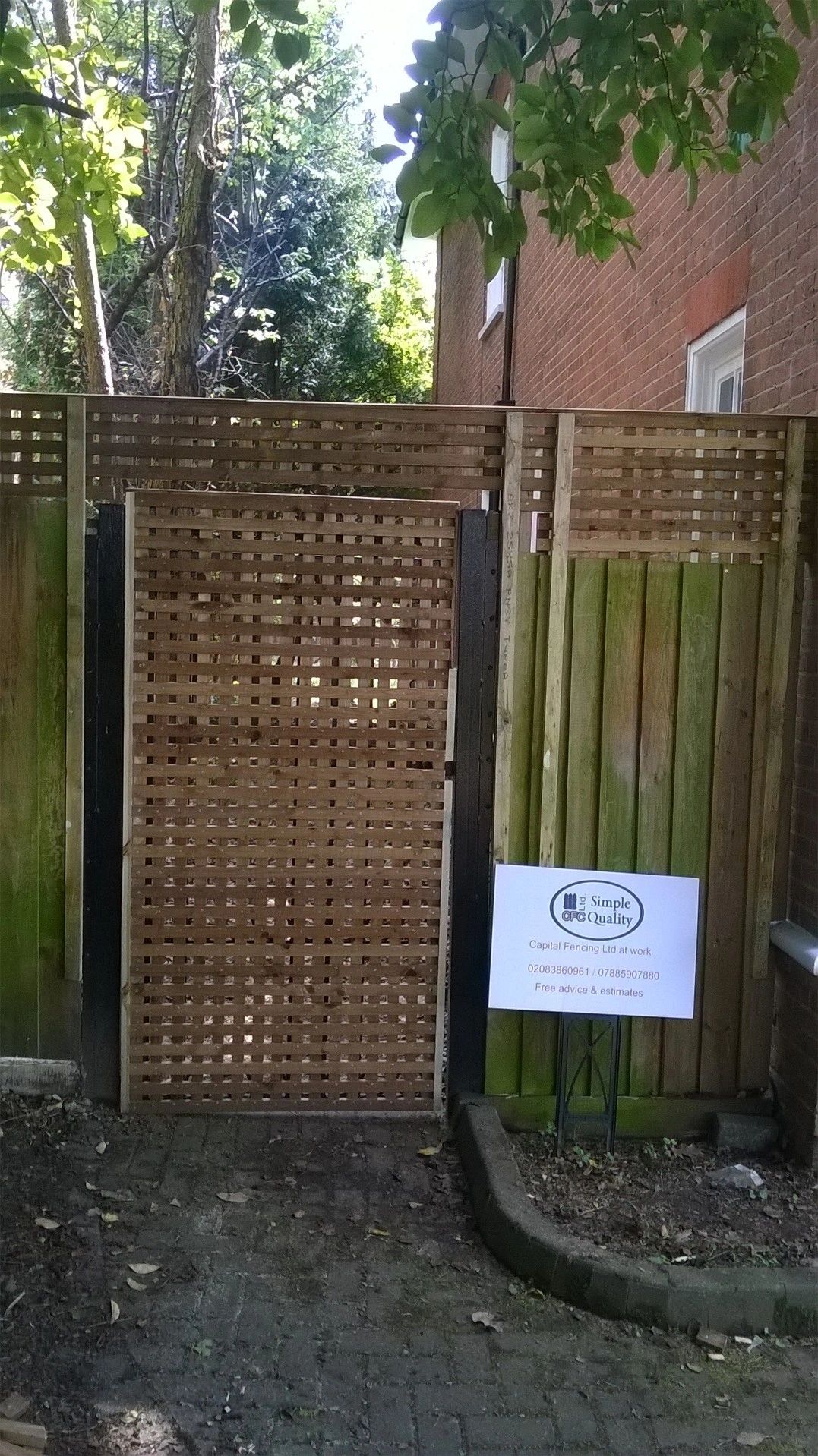
  • hardwood pedestrian gate through a brick garden wall opening
  • matched picket gate into a painted picket frontage

Pedestrian Side Gates FAQs — Cheshunt

Can you match a new pedestrian gate into my existing fence?

On pedestrian side gates jobs in Cheshunt (EN7), our default answer is: single leaf on ball-race hinges, thumb-latch and dead-locking hardware, closing stop and drop-bolt where security is a priority. We'll walk you through carried in as a like-for-like match to what's already there — no visible new post on the site visit before you commit.

Do you fit the latch and any hardware on the same visit?

Across Cheshunt we spec around ground water near the lee valley means post bases need extra care to prevent rot, so on pedestrian side gates that usually means closeboard-matched softwood for behind-the-house lines. We'll walk you through carried in as a like-for-like match to what's already there — no visible new post on the site visit before you commit.

How do I keep the gate closed without a spring hinge?

Broxbourne Borough coverage means we can survey most EN7 addresses inside a week — single-leaf pedestrian gates matched into existing fencing runs. We'll walk you through carried in as a like-for-like match to what's already there — no visible new post on the site visit before you commit.

Can a pedestrian gate go through a brick wall opening?

Practically: single 900mm pedestrian gate cut into an existing closeboard run. That's the Cheshunt version of this job, not a generic one. The honest trade-off is hinging off the last post of an old fence run — the post moves and the gate stops closing within weeks — which is exactly what our default spec designs out.

What hinges do you use so the gate doesn't drop?

On pedestrian side gates jobs in Cheshunt (EN7), our default answer is: single leaf on ball-race hinges, thumb-latch and dead-locking hardware, closing stop and drop-bolt where security is a priority. For context: hinge and latch geometry sized for daily use rather than as a one-off decorative piece. Measured, quoted and installed by the same small crew.

Recent pedestrian side gates work
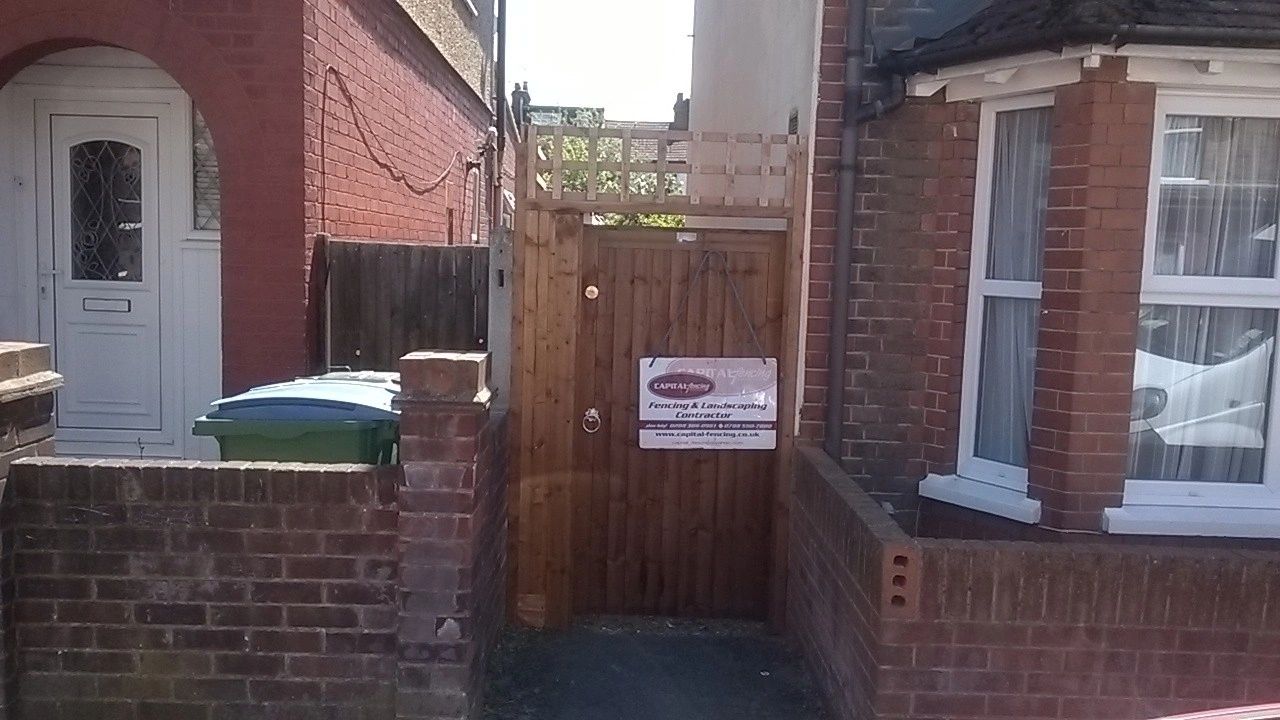
bespoke wooden gate installed by Capital Fencing in Cheshunt (EN7)double driveway gates installed by Capital Fencing in Cheshunt (EN7)hardwood side gate installed by Capital Fencing in Cheshunt (EN7)metal entrance gate installed by Capital Fencing in Cheshunt (EN7)

How we approach pedestrian side gates on Cheshunt properties

Dog day-care and kennels

Commercial dog day-care and kennel boundaries need to be genuinely dig-proof and jump-proof rather than just visually enclosing, which usually means a below-ground kick board or buried mesh apron along the base as well as adequate fence height.

Licensing under the Animal Welfare (Licensing of Activities Involving Animals) Regulations sets minimum boundary standards for kennels and day-care premises, and an inspector will check fence condition as part of renewal.

Double-gated airlock entries, where an inner and outer gate can't be open at the same time, are a common feature at the perimeter to stop dogs escaping through a single opened gate.

Where the adopted highway boundary actually sits

The legal edge of an adopted public highway doesn't always match the visible edge of the tarmac or verge, and can extend further onto what looks like private land in some cases.

Erecting a fence, wall or gate on adopted highway land without authorisation is a separate issue from planning permission, and the highway authority can require its removal.

Where there's any doubt about the exact highway boundary, the local highway authority can usually confirm the extent of the adopted highway against its own records.

Repairing fence sections undermined by fox or badger digging

A gap dug beneath a gravel board or the base of a panel is usually a fox rather than a badger unless it's part of a larger, more established sett system, and the repair approach differs depending on which is causing it.

Fox damage can usually be repaired by reinforcing the base with a buried mesh skirt or a deeper gravel board, but any active badger sett close to the boundary is legally protected and needs specialist advice before any digging near it as part of the repair.

Off-street parking and dropped kerbs

Converting a front garden to off-street parking usually requires a dropped kerb permit from the highway authority, and a boundary fence or gate across that new access has to be positioned clear of the visibility splay the dropped kerb creates.

Where a low front boundary already exists specifically to preserve sightlines onto the new parking, replacing it with a taller or solid fence can undo the safety benefit the dropped kerb approval was granted on.

It's worth checking whether the dropped kerb approval included any conditions on boundary treatment before ordering a new front fence or gate.

Ivy and climber damage to fencing

Ivy and other vigorous climbers work their tendrils into joints and between boards, prising fixings apart gradually and trapping moisture against the timber underneath the growth.

Removing the growth as part of a repair often reveals damage that was hidden by the foliage, so the full extent of the repair sometimes isn't clear until the climber has been cut back.

Balancing tight mesh apertures against airflow around plant equipment

A tight-aperture high-security mesh gives strong resistance to climbing and reach-through, but wrapped closely around outdoor plant equipment such as chillers or generators it can restrict airflow needed for the equipment to run efficiently.

Setting the mesh enclosure at a slight distance from the equipment casing, or specifying a marginally larger aperture where the site's threat assessment allows it, keeps most of the security benefit while avoiding an airflow restriction that could affect equipment performance.

Waste carrier duty of care for site waste

Anyone removing fencing, decking or building waste from a client's property in the course of business needs to be a registered waste carrier with the Environment Agency, and should be able to provide a waste transfer note showing where the material was taken.

Treated timber, in particular, is classed differently to plain untreated offcuts and generally can't simply go on a bonfire or into general household waste, since some older preservatives fall under hazardous waste rules.

Asking a contractor for their waste carrier registration number and a transfer note isn't excessive caution — the householder can be liable if waste is later found fly-tipped and traced back to the job.

Waste carrier duty of care for old fencing

Under the Environmental Protection Act 1990, anyone arranging removal of construction waste such as old fence panels and posts has a 'duty of care' to ensure it's handled by a registered waste carrier.

Asking to see a waste carrier's registration number, and requesting a waste transfer note for larger quantities, is a reasonable and legitimate request rather than an unusual one.

Householders can be held responsible if waste from their property is later found fly-tipped, even where they paid someone else to take it away, which is why checking credentials matters.

Marker tape and underground cable protection during fencing works

Even where a cable route has been avoided by shifting post positions, a warning marker tape laid above the cable at a shallower depth than the cable itself gives a visual and physical warning to anyone digging near the line in future.

This is a low-cost addition worth doing whenever a post line runs close to a known service, since a fence contractor working carefully today doesn't guarantee the same care from whoever digs near that boundary years later.

Alley gates on shared rear access

An alley gate closes off a shared rear passage between terraced properties and is typically installed and maintained under an agreement between several households or with local authority involvement, rather than by a single owner.

Repairs on these gates often need to account for multiple keyholders and heavier-than-domestic use, since several households pass through the same gate daily.

Gate hinge material and load ratings

Gate hinges are rated by the load they can bear without excessive wear or sag, and that rating depends on the hinge's material, its pin diameter and the bearing surface area between the moving parts.

A heavy timber gate on a lightweight hinge designed for a garden gate will wear the pin and bushing far faster than the same hinge on a lighter gate, eventually developing a visible droop at the latch side.

Stainless steel or greased bronze bushings resist wear better than plain steel-on-steel hinges, particularly on gates opened frequently, where repeated friction is the main driver of hinge wear rather than corrosion.

Safety edges and force limits on automated gates

Automated gates are expected to operate within recognised safety standards covering force limits and trapping-point protection, generally addressed through pressure-sensitive edges, photocells or a torque-limited motor rather than relying on the gate design alone.

This is specialist automation-engineer territory; on the gate itself, we make sure there are no obvious additional trapping points created by the leaf design before automation is fitted.

Scrap value theft targeting fence fittings

Cast aluminium or brass post caps and decorative finials have occasionally been targeted for scrap value on isolated boundaries, in the same way capping rails have, so lower-value steel or composite alternatives are sometimes specified deliberately on an exposed run for that reason alone.

Where a decorative metal fitting is wanted for appearance, fixing it with concealed or one-way screws reduces how quickly it can be removed compared with an exposed standard fixing.

Letterplates fitted into gate doors

A letterplate is occasionally fitted into a solid garden or side gate door serving as a secondary entrance, and its position needs to clear internal ledges, braces or a deadlock case before cutting the opening.

Weather sealing around a letterplate in an exterior gate door matters more than on a covered porch door, since the opening faces the weather directly with no canopy above it.

Temporary propping versus a permanent repair

A gate that's failed suddenly, such as a snapped hinge or a post knocked out of the ground, sometimes needs a temporary prop or fixing to secure the opening safely until a permanent repair can be carried out, particularly where the opening needs to remain secure overnight.

It's worth being clear with a client about which stage a repair is at, since a temporary fix isn't intended to be left in place long-term.

Level changes revealed during a repair

Taking down a damaged section sometimes reveals that the ground level has changed since the original fence went up — through landscaping, subsidence or built-up paths — which affects how the replacement section should be set.

Where a level change is found, it's addressed as part of the repair rather than reinstating the fence at the original, now-inaccurate, ground line.

Gravel boards in timber and concrete

A gravel board sits at the base of a fence, between the ground and the lowest board or panel, taking the ground contact and splash-back so the panels above it don't have to.

A timber gravel board is cheaper and easier to cut to length but is the component most likely to need replacing within a few years, since it sits closest to damp ground; a concrete gravel board costs more up front but essentially removes that recurring repair.

Either type should sit slightly proud of finished ground level with a stone bed beneath it, rather than being buried, so water can drain away instead of sitting against the timber or panel edge.

Spectator segregation fencing at a sports ground boundary

Beyond the outer perimeter, many sports grounds use internal segregation fencing to separate spectator areas, and this internal fencing is usually a different specification to the outer boundary, prioritising crowd safety and sightlines over anti-intrusion detailing.

Any internal fencing used for crowd control needs to allow rapid emergency evacuation, so gate positions and opening widths are checked against relevant safety guidance rather than set purely by the site's security brief.

Overhanging branches crossing a boundary line

A property owner generally has the right to cut back branches or roots that cross the boundary from a neighbour's tree, up to the boundary line, though the cut material technically still belongs to the tree's owner and should be offered back.

This self-help right doesn't apply where the tree is protected by a Tree Preservation Order or sits in a conservation area, in which case permission is needed before cutting.

Where a fence line is being planned near an overhanging tree, checking the tree's protected status first avoids inadvertently carrying out unauthorised work.

Choosing rail section size for a security run

Rails on a palisade or railing run are sized in cross-section to the span between posts, not to the pale height alone, because a rail that's too slender for its span will visibly deflect under a leaning or pushing load.

A heavier box-section or channel rail is specified on wider bays or taller runs, and increasing bay width to save on posts only works if the rail section is upsized to match the extra span.

Patching a section of mesh that has been cut or torn

A cut or torn section of chain-link or welded mesh is normally patched by weaving or wiring in a new panel of matching mesh gauge rather than trying to splice the damaged wires back together.

Matching wire gauge and mesh aperture matters for security fencing, since a patch in a coarser gauge than the surrounding mesh is both visibly obvious and a weaker point than the rest of the run.

Digging in waterlogged winter ground

A post hole dug in saturated winter ground can collapse in on itself before concrete goes in, particularly in sandy or silty soils that don't hold a vertical face when wet.

Digging a slightly wider hole and using a temporary former — a section of pipe or shuttering — to hold the sides while concrete is placed can rescue a hole that would otherwise keep sloughing back in.

Where conditions are bad enough that holes won't stay open at all, it's often more efficient to wait for a drier spell than to keep re-digging the same collapsing hole through a single working day.

Whether the brief is single 900mm pedestrian gate cut into an existing closeboard run or matched picket gate into a painted picket frontage, we quote it from a site visit, not a photo. Cheshunt is inside our core working patch and most jobs are booked in inside a fortnight. Roads such as Windmill Lane and Turners Hill are typical of the local layout. Cedars Park is a useful local reference point. Gardens backing onto the Lee Navigation and the New River have restricted access from the front, which affects how a delivery is planned.

Get In Touch

Get My Free Quote — 24h Response

No callout fee · Free site visit · Friendly local team covering London & Hertfordshire.

Call us
07885907880
or 02036484746
Email
capital_fencing@yahoo.com
WhatsApp
Message us anytime
Area
London & Hertfordshire
Payment
Card payments accepted

Pay by debit or credit card, bank transfer or cash once the work and price are agreed. No deposit taken online.

Request a Free Quote

We'll get back to you within 24 hours.

Free Site Visit No Callout Fee
Call WhatsAppQuote