Noise and timing considerations on a repair
Cutting timber or breaking out old concrete can be noisy, and giving a neighbour advance notice of a repair on a shared boundary avoids unnecessary friction, particularly on a terraced row where several gardens sit close together.
Timing louder stages of a repair to reasonable hours is a simple courtesy that costs nothing and reduces complaints on tightly packed sites.
Key-alike cylinders across multiple gates
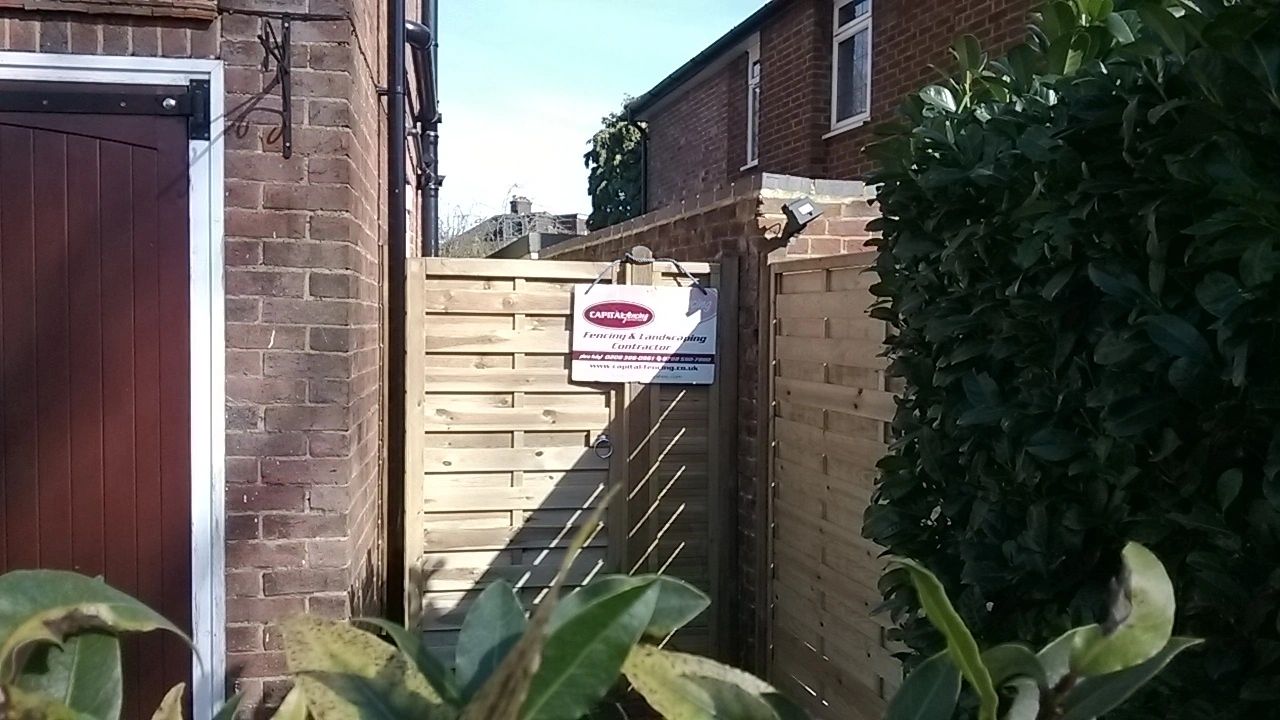
A key-alike cylinder set lets several gates on one property, such as a side gate and a bin store gate, be opened with a single key rather than a separate key for each, which is a common request on properties with multiple access points.
Specifying key-alike hardware needs to happen at the point of ordering the cylinders, since matching an existing single cylinder to a new one after installation isn't generally possible without replacing both.
Powder coating versus galvanising for steel security fencing
Hot-dip galvanising bonds a zinc layer to the steel that self-heals minor scratches through sacrificial corrosion, making it the more durable base finish for an exposed or coastal boundary.
Powder coating adds colour and a smoother surface but relies on the coating staying intact — galvanised-then-powder-coated steel combines both, giving corrosion protection under a decorative finish, and is the usual spec where appearance matters as much as longevity.
Boundary treatments for flats and maisonettes
Shared amenity gardens attached to flats or maisonettes usually have boundary decisions made collectively through a management company or freeholder rather than by an individual leaseholder, which changes who needs to sign off a fence or gate change.
Lease terms sometimes specify who's responsible for maintaining which boundary, and altering a shared boundary without checking the lease is a common source of dispute between leaseholders.
Where several flats share a single rear garden, dividing it with new fencing usually needs agreement from all affected leaseholders, not just the person requesting the work.
Front boundary choices and kerb appeal
A front boundary is one of the first things anyone sees of a property, and low-key choices — a consistent gate style, tidy capping, a colour that complements the brickwork — do more for kerb appeal than an expensive but mismatched material choice.
Open or low front boundaries tend to suit properties where the frontage itself is attractive and worth showing off, while a higher, more solid front boundary suits a busier road or a desire for more privacy from passers-by.
It's worth thinking about a front boundary as a long-term fixture rather than following short-lived trends, since it's one of the more visible and slower-to-replace elements of a property's exterior.
Standard fence panel heights and why they matter
Fence panels are typically supplied in fixed height increments — commonly around 0.9m, 1.2m, 1.5m and 1.8m — which is worth knowing when planning a boundary near the 2m permitted development limit, since a gravel board on top of a full-height panel can tip a run over that limit without anyone intending it to.
Odd plot heights, sloping ground or a specific privacy requirement sometimes mean a bespoke panel height is the only way to get an exact fit, which costs more than off-the-shelf stock but avoids an awkward final course.
It's worth measuring the total height including any gravel board and capping before ordering, rather than just the panel itself, to avoid a nasty surprise at the planning-limit boundary.
Timber sourcing and certification schemes
FSC and PEFC certification track timber back through the supply chain to a managed, legally-harvested source, and UK public sector specifications increasingly require one or the other for any structural or landscaping timber.
For a domestic fence this isn't a legal requirement, but certified stock gives a paper trail on sourcing that some clients specifically ask for, particularly on larger commercial or estate contracts where corporate sustainability policy applies.
Certification is about the chain of custody rather than the treatment or grade of the wood, so it sits alongside, not instead of, checking the timber is correctly treated for its intended use class.
Level changes revealed during a repair
Taking down a damaged section sometimes reveals that the ground level has changed since the original fence went up — through landscaping, subsidence or built-up paths — which affects how the replacement section should be set.
Where a level change is found, it's addressed as part of the repair rather than reinstating the fence at the original, now-inaccurate, ground line.
Why repaired sections sometimes weather differently
New timber fitted into an older run will weather at a different rate to the surrounding boards for the first year or two, simply because the existing timber has already taken its first few seasons of treatment and UV exposure.
This settles down over time and isn't a sign of a poor repair — we explain this at the point of quoting so it isn't a surprise later.
Setting corner posts before intermediate posts
Corner and end posts are normally set first and their positions checked and finalised before any intermediate post along the run, since every other post's position is measured relative to those fixed points.
Setting intermediate posts first and corners last risks a corner ending up slightly off the true line established by the string, which then means either accepting a visible kink or redoing intermediate posts to correct it.
This sequence matters even more on a run with two changes of direction, where getting one corner wrong compounds the error along the whole of the next leg.
Flats and maisonettes with communal gardens
Where a garden is communal to several flats, no single leaseholder normally has authority to alter the boundary fence unilaterally — that decision usually sits with the freeholder or a resident's management company under the lease.
Ground-floor maisonettes with an exclusive-use garden are a common exception, but the lease still often restricts fence height or style to protect the amenity of upper flats overlooking the space.
Any quote for work in a communal garden should confirm who is legally instructing the job and paying for it before work starts, since informal agreement from one resident isn't the same as management company sign-off.
Boundary ownership evidence and T-marks
A 'T' mark on a title plan, pointing inward from the boundary line towards a particular plot, is the traditional (though not universal) convention indicating that plot owns and is responsible for that boundary structure.
Where both sides of a boundary carry a T, or neither does, the deeds are silent and ownership defaults to whatever can be evidenced by other means — old photographs, the position of fence posts, or long-standing maintenance history.
T-marks aren't a legal guarantee and can be missing or wrong on older plans, so where a boundary is disputed it's worth treating the mark as a starting point for discussion rather than conclusive proof.
Sequencing a multi-day install
A typical multi-day fence installation runs old fence removal and waste clearance first, then post setting with time for concrete to go off, then panels, gravel boards and capping once posts are firm enough to take a load.
Rushing panels onto posts before the concrete has cured enough — particularly in cold weather when curing slows down — is a common cause of a fence leaning within its first few weeks.
On a longer run it often makes sense to work in sections so part of the boundary is never left fully open overnight, rather than removing the entire old fence before any new posts are in.
Retrofit access-control readiness (mechanical side)
A gate can be prepared mechanically for future electronic access control — solid enough hinges, a squared frame and a latch position that suits an electric strike or maglock — without the electrical and control side being fitted at the same time.
We handle this mechanical preparation and refer the electronic access-control installation itself to a specialist.
Preservative retention levels
Retention describes the quantity of preservative chemical actually held within the timber after treatment, usually expressed in kilograms per cubic metre, and is a more meaningful durability measure than the treatment process alone.
Higher retention is specified for higher-risk applications such as ground-contact posts than for above-ground rails, reflecting the greater and more sustained moisture exposure a buried timber faces.
Retention can only be verified by laboratory analysis of a sample core, so in practice specifiers rely on the treatment plant's use-class certification rather than visually inspecting the finished timber, since colour alone doesn't indicate how much preservative penetrated.
Pet-proofing a garden boundary
Dogs that dig will often go under a fence line rather than over it, so a gravel board or buried mesh apron at the base does more to keep a determined digger in than extra height above ground.
Gaps at gate thresholds and where a fence meets a wall or building are the most common escape points, and are worth checking specifically rather than assuming a continuous fence line is actually continuous at ground level.
Smaller or younger dogs and cats can fit through gaps that look too small to be a concern, so picket or trellis-style boundaries usually need a solid section or mesh backing if pet containment is the priority.
CDM regulations on domestic and commercial jobs
The Construction (Design and Management) Regulations 2015 apply to domestic projects as well as commercial ones, though on a domestic job the homeowner's CDM duties normally pass automatically to the contractor or principal contractor rather than sitting with the client directly.
On a commercial or public sector site, or a domestic job involving more than one contractor, formal duty-holder roles (principal designer, principal contractor) need to be identified and a construction phase plan put in place before work starts.
Even a straightforward domestic fencing job benefits from basic CDM thinking — safe access, checking for overhead cables or buried services, and clear site boundaries during the works — regardless of whether the formal paperwork threshold is met.
Decking substructure ventilation
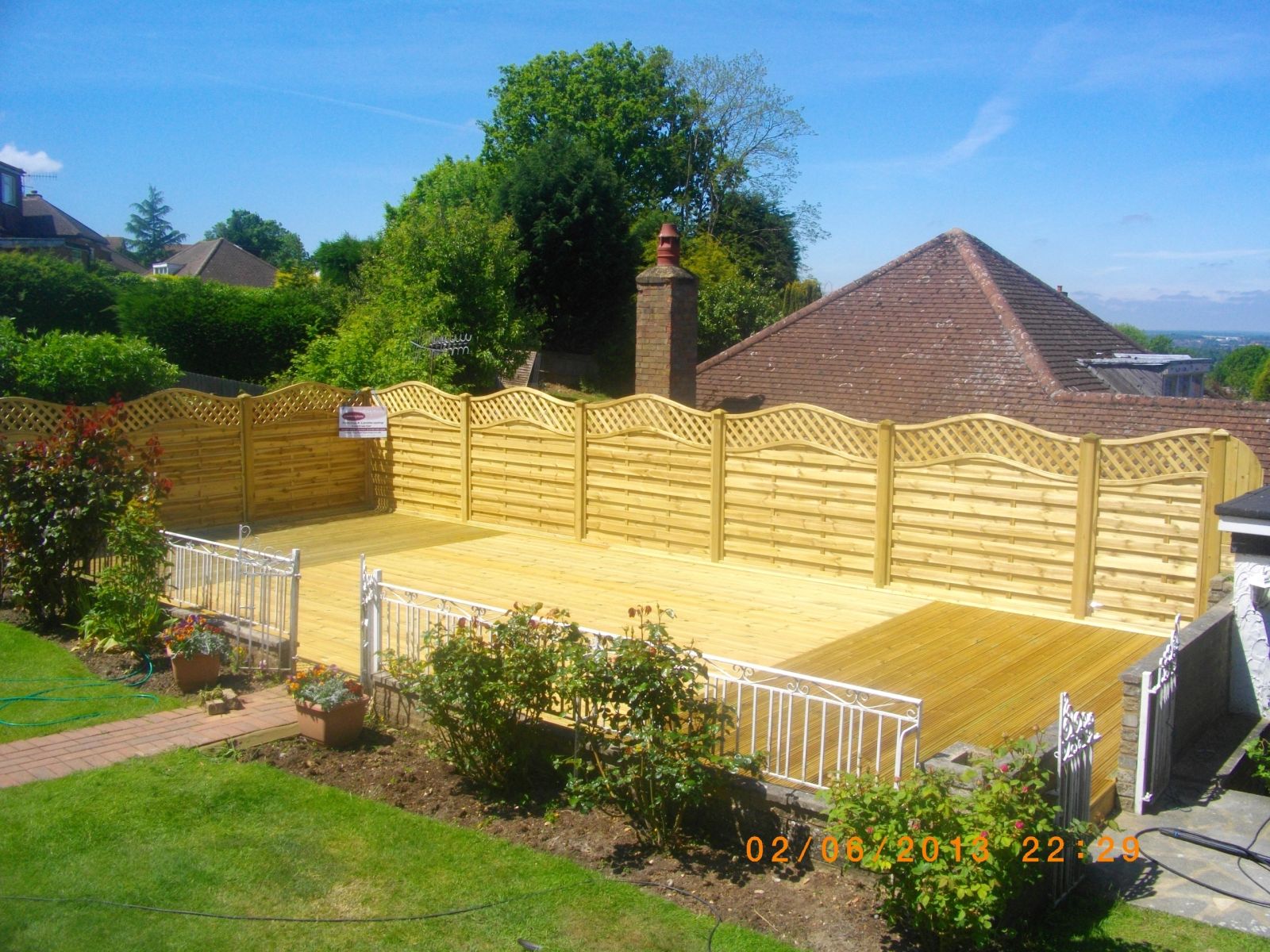
A decking substructure needs airflow underneath it to dry out after rain, which is why ground-level decks are built with a ventilation gap rather than sitting directly on solid paving or soil, and why skirting the underside solid on all sides is a common cause of premature substructure rot.
Low decks close to the ground are the highest risk, since there's little room for cross-ventilation, and some ground preparation — a weed membrane and gravel bed rather than bare soil — helps keep humidity down in that void.
Composite deck boards themselves tolerate damp better than timber, but a timber joist substructure underneath a composite deck still needs the same ventilation and ground clearance as it would under timber boards.
Tree roots and root protection areas
A tree's root protection area is calculated from its stem diameter and generally extends well beyond the canopy spread, meaning a fence line can fall inside it even where the tree itself looks distant.
Excavation within a root protection area should avoid cutting roots over around 25mm diameter where possible, using hand tools and routing the post line slightly off-square if that avoids a structural root.
For a fence contractor this usually means agreeing a no-dig or reduced-depth post solution on the affected section rather than a standard auger run across the whole boundary.
Gravel board material choices
A gravel board sits at the base of a panel fence to keep the panel itself clear of ground moisture and splashback, and is commonly available in treated timber, concrete or composite, each with different durability trade-offs at that most exposed position.
Timber gravel boards are the cheapest to replace individually but also the first component to rot, since they sit closest to damp ground and soil splash, while concrete gravel boards resist rot entirely but can crack under impact or ground movement.
Composite gravel boards split the difference, resisting moisture better than timber without concrete's brittleness, though they typically cost more than either alternative for the same length.
Slamming post and gate stops
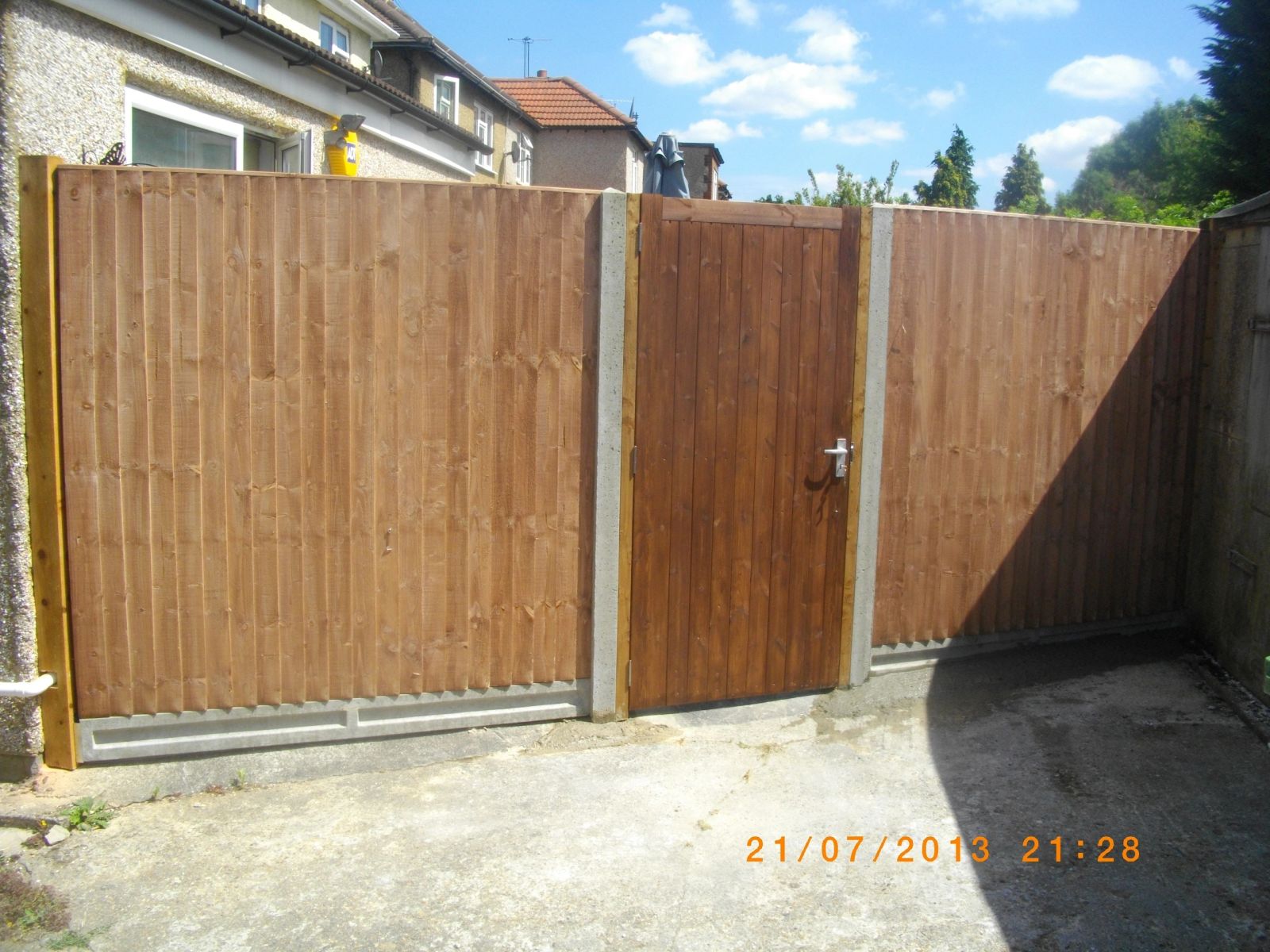
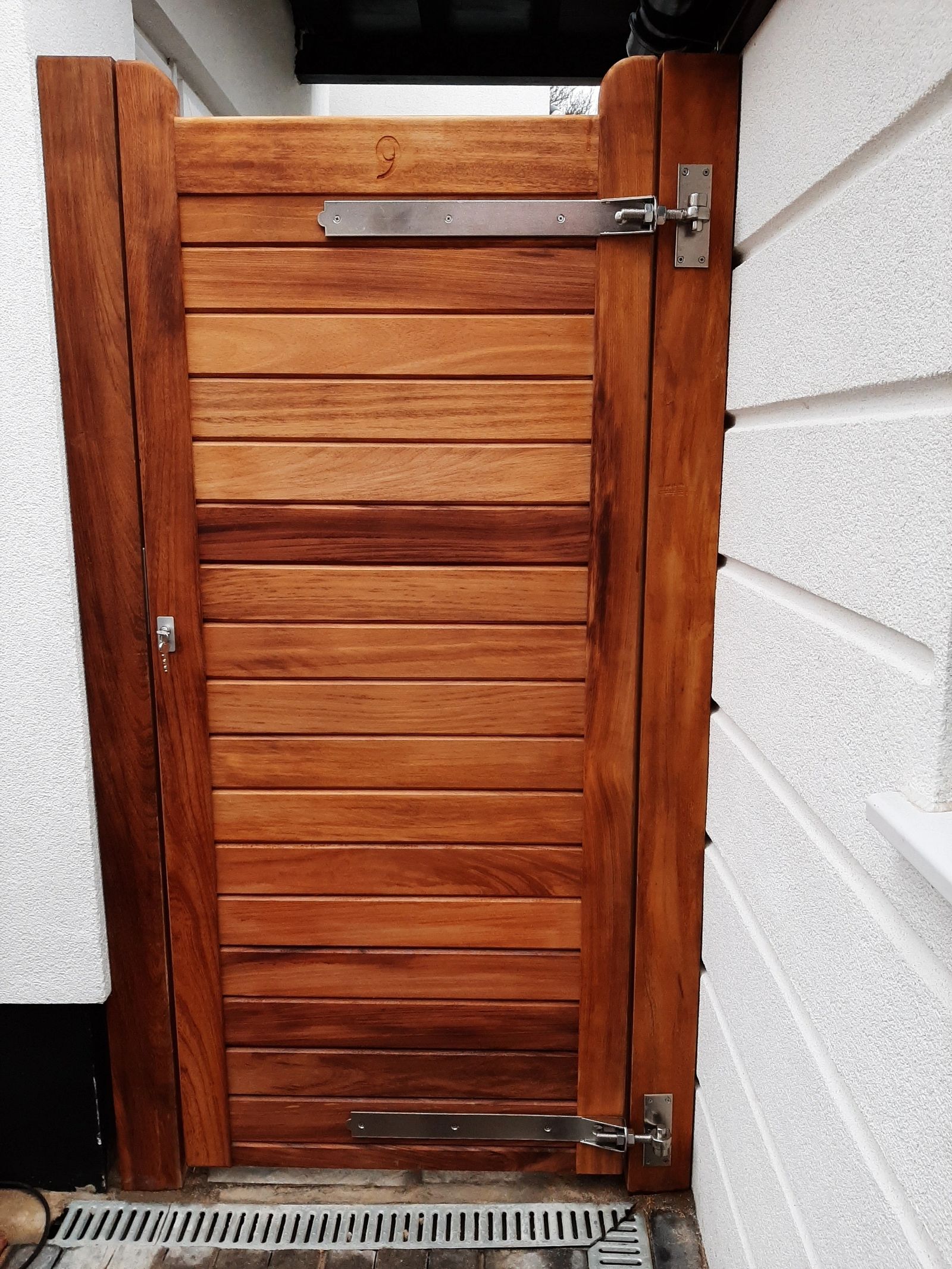
The slamming post on the latch side takes a repeated impact load every time the gate closes, and a stop fitted to it prevents the gate over-swinging past its closed position and straining the hinges on the return.
A missing or worn stop is a common, low-cost cause of a gate that gradually racks out of square from repeated over-travel.
Reinstating turf strips damaged by tool storage
A pile of tools, offcuts or a mixing tray left in one spot on a lawn for several days can leave a yellowed, compacted patch even after the job is finished and everything is cleared away.
Moving stored items to a slightly different spot every day or two, where the site allows, spreads that pressure rather than concentrating it in a single dead patch that then needs separate attention to recover.
Where a genuinely fixed storage point is unavoidable, laying a board or matting underneath from the start protects the grass far more effectively than trying to revive a flattened patch afterwards.