Resetting versus replacing a post
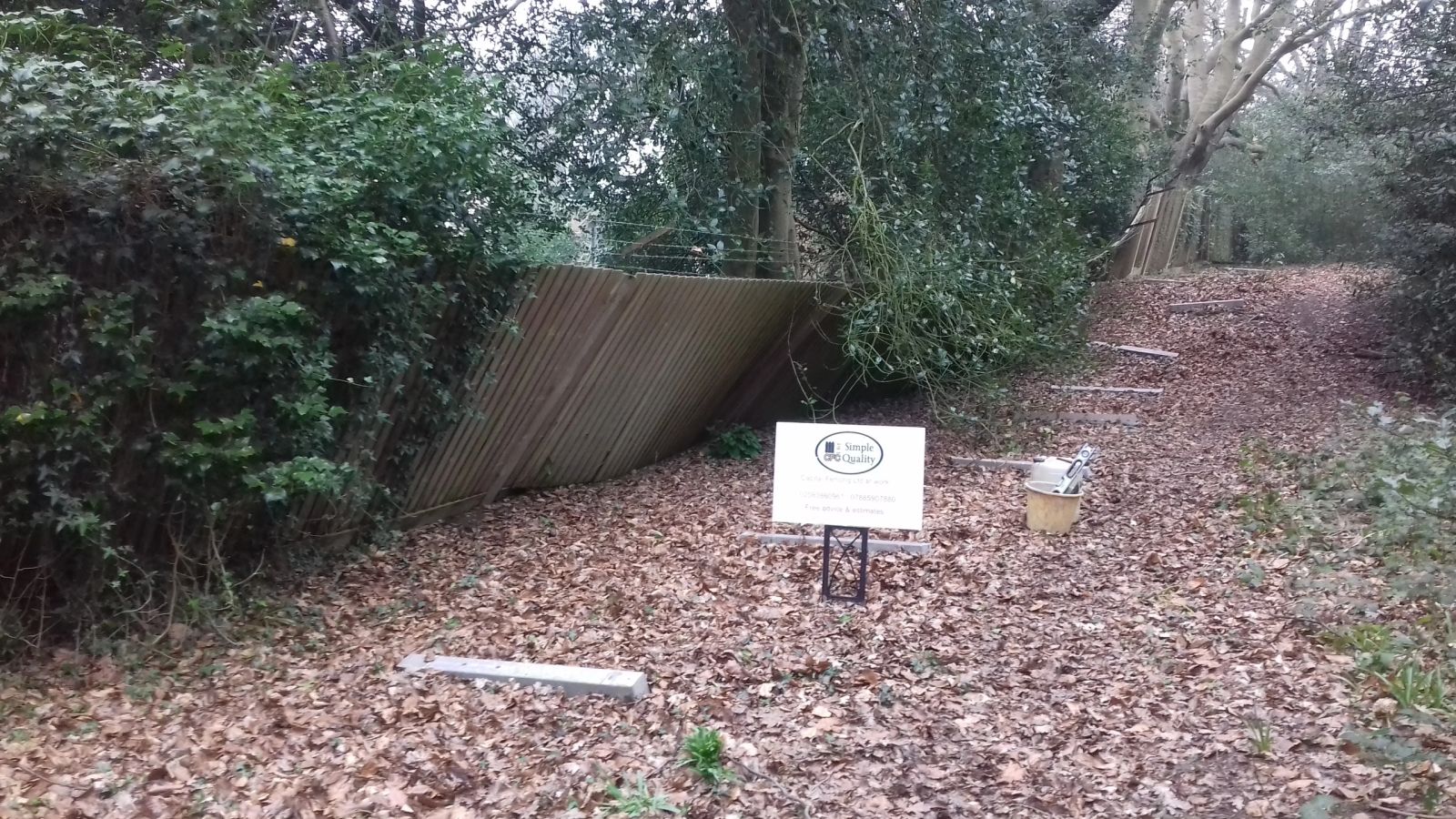
A post repair is either a reset in fresh concrete where the timber itself is sound, a concrete spur bolted above a rotten section where enough good timber remains, or a full replacement where rot has reached the panel fixings.
We test each post on site with a probe at ground level rather than deciding from a visual check alone, since a post can look fine above ground and be rotten just below it.
Feather-edge versus overlap panel construction
Feather-edge fencing uses individual tapered boards nailed vertically to horizontal arris rails, built up on site board by board, which makes it easier to repair a single damaged board without disturbing the rest of the run.
Pre-made overlap or lap panels are faster to install since they arrive as a complete unit, but a single split board usually means replacing the whole panel rather than one board.
Feather-edge also tends to be the sturdier choice on an exposed or long run, since the individual boards and rail structure resist wind loading better than a thinner factory panel.
Composite versus timber
Composite decking and fencing boards trade a higher upfront cost for lower ongoing maintenance — no annual staining or oiling, and better resistance to rot in permanently damp or shaded spots where timber struggles.
The trade-off is that composite doesn't weather the way timber does; it stays close to its original colour rather than silvering or taking on the character some clients want, and off-cuts and end sections need cutting and capping carefully to stop moisture getting into the core.
For a boundary fence that's mostly out of sight, timber with a reapplied treatment every few years is often the more economical long-term choice; for a heavily-used deck, composite's lower maintenance burden usually wins out.
A boundary at the bottom of a slope
A fence line at the foot of a slope collects both surface run-off and, on clay, a slower seepage of water moving through the ground itself, so the ground here is often wetter and softer than the rest of the plot.
Post bases in this position benefit from a raised free-draining collar rather than concrete flush with the surrounding grade, keeping standing water away from the timber-to-concrete joint.
It's also worth checking whether the fence itself is inadvertently damming water that would otherwise continue draining downhill off the plot entirely.
Balustrade requirements on raised decking
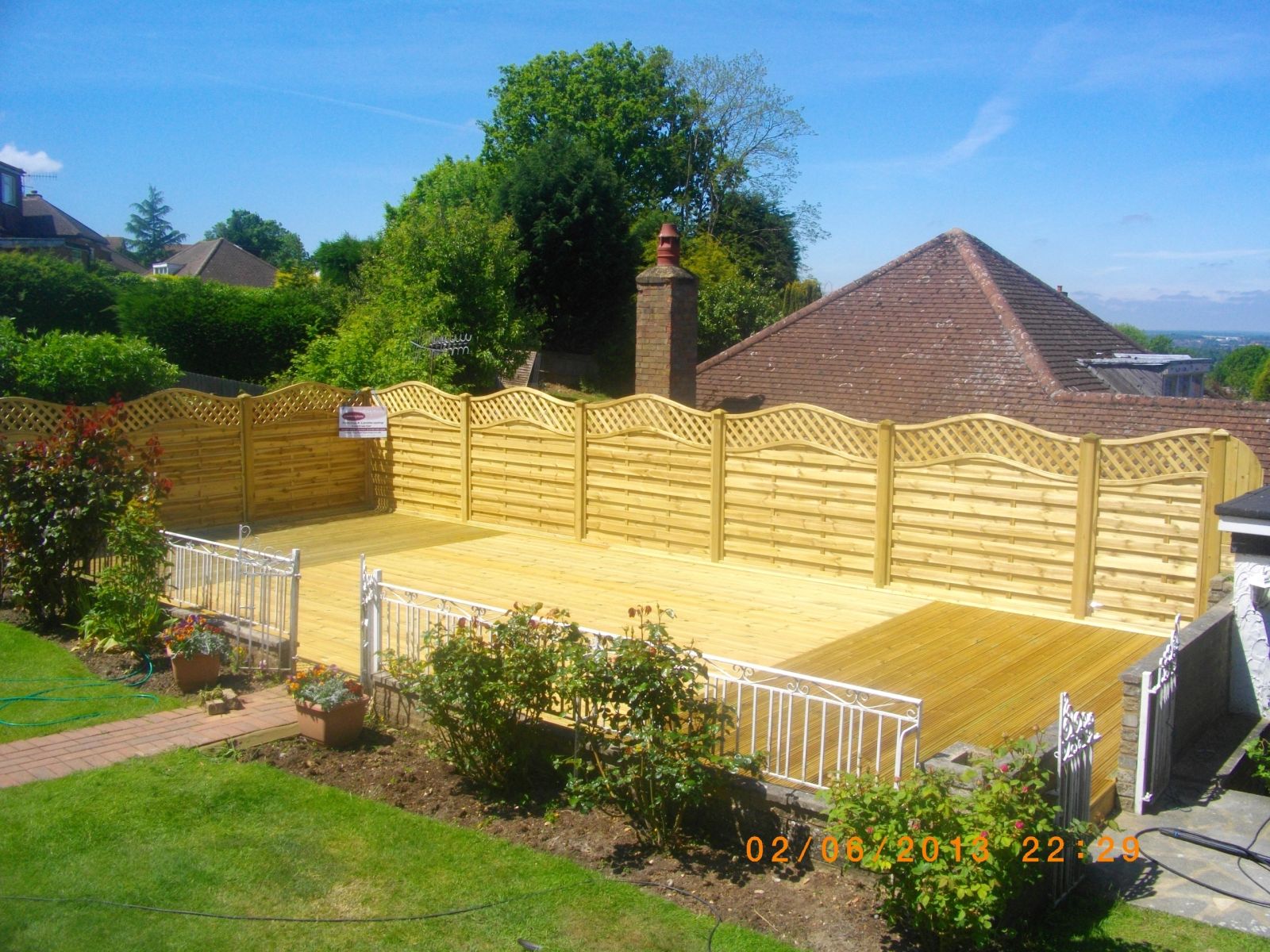
Building regulations generally expect a guarding balustrade wherever a raised deck has a drop of around 600mm or more, with a minimum height (typically around 900mm-1100mm depending on the situation) and gaps small enough that a 100mm sphere can't pass through.
That gap rule is specifically there to stop a small child getting a head or limb through the balustrade, so wide-slat contemporary balustrade designs need checking against it just as carefully as traditional close-spaced spindles.
A deck under that drop threshold doesn't need a balustrade by regulation, but a low kerb or edge trim is still worth considering as a visual cue to the edge, particularly at night.
Why repaired sections sometimes weather differently
New timber fitted into an older run will weather at a different rate to the surrounding boards for the first year or two, simply because the existing timber has already taken its first few seasons of treatment and UV exposure.
This settles down over time and isn't a sign of a poor repair — we explain this at the point of quoting so it isn't a surprise later.
Vehicle and impact loading on perimeter fencing
A boundary next to a car park, loading bay or farm track needs posts and panels sized for accidental impact loading, not just wind and climbing loads, because a reversing vehicle applies a very different force to the same run.
Where impact is a realistic risk, a kerb, bollard or heavier-gauge post is used to take the hit rather than relying on the fence panel itself to absorb it.
Raised beds built directly against a fence
A raised planting bed built with its back edge against a fence line keeps damp soil and mulch in permanent contact with the lowest boards or gravel board, which accelerates rot at exactly the point most vulnerable to moisture.
Lining the inside face of the bed against the fence with a damp-proof membrane, rather than backfilling soil directly onto the timber, reduces this contact without changing the visible design.
This detail is easy to miss at the planning stage since the bed and the fence are often specified and built by different trades without either flagging the interaction.
Painted versus stained finish maintenance
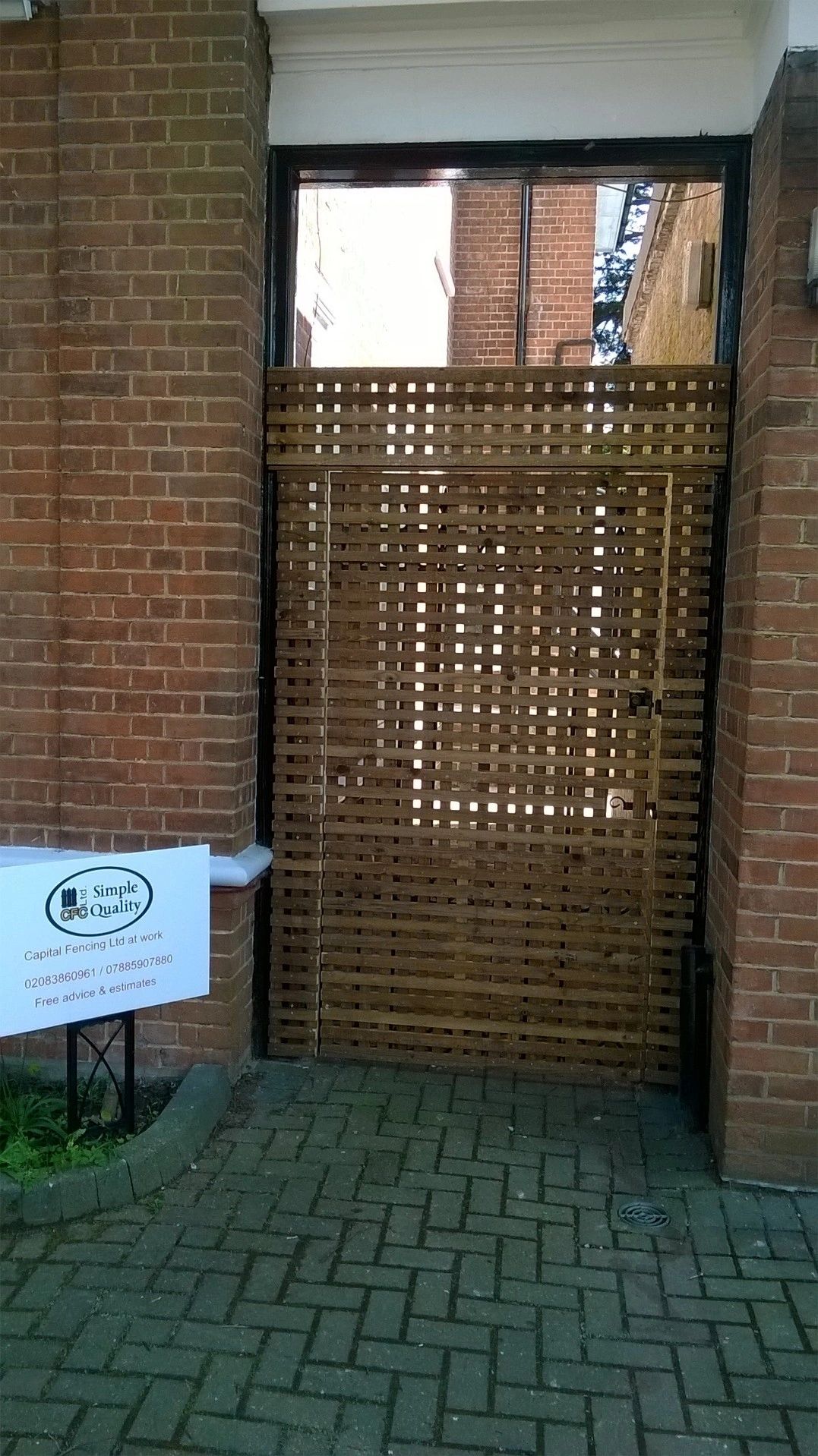
A painted gate hides the timber grain and needs a full film to stay intact, so any crack or chip in that film lets water in behind the coating and can accelerate local rot if left unaddressed.
A stained or oiled finish penetrates the timber rather than sitting as a film, so it wears more evenly and is easier to top up in patches without a full strip-back.
School and nursery boundary needs
Boundaries around schools, nurseries and other settings used by children are usually specified with child safety in mind first — no horizontal rails that could be used to climb, gaps too narrow to trap a small limb, and self-closing gates with child-safe latches on any pedestrian access.
Height matters both for containment and sightlines: too high and staff lose visibility into a play area from a building; too low and it's not a meaningful boundary at all.
Any work on an occupied site with children present also has practical scheduling implications — most of this work happens outside term time or during holiday closures to avoid disruption.
Locating buried services before digging
Before any post hole goes in near a driveway, front boundary or previously-disturbed ground, a cable and pipe locator (CAT and Genny) sweep is standard practice, since gas, water, electricity and telecoms runs aren't always where a plan suggests.
Rear gardens are lower risk but not risk-free — older properties sometimes have redundant supply runs or septic/drainage pipework crossing the plot from a pre-mains era.
Where a locator flags a hit, hand-digging around the service rather than augering through is the only safe approach, even if it adds time to the job.
Tamper-evident caps over external fixing bolts
A plastic or metal tamper-evident cap fitted over an external bolt head shows visible signs of damage if someone has attempted to remove it, giving a maintenance team an early visual signal that a section of fence has been interfered with even where nothing has actually come loose.
This is a low-cost addition on a run where fixings are otherwise exposed, and it's most useful on a boundary that isn't checked in person every day, where interference could otherwise go unnoticed for some time.
Earthing and bonding requirements for a substation compound fence
A metal fence around an electrical substation compound needs to be correctly bonded to the site's earthing system, since an ungrounded metal fence near live electrical equipment can become dangerously energised under fault conditions.
Bonding work at a substation compound is carried out to the network operator's own specification rather than a general fencing standard, and a fencing contractor working on this type of site coordinates closely with the operator's engineers on sequencing and isolation.
Choosing rail section size for a security run
Rails on a palisade or railing run are sized in cross-section to the span between posts, not to the pale height alone, because a rail that's too slender for its span will visibly deflect under a leaning or pushing load.
A heavier box-section or channel rail is specified on wider bays or taller runs, and increasing bay width to save on posts only works if the rail section is upsized to match the extra span.
Post cap material and function
A post cap's primary function is shedding rainwater away from the post's end grain, which is the most absorbent and vulnerable part of a timber post, rather than being purely decorative.
A pyramid or bevelled profile sheds water faster than a flat cap, reducing the time water sits pooled on the timber surface after rain, which matters more on a flat-topped post than people often assume.
Metal, plastic and timber caps all achieve the same water-shedding function to varying degrees, but a cracked or ill-fitting cap that lets water track down between the cap and the post can trap moisture worse than no cap at all.
Land registered as a town or village green
Land formally registered as a town or village green carries strong legal protection against enclosure or obstruction, including from fencing, under the Commons Act 2006.
This status can sometimes apply to open spaces that don't look obviously like a traditional village green, following a successful community application to register them.
Checking the relevant register before fencing land bordering an open green space avoids inadvertently obstructing protected land.
Secure by Design principles for boundaries
Secure by Design is a police-backed set of principles covering layout, lighting, sightlines and boundary treatment that developments are assessed against, and fencing specification is one part of meeting it.
Applying the principles generally means avoiding blind corners, keeping sightlines open where surveillance matters, and using proportionate rather than maximum height and solidity on each boundary.
Rising damp at the gravel board
A timber gravel board sitting flush against damp soil draws moisture upward by capillary action in the same way a wall can suffer rising damp, and it is usually the first component to fail on an otherwise sound fence.
Concrete gravel boards avoid this entirely and are now the standard base for that reason, but where timber boards are kept for appearance, setting them a few millimetres proud of finished ground level makes a real difference.
Backfilling right up against a timber board with topsoil or mulch defeats the point, since it holds moisture directly against the face that most needs to stay dry.
Rotating spike toppings as a climb deterrent
A rotating spike topping uses a free-spinning tube studded with blunt spikes along the top of a wall or fence, so that a hand or foot pressing down on it spins rather than gripping, which defeats a climbing attempt without the injury risk of a fixed razor product.
It's most often fitted to a boundary wall in a residential or light-commercial setting where a coil topping would look too industrial, and it needs periodic checking that the rotating mechanism hasn't seized with paint overspray or corrosion.
Digging out a post hole obstructed by established roots
A footing being reopened for repair sometimes has tree or shrub roots grown through or around it since the original installation, and cutting through a substantial root without checking what it belongs to risks damaging a protected tree or destabilising nearby planting.
Where roots are minor, careful digging around rather than through them lets the post go back in the same position; where a significant root has effectively taken over the footing, repositioning the post slightly is often the more practical repair.
Conservation area material rules
Inside a conservation area, the council can restrict fence height, colour and material even within otherwise-permitted development limits, usually through an Article 4 direction that removes some of the usual PD rights.
The common ask is close-boarded or picket timber in a natural or traditionally painted finish rather than modern composite or bright stains, particularly on frontages visible from the street.
For a listed building itself, or land within its curtilage, listed building consent can apply even to a garden fence, so it's worth a call to the conservation officer before committing to a spec.
Tree root damage to a shared boundary structure
Where a neighbour's tree roots have visibly damaged a shared boundary wall or fence footing, resolving responsibility for repair can depend on tree ownership, the nature of any easement, and whether prior warning was given about root damage.
This is a fact-specific question rather than one with a single automatic answer, and can occasionally end up needing legal advice where the cost of repair is significant.
Documenting the damage with photographs and dates as it develops is useful evidence regardless of which direction a later conversation about responsibility takes.