Fallen branch impact damage
A falling branch typically damages a localised section — one or two panels and sometimes the post beneath the point of impact — rather than the whole run, so repair can usually be confined to the affected bay.
The bays either side are still worth checking, since the same impact can rack a neighbouring post even where the panel there shows no visible damage.
Clearing debris from a sliding gate track
Leaves, gravel and windblown litter collect in a ground-level sliding gate track over time, and a build-up is one of the most common reasons a gate that used to run smoothly starts binding or stalling partway along its travel.
Regular clearing of the track, particularly after autumn leaf fall or after a period of wind, prevents debris from being repeatedly crushed into the track and becoming harder to remove.
Material delivery constraints on restricted-access sites
A property reached only by a narrow alley, a flight of steps, or a shared passage without vehicle access changes how gate materials are delivered and handled, since a full-size gate leaf, a bag of postmix or a length of steel box section may need carrying in by hand over some distance.
This constraint is worth identifying before materials are ordered, since it can affect what size or weight of gate is practical to specify for that particular access route.
Wheels and rollers on old sliding gates
Wheels on an older sliding gate wear unevenly over years of use, and a gate that starts to lean or drag to one side as it slides is often down to worn wheels rather than a bent frame.
Replacing worn wheel or roller assemblies is usually straightforward provided the track or guide rail underneath is still true.
Hedgerow removal and nesting-bird season
Removing or cutting back a hedge to install a new boundary fence is generally best avoided between March and August, the main bird nesting season, since disturbing an active nest is an offence under the Wildlife and Countryside Act regardless of intent.
Some countryside and agricultural hedgerows are also protected under the Hedgerow Regulations, which can require notifying the local authority before removal even outside a garden setting.
A pre-work check of the hedge for active nests, and scheduling removal for autumn or winter where the timeline allows, avoids both the legal risk and the delay of having to stop mid-job.
Ventilation requirements under a deck
A low-level deck with boxed-in sides and no airflow underneath traps moisture against the joists and the underside of the boards, which is one of the most common causes of premature timber rot on an otherwise well-built deck.
Leaving gaps in the skirting, or fitting purpose-made ventilation grilles, allows air to circulate beneath the structure and lets the timber dry out between wet periods rather than staying permanently damp.
Decks built very close to ground level with minimal void beneath them are particularly at risk and sometimes need a raised design specifically to allow enough clearance for airflow.
Water ingress at the bottom rail
The bottom rail of a gate sits closest to splash-back from the ground and holds moisture longer than any other part of the frame, making it the most common place for rot to start on an otherwise sound gate.
Where a repair addresses bottom-rail rot, raising ground clearance slightly or improving drainage underneath is worth doing at the same time to slow the same failure recurring.
Aligning hinges before final gate fixing
Hinges fixed slightly out of vertical alignment with each other make a gate bind or swing shut under its own weight rather than staying wherever it's left, even if each hinge individually looks correctly fitted.
Propping the gate at the intended finished height and checking the gap is even top and bottom before final fixing catches most alignment problems while they're still easy to adjust.
Loosely fitting the top hinge first, checking swing and clearance, and only then fully fixing both hinges is a more forgiving sequence than fully fixing both at once and finding the gate doesn't swing cleanly.
Stainless fixings near a road
Fixings on a gate close to a public road pick up more airborne grit, salt spray in winter and general moisture than one set back in a garden, which accelerates corrosion on standard galvanised screws and bolts.
Stainless steel fixings cost more but resist this environment noticeably better, and are worth specifying on any roadside gate repair.
Waste carrier duty of care for site waste
Anyone removing fencing, decking or building waste from a client's property in the course of business needs to be a registered waste carrier with the Environment Agency, and should be able to provide a waste transfer note showing where the material was taken.
Treated timber, in particular, is classed differently to plain untreated offcuts and generally can't simply go on a bonfire or into general household waste, since some older preservatives fall under hazardous waste rules.
Asking a contractor for their waste carrier registration number and a transfer note isn't excessive caution — the householder can be liable if waste is later found fly-tipped and traced back to the job.
Waste carrier duty of care for old fencing
Under the Environmental Protection Act 1990, anyone arranging removal of construction waste such as old fence panels and posts has a 'duty of care' to ensure it's handled by a registered waste carrier.
Asking to see a waste carrier's registration number, and requesting a waste transfer note for larger quantities, is a reasonable and legitimate request rather than an unusual one.
Householders can be held responsible if waste from their property is later found fly-tipped, even where they paid someone else to take it away, which is why checking credentials matters.
Deck height relative to the house damp-proof course
Building guidance generally recommends decking be kept at least 150mm below the house's damp-proof course, since a deck built level with or above the DPC risks bridging it and allowing damp to track into the house wall.
This is a common issue on a sloping plot where the natural ground level near the house is already close to the DPC, leaving very little room to build a deck without breaching that clearance.
Where the clearance genuinely can't be achieved without lowering the deck excessively, a drained gap or a change in construction detail near the house wall is a better solution than ignoring the clearance altogether.
Allotments and community gardens
Allotment sites are typically let by the local authority or an allotment association under a tenancy agreement that sets rules on plot boundary fencing, often restricting height and material to keep sightlines open across the site.
Individual plot fencing usually needs to stop short of shared paths and communal water points, and materials have to be carried in by hand or barrow since most allotment sites don't allow vehicle access beyond a car park at the entrance.
Community garden boundaries also often need a design that keeps the plot secure from casual access out of hours while remaining welcoming during open sessions, which is a different brief from a private garden fence.
Lichen colonising capping and post tops
Lichen tends to establish on horizontal or gently sloped timber surfaces that stay damp longest, which makes flat-topped capping and post caps more susceptible than the vertical panel faces below them.
Unlike algae, lichen grows slowly and bonds tightly to the timber surface, so a stiff brush rather than a pressure washer is usually needed to remove it without damaging the wood fibres underneath.
Once removed, a capping profile with a fall to shed water reduces how quickly lichen re-establishes compared with a flat top that holds a film of moisture after every rain.
Security lighting and cameras near a shared boundary
Security lighting or CCTV cameras fitted to a boundary fence can raise both nuisance and, for cameras capturing a neighbour's property, data protection considerations under UK GDPR if used inappropriately.
Positioning cameras to minimise capturing a neighbour's garden or windows, and using shielded lighting that doesn't spill excessively onto adjoining land, generally avoids most disputes before they start.
Where a neighbour raises a specific concern about a camera or light on a shared boundary, addressing it directly is usually simpler than waiting for a formal complaint to the council or Information Commissioner's Office.
Trellis toppers for extra height and privacy
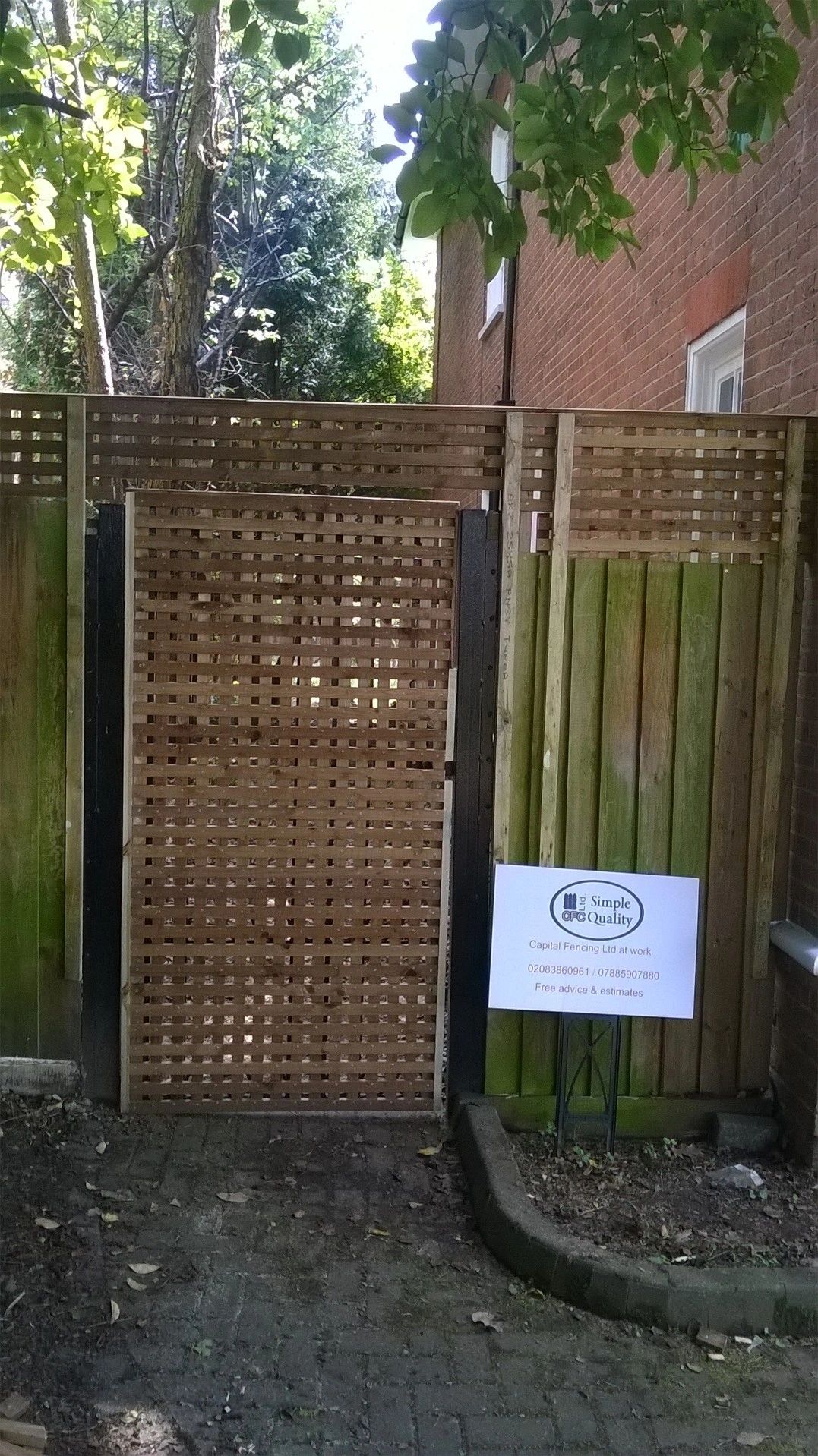
Adding a trellis topper to an existing or new fence is a common way to gain extra height for climbing plants or additional privacy without exceeding permitted development limits for a solid boundary.
Because trellis is inherently more open than solid panel, it doesn't usually count the same way toward the 2m height rule in every case, but it's still worth checking with the local authority since interpretations vary.
A trellis topper needs its own bracing where it's more than a token height, since a tall panel of trellis catching wind behaves more like a sail than most people expect.
Gate hinge material and load ratings
Gate hinges are rated by the load they can bear without excessive wear or sag, and that rating depends on the hinge's material, its pin diameter and the bearing surface area between the moving parts.
A heavy timber gate on a lightweight hinge designed for a garden gate will wear the pin and bushing far faster than the same hinge on a lighter gate, eventually developing a visible droop at the latch side.
Stainless steel or greased bronze bushings resist wear better than plain steel-on-steel hinges, particularly on gates opened frequently, where repeated friction is the main driver of hinge wear rather than corrosion.
Acoustic fencing near busy roads or railways
Taller acoustic fencing intended to reduce traffic or railway noise is still subject to the same general permitted development height limits as any other boundary structure, unless it forms part of a formally consented scheme.
Some acoustic fencing along significant infrastructure is installed by the highway or rail authority itself under separate statutory powers, which is different from a homeowner adding their own noise barrier.
A homeowner wanting extra height for noise reasons alone would generally still need to apply for planning permission above the normal limit, the same as for any other reason.
Repairing a fence near a tree protected by a Tree Preservation Order
Digging a new post hole or footing close to a protected tree's root zone can be restricted even where the fence itself needs no permission, since the restriction is about protecting the tree's roots rather than the fence.
Where root heave from a nearby tree has caused the damage being repaired, it's worth checking whether the tree is protected before digging anywhere near it, since hand-digging around roots or repositioning the post slightly may be required instead of a standard footing.
Measuring height from natural ground level
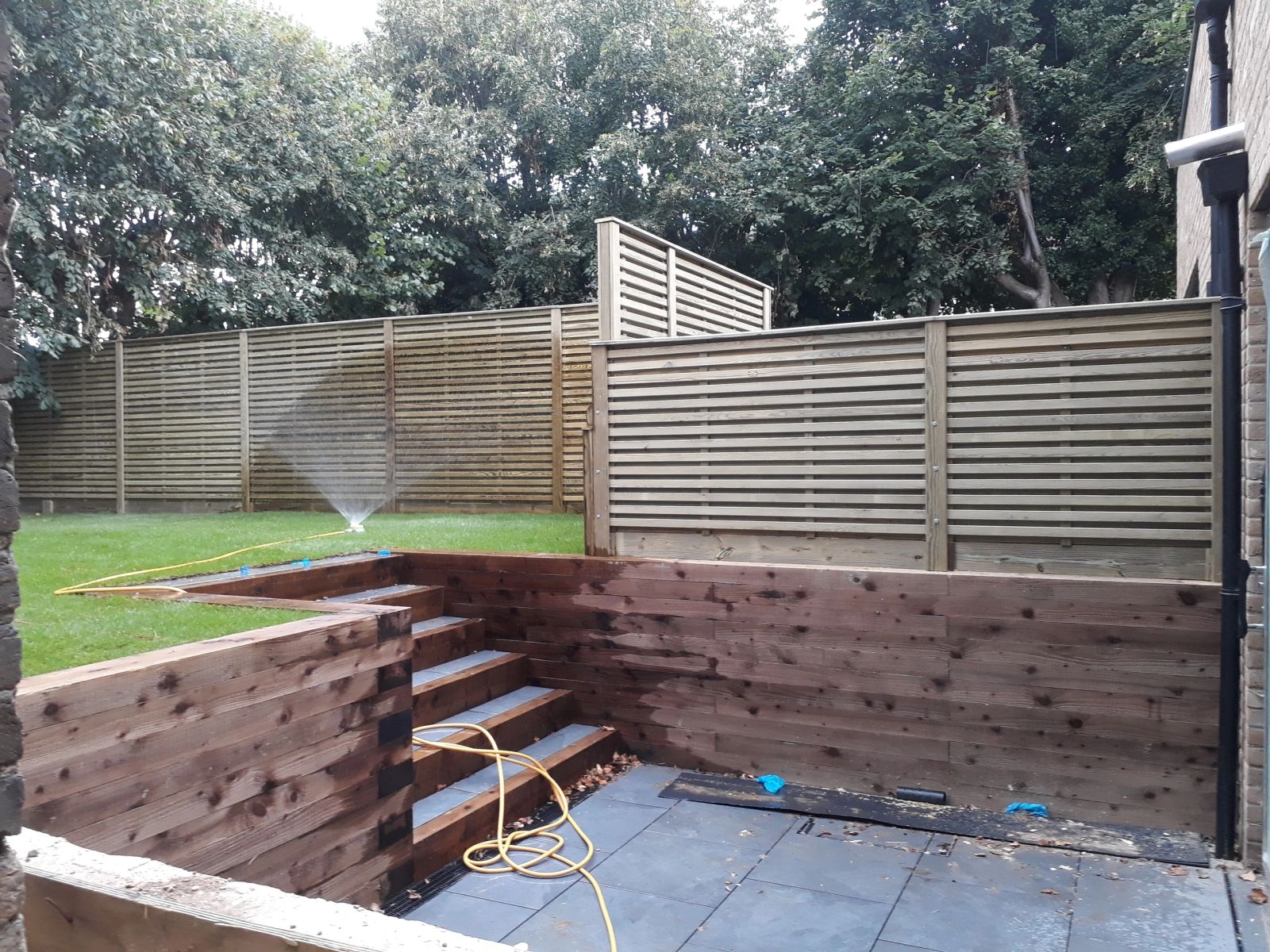
Permitted development height limits are measured from the natural ground level on the lower side of the boundary, not from any raised bed, deck or hardstanding that's been added since, which matters wherever one side of a plot has been built up.
On a level change between neighbouring gardens, the higher ground effectively gives that side a taller fence relative to the lower garden even though the fence itself is a uniform height along its top rail.
Councils measuring a disputed fence will normally use the original survey level or historic photos where the ground has since been altered, so changing levels doesn't retrospectively legalise an over-height fence.
Tangential shrinkage and cupping
Wood shrinks more in the direction that runs tangentially to the growth rings than along the grain's length, and boards cut close to the outer edge of a log (flat-sawn) show this most, curling into a dish shape known as cupping as they dry.
A board with growth rings running roughly parallel to its face is far more prone to cupping than one cut through the centre of the log, where rings run closer to perpendicular to the face.
Fixing boards with two nails or screws per bearer rather than one resists cupping better, since a single central fixing lets the edges lift and curl relatively freely.
Packing a hinge to correct drop
Where a gate has dropped only slightly and the frame itself is still square, packing out the top hinge or shimming the bottom one can correct the swing without remaking any joints.
This is a quick adjustment rather than a permanent fix if the underlying cause is a loose fixing, so we still check why the drop happened before packing alone is used as the solution.