Checking a drop bolt for bend before replacement
A drop bolt that no longer locates in its ground socket is often bent slightly from repeated contact rather than broken, and a bent bolt can sometimes be straightened rather than replaced if the bend is caught early.
Leaving a bent bolt in use accelerates wear on the socket edges as it forces its way in at an angle each time, which turns a simple bolt problem into a socket replacement too.
A boundary between residential and mixed-use premises
A boundary between a residential garden and a mixed-use building — flats over a commercial unit, for example — often needs to address noise from several different sources at once, such as deliveries, extraction and general trading activity.
Identifying which of those sources is actually dominant, rather than designing a barrier to a generic worst case, avoids over-specifying for a source that's actually a minor contributor to the overall disturbance.
Safety edges and force limits on automated gates
Automated gates are expected to operate within recognised safety standards covering force limits and trapping-point protection, generally addressed through pressure-sensitive edges, photocells or a torque-limited motor rather than relying on the gate design alone.
This is specialist automation-engineer territory; on the gate itself, we make sure there are no obvious additional trapping points created by the leaf design before automation is fitted.
Level differences between plots and who retains
Where two plots sit at different levels, the general presumption in law is that whoever created the level difference — usually by cutting or raising ground during earlier development — is responsible for retaining it, though on old or unclear plots this isn't always documented.
A fence contractor isn't in a position to resolve a retaining dispute, but should flag it clearly where a proposed fence line runs directly along or above an unretained level change, since a fence is not a retaining structure and shouldn't be asked to do that job.
Getting this distinction agreed in writing between neighbours before work starts avoids the fence being blamed later for a ground movement problem it never caused.
A boundary at the bottom of a slope
A fence line at the foot of a slope collects both surface run-off and, on clay, a slower seepage of water moving through the ground itself, so the ground here is often wetter and softer than the rest of the plot.
Post bases in this position benefit from a raised free-draining collar rather than concrete flush with the surrounding grade, keeping standing water away from the timber-to-concrete joint.
It's also worth checking whether the fence itself is inadvertently damming water that would otherwise continue draining downhill off the plot entirely.
Addressing a retaining sleeper wall that has started to bulge
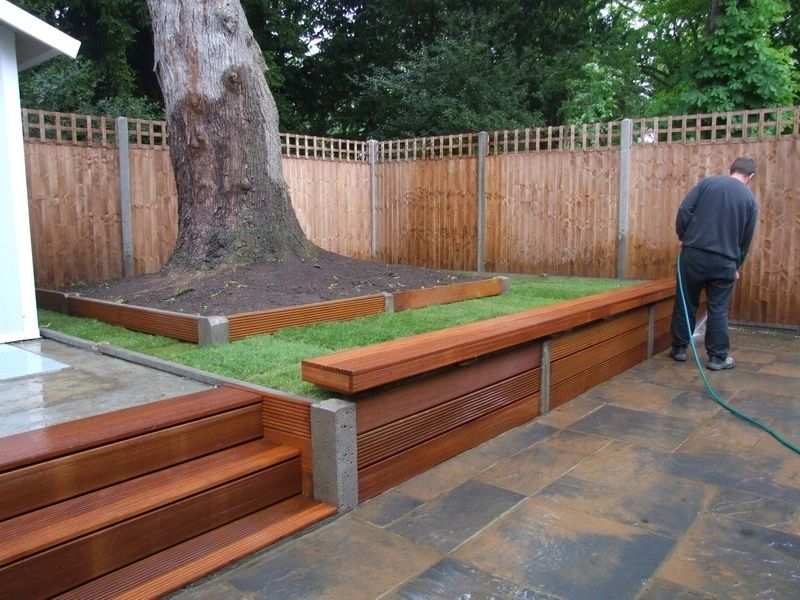
A timber sleeper retaining wall bulges where the soil behind it has built up more pressure than the wall's bracing or embedded posts were designed to hold, often after prolonged rain has saturated the retained ground.
A wall bulging only slightly can sometimes be reinforced with additional bracing posts driven in behind it, but a wall bulging enough that sleepers have visibly separated at their joints usually needs partial or full rebuilding with proper drainage behind it.
Access hatches in a screened enclosure
An acoustic enclosure built around fixed plant needs a hatch or removable panel sized for routine servicing access, positioned so it can be reached without dismantling the whole structure.
The hatch itself is a potential gap in the acoustic seal, so it's detailed with an overlapping edge or gasket rather than left as a simple butt-fitted panel.
Movement joints in timber cladding
Timber cladding boards fixed edge to edge without any allowance for seasonal expansion can buckle or split as the boards swell in wet weather and have nowhere to expand into.
A small gap left between board ends, or a slightly loose fixing pattern that allows a board to expand slightly within its fixing slots, accommodates this movement without transferring stress into the board itself.
The required gap varies by species and board width, since wider boards and more moisture-reactive species move more in absolute terms than narrow boards of a stable species for the same change in humidity.
Low-frequency limits of a fence barrier
Low-frequency noise, such as heavy diesel engine rumble or bass from nearby plant, is inherently harder for any fence-height barrier to reduce than higher-frequency noise, because long sound wavelengths diffract over a barrier more readily.
We're upfront that a fence will typically do more for the higher-frequency content of traffic noise than for a low, droning hum, since that's a limitation of physics rather than of the build quality.
Roller bearing lubrication schedules
Sliding gate rollers with sealed bearings need far less frequent attention than an open bearing type, but neither should be left ungreased indefinitely, since grit working into a bearing accelerates wear regardless of the seal.
A roller that's started to squeal or feels rough when turned by hand has usually already lost some grease or picked up grit, and catching this before the bearing fails outright is cheaper than a full roller replacement.
Pressure treatment and incising
Pressure treatment (vacuum-pressure impregnation) forces preservative into the timber under pressure rather than just coating the surface, which is why treated softwood outperforms a surface-brushed equivalent even though both can look similar when new.
Denser softwoods such as redwood resist deep penetration, so posts and other high-risk sections are often incised first — small slits cut into the surface — to let preservative reach further into the timber than it otherwise would.
Incising leaves a visible pattern of shallow cuts on the timber face, which is a normal sign of proper treatment rather than a defect, though it's more noticeable on posts than on finish-grade boards.