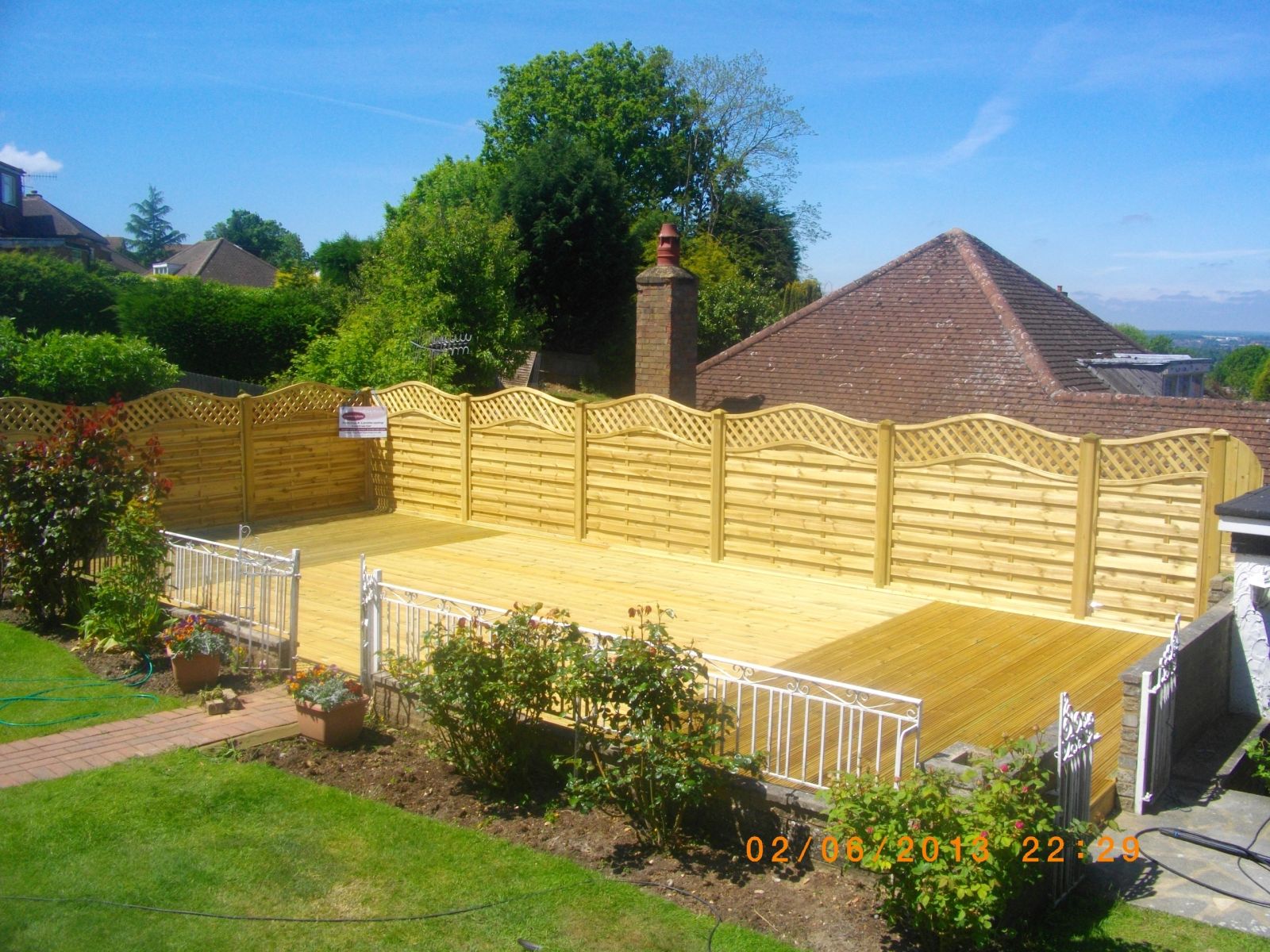
Pergola and screen timbers
Pergola posts generally need a larger section than a fence post of the same height, since they carry a horizontal beam and roof structure rather than just resisting wind on a flat panel, and undersized posts show up as noticeable sway at the top rather than immediate failure.
Softwood pergolas are almost always pressure-treated given the exposure, while a hardwood pergola can be left to weather untreated in the same way an oak gate can, at a higher initial material cost.
Screening timbers fixed to or beside a pergola structure follow the same gap and profile logic as free-standing slatted fencing, so the same trade-offs between privacy, light and wind loading apply.
Inspecting for board warping on an acoustic run
A warped or cupped board within an otherwise flat acoustic panel creates a small gap at its edges even if the timber itself hasn't failed structurally, and that gap is enough to let sound through at that point.
A periodic visual check along the run, sighting along the face for any board standing proud of its neighbours, catches this kind of early movement before it develops into a larger and more obvious gap.
Checking joist bearing sits level across uneven support pads
Deck support posts or pads set at even so-slightly different heights throw the whole joist run out of level, which shows on the finished deck as a barely perceptible but persistent lean across its width.
Checking each support with a long level laid across several posts at once, rather than checking each post in isolation, catches a gradual drift in height across the run that individual checks would miss.
Packing shims under a joist to correct a low support point is an acceptable fix for a small discrepancy, but it isn't a substitute for getting the support posts themselves right in the first place on a new build.
When deeds don't say who owns a boundary
It's common for older title deeds to be entirely silent on which side owns a given boundary, especially on properties built before detailed conveyancing plans became standard practice.
In that situation there's no single automatic rule that applies in every case, and long-standing practical evidence — who has always maintained the fence, existing physical features — can carry real weight.
Where ownership genuinely isn't clear, we'd always suggest raising it with the neighbour and, if needed, a conveyancing solicitor, rather than assuming a default answer.
A plot facing a motorway slip road
A slip road combines merging and accelerating traffic with the general flow of the adjoining carriageway, and the acceleration component can be louder at close range than steady-speed traffic on the main lanes themselves.
Because a slip road often sits on an embankment or elevated section relative to nearby housing, the barrier height needed to break the sightline to the road surface can be greater than for a plot facing a road at the same ground level.
Seasonal timing for fence repairs
Repairs undertaken in late autumn or winter often coincide with wetter ground and slower-curing concrete, which can extend how long a post takes to reach full strength before it should be loaded.
Where a repair isn't urgent, timing it for a drier period gives both the timber treatment and any concrete footing a better chance to cure properly before winter weather returns.
Ivy growth as a structural load
Established ivy doesn't just sit on a fence for appearance — its woody stems and aerial roots add real dead weight, and a mature growth can add the equivalent of several boards' worth of load to a panel over years of unchecked growth.
Ivy also holds moisture directly against the timber or brickwork it covers, which accelerates rot or mortar erosion underneath even though the visible growth looks healthy.
Removing mature ivy from a fence intended to stay in place needs care, since cutting the base and letting it die back gradually avoids suddenly exposing timber that has been softened by long-term dampness underneath.
Shared driveways and where fencing can go
Semi-detached and some terraced properties sometimes share a driveway or side access under a right of way recorded in both sets of title deeds, which limits where a fence can be positioned along that strip.
Fencing off a shared driveway without checking the recorded rights can obstruct a neighbour's legitimate access, even if the land is technically owned by only one party.
Checking both properties' title documents for a recorded shared access right before proposing any fencing along a shared drive avoids this becoming a dispute later.
Protecting an adjoining property while working a boundary corner
Work at a corner post often means standing tools, ladders or spoil temporarily on or very close to a neighbour's side of the boundary, which is worth agreeing in advance rather than assuming implied consent.
Where the corner adjoins a neighbour's planted border or a section of their own fence, photographing the condition before work starts gives both parties a clear reference if any question arises afterwards about pre-existing damage.
Finishing and clearing a corner section fully before moving along the rest of the run, rather than leaving it half-done for days, reduces the time any disruption to the neighbour's side is visible or ongoing.
Fox digging beneath chicken runs and fence lines
Foxes are capable diggers and will exploit any soft ground at the base of a fence or run, particularly around poultry enclosures, so a below-ground barrier matters as much as the fence height itself.
An L-shaped buried apron of mesh, turned outward from the base of the fence rather than straight down, stops digging by making the animal hit an obstruction before it reaches the fence line itself, which is more reliable than depth alone.
This detail is worth specifying separately from the fence quote for anyone keeping poultry or small livestock, since standard fence installation doesn't normally include a buried predator barrier.
Cill board water-shedding function
A cill or capping rail fitted along the top of a panel fence sheds rainwater clear of the panel's top edge, in the same way a window cill sheds water clear of a wall, reducing the time the top edge of boards stays saturated.
Without a cill, the end grain along the top of vertical boards absorbs water directly and repeatedly, which is a common cause of premature rot starting specifically at the top of a panel rather than the base.
A cill with a slight forward overhang and a drip groove on its underside sheds water further clear of the face below it than a flush-fitted cill, reducing streak staining on the boards beneath.