Weather delays and rescheduling honestly
Concrete won't cure properly in a hard frost, and post holes dug in heavy rain can collapse or fill with water before the post goes in, so a genuinely bad-weather day is a legitimate reason to reschedule rather than push through and risk a poor-quality fix.
Wind strong enough to make handling full panels unsafe is a similarly clear-cut reason to delay, particularly when working at height on taller gates or fence runs.
Being upfront about a weather delay as soon as it's known, rather than on the morning the crew was due, gives the client time to adjust their own plans around the new date.
Protecting lawn edges along a new fence line
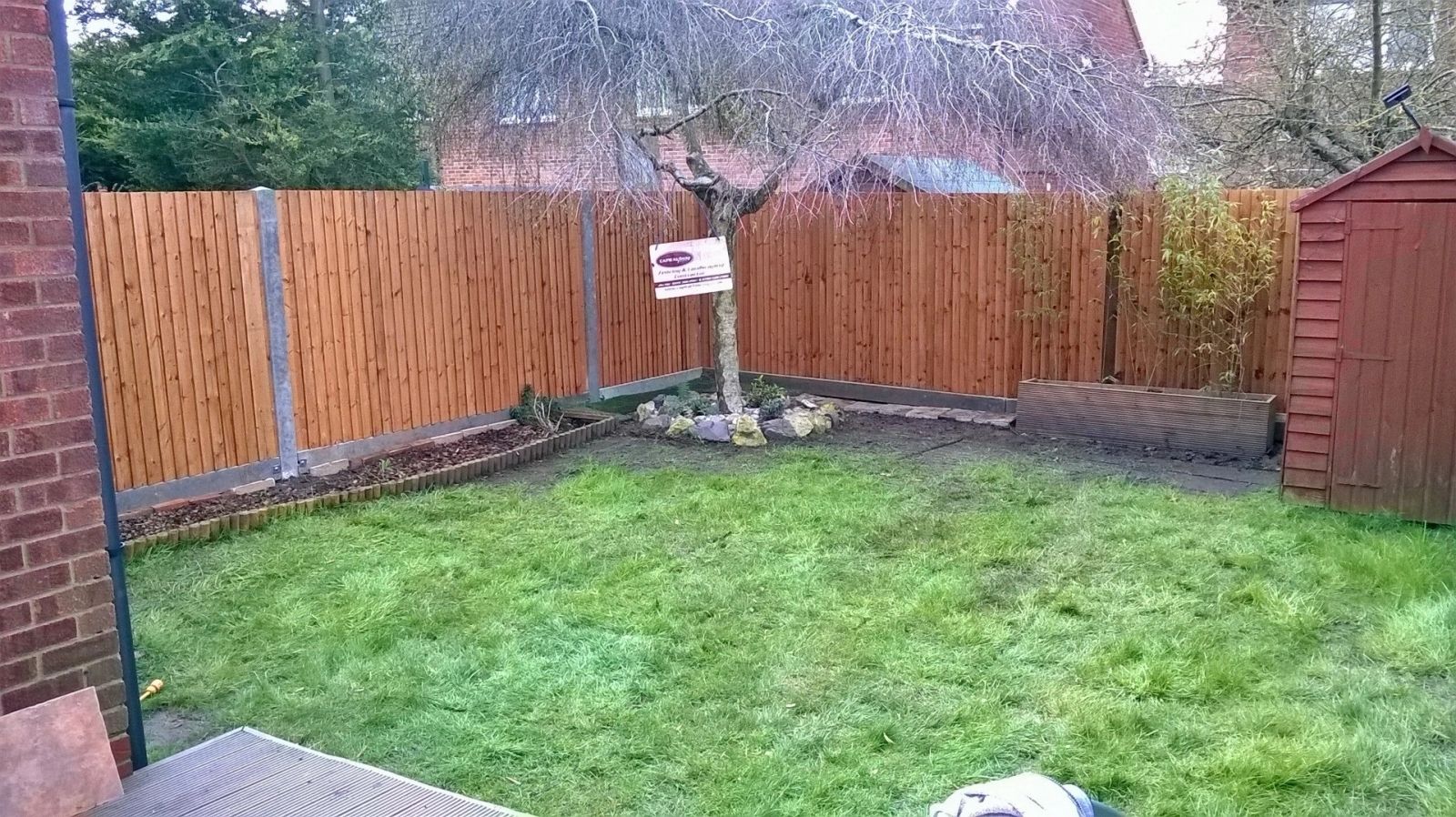
Digging post holes and levelling ground along a boundary inevitably disturbs a strip of lawn either side of the new line, and that strip is worth marking out and treating as a working area from the start rather than letting the disturbed area creep wider as the job progresses.
Turf lifted carefully in one piece before digging starts can sometimes be relaid afterwards rather than reseeded, which gives a faster-recovering edge than bare soil left to regrow from seed.
Where reseeding is the only realistic option, timing the final reinstatement for a season when grass seed actually establishes reliably avoids a bare strip sitting exposed for months after the fencing itself is finished.
Continuous strip footing compared with individual post holes
A continuous concrete strip footing running the full length of a fence line gives even support and a clean base for a plinth wall or kickboard, and is generally chosen where the boundary also needs a level base to close gaps under the fence.
Individual post holes are quicker and cheaper on a long straight run over consistent ground, but they leave open ground between posts that needs a separate gravel board or infill strip if a continuous barrier at ground level is also required.
Mass per unit area as the governing factor
Acoustic performance in a solid fence is driven mainly by mass per unit area — a heavier, denser panel of a given thickness blocks more sound than a lighter one of the same size, regardless of how the surface looks.
This is why a thin, lightweight composite sheet marketed as acoustic rarely matches a genuine double-skin timber and mineral-wool build of similar height; the spec sheet mass figure matters more than the branding.
Boundary marking after installation
Once a new line is up, marking its exact position against the title plan — rather than relying on where the old fence happened to sit — avoids a future dispute if the new run has shifted slightly from the original.
A simple record of post positions relative to a fixed point on site is worth keeping, particularly where the new boundary is more solid or permanent than what it replaced.
HMOs and student lets
Houses in multiple occupation see heavier day-to-day wear on boundary fencing than a single-family home — more bikes, more bins, more casual leaning and climbing — and a spec that assumes normal domestic use often underperforms within a couple of years.
Licensing conditions for larger HMOs sometimes specify secure cycle storage or bin enclosures behind a lockable gate, which needs building into the boundary design rather than treated as an afterthought.
Because tenancies turn over regularly, it also helps to agree access arrangements with the managing agent rather than relying on whichever tenant happens to be in at the time of the survey.
HMO licensing and boundary obligations
A licensed House in Multiple Occupation can carry specific conditions relating to the external areas of the property, including secure and well-maintained boundary fencing, safe means of escape through a rear garden, and bin storage screened from the street.
Licensing officers inspecting the property will check the condition of boundary structures as part of the wider fire safety and amenity standards, and a broken or unsafe fence can be flagged as a licence condition breach requiring remedy within a set period.
Landlords of licensed HMOs should treat boundary repair requests from the council's licensing team as time-limited compliance matters rather than routine maintenance to schedule at leisure.
Capping profile and how it sheds versus holds water
A flat-topped capping board holds a thin film of water after rain for longer than a capping profile with a rounded or angled top designed specifically to shed water to one side.
This difference seems minor but compounds over years, since the flat profile spends far more cumulative hours saturated, accelerating both rot and the lichen and algae growth that thrive on damp horizontal surfaces.
Choosing a weathered or torus capping profile over a plain flat board is a small upfront cost that measurably extends the component's realistic service life.
UV silvering rates by aspect and species
Untreated or lightly-treated softwood exposed to full sun typically silvers to a grey patina within twelve to eighteen months, while the same timber on a shaded north face can take several years to reach the same appearance.
Hardwoods like oak silver more evenly and hold their structural integrity through the process better than softwood, which is one reason clients choosing a natural weathered look often move toward hardwood despite the higher upfront cost.
Because silvering rate varies so much by aspect, a run that turns a corner from full sun to full shade can look like two different ages of fence within its first two years even though it was installed on the same day.