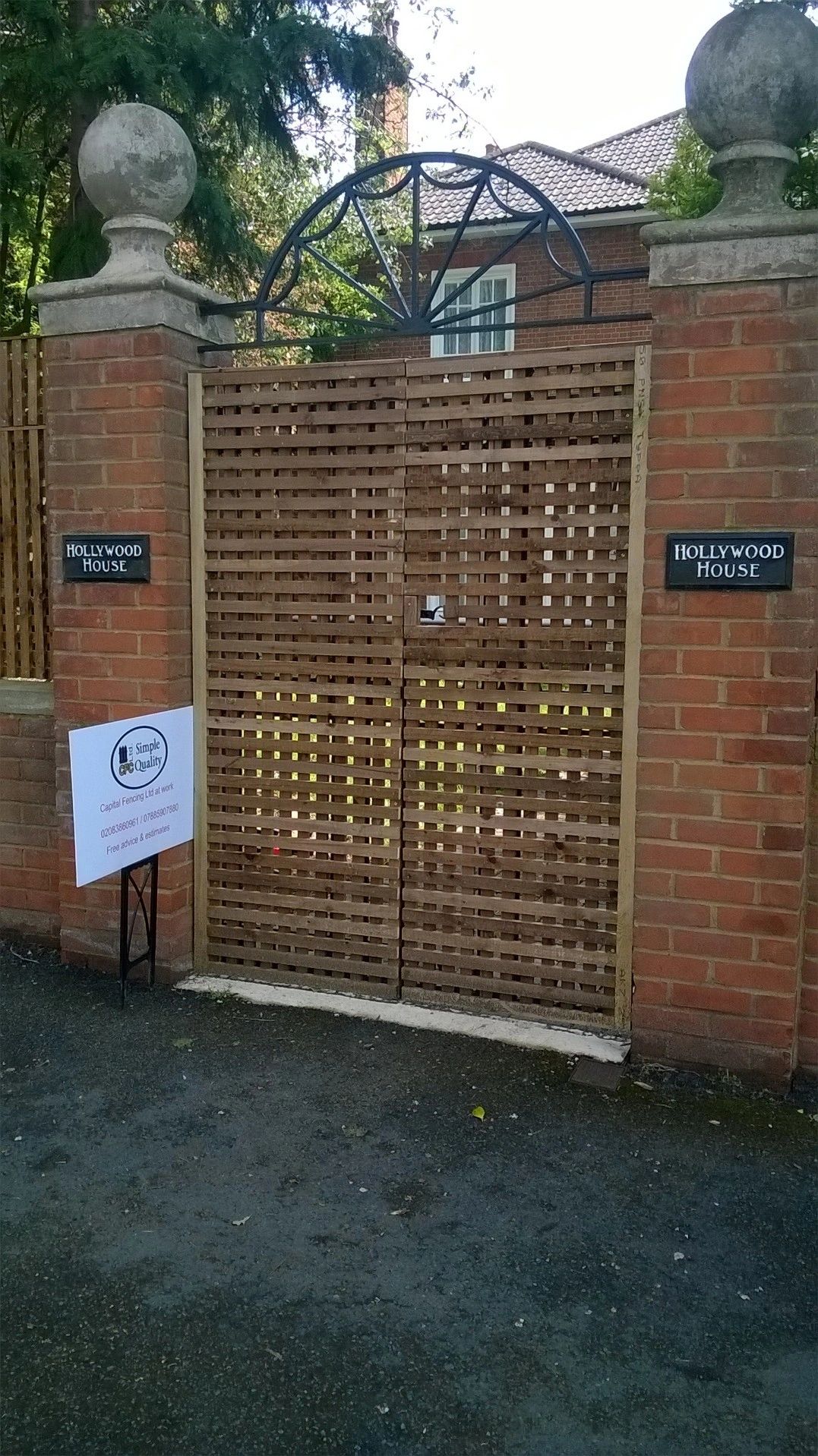
Power supply and cabling for automated gates
An automated gate needs a reliable power supply run to the gate location, which on many plots means a new armoured cable run from the property rather than relying on an existing outdoor socket not rated for permanent outdoor use.
Solar-powered gate automation is an option on plots without easy mains access, though it needs a battery sized for the gate's actual cycle frequency rather than a generic system that undersizes for a busy driveway.
Any outdoor electrical work for gate automation should be certified by a qualified electrician under Part P of the Building Regulations, since it isn't the kind of job to treat as a DIY extension of the fencing work.
Carrying out a final walk-round check before calling a job complete
A final check along the full run — hinges swinging freely, caps seated, fixings tight, gravel boards sitting flush — catches small issues that are quick to fix on the day but awkward to revisit once tools and materials have left site.
Checking gate latches and bolts actually engage properly under normal use, not just that they look fitted, avoids a callback for something that would have taken moments to adjust while still on site.
A brief look at the surrounding area — cleared spoil, protected surfaces returned to their original state, tools accounted for — is as much a part of finishing the job properly as the fence itself.
Out-of-hours security considerations for a GP surgery boundary
A GP surgery boundary needs to accommodate a high daytime footfall of patients and visitors alongside stronger overnight security around bin stores, plant rooms and any area holding clinical waste, which often means combining an open, welcoming frontage with a more solid, higher-security rear compound.
Access for ambulance and emergency vehicles is checked against gate width and turning space before a security gate is specified, since a locked or narrow rear gate can delay emergency access if not planned around actual vehicle routes.
The 1m limit next to a highway
Where a boundary fronts a highway used by vehicles — which includes most residential roads, not just main routes — permitted development height drops to 1 metre rather than 2 metres.
This lower limit exists mainly for visibility and road safety reasons, so it applies even where the fence itself is set back slightly from the actual carriageway edge.
Corner plots can be caught by this rule on more than one side, which is easy to miss when only the main frontage is considered.
Inspecting for board warping on an acoustic run
A warped or cupped board within an otherwise flat acoustic panel creates a small gap at its edges even if the timber itself hasn't failed structurally, and that gap is enough to let sound through at that point.
A periodic visual check along the run, sighting along the face for any board standing proud of its neighbours, catches this kind of early movement before it develops into a larger and more obvious gap.
Dog kennels and repeated barking
Kennelled dogs barking in response to passers-by or other triggers produce a noise that's both loud and unpredictable in timing, which makes it harder to screen effectively than a noise source with a steady, predictable pattern.
A solid barrier close to the kennel run breaks the dogs' sightline to the trigger — often a person or another animal passing — which can reduce the frequency of barking as well as attenuating the sound itself.
Choosing a skip or a grab lorry for waste removal
A skip left on site suits a job generating waste steadily over several days and where there's a legal spot to place it, such as a driveway, but it needs a permit if it sits on the public highway.
A grab lorry collects loose spoil, rubble and old fencing directly without a skip being dropped and left, which suits a single big clearance visit and avoids occupying space on a narrow driveway or street for the whole job.
For a small domestic run, van-and-tip removal on the last day is often simpler than either option, and the right choice generally comes down to waste volume and how long the site can accommodate a static skip.
Matching joist centres to the deck board chosen
Choosing the decking board before finalising joist centres avoids a common sequencing mistake, since a thinner or more flexible board specified after the substructure is already built may need joists closer together than what's already in the ground.
Board thickness, species and orientation (laid along or across the joists) all interact, so a change to any one of them partway through a project can mean revisiting the joist layout rather than just swapping the board.
Getting board specification confirmed before ordering joist timber is a small step that avoids costly rework on a part-built substructure.
Acoustic screening for a balcony
A balcony sits elevated above ground level, often putting it directly in the line of sight of an elevated noise source like a railway viaduct or an upper storey of a neighbouring building that a ground-level garden fence never has to address.
Screening a balcony usually means a solid panel fixed to the balcony structure itself rather than a boundary fence, and that panel's fixing needs checking against the balcony's own load capacity and any relevant building regulations.