Tenancy and landlord repair responsibilities
Responsibility for a garden boundary at a rented property depends on the tenancy agreement, but where it's silent, the general position is that a landlord is responsible for structural boundary features while day-to-day garden maintenance often falls to the tenant.
A tenant generally can't authorise permanent alterations like a new fence line or wall without the landlord's consent, even where they're happy to pay for it, since it affects the property the landlord owns.
Storm or accidental damage to a boundary fence at a let property is usually the landlord's repair obligation, arranged directly or through a managing agent, rather than something the tenant is expected to fund unless they caused the damage.
Overhanging branches crossing a boundary line
A property owner generally has the right to cut back branches or roots that cross the boundary from a neighbour's tree, up to the boundary line, though the cut material technically still belongs to the tree's owner and should be offered back.
This self-help right doesn't apply where the tree is protected by a Tree Preservation Order or sits in a conservation area, in which case permission is needed before cutting.
Where a fence line is being planned near an overhanging tree, checking the tree's protected status first avoids inadvertently carrying out unauthorised work.
A spec checklist for comparing quotes
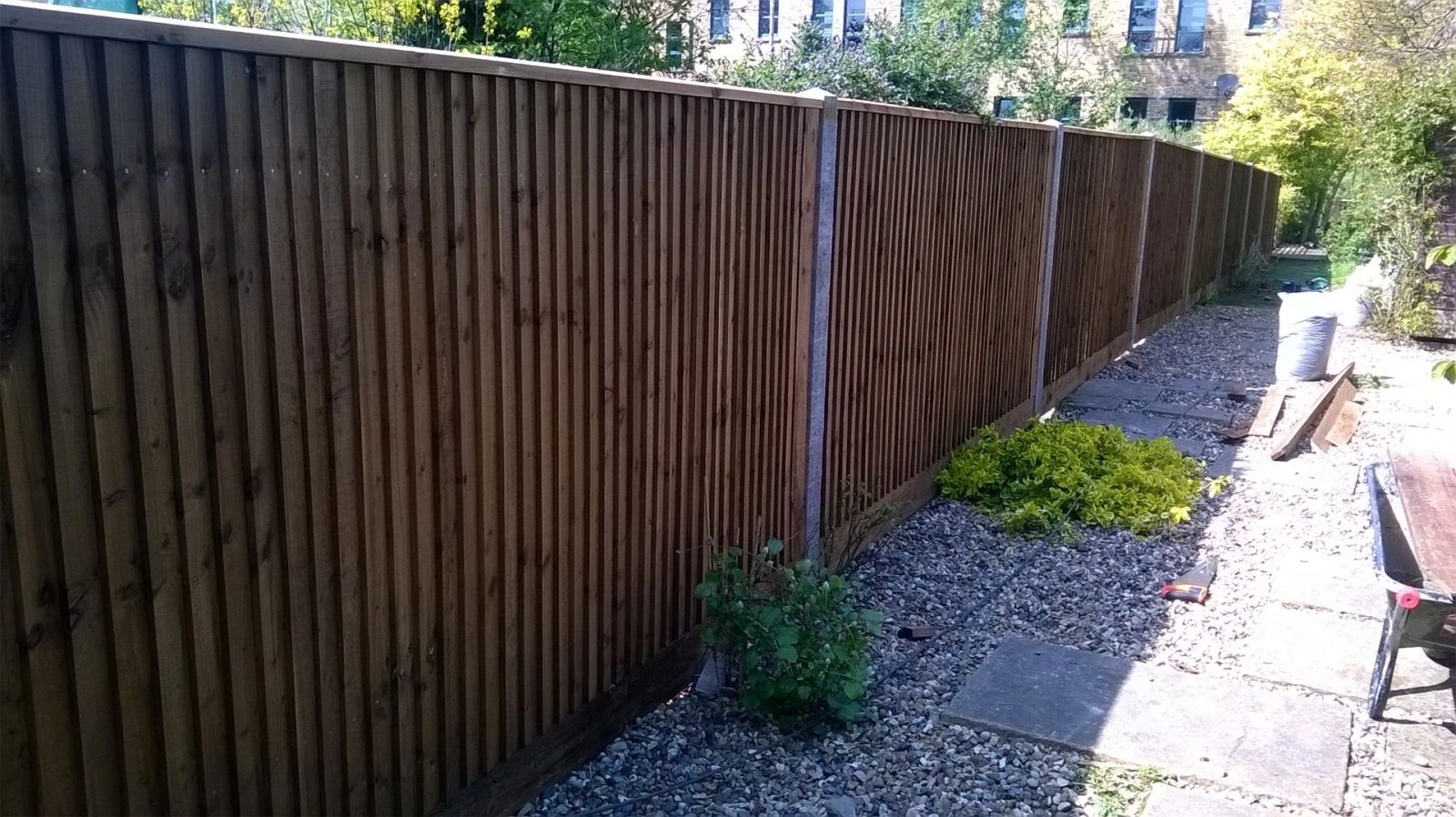
Two quotes at very different prices for what looks like the same fence often differ in the parts that aren't obvious from a headline description — post type and spacing, gravel board material, rail count, use class of treatment, and whether waste removal is included.
Worth confirming explicitly: post material and size, number of arris rails for the height quoted, gravel board type, treatment use class of ground-contact timber, fixing corrosion class, and whether post caps and capping rail are included as standard.
A written spec covering those points, rather than just a total price and a photo of a similar job, is the practical way to compare quotes on equal terms rather than discovering the difference once the fence is already up.
Refrigeration chiller unit noise
An external chiller or condenser unit for commercial refrigeration produces a continuous low-frequency hum from its compressor and fan, and low-frequency noise is harder for a barrier to attenuate than higher-pitched sound.
A dense, well-sealed enclosure close around the unit itself tends to help more than a distant boundary fence, since it intercepts the noise at source rather than after it has already spread across a yard.
Earthing and bonding requirements for a substation compound fence
A metal fence around an electrical substation compound needs to be correctly bonded to the site's earthing system, since an ungrounded metal fence near live electrical equipment can become dangerously energised under fault conditions.
Bonding work at a substation compound is carried out to the network operator's own specification rather than a general fencing standard, and a fencing contractor working on this type of site coordinates closely with the operator's engineers on sequencing and isolation.
Who maintains a grass verge next to a boundary
A grass verge between a garden boundary and the road is often owned and maintained by the local council as part of the adopted highway, rather than by the adjoining property owner.
This affects where a fence can legally be positioned, since building onto highway land, even a seemingly unused verge, generally needs authorisation.
Where the extent of a verge and its ownership isn't obvious, the local highway authority can usually confirm it against their adopted highway records.
Corner plots with two effective road frontages
A corner plot bounded by two separate roads can be treated as having two frontages for permitted development purposes, meaning the lower 1m height limit potentially applies on both sides rather than just one.
This is a common point of confusion, since the 'front' of the house and the road-facing boundary aren't always the same thing on an L-shaped or wraparound plot.
Checking with the local planning authority which boundaries count as fronting a highway is worthwhile before fencing any corner plot to the maximum height.
Alley-gating orders on rear access lanes
Some councils and police teams run formal alley-gating schemes, fitting lockable gates across shared rear alleys behind terraced housing under a specific legal order to reduce burglary and fly-tipping, with keys issued to residents whose properties back onto the lane.
Where such an order already exists, individual residents generally can't add their own separate gate or fence across the same alley without going through the same scheme, since the order regulates access for everyone on the row, not just one household.
Where no scheme exists but residents want one, the request usually starts with the council's community safety or highways team, since a privately-installed gate across a public right of way without authorisation can be ordered removed.
Sheeting plants and borders during fencing works
Established shrubs and borders close to a fence line are easily damaged by dropped tools, spoil heaps or simply being walked over repeatedly during a multi-day job, so temporary boards or breathable sheeting laid over beds reduces incidental damage.
Concrete dust and cement splash can scorch foliage if it settles on leaves and isn't rinsed off promptly, which is worth flagging before mixing starts next to a prized border.
Where a plant genuinely sits in the way of a post position, agreeing with the client in advance whether it's moved, worked around, or the post offset avoids an awkward decision made on the spot mid-dig.