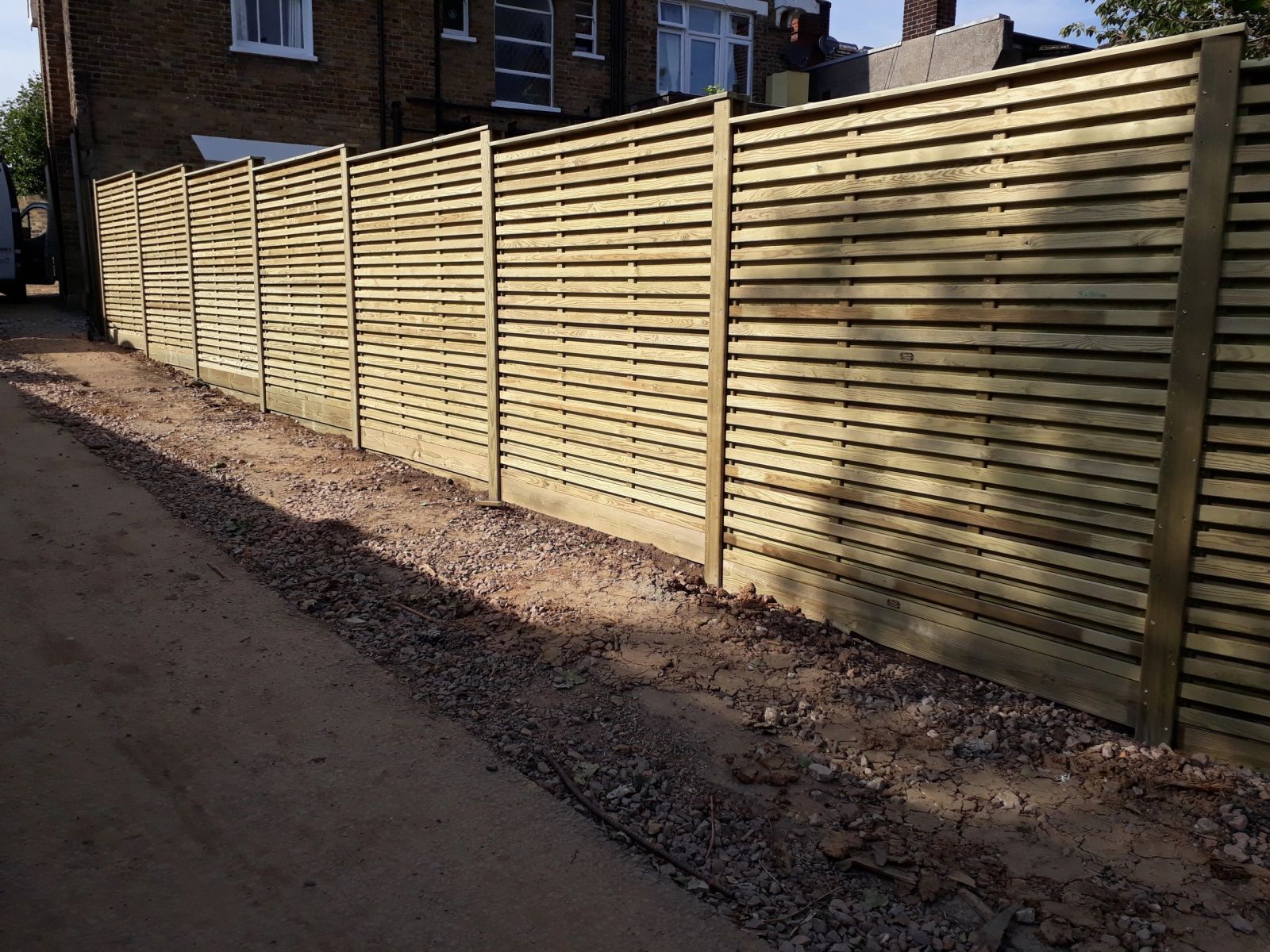
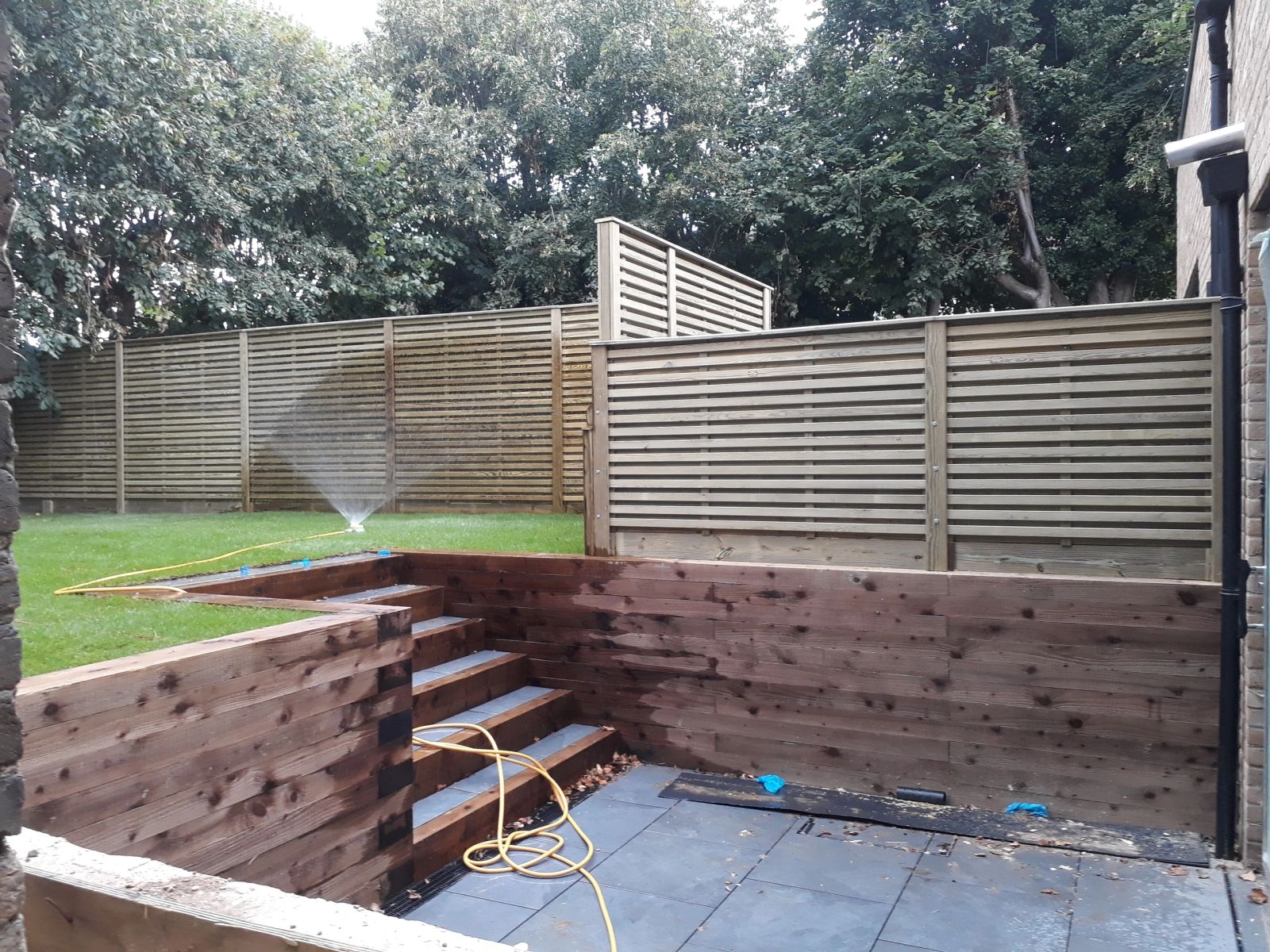
A boundary between residential and mixed-use premises
A boundary between a residential garden and a mixed-use building — flats over a commercial unit, for example — often needs to address noise from several different sources at once, such as deliveries, extraction and general trading activity.
Identifying which of those sources is actually dominant, rather than designing a barrier to a generic worst case, avoids over-specifying for a source that's actually a minor contributor to the overall disturbance.
Hardwood options for gates
Gates take more racking stress than a fixed fence panel, opening and closing on a single edge, which is why hardwoods such as oak or iroko are often specified for gates even where the adjoining fence is softwood.
Oak's natural durability means it can be left untreated and will weather to silver-grey, but it also moves seasonally and can stain surrounding masonry with tannin run-off in wet weather, which is worth flagging before it's fitted next to a pale render or paving.
Hardwood gate frames are usually built with mortice-and-tenon joints rather than the simple nailed or bracketed joints acceptable on a softwood panel, since the joint has to resist years of racking without loosening.
Recoating a heavy acoustic facing
A timber-faced acoustic panel needs the same kind of periodic stain or paint maintenance as any exterior timber, but access can be more limited where a dense panel sits close to a boundary wall or a neighbour's property.
Planning recoating around that access constraint, and choosing a product suited to a less frequently reachable surface, avoids a situation where one face of the run is maintained less often than the other simply because it's harder to reach.
Timber sourcing and certification schemes
FSC and PEFC certification track timber back through the supply chain to a managed, legally-harvested source, and UK public sector specifications increasingly require one or the other for any structural or landscaping timber.
For a domestic fence this isn't a legal requirement, but certified stock gives a paper trail on sourcing that some clients specifically ask for, particularly on larger commercial or estate contracts where corporate sustainability policy applies.
Certification is about the chain of custody rather than the treatment or grade of the wood, so it sits alongside, not instead of, checking the timber is correctly treated for its intended use class.
Barrier height relative to source and receiver height
The effective height of a barrier is judged relative to both the noise source and the listener — a fence that clears a car's exhaust height does far less for noise from an elevated railway or a first-floor extract fan.
Where the source sits above ground level, such as a raised road or a rooftop unit, a taller barrier or one positioned closer to the source is needed to keep the line of sight broken.
Cat-proofing with angled overhangs
Cats are agile climbers rather than diggers, so containment relies on preventing a solid grip at the top of the fence rather than closing ground-level gaps, typically with an angled overhang or rotating roller bar fitted along the top.
These systems work by tipping the cat back into the garden as it reaches the top rather than physically blocking the climb, and need a consistent, unbroken run along the full boundary to be effective, since a single untreated gate or low section undoes the rest.
Overhang brackets add a small amount of extra load and a slight increase in overall height, both of which are worth checking against permitted development limits before fitting.
Gust funnelling between semi-detached gaps
The narrow gap between two semi-detached or terraced houses can accelerate wind passing through it, in the same way air speeds up through a nozzle, so a fence sitting at the mouth of that gap sees higher gusts than the open garden either side.
This is easy to miss on a site visit if the wind isn't blowing that day, but it shows up over a few winters as one particular bay of panelling failing repeatedly while the rest of the run stays sound.
Reinforcing just that section with a heavier post or a part-slatted panel is usually enough, rather than upgrading the whole run.
Public liability considerations on a shared boundary
Work that takes place on or near a shared boundary inherently affects two properties, which is one reason contractors carry public liability insurance covering damage or injury arising from the works, generally quite separate from any specific job guarantee.
Clients are entitled to ask to see a contractor's current public liability certificate before work starts, and for jobs involving excavation near a neighbour's structure or a shared wall it's reasonable practice to confirm cover explicitly rather than assume it.
This is a generic industry consideration rather than a claim about any particular policy, and the details of cover, exclusions and limits vary between insurers and should be checked directly with the provider.
Skip permits on a public highway
A skip placed on a public road or pavement, rather than entirely on private land such as a driveway, generally needs a permit from the local council's highways department beforehand.
Permits usually specify how the skip must be lit and marked, particularly overnight, and there are often restrictions near junctions or on narrower streets.
Placing a skip on the highway without the required permit can result in a fine, so it's worth checking with the skip hire company or council directly rather than assuming it's not needed.