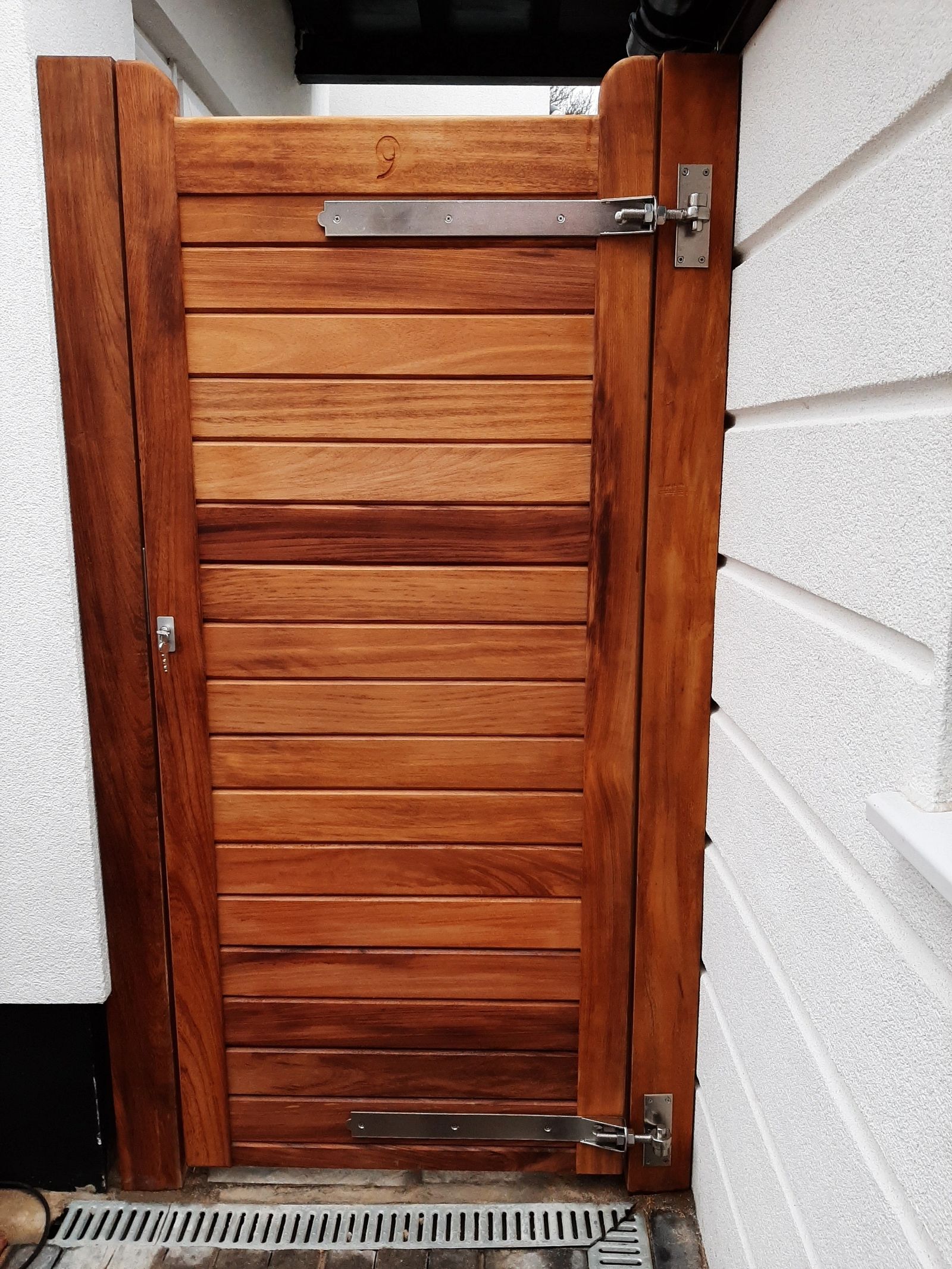
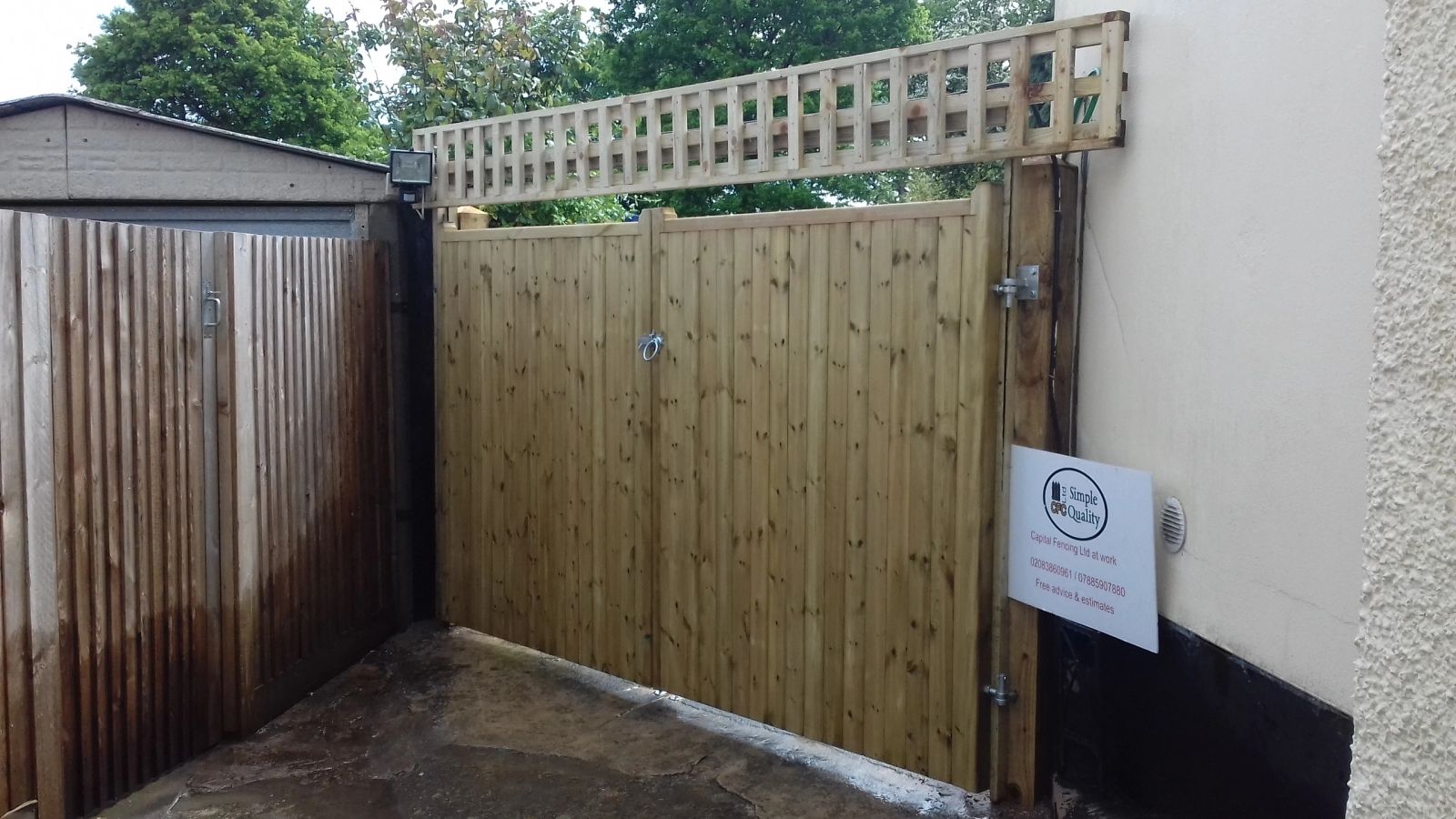
Timber, mesh and steel palisade compared
Timber gives a solid sightline and a domestic look but needs a heavier spec than a standard garden fence to hold a security brief; steel palisade and weld-mesh give a harder physical barrier with a more industrial appearance, which suits a yard better than a front garden.
Most briefs end up as a mix — a solid section where privacy matters and a mesh or railing return where an open sightline is more useful — rather than one material for the whole boundary.
How post hole diameter relates to load capacity
A wider post hole gives the concrete footing more surface area to resist overturning, which matters most on a taller or more exposed security run where wind and impact loading are higher than on a standard garden fence.
Increasing hole depth without also increasing diameter has a smaller effect on lateral resistance than is often assumed, since it's the concrete's bearing area against the surrounding soil that resists the post trying to rotate, not depth alone.
Overhanging branches crossing a boundary line
A property owner generally has the right to cut back branches or roots that cross the boundary from a neighbour's tree, up to the boundary line, though the cut material technically still belongs to the tree's owner and should be offered back.
This self-help right doesn't apply where the tree is protected by a Tree Preservation Order or sits in a conservation area, in which case permission is needed before cutting.
Where a fence line is being planned near an overhanging tree, checking the tree's protected status first avoids inadvertently carrying out unauthorised work.
Continuous strip footing compared with individual post holes
A continuous concrete strip footing running the full length of a fence line gives even support and a clean base for a plinth wall or kickboard, and is generally chosen where the boundary also needs a level base to close gaps under the fence.
Individual post holes are quicker and cheaper on a long straight run over consistent ground, but they leave open ground between posts that needs a separate gravel board or infill strip if a continuous barrier at ground level is also required.
Acoustic screening on a roof terrace
A roof terrace is typically more exposed to noise than a ground-floor garden, since there's no surrounding building mass or ground-level obstruction to interrupt sound travelling across open rooftops.
A screen on a roof terrace has to be assessed for wind loading as much as acoustic performance, since a solid acoustic panel at height catches significantly more wind than the same panel at ground level, with knock-on implications for the terrace structure itself.
Choosing between timber, concrete and steel posts
Timber posts are the cheapest and easiest to work with but are the first part of a fence to rot, particularly at ground level where they sit in permanently damp soil or concrete.
Concrete slotted posts cost more upfront and are harder to cut or adjust on site, but don't rot and hold panels rigidly without needing separate fixings, which suits a long, exposed or heavily-used run.
Steel posts, either box section or RSJ, are mostly reserved for commercial, security or very heavy-load applications where timber or concrete wouldn't cope with the weight or vandal-resistance required.
Garden orientation and post-rain drying time
A south or west-facing garden dries out after rain considerably faster than a north or east-facing one, purely because it receives more direct sun through the day, which has a real effect on how long timber sits wet and therefore how fast rot and mould can establish.
This is worth factoring into treatment choice as much as species choice — a slower-drying orientation benefits more from a breathable stain that lets residual moisture escape than from a heavier film-forming coating that traps it in.
Two identical fences in the same postcode but opposite orientations can have meaningfully different realistic maintenance intervals for this reason alone.
Safeguarding considerations on school and nursery sites
Fencing and gate work on a school or nursery site typically has to be scheduled around supervised access, since contractors are usually required to sign in, wear visible identification, and avoid unsupervised contact with children during term time.
Perimeter security fencing for these sites is often specified with anti-climb profiles and minimum heights well above a typical domestic garden fence, reflecting safeguarding rather than purely boundary-marking needs.
Work is frequently timetabled for holidays or after hours specifically to avoid any overlap between contractors on site and children present, which affects programme length more than the fencing work itself.
Aluminium extrusion profiles
Aluminium fencing and gate components are typically formed by extrusion, forcing heated aluminium billet through a shaped die to produce a continuous profile with a consistent cross-section, which allows complex hollow or ribbed shapes not practical in sawn timber or rolled steel.
Extruded profiles are usually finished with an anodised or powder-coated surface, since bare aluminium forms a natural oxide layer that resists corrosion well but can look dull and inconsistent if left unfinished.
Aluminium's lower strength relative to steel for a given section size means extruded profiles are often designed with internal ribbing or a boxed cross-section to achieve adequate rigidity without excessive material thickness.
Setting a stepped post line down an embankment
A fence line running down an embankment is usually stepped bay by bay rather than raked to follow the slope continuously, which keeps each panel level and avoids the increasing gap under a raked panel that opens up as the ground falls away more steeply than the panel's rake angle.
Post lengths above ground level vary along a stepped run to keep the top line consistent, so posts are ordered or cut to several different lengths rather than a single stock size for the whole embankment section.
Cleat fixing at pale-to-rail junctions
Pales are commonly bolted to rails through a cleat rather than welded, because a bolted cleat can be replaced individually if a pale is damaged, whereas a welded joint means cutting into the rail to make a repair.
Cleats are punched to match the pale profile so the fixing sits flush rather than proud, and a mismatched cleat left loose is one of the more common defects found on an older palisade run at survey stage.