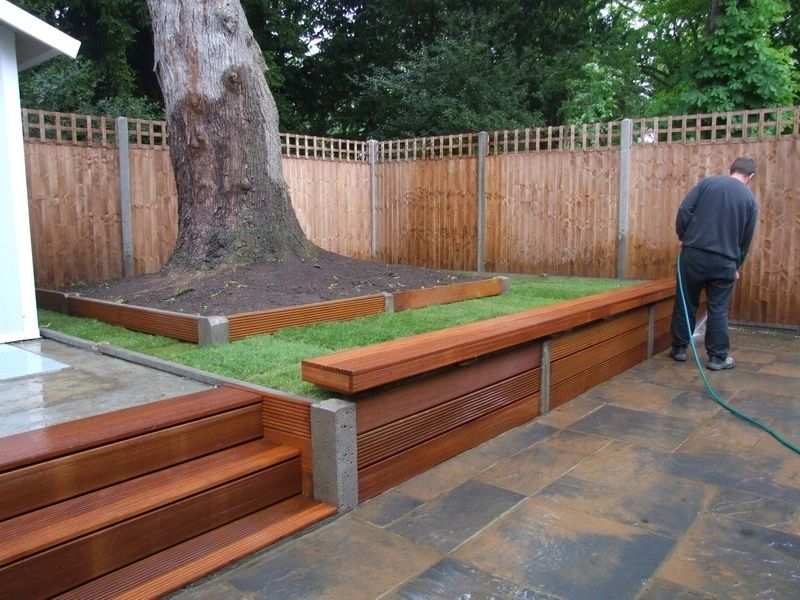
Handling heavier materials on a tight site
Double-skin timber and mineral-wool infill are bulkier and heavier to move than standard fence panels, so a site with narrow rear access or no vehicle route to the garden needs materials carried through in stages rather than dropped at the boundary.
We plan the delivery and stacking sequence before starting so infill isn't left exposed to weather between the two skins going up.
North-facing boundaries and slower drying
A north-facing boundary receives little or no direct sun through autumn and winter, so rainfall sits on the timber and in the surrounding ground noticeably longer than on a south-facing equivalent.
This affects concrete curing time as well as timber drying — a post base poured on a north-facing run in cold weather takes longer to reach working strength and shouldn't be loaded or backfilled early just because a south-facing base nearby has already set.
Over the life of the fence, the practical effect is usually a shorter repaint or restain interval on the shaded side than the rest of the same boundary.
Retrospective planning applications for boundary work
Where boundary work turns out to have needed planning permission that wasn't obtained, it's possible to apply retrospectively, though this carries the real risk of the council refusing and requiring the structure to be altered or removed.
A retrospective application doesn't guarantee approval just because the work is already complete, and the council assesses it on the same planning merits as if it hadn't been built yet.
Checking whether permission is needed before work starts is considerably less stressful and less costly than applying retrospectively after the event.
Timber density and moisture content
Denser timber species and sections add more mass per board than a lighter, fast-grown equivalent of the same nominal thickness, which is why species and grading are specified rather than left to whatever's in stock.
Moisture content also affects mass and stability — timber supplied too wet will shrink as it dries, opening joints that were sealed at installation, so kiln-dried or properly seasoned stock is preferred for an acoustic build.
Brick and blockwork alternatives
A brick or blockwork wall offers higher mass per unit area than most timber acoustic builds and performs well as a barrier, but comes with its own foundation, planning and cost considerations that a timber fence doesn't.
Where a wall isn't practical, a heavier timber-and-mineral-wool build is the usual compromise, trading some mass for lower foundation demand and faster installation.
Nail versus screw fixing on repairs
Nailed fixings are faster to install and are the standard on new panel builds, but a screwed fixing holds better in timber that's already slightly softened by weathering, which makes screws the more reliable choice on a repair into older stock.
Screws also allow a board or rail to be removed cleanly if it needs replacing again later, whereas a nailed fixing usually damages the surrounding timber on removal.
Waney-edge boards
Waney-edge boards, sometimes called weatherboard, retain the natural, uneven outer edge of the log they were cut from, including some bark-line curvature, rather than being sawn to a straight parallel edge.
They're generally cheaper than feather-edge because more of the log's cross-section can be used, but the irregular edge means overlaps vary along the length of each board and can't be set as precisely.
The rustic appearance is often the main reason they're chosen over feather-edge, particularly for informal or rural boundary fencing where a uniform finish isn't the priority.
Protecting lawn edges along a new fence line
Digging post holes and levelling ground along a boundary inevitably disturbs a strip of lawn either side of the new line, and that strip is worth marking out and treating as a working area from the start rather than letting the disturbed area creep wider as the job progresses.
Turf lifted carefully in one piece before digging starts can sometimes be relaid afterwards rather than reseeded, which gives a faster-recovering edge than bare soil left to regrow from seed.
Where reseeding is the only realistic option, timing the final reinstatement for a season when grass seed actually establishes reliably avoids a bare strip sitting exposed for months after the fencing itself is finished.
Routing deck lighting cable away from standing water
Low-voltage deck lighting cable run beneath boards needs to be kept clear of any point where water is likely to pool, since even low-voltage cable connectors degrade faster in permanently wet conditions than in the intermittent dampness the rest of the substructure sees.
Routing cable along the higher side of a deck's fall, rather than through the lowest point where water naturally collects, is a simple planning step that extends the life of an otherwise reliable lighting installation.
Any cable joints beneath a deck should use fully waterproof-rated connectors rather than standard household connectors, given the substructure environment is functionally outdoors and damp regardless of overall deck condition.
Mediation as a step before a formal boundary dispute
Community and property mediation services exist specifically to help neighbours resolve disagreements, including boundary and fencing disputes, without going straight to solicitors or court.
Mediation is generally faster and considerably cheaper than formal legal action, and can preserve a working relationship between neighbours who will, after all, remain neighbours.
Where a boundary disagreement is becoming entrenched, raising the idea of mediation early is often more productive than escalating straight to legal correspondence.
Fencing next to a railway line
Gardens backing directly onto an operational railway usually have a boundary that belongs to the railway infrastructure owner rather than the homeowner, and any work near that boundary needs their agreement rather than being treated as a standard garden fence job.
Vibration from passing trains is a genuine consideration for post stability on ground close to the tracks, and residents commonly want additional sound-deadening in the fence specification for the same reason.
Access for maintaining a railway-side boundary is often restricted to the rail side only, which changes which side of the fence a repair crew can realistically work from.