Latch and drop-bolt corrosion over a gate's lifecycle
A gate latch or drop bolt sees repeated mechanical wear on top of weather exposure, and standard zinc-plated steel components typically show surface corrosion and stiffening action within a few years of regular outdoor use.
Stainless steel or marine-grade fittings cost more initially but avoid the seized or snapped bolt that is one of the most common minor gate failures, particularly on a drop bolt that isn't operated daily and can seize unnoticed.
An annual light oiling of moving parts, alongside the general hinge check, keeps a latch mechanism working smoothly well beyond the point a neglected one would start sticking.
Security lighting and cameras near a shared boundary
Security lighting or CCTV cameras fitted to a boundary fence can raise both nuisance and, for cameras capturing a neighbour's property, data protection considerations under UK GDPR if used inappropriately.
Positioning cameras to minimise capturing a neighbour's garden or windows, and using shielded lighting that doesn't spill excessively onto adjoining land, generally avoids most disputes before they start.
Where a neighbour raises a specific concern about a camera or light on a shared boundary, addressing it directly is usually simpler than waiting for a formal complaint to the council or Information Commissioner's Office.
Setting posts in clay
London clay and the heavier Hertfordshire boulder clays shrink and swell noticeably between a dry summer and a wet winter, which is exactly the movement that works a badly-set post loose over a few seasons.
The fix is depth and drainage rather than just more concrete: posts need to go below the zone that dries out and cracks seasonally, typically deeper than the standard 600mm used on free-draining ground, with a stone or gravel key at the base so water isn't trapped against the timber.
Postcrete alone on shallow clay bases is one of the most common reasons we're called out to replace a fence that's only a few years old.
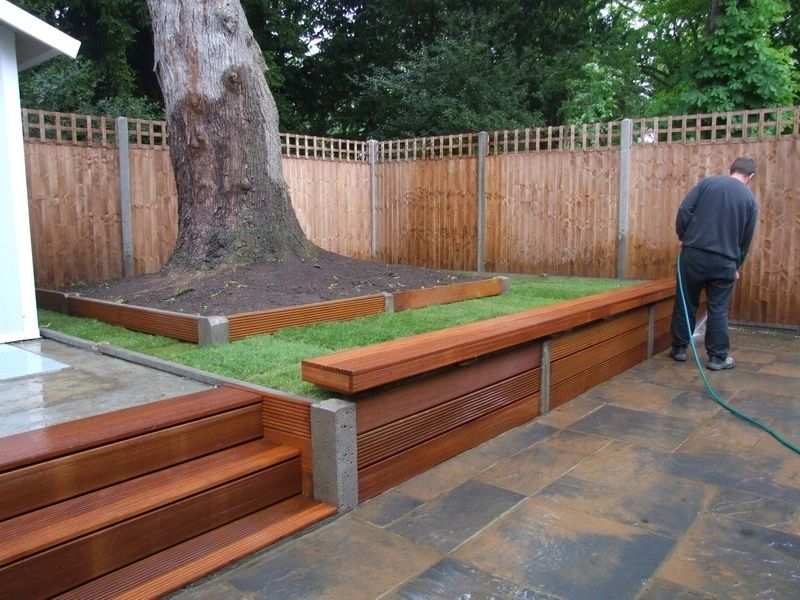
Raised beds built directly against a fence
A raised planting bed built with its back edge against a fence line keeps damp soil and mulch in permanent contact with the lowest boards or gravel board, which accelerates rot at exactly the point most vulnerable to moisture.
Lining the inside face of the bed against the fence with a damp-proof membrane, rather than backfilling soil directly onto the timber, reduces this contact without changing the visible design.
This detail is easy to miss at the planning stage since the bed and the fence are often specified and built by different trades without either flagging the interaction.
Checking planning conditions before repairing a boundary near a listed building
A fence adjoining or visible from a listed building can be subject to planning conditions that affect even a like-for-like repair, particularly if the fence itself is considered part of the setting or curtilage.
Where that applies, it's worth confirming what's actually restricted before starting work, since some conditions only affect changes in height, material or appearance rather than a straightforward repair that keeps the fence as it was.
Sanding and re-treating a timber gate
A timber gate that's greying or losing its finish benefits from a light sand back to bare or sound timber before re-treating, since coating over a failed or flaking existing finish traps moisture underneath rather than sealing it out.
This is worth doing every few years depending on exposure, well before the timber itself starts to soften or split.
Temporary propping and making safe
Where a full repair can't happen immediately, a leaning panel or post can be temporarily propped or strapped to stop it falling further, which reduces risk without committing to the final repair method on the spot.
Temporary propping is treated as exactly that — a stopgap — since a prop left in place over a wet season can itself start to sink or shift in soft ground.
Party wall notices and communication
The Party Wall etc. Act 1996 covers work to a shared wall or excavation near a neighbour's foundations, and while an ordinary timber fence on a boundary line usually falls outside it, a new masonry boundary wall built astride the line, or deep post holes close to a neighbour's foundations, can bring it into play.
Where the Act applies, formal written notice is required before work starts, giving the neighbour a defined period to consent or dissent, and proceeding without notice risks an injunction even on otherwise straightforward work.
Even where the Act doesn't strictly apply, a simple letter or conversation confirming line, height and access before work starts avoids most of the disputes that end up needing formal resolution.
What an Article 4 direction actually does
An Article 4 direction is a mechanism councils use to withdraw specific permitted development rights across a defined area, often to protect the character of a conservation area or estate.
Where one applies to boundary treatments, works that would normally need no permission at all — like replacing a fence panel-for-panel — can require a planning application.
Article 4 directions are published by the local authority and searchable against individual addresses, so checking before ordering materials avoids an unwelcome retrospective planning conversation.
Brown versus green treatment pigments
The green or brown tint in pressure-treated softwood comes from a pigment or dye added to the preservative solution during treatment, largely as a visual indicator that the timber has been through the process rather than for any protective purpose.
Green pigments were historically more common but have become less fashionable, with brown or 'tanalised brown' now the more usual finish for fencing timber sold in the UK.
Because the colour is only pigment-deep in places, freshly cut ends and any surface planing during fitting will expose the paler, untreated-looking wood beneath, which is another reason to treat cut ends separately.
Standard fence panel heights and why they matter
Fence panels are typically supplied in fixed height increments — commonly around 0.9m, 1.2m, 1.5m and 1.8m — which is worth knowing when planning a boundary near the 2m permitted development limit, since a gravel board on top of a full-height panel can tip a run over that limit without anyone intending it to.
Odd plot heights, sloping ground or a specific privacy requirement sometimes mean a bespoke panel height is the only way to get an exact fit, which costs more than off-the-shelf stock but avoids an awkward final course.
It's worth measuring the total height including any gravel board and capping before ordering, rather than just the panel itself, to avoid a nasty surprise at the planning-limit boundary.