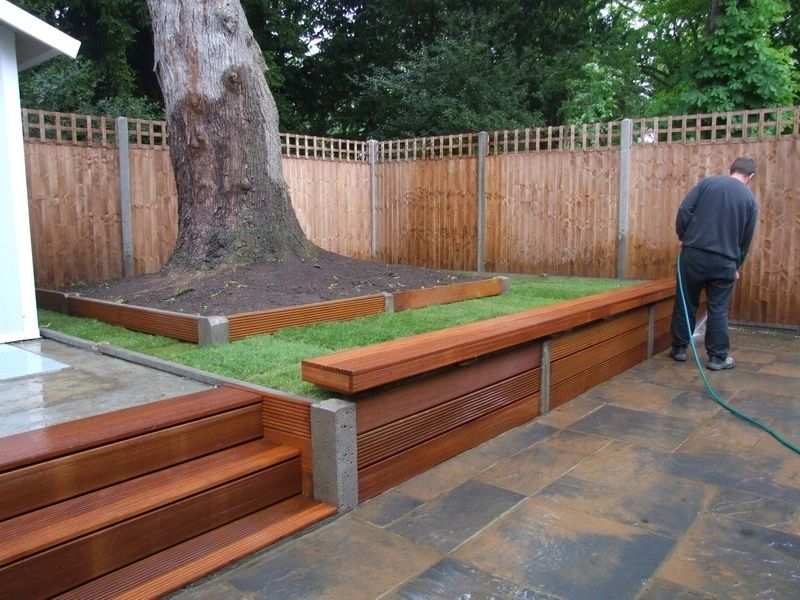
Hardwood versus composite decking movement
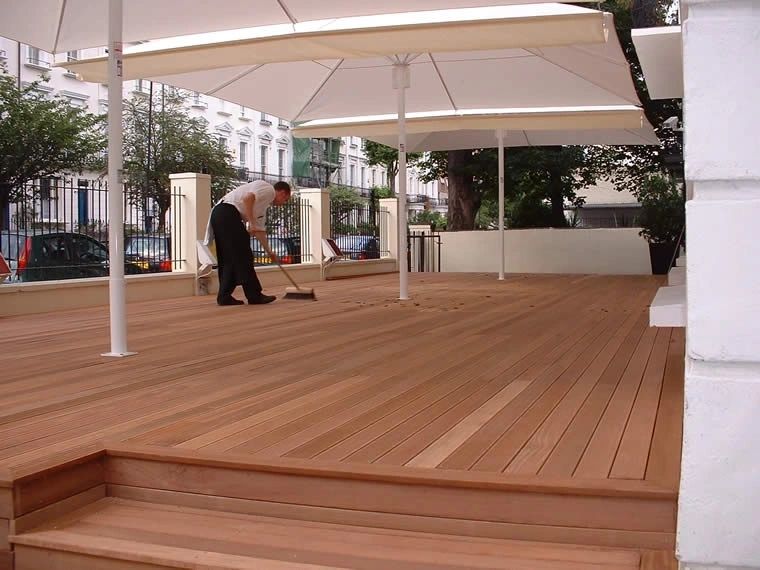
Hardwood decking boards, like any solid timber, shrink and swell across their width with moisture changes, which is why they're laid with a consistent gap between boards rather than tight-butted, and why that gap can look different in a dry summer compared with a wet winter.
Composite boards move less with moisture but expand and contract more with temperature than timber, so the gapping and fixing method used has to account for a different kind of movement rather than assuming timber spacing rules apply directly.
Both need their end cuts sealed or capped where boards are cut to length on site, since a cut end is the point most likely to take on water and start to degrade first.
Digging a post hole beside a mature root plate
Close to a mature tree, the first spade or auger pass often meets structural roots rather than clear soil, and cutting a root over roughly 25mm diameter can affect the tree's stability as well as its health.
Hand-digging with a spade and fork lets roots be worked around and exposed gradually, which an auger or mechanical borer can't do since it cuts through whatever's in its path without warning.
Where a root genuinely blocks the only sensible post position, moving the post sideways along the line by a short distance is almost always preferable to severing a major root to keep to the original spacing.
Sliding versus swing gate mechanisms
A swing gate needs clear space to open into, whether that's the driveway itself or the street, while a sliding gate runs parallel to the boundary and suits plots where that swing space isn't available.
Sliding gates need a level, unobstructed track run at least as long as the gate itself, plus a foundation for the track and rollers that copes with the gate's full weight — cutting corners here is the most common cause of a sliding gate that jams.
Swing gates are generally simpler to install and service, which is worth weighing against a sliding gate's space-saving advantage on a tight or sloping driveway.
Replacing a post without dismantling the whole run
A single post can often be replaced by supporting the panels either side on temporary props, cutting the old post out at ground level, and fitting the new post into a fresh footing without lifting the neighbouring panels out.
This depends on the panel fixing type — nailed panels are harder to free without damage than panels held with clips or brackets, which come apart more cleanly.
Fast-setting post mix performance in cold, exposed conditions
Fast-setting post-fix concrete generates heat as it cures, which normally helps it set reliably even in cool weather, but on a genuinely exposed and cold site that heat can be carried away faster than it's generated, slowing or compromising the cure.
In these conditions a longer undisturbed curing period, or a mix formulated for cold-weather use, gives a more reliable result than assuming a fast-set product will behave the same as it would in a sheltered garden.
Posts loaded too soon after pouring on an exposed site — by wind rather than by the installer — are a genuine risk that doesn't apply in the same way to a sheltered, still garden.
Post caps and end-grain protection
A timber post's end grain sits at the top, cut across the fibres, and that exposed grain draws in water far faster than the treated face of the post, which is why an unprotected post top is often the first place rot takes hold.
A weathered or pyramid-cut post cap sheds water off the end grain instead of letting it pool, and a cap that oversails the post slightly also keeps water from tracking down the sides at the joint.
It's a small, low-cost detail that's frequently skipped on budget jobs, and its absence is a reliable way to predict which posts in an older fence will need replacing first.
What a site survey covers
A proper site survey checks the boundary line against the deed plan where available, probes ground conditions at a few points along the run, and confirms access for both delivery vehicles and hand-carried materials.
It should also flag anything that changes cost before it becomes a surprise later — buried services, a shared boundary needing neighbour agreement, overhead cables limiting how tall equipment can be used, or a slope needing a stepped rather than level run.
A survey that skips any of these and goes straight to a headline price is the most common reason a quote changes significantly once work actually starts.
Go-kart track and small-engine noise
A go-kart track produces a high-revving small-engine noise that's tonal and carries well, similar in character to motorcycle noise but more continuous during a session, making it a demanding source for a garden barrier to soften.
Because the noise repeats in laps rather than as a single pass, a barrier's benefit is felt as a lower peak on each lap rather than a change to the overall duration of a session.
Restrictive covenants on open-plan frontages
Many post-war estates were built with an explicit covenant in the title deeds preventing front garden fences or walls above a low height, intended to preserve an open-plan street appearance.
These covenants are private legal obligations between landowners rather than planning rules, and breaching one can in principle be enforced by whoever holds the benefit of the covenant, sometimes a management company.
Checking the title register for this kind of restriction before fitting a front boundary fence avoids finding out about it after the work is done.
Repairing a spot damaged repeatedly by a dog
A dog that digs at the base of a fence or chews at exposed board edges tends to concentrate damage at one recurring spot rather than spreading it along the whole run, which makes a localised repair — a buried mesh skirt, a metal kick-plate — more effective than a general fence upgrade.
Addressing the underlying cause, such as blocking the specific gap the dog is trying to reach through, matters as much as the physical repair, since a repaired section without that change is often damaged again in the same place.
Community-wide hedgehog gap linking across multiple boundaries
A single hedgehog gap in one fence achieves little if the neighbouring boundaries along the same row of gardens remain solid, since the animal still can't move beyond the first connected garden.
Some local wildlife groups now coordinate gap positions across a terrace or street so that a continuous corridor is created through several gardens rather than isolated single gaps.
Where a client is enthusiastic about this, it's worth suggesting they mention it to neighbours early, since agreeing gap positions in advance avoids gaps that don't line up once each fence is finished.