Step riser heights on a raised deck
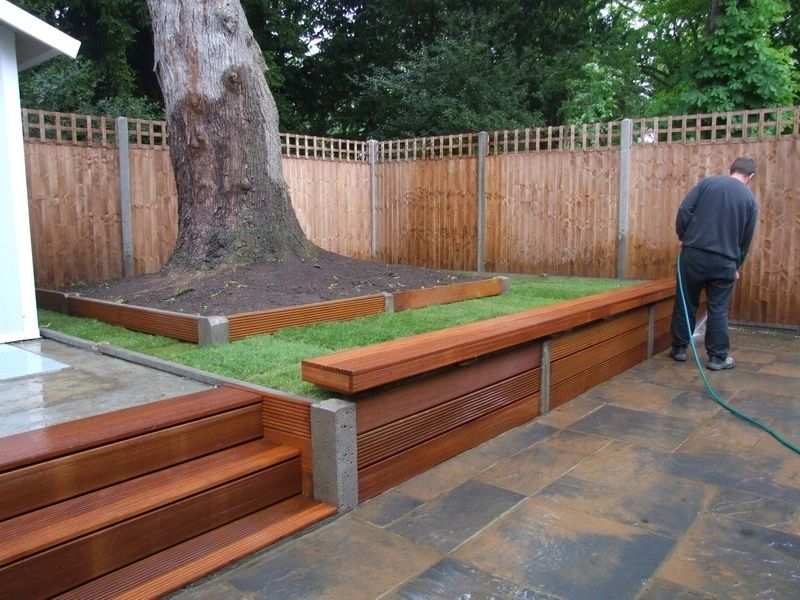
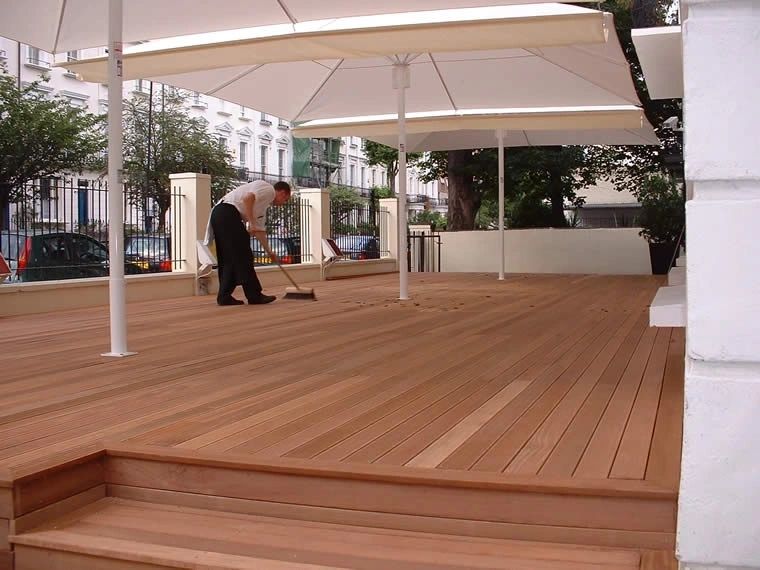
Steps down from a raised deck work best with consistent riser heights throughout the flight, since an irregular step height is a common trip hazard, particularly where the top or bottom step differs slightly from the others.
Building regulations guidance for steps in a domestic setting generally favours risers in the range of roughly 150-170mm with adequate going (tread depth), though garden steps have more flexibility than an internal staircase.
Where a deck sits at a height that doesn't divide evenly into consistent risers, it's better to adjust the deck height slightly at the design stage than to build one oddly-sized step to make up the difference.
Downpipe discharge points near a fence base
A downpipe discharging directly onto open ground near a fence line, rather than into a proper drain or soakaway, concentrates a large volume of roof water at one specific point along the boundary during heavy rain.
Over time this creates a permanently saturated patch that behaves like a high water table locally, even though the rest of the garden drains normally.
Redirecting the discharge with a short length of pipe or a small soakaway a metre or two from the fence line resolves the issue far more effectively than trying to compensate with a more resistant post base.
Wind load: solid panels versus slatted screens
A solid close-boarded panel presents its whole face to the wind, so on an exposed run the load transferred into the post is far higher than the same height in a slatted or louvred screen with even small gaps between boards.
Manufacturers' span tables for solid panels assume a sheltered suburban garden; on an open plot the safe bay width between posts often needs reducing rather than relying on the standard 1.8m centre.
Where the client wants privacy rather than a windbreak, a slatted design with a close-boarded section lower down still cuts load noticeably while keeping most of the screening effect.
Rights of way crossing a boundary line
A right of way recorded on a title can allow a third party — a neighbour, or sometimes the public — to cross land that would otherwise be private, which affects where a continuous fence line can practically go.
Fencing across a recognised right of way without providing for continued access can itself become a legal problem, regardless of who owns the underlying land.
Checking the title register for registered rights of way before finalising a fence layout is worthwhile wherever a path, gate or informal shortcut already crosses the plot.
Corner visibility splays affecting fence height specifically
Some corner plots have a specific visibility splay condition attached to their planning history that limits fence, hedge or wall height at the junction to well below the normal 1m road-facing limit.
This is separate from the general permitted development height rule and takes precedence where it applies, since it's usually tied to road safety at a specific junction.
Checking the property's planning history for this kind of condition before fencing a corner plot boundary avoids building something that later needs cutting back.
Pressure washing a fence before assessing the extent of repair needed
Algae, dirt and old flaking coatings can hide the true condition of timber underneath, so a light clean before a repair assessment sometimes reveals splits, rot or fixing corrosion that wasn't visible under the surface grime.
Pressure washing needs a gentle setting and some distance from the timber face, since an aggressive jet held too close can strip soft surface fibres from weathered wood and make marginal timber look more damaged than it actually is.
Setting out a line over a sloping plot
On a slope, a string line pulled level between two posts of equal height will sit above the ground at one end and below it at the other, so setting out has to work from a boning rod or a laser level rather than the string alone.
The usual method is to fix the top and bottom posts first, establish the actual fall between them, then decide bay by bay whether intermediate posts step down in even drops or follow the ground continuously.
Getting this decision agreed before any post is concreted matters, because changing from a stepped to a raked layout partway along a run after posts are set means starting again.
Delivery access and material drop-off
Fencing materials are heavy and awkward rather than especially bulky individually, but a full job's worth of posts, panels and gravel boards still needs a genuine drop-off point close to the work area rather than a kerbside stack carried the full plot length.
On restricted streets, agreeing a specific delivery slot with the supplier avoids a lorry blocking a road during school run or peak hours, which is often the point neighbours complain about a job rather than the noise of the work itself.
Where a driveway can take a small vehicle, checking headroom and turning space in advance saves a delivery being refused on the day and materials having to be hand-carried instead.
Fences crossing a natural drainage swale in the garden
Some gardens have a shallow natural low line, or swale, that carries surface water across the plot during heavy rain even without any formal drainage installed, and a fence built straight across it without allowance for that flow effectively becomes a small dam.
Water backing up against a fence in these conditions accelerates rot at that specific point and, in significant storms, adds a load the fence wasn't designed to resist.
A gap under the gravel board or a permeable section at the exact point the swale crosses the boundary lets water pass through rather than building up against the structure.
Drop bolts and ground sockets
A drop bolt fixed to the bottom rail of a leaf drops into a ground socket to hold that leaf still while the other leaf is used for daily access, and a socket that's silted up or out of alignment is a common reason a drop bolt stops locating properly.
We check the socket depth and drainage as well as the bolt itself, since a blocked socket is often mistaken for a bent or worn bolt.
The distance-doubling rule of thumb
As a rough rule, doubling the distance from a point noise source reduces the sound level by a noticeable, broadly consistent amount in open ground, which is why moving a seating area further from a boundary can help almost as much as adding barrier height.
This rule applies most cleanly to a single point source in open space and becomes less reliable near reflective surfaces or with a source spread along a line, like a road, rather than concentrated at one point.