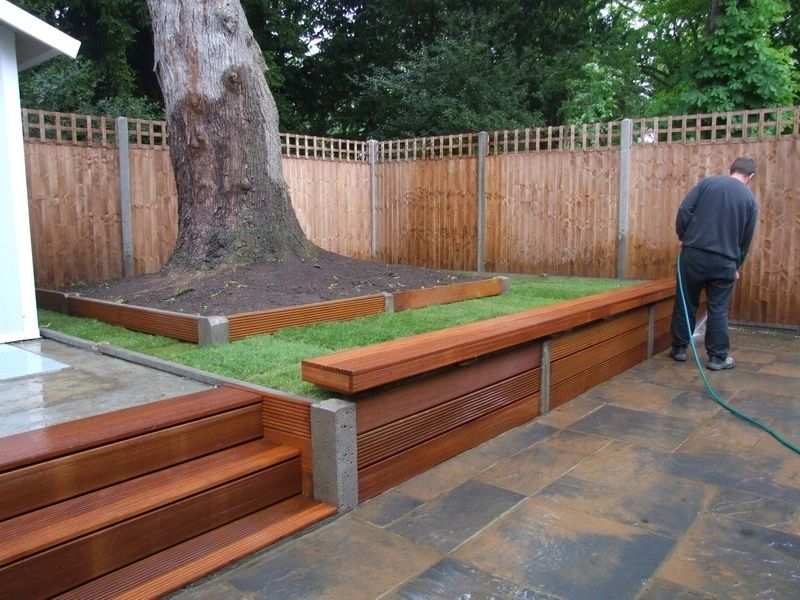
Decking oil versus fence stain maintenance cycles
Decking oil is formulated to cope with foot traffic and standing water in a way that a vertical fence stain isn't, and typically needs reapplying annually on a well-used deck compared with the two-to-three year cycle for a fence.
The horizontal surface of a deck also collects standing water and UV exposure differently to a vertical panel face, wearing unevenly in high-traffic paths compared with less-used corners.
Clients used to a fence's maintenance rhythm sometimes underestimate how much more frequently a deck's finish needs attention, which is worth setting expectations on at the time of installation.
Resolving height and style disputes with a neighbour
Disagreements over a shared fence usually come down to height, style or who's responsible for a section, and most are resolved fastest with a plain conversation and a written note of what's agreed before work starts.
Where a genuine dispute over the boundary line itself exists, the Land Registry title plan (not the fence's current position) is the reference point, and a RICS-qualified boundary surveyor can produce a determined line if the deeds are ambiguous.
We'd always rather delay a start date by a week to get sign-off from both sides than build a fence that has to be moved once a dispute surfaces.
Parking suspensions and permits for works
Where a job needs a van parked directly outside for loading, or a dropped kerb blocked for delivery, most councils offer a paid parking bay suspension or dispensation that has to be applied for in advance, sometimes with several working days' notice.
On residents' permit streets, working without a suspension risks a parking charge notice for the vehicle even where the work itself is entirely legitimate, since traffic wardens enforce the bay markings regardless of the reason for parking.
Booking the suspension early and displaying the paperwork in the vehicle windscreen is a small piece of admin that avoids delays and unnecessary penalty charges on street-fronting jobs.
Mixing old and new timber colour on a repair
Freshly treated timber is noticeably lighter or greener than an older run that's already weathered, and that colour difference is temporary rather than a defect, evening out over the first year or two of UV exposure and weathering.
Where colour match matters immediately, a treatment or stain closer to the weathered tone can be applied to the new timber, though it won't be an exact match on day one.
Diagnosing gate sag: hinge, post, or frame
A sagging gate can stem from three distinct causes that need different fixes — worn or undersized hinges, a hinge post that has itself leaned out of true, or a gate frame that has racked out of square through inadequate diagonal bracing.
Testing the diagonal measurement corner-to-corner on the gate frame quickly shows whether the frame itself has racked, while checking the hinge post with a spirit level separately identifies a foundation problem rather than a hardware one.
Treating a leaning-post problem with heavier hinges alone doesn't fix the underlying cause and the gate will sag again once the new hinges have taken up their own wear.
Green belt and stock-proof boundaries
Plots backing onto green belt land, paddocks or working farmland often need a genuinely stock-proof boundary rather than a decorative garden fence, particularly where livestock graze the adjoining field.
Post-and-rail with stock netting, or a taller close-boarded run where privacy also matters, both do the job, but a standard panel fence with gaps at the base is routinely pushed through or under by sheep and larger dogs.
Any new boundary on green belt land should also be checked against local planning policy, since green belt designation adds another layer of restriction on top of the usual permitted development rules.
Decking board profiles and grooves
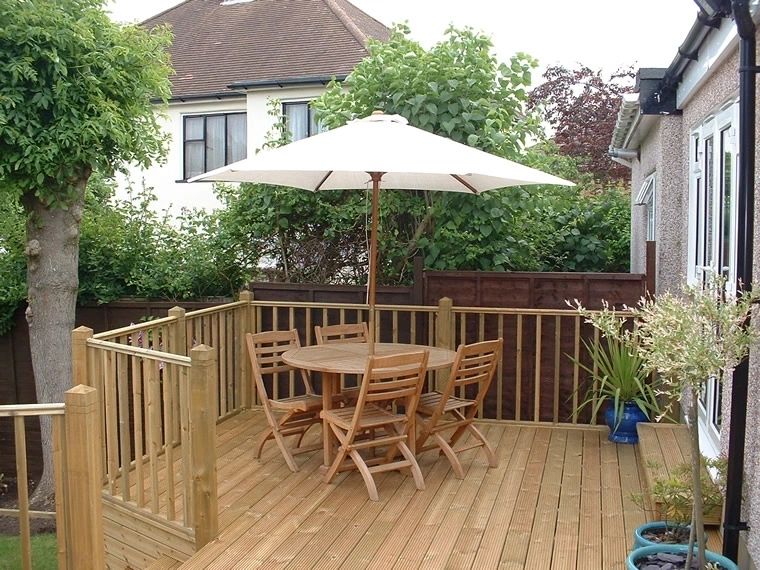
Timber decking boards commonly come grooved (ribbed) on the top face for grip, reversible to a smooth face for a more contemporary look, or with a rounded profile that sheds water more readily but offers less traction underfoot.
Grooved boards trap dirt and moisture in the channels more than a smooth or rounded profile, so they need more regular brushing or washing to avoid becoming slippery with algae, particularly in shaded, damp positions.
Composite boards are usually extruded with a fixed groove or embossed texture rather than milled, and the profile is generally part of a wider system with matching edge trims rather than a feature that can be mixed freely between board types.
Oak tannin staining on fixings
Oak contains a high concentration of tannic acid, which reacts with iron to produce a dark blue-black stain that can streak down a post or rail from any ferrous fixing left in contact with damp oak.
The same reaction corrodes ordinary mild steel fixings faster than it would in most other timbers, which is why stainless steel or silicon bronze fixings are the usual specification for oak gates and structural oak work.
Staining is largely cosmetic and doesn't weaken the timber, but on a visible feature gate it's often the deciding factor in paying the difference for stainless fixings over galvanised ones.
Applying to modify or discharge an old covenant
Where an old restrictive covenant genuinely no longer serves a useful purpose, it's possible to apply to the Upper Tribunal (Lands Chamber) to have it modified or discharged, though this is a formal legal process rather than a quick fix.
This route is generally used where a covenant is preventing otherwise sensible work and informal agreement with whoever benefits from it can't be reached.
Given the legal complexity involved, this is very much a solicitor-led process rather than something to attempt without professional advice.
Construction hoarding versus the permanent boundary
Temporary site hoarding during a build is a separate specification from the permanent boundary that eventually replaces it — hoarding is chosen for site security and public safety during works, often under a party wall or highways licence, while the permanent fence is chosen for the finished property.
Where a boundary needs both, it's worth planning the sequence so the permanent fence isn't installed and then damaged by ongoing construction traffic before the build finishes.
Hoarding on a public highway usually needs its own licence from the council, separate from any planning permission covering the building work itself, and unlicensed hoarding on a footway can be removed by the authority.
How a gate rebuild is sequenced
Where a frame needs rebuilding rather than just re-hanging, the frame is squared and fixed first, then the existing gate face is re-hung onto it, keeping as much of the original timber as is still sound rather than starting from scratch.
Hinges and latches are fitted last, once the frame and gate are confirmed square and level.