Pedestrian gate self-closing devices
A hydraulic or spring-loaded self-closing hinge brings a pedestrian gate back to a closed and latched position automatically, which is useful where a gate needs to stay shut for security or to keep a garden secure for children or pets.
These devices need occasional tension adjustment as they wear, and a gate that no longer closes fully is often a closer needing adjustment rather than a hinge fault.
Diagonal bracing struts on gate posts
A diagonal timber or metal strut run from partway up a gate post back to a buried anchor or second post resists the twisting and leaning force a heavy gate exerts on its hinge post over time, particularly on wide or heavy gates.
Without bracing, that twisting load is carried entirely by the post's own embedment in the ground, which can gradually work the post out of true even where the concrete footing itself remains intact.
Bracing is generally specified based on gate weight and width rather than applied universally, since a light pedestrian gate rarely generates enough leverage to need it while a wide vehicle gate almost always does.
Properties with no registered title at all
A small proportion of properties in England and Wales, usually those that haven't changed hands or been mortgaged for a very long time, still aren't registered with HM Land Registry at all.
In these cases, boundary questions rely entirely on the original paper deeds held by the owner, which can be less detailed or harder to interpret than a modern registered title plan.
First registration can be triggered voluntarily or by certain transactions, and often brings helpful clarity to boundary questions that were previously only defined by older paper deeds.
Timber versus metal for a replacement gate
A timber gate is easier to match to an existing fence line and easier to repair in sections, while a metal gate holds its shape better against warping and racking but is harder to alter once fabricated.
We recommend based on what the existing boundary is built from and what the client actually wants to maintain over time, not a single default material.
Painted versus stained finish maintenance
A painted gate hides the timber grain and needs a full film to stay intact, so any crack or chip in that film lets water in behind the coating and can accelerate local rot if left unaddressed.
A stained or oiled finish penetrates the timber rather than sitting as a film, so it wears more evenly and is easier to top up in patches without a full strip-back.
Hedge pressure on a fence line
An unmanaged hedge planted close to a boundary fence pushes against the panel or rail as it thickens, and that steady lateral pressure can bow a panel or rack a post over several seasons even without any storm involved.
Cutting the hedge back from the fence line at repair time reduces the chance of the same section failing again shortly after.
Carrying 2.4m panels through a domestic hallway
A standard 2.4m fence panel is longer than most internal hallways are wide, so it has to be carried end-on through doorways and pivoted at corners rather than moved flat, which takes two people to control safely.
Door frames, light switches and stair newels are the most common casualties of moving long panels through a house, so a dry run to identify pinch points before committing to carrying a stack of panels through saves repeated near-misses.
Where a hallway genuinely can't take a full panel around a tight corner, the practical fallback is building the run from shorter featheredge boards fixed in place rather than trying to force a pre-built panel through.
Converting a single gate to double
Widening a single gate opening into a double-leaf gate usually needs a new or repositioned hanging post partway across the opening as well as a slamming post on each outer side, rather than simply hanging two narrower leaves off the existing posts.
This is more involved than a straightforward repair and is worth planning against the full opening width before committing to a leaf size.
Specifying fencing for an exposed hilltop plot
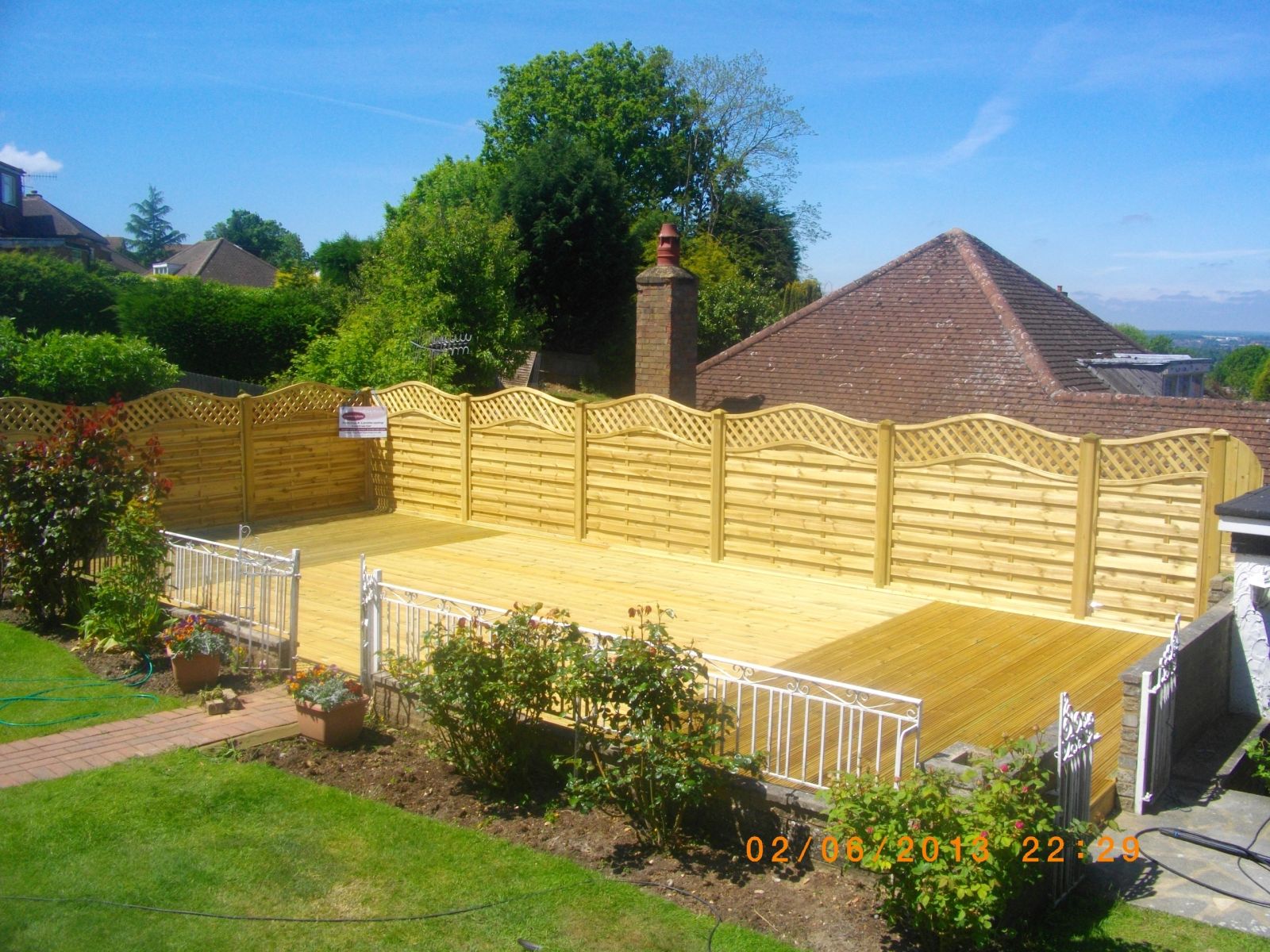
Plots on high ground with little surrounding shelter, common on the higher parts of the Chilterns and similar ridgelines, combine strong wind loading with faster-drying but also faster-weathering timber due to constant air movement.
A specification for this kind of site usually combines shorter bay spacing, part-slatted or louvred infill to reduce wind load, and a slightly heavier post section than the same height fence would need in a sheltered valley garden a few miles away.
It's a case where two gardens in the same postcode can genuinely need different specifications purely because of local topography rather than anything about the boundary itself.
Cane bolts on double gates
A cane bolt is a long sliding bolt dropped into a separate ground socket some distance below the gate, giving more holding leverage against wind or knock than a short drop bolt on a wide double-gate leaf.
They're common on wider vehicle gates where a standard drop bolt alone doesn't give enough resistance to the leaf swinging in wind.
Retaining structures below a fence line
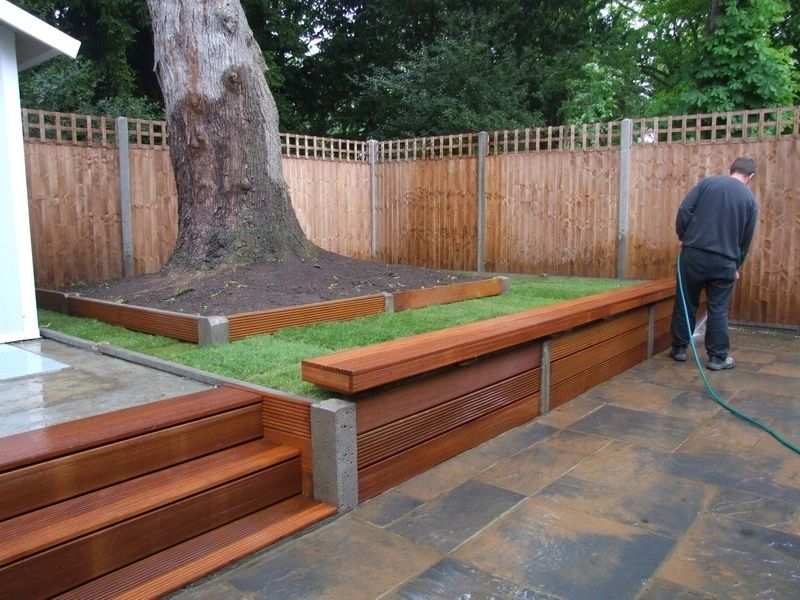
Where a retaining wall or sleeper structure holds back a level change directly under a fence, the fence and the retaining structure are doing two different jobs and shouldn't be treated as one build.
A timber fence post bolted into the top of a retaining wall relies entirely on that wall's own stability, so any doubt about the wall's condition needs resolving before new fencing is fixed to it.
Water draining from the raised bed above a retaining structure often exits at its base, which is worth accounting for when choosing post fixings and base materials at that point in the run.